The complete guide to a profitable part-out
A profitable part-out is a chain, and the chain is only as strong as its weakest link. Buy wrong and no amount of good listing saves it. Skip the legal gate and the cheapest car becomes the most expensive. List wrong and the best buy bleeds out in returns. This is the map of the whole chain, start to finish - each stage links to its deep guide, so use this to see how the links connect and follow any one down when you need the detail.
Before you buy: clear the legal gate
The mistakes that cost the most happen before the first teardown. Confirm you have a clean title and any state dismantler or salvage license, and know the federal layer on top: you must report to NMVTIS if you handle five or more salvage vehicles a year, and EPA rules govern the fluids and refrigerant you will pull. The full picture is in the federal regulations for auto recyclers, with the state licensing question and NMVTIS reporting in their own guides. Clear this gate first; everything after depends on it.
Buy with numbers, not gut feel
The margin is mostly decided at the buy. Value the parts you can realistically pull and sell, not the car as one asset, and subtract every cost - acquisition, auction and gate fees, transport, storage, labor, and the parts that never sell - before you bid. The expected-value math for this, part by part, is its own subject in how to part out a car for profit; when you are staring at a specific lot, whether a salvage car is worth parting out and parting out versus selling the car whole settle the call. If the numbers do not clear with room to spare, walk away - there is always another car. A pre-bid estimate, from Pre-bid ROI or your own spreadsheet, is a projection to guide the bid, not a promise you will keep that profit.
Intake, depollution, and safety
Win the car and the clock starts. Reconcile the VIN against the title, then depollute before you tear down: capture fluids and refrigerant properly under EPA rules, and handle the safety-critical parts with care - undeployed airbags carry reserve power and can deploy after the battery is disconnected, so follow the wait procedure, and treat EV high-voltage systems as live until isolated. The safe intake-to-teardown order is walked through in what auto dismantling is, and the receiving and logging side in how to inventory a salvage yard.
Dismantle and grade
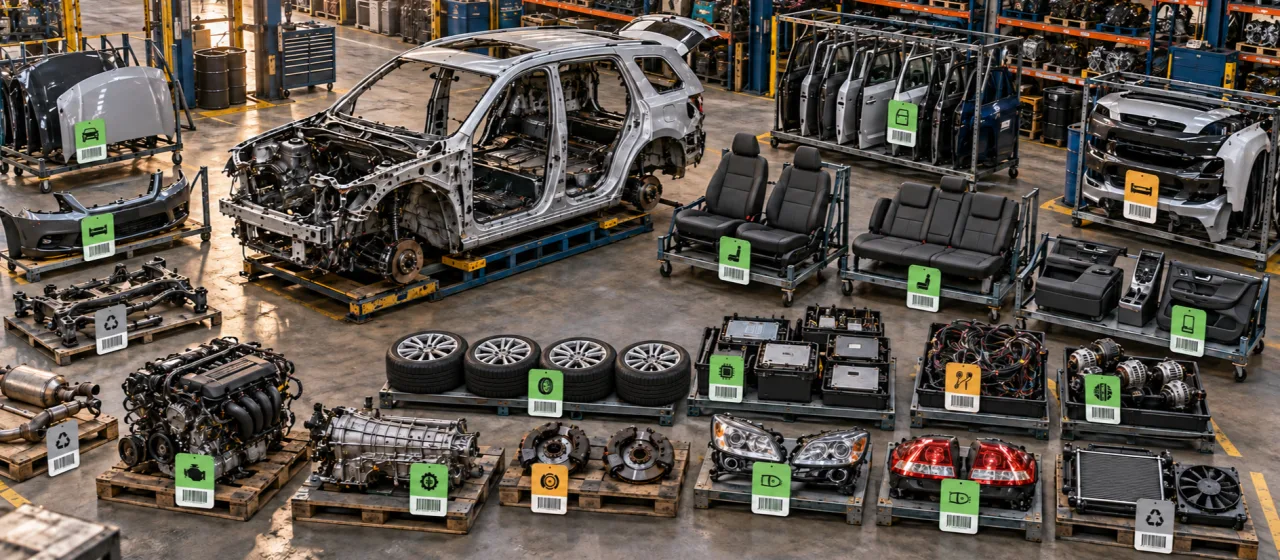
Pull the high-value, fast-moving parts first and get them listed the same week, because cash flow comes from the top of the list: the engine and doors fund the next donor while slow trim clips do not. Which parts carry the value is not a fixed rule - it depends on real demand, condition, labor, and shipping - so confirm it against the most profitable parts to sell rather than assuming a universal top five. Test, grade, and photograph each part as you pull it.
Catalog with fitment
Catalog each part to its donor with condition, location, photos, and - critically - its fitment. Decoding the VIN at intake gives every part a consistent vehicle identity, which is where VIN decoding speeds up cataloging, but the VIN identifies the donor; it does not by itself prove a part fits. Confirm fitment on part-level evidence before you list, using the way to be sure a used part fits. Accurate, confirmed fitment is what reaches the right buyers and comes back less often.
List once, sync everywhere
List each part on the channels that fit it - eBay for national reach, Facebook for local - from one inventory record. The full eBay workflow is the salvage-yard eBay pillar. The catch is the double-sell risk: the moment a part sells on one channel it has to come off the others, or you are refunding and taking a defect. That removal is automatic on eBay through the API and assisted on Facebook through a browser extension, near-real-time with retry rather than an instant guarantee, and how that list-once, delist-everywhere works is its own piece. This is the step that breaks most growing yards when it is done by hand.
Fulfillment and returns
Pack parts to survive freight, and treat the returns you do get as data. Wrong fitment is the most preventable return there is, so a listing built on confirmed fitment is your cheapest returns insurance - the full returns playbook turns a bad return into a fix to the source.
Measure and close: profit per donor
The number that tells you whether your buying works is profit per donor: total sales from the car minus everything it cost. Keep it honest - separate projected from realized, allocate costs across the parts, and remember that unsold inventory is not profit until it sells - and close each donor with its scrap and core residual recorded. Track it on every car, compare the projection to the realized result, and your next hundred buys get sharper. That is what per-donor profit-and-loss is for.
How reParta runs the whole chain
reParta runs this chain in one place, at any size, from a garage doing a few donors a month to a yard moving them by the row. It starts before you bid: enter the VIN and your max bid, and Pre-bid ROI returns a projected parts list, net profit, and a risk score from real used-market prices - a projection to guide the buy, not a guarantee. Win the car and the VIN decode at intake locks in the donor identity; from there reParta’s own built-in OEM cross-reference and part-level fitment maps each part to the vehicles it fits, and you confirm before it goes live. Listing then runs itself: eBay list and delist are automatic through the native API, Facebook is assisted through the extension, both near-real-time with retry so a sold part comes down fast. Every donor rolls up into a per-donor profit-and-loss, projected at the buy and realized as parts sell. Watch out for tools that let AI guess fitment from a title or a photo - a confident wrong compatibility is the wrong door shipped and returned; reParta ties fitment to part-level data the seller confirms instead. It is all one auto parts inventory management software, on Garage, Yard, and Yard Pro.
Every link matters, and the profit you planned at the buy is not a profit you are guaranteed to keep - it is a number you can track, defend, and improve. Strengthen the weakest link and the whole part-out gets more profitable. Start a free 14-day trial - no card required - or see plans and pricing.
Frequently asked questions
What are the stages of a profitable part-out?
Eight, in order: clear the legal gate (title, dismantler license, NMVTIS, EPA) before you buy; buy on modeled numbers, not gut feel; intake and depollute the vehicle safely; dismantle and grade; catalog each part to its donor with verified fitment; list across channels without double-selling; fulfill and minimize wrong-fit returns; then close the donor with a per-donor profit-and-loss. Each stage has its own deep guide; this one is the map that ties them together.
Do I need a license to part out cars for profit?
Usually, once you are doing it as a business. Most states require a dismantler, salvage, or recycler license, and there are federal duties on top: NMVTIS reporting if you handle five or more salvage vehicles a year, and EPA rules for fluids and refrigerant. Confirm your own state and the federal layer before you buy, because the cheapest mistake to avoid is the one you make before the first teardown.
Is the profit from a pre-bid estimate guaranteed?
No. A pre-bid estimate is a projection to guide your bid, built from real used-market prices and your own inputs - it is not a guarantee. Realized price, defects, returns, and the parts that never sell all move the final number. The value of modeling the buy is not certainty; it is bidding with numbers instead of a hunch, then comparing what you projected against what actually landed.
How do I stop double-selling when I list on eBay and Facebook?
List from one inventory record and have the part come off the other channels when it sells. On eBay that is automatic through the API; on Facebook Marketplace, which has no public listing API, it is assisted through a browser extension, and the delist is near-real-time with retry rather than an instant guarantee. The reliable goal is fast, reconciled removal so a sold part does not stay live long enough for a second buyer.
What is the single number that tells me if my part-out buying works?
Profit per donor: the total the car earned minus everything it cost, tracked on every donor. Keep it honest by separating projected from realized, allocating costs across the parts, and remembering that unsold inventory is not profit until it sells. Compare the projection you made at the buy against the realized result, and your next hundred buys get sharper.