Federal regulations for auto recyclers: NMVTIS, EPA, OSHA, DOT, and Form 8300
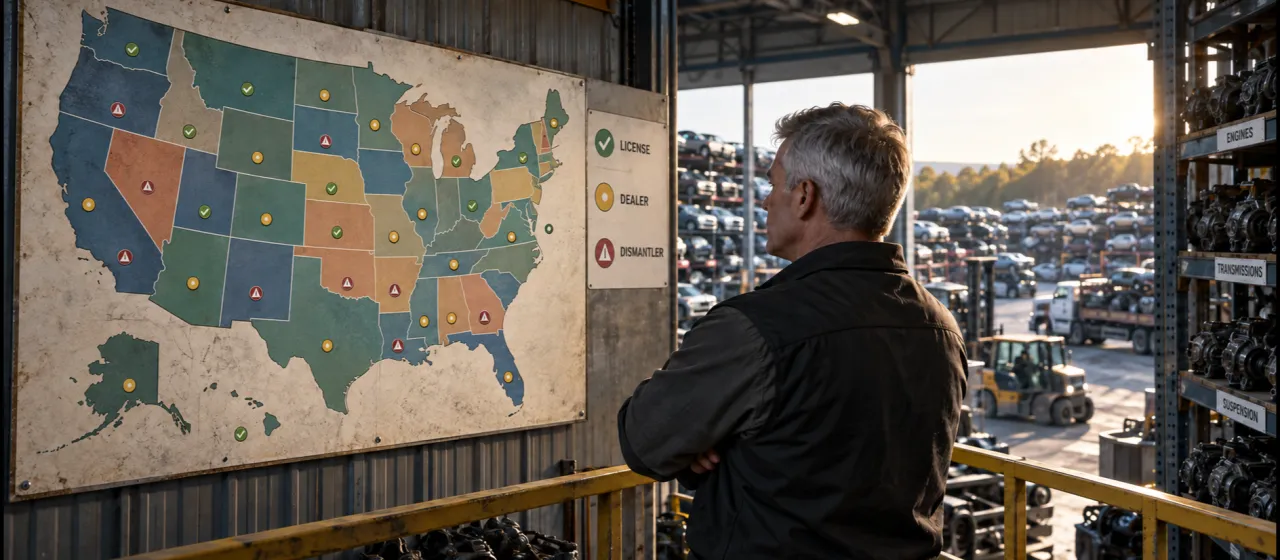
Getting the right state license is only half the picture. Whatever your state calls the credential - dismantler, recycler, salvage dealer, or wrecker - a federal layer sits on top the moment you start dismantling salvage vehicles. The federal regulations for auto recyclers are not a single license; they are a stack of separate duties, and they are trigger-based, not volume-based - most switch on with a specific activity, shipment, or transaction, and only a few (like NMVTIS) carry an explicit annual vehicle count. Each is enforced by a different agency.
This guide maps the federal layer to what a small yard actually has to do. It is a starting point, not legal advice - confirm the current rules with each agency for your operation. For the state side, see our state-by-state licensing guide, and for the full startup path, how to start a used auto parts business.
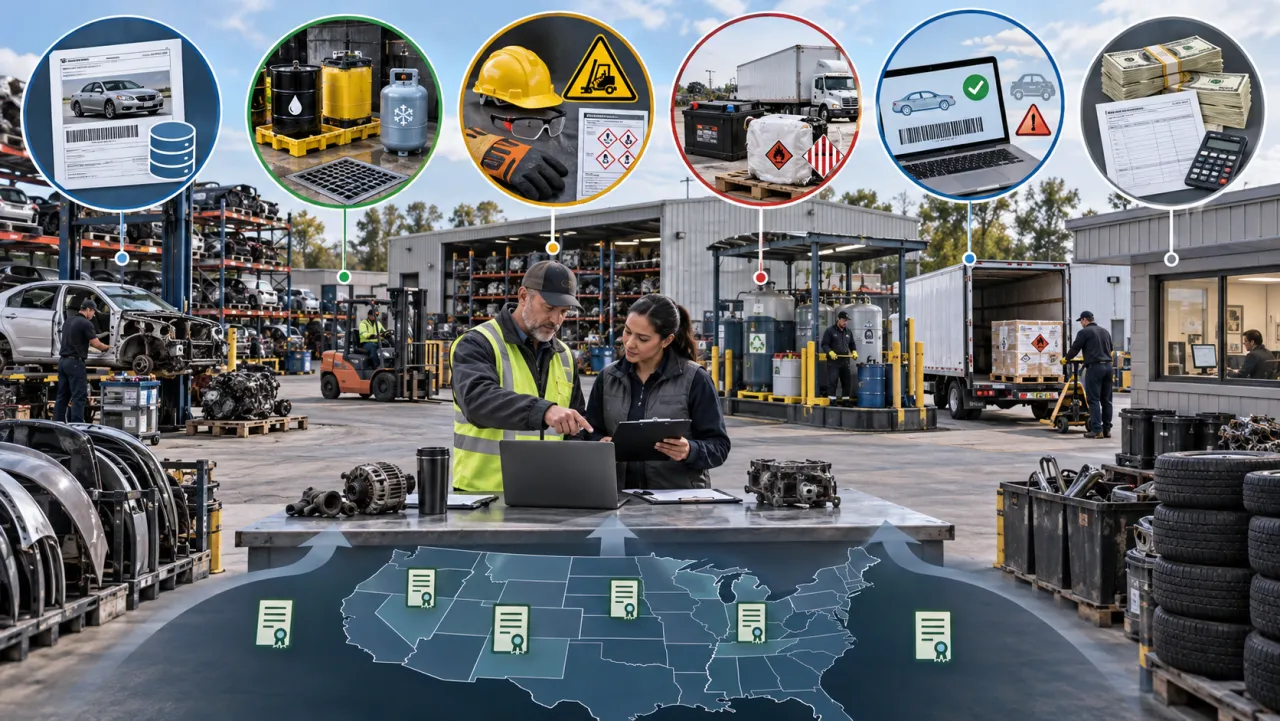
The federal regulations for auto recyclers at a glance
Six federal areas can apply to a used-auto-parts operation, each with its own trigger and its own agency:
- NMVTIS reporting - once you handle five or more junk or salvage vehicles a year
- EPA environmental - stormwater, used oil, hazardous waste, spill prevention, refrigerant, and catalytic converters
- OSHA safety - hazard communication plus equipment-specific programs, once you have employees
- DOT / PHMSA hazmat - shipping airbags, batteries, and other regulated parts
- NHTSA recalls - the ban on selling recalled parts for installation
- IRS Form 8300 - reporting large cash payments
The rest of this guide walks each one and links the official source.
NMVTIS: the reporting duty most people miss
The single most-overlooked federal rule is NMVTIS reporting. Under the Anti-Car Theft Act, if you handle five or more junk or salvage vehicles in a year you generally must report each one to the National Motor Vehicle Title Information System at least once a month. The definition is broad - junk yards, salvage yards, auto recyclers, shredders, pull-apart yards, salvage pools and auctions all count. Insurers are reporting entities too, but with a narrower scope: they report vehicles they take possession of or determine to be total losses for the current model year and the four prior years, whereas a yard reports all qualifying vehicles regardless of age.
Each report covers, at minimum, the reporting entity, the VIN, the date the vehicle was obtained, who it came from, and its disposition (crushed, sold, or otherwise). It runs on a monthly cycle - each month you report the qualifying vehicles you obtained the prior month, not a separate 30-day clock per car - and if a vehicle’s final disposition is not known yet, you still report the acquisition and file a supplemental report once it is. A few carve-outs exist (no duplicate report when your state already forwards the data to NMVTIS, or when a vehicle is cleared by a federal theft verification), and failure to report can carry a civil penalty per violation. The practical takeaway: NMVTIS reporting should be an event in your inventory system, captured as each car comes in, not a spreadsheet you scramble to fill at month-end.
Title, VIN, and stolen-property control
Tied to NMVTIS is basic title and VIN discipline on every donor vehicle: verify the seller and their authority to sell, get a valid ownership document, check that the VIN on the car matches the paperwork, keep the auction invoice or bill of sale, follow your state’s title-surrender process, and do not begin dismantling until you have clear authority to. Never alter a VIN, move an identification plate, or accept a vehicle or part with a destroyed number without escalating it. This is where a clean chain of custody protects you from stolen-property liability.
EPA: the environmental layer
A salvage yard is an industrial site in the eyes of the EPA, and several programs can apply:
- Stormwater. Auto salvage falls under EPA’s industrial stormwater program as “Sector M,” which generally requires a stormwater permit and a written Stormwater Pollution Prevention Plan (SWPPP) - usually from your state, since most states run their own delegated program - though a yard that keeps all parts, fluids, and dismantling under a storm-resistant shelter may instead file a no-exposure certification.
- Used oil. Used oil is regulated under 40 CFR Part 279: store it in sound containers and tanks clearly marked “Used Oil,” and keep it separate from solvents and hazardous waste, since mixing can pull the whole volume into the far stricter hazardous-waste rules.
- Hazardous waste. Beyond used oil, you must make a waste determination for each stream you generate - spent solvents, contaminated fuel, paint waste, absorbents, aerosol cans, mercury switches, batteries - and your generator category depends on how much hazardous waste you produce per month, not on your business size.
- SPCC. The Spill Prevention, Control, and Countermeasure rule can apply once you have more than 1,320 gallons of aggregate aboveground oil-storage capacity (counting only containers of 55 gallons or more), or more than 42,000 gallons completely buried, with a reasonable expectation of a discharge reaching navigable waters. See who is regulated by SPCC.
- Refrigerant. Intentionally venting refrigerant is prohibited under the Clean Air Act (Section 608), and paid motor-vehicle A/C service requires a Section 609-certified technician with approved recovery equipment. Separately, when a vehicle is scrapped the final person in the disposal chain must recover the refrigerant, or verify it was already recovered, before disposal - a duty that binds a dismantler or scrapper even if it does no paid A/C service.
Coolant, brake fluid, fuel, filters, lead-acid and lithium batteries, mercury switches, and tires all carry their own handling and disposal rules, many of them stricter at the state level. Batteries, solvents, mercury, and fluids contaminated in service are Superfund (CERCLA) hazardous substances and can create long-term cleanup liability - clean petroleum and fuel fall under CERCLA’s statutory petroleum exclusion, but other federal and state cleanup laws still reach them. One more Clean Air Act trap sits here: a used catalytic converter can be resold for reinstallation only if it meets EPA’s aftermarket conditions (tested, matched to the vehicle, labeled), and selling an unqualified one for installation is treated as illegal tampering. We break this whole layer down in salvage yard EPA compliance.
OSHA: worker safety
There is no single universal OSHA checklist - the programs you need follow your actual hazards. OSHA is an employee-safety law, so a genuine solo owner with no employees is not covered by federal OSHA (though state OSHA, fire, and environmental rules can still apply). The most common program once you hire is Hazard Communication (29 CFR 1910.1200): once you have employees who may be exposed to a hazardous chemical (solvents, paint, fuels), you need a written HazCom program - a chemical list, labels, safety data sheets, and training before anyone starts work. The rest switch on with the equipment and work they cover, which a dismantling yard almost always has: powered-industrial-truck (forklift) training if you run a forklift, lockout/tagout for servicing equipment, and vehicle stabilization for working under lifted cars.
DOT / PHMSA: shipping hazmat parts
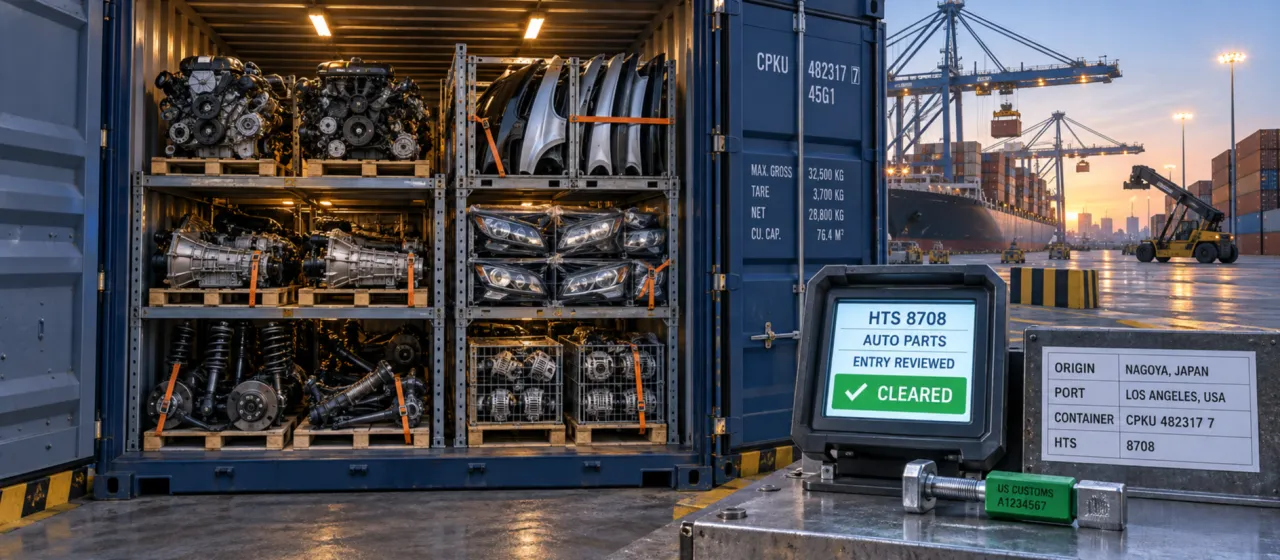
Plenty of the parts you sell are hazardous material to ship. Airbag inflators, airbag modules, and seat-belt pretensioners ship as UN3268 (Class 9) only when they have been tested and approved through a PHMSA-authorized process (with an EX number where required); otherwise they ship as the more restrictive UN0503 (Division 1.4G) - it is not a pass/fail call you make yourself. Either way, packaging, marking, shipping papers, and recordkeeping apply, and anyone who classifies or ships them is a “hazmat employee” who needs PHMSA training. Lithium batteries are regulated too, and damaged, defective, or recalled ones are forbidden from all commercial aircraft, cargo and passenger alike - they may ship only by highway, rail, or vessel with special packaging under 49 CFR 173.185(f), absent a specific approval. A normal carrier label is not enough - you need hazmat-compliant packaging, documentation, and a trained shipper. We cover the practical side in how to ship used auto parts and the 2026 eBay airbag rules.
NHTSA: recalls and safety-critical parts
The real federal rule here is a sale prohibition: under 49 U.S.C. 30120(j) and 49 CFR 573.12, no person may sell recalled motor-vehicle equipment for installation until the defect is remedied - and “no person” includes a used-parts seller, not just franchised dealers. The NHTSA VIN lookup is one useful control toward that, not a legally mandated procedure, and it is not enough on its own for a detached used part: it shows unrepaired vehicle recalls (not completed ones), misses some recent campaigns and most older than fifteen years, and a recall closed on the donor VIN does not mean the removed part itself is remedied. Pair it with part-number and manufacturer-campaign checks, keep a stop-sale policy, and be especially careful with airbags, inflators, pretensioners, steering and brake components, and EV batteries - the parts where a recall or a counterfeit can get someone hurt.
IRS Form 8300: large cash payments
If your business takes in more than $10,000 in cash in one transaction or a series of related transactions, you generally must file IRS Form 8300 within fifteen days, give each named payer a written statement by January 31 of the next year, and e-file once you file ten or more information returns in a year. Breaking a payment into smaller pieces to stay under the threshold (structuring) is illegal and carries civil and criminal penalties. Set a written cash policy and capture customer identity for large cash sales.
How federal regulations for auto recyclers stack with your state
None of this replaces your state license, and your state license does not cover any of this. The federal regulations for auto recyclers run in parallel with the state credential: you can hold the correct dismantler or recycler credential and still be out of compliance on NMVTIS, stormwater, or hazmat shipping. Some states also layer their own stricter versions on top - a shorter NMVTIS-style reporting window, tougher stormwater terms, or extra recordkeeping. When you write to your state agency to confirm licensing, ask which federal duties they expect you to already have in place.
Where reParta fits
Most of the federal layer is a records problem once you are running - and records are exactly what a good system makes automatic. reParta ties every part to its donor VIN and title, so the identifiers a salvage title and an NMVTIS report need are captured as you work instead of reconstructed at month-end. Test evidence, condition, and disposition live on the part record, so a recall stop-sale or a warranty trace is a lookup, not an archaeology project. And because stock lives in one place and syncs across eBay and Facebook, a part that sells on one channel comes down from the others - double-sale protection, not angry buyers.
This guide is general information, not legal or environmental advice. Federal requirements depend on your operation and can change, and states add their own rules on top. Confirm the current rules with each agency - and a licensed attorney or environmental professional where the stakes call for it - before you rely on any of this.
Building a yard that runs clean? reParta keeps every part tied to its donor VIN and title, captures the VIN, title, and disposition details an NMVTIS report and a salvage title draw on, and syncs stock across eBay and Facebook for double-sale protection. Start a free 14-day trial - no card required - or see pricing.
Frequently asked questions
Is there a federal license to recycle auto parts?
No. There is no federal auto-recycling license - licensing is done by the states. But there are federal rules that apply on top of your state license, the biggest being a federal reporting duty to NMVTIS for any business that handles five or more junk or salvage vehicles a year. Environmental (EPA), worker-safety (OSHA), hazmat-shipping (DOT), recall, and cash-reporting rules also apply based on what you actually do.
What is NMVTIS and who has to report to it?
NMVTIS is the National Motor Vehicle Title Information System. Under the Anti-Car Theft Act, a business that acquires five or more junk or salvage vehicles in a year - junk yards, salvage yards, auto recyclers, shredders, pull-apart yards, salvage pools and auctions, and insurers that send total-loss vehicles - must report each vehicle to NMVTIS at least monthly. The report includes the VIN, the date obtained, who it came from, and the vehicle's disposition. Failure to report can carry a civil penalty per violation.
What EPA rules apply to a salvage yard?
A salvage yard typically falls under EPA's industrial stormwater program (auto salvage is 'Sector M'), which generally needs a stormwater permit and a written SWPPP (or your state's equivalent), unless a fully sheltered yard files a no-exposure certification. Used oil is regulated under 40 CFR Part 279 - containers marked 'Used Oil,' kept separate from hazardous waste. The SPCC rule can apply once aboveground oil capacity passes 1,320 gallons (counting containers of 55 gallons or more). Refrigerant may not be intentionally vented under the Clean Air Act (Section 608); paid A/C service needs a Section 609-certified technician, and when a vehicle is scrapped the final person in the disposal chain must recover the refrigerant first.
How do I legally ship an airbag or a used battery?
Airbag inflators, airbag modules, and seat-belt pretensioners are hazardous material - they ship as UN3268 (Class 9) only when tested and approved through a PHMSA-authorized process, otherwise as UN0503 (Division 1.4G), under 49 CFR 173.166; it is not a pass/fail call you make yourself. Damaged, defective, or recalled lithium batteries are forbidden from all commercial aircraft (cargo and passenger) and may ship only by ground, rail, or vessel with special packaging. A normal carrier label is not enough; use hazmat-compliant packaging, papers, and a trained shipper.
Do I have to report cash payments in an auto parts business?
Yes. If your business receives more than $10,000 in cash in one transaction or a series of related transactions, you generally must file IRS Form 8300 within 15 days, give the payer a written statement by January 31 of the next year, and e-file once you file ten or more information returns in a year. Breaking a payment into smaller amounts to avoid the report (structuring) is illegal and carries civil and criminal penalties.
Does a state dismantler license cover the federal rules?
No. A state license and the federal rules are separate. You can hold the correct state dismantler or recycler license and still be out of compliance on NMVTIS, EPA, OSHA, DOT, or Form 8300. The federal duties apply on top of the state credential, and some states layer their own stricter versions on top of the federal floor.