How to inventory a salvage yard (step by step)
The yards that grow are not the ones with the most parts. They are the ones that can find and sell the parts they have. Inventory is a system, not a pile. Here is how to build one.
How to inventory a salvage yard, start to finish
Inventory is not a stage that happens after teardown - it is the spine that runs through the whole yard, from the moment a car rolls through the gate to the day the last part ships and the shell is crushed. The clearest way to think about how to inventory a salvage yard is to see a donor passing through a series of gates - intake, depollution, dismantling, catalog, order and channel control, packing, and returns - where the inventory record is opened at the first gate, read and written at every gate in between, and closed at the last. Get that spine right and the day-to-day steps below fall into place.
Open the salvage yard inventory record at intake
The single most useful change most yards can make is to create the record at intake, before a wrench ever touches the car. Done well, how to inventory a salvage yard comes down to one habit: the record starts at the gate, not at teardown. Open a donor record and capture the fields you will never reconstruct later:
- an internal donor (stock) number and the VIN, verified against both the vehicle and the title;
- year, make, model, trim, engine, transmission, drivetrain, and production date;
- mileage, title/ownership-document type, and the acquisition source, date, and price (with auction and transport costs);
- seller or provider, gate pass, invoice, and keys;
- arrival damage description and photos, and the yard location;
- hold, NMVTIS-reporting, depollution, and dismantling status flags;
- open-recall, airbag, and EV or hybrid flags (a NHTSA VIN lookup surfaces open recalls, though it is not a complete recall history).
Then place the vehicle on an intake hold until the ownership documents and any state-required title, lien, theft, waiting-period, or dismantling-clearance steps are done - the exact sequence depends on your state and how you acquired the car. No teardown before that clears, and never alter a VIN or move an identification plate. Opening the record here means every part you later pull already has a donor to attach to, which is the foundation everything downstream depends on. See whether you need a license to sell used auto parts for the licensing side of intake.
Decide what to inventory before you dismantle
Not every part a car could yield belongs on a shelf. Before teardown, decide, part by part, which of four paths each one takes: dismantle and warehouse it, leave it installed on the donor and inventory it in place, send it to a core buyer, or treat it as scrap or surplus. Weigh historical demand, existing stock, recent sales, the expected net price, removal labor, testing cost, storage footprint, shipping complexity, return rate, and scrap or core value. This one decision drives your labor, storage, inventory turns, and how much dead stock you create - so make it deliberately, not by pulling everything and sorting it out later.
1. Catalog at teardown, not later
The cheapest moment to record a part is the moment you pull it. The donor record already exists from intake, so now you open a part record linked to it and fill in the fields that make it sellable: a unique part SKU and the donor stock number and VIN; a standardized part type; the OEM and interchange numbers; the source-vehicle attributes; side and position; color or paint code where it matters; a condition grade with damage codes; tests performed and their result; serial number if one exists; photos; storage location; quantity; price; and its channel and hold/reservation status. “I’ll log it later” is how parts become invisible, and a part you cannot find is a part you cannot sell.
Keep SKU, location, and status as three separate things. The SKU is the part’s permanent
identity - a stable link such as donor stock number plus a part sequence (for example
D-260914-038-P017); the location tells you where it physically sits (WH1-A04-R02-B06); and the
status tells you whether it is available, reserved, sold, or on hold. Never bake the location into
the SKU, because parts move and the identity must not.
2. Record donor data, fitment, interchange, and OEM numbers separately
“Headlight” is not inventory. But “front-right headlight” is still not enough, because compatibility can turn on trim, halogen vs. HID vs. LED, adaptive vs. not, the connector, a control module, market spec, and production date. Record four distinct things, not one blurred label: the donor attributes (what the car it came off actually is), the application fitment (the vehicles and configurations it installs on), the interchange references (functionally interchangeable parts or applications), and the OEM cross-reference numbers. A part often fits vehicles beyond its own donor, but production dates, options, connectors, calibrations, and market-specific equipment create exceptions, so treat interchange as a claim to verify, not a guarantee. And drop “good condition” for a standardized grade with the damage location and codes noted - a subjective word is what comes back as a return.
3. Give every part a real location, and record every move
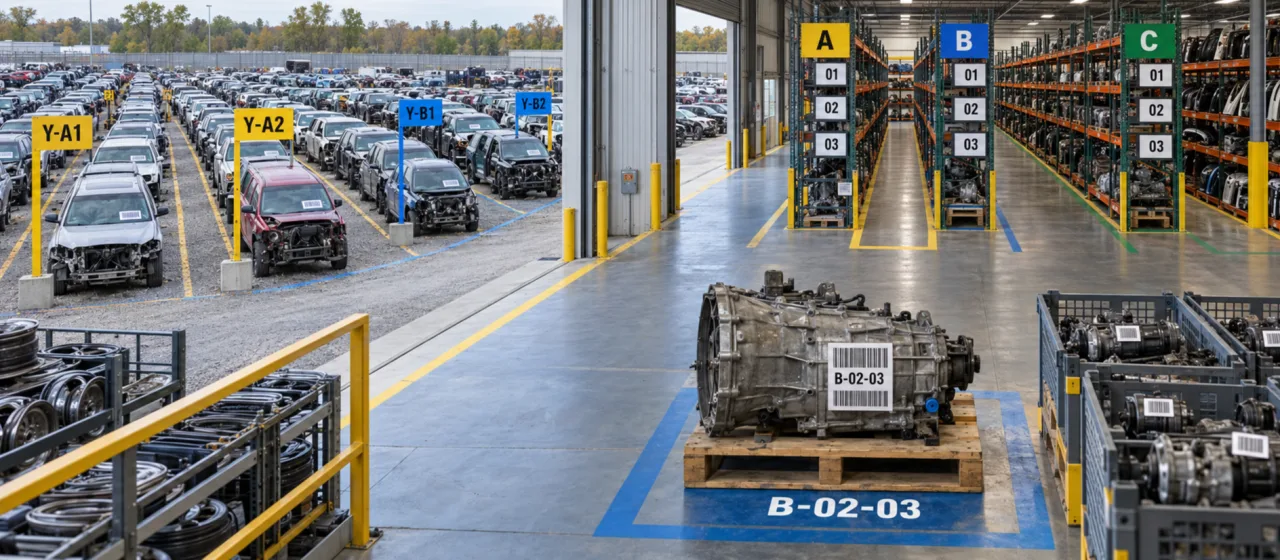
A tagged location turns a treasure hunt into a pick, but “row, shelf, bin” is only the start. Model the real hierarchy - yard, building, zone, aisle, rack, shelf, bin - plus the working areas a part passes through: donor row, staging, testing, photo station, shipping, quarantine, returns, cores, and scrap. Then enforce a movement workflow every time a part moves: scan the part, scan the destination location, confirm the move, and store the timestamp and the employee, keeping the location history. The one policy that makes it hold: no unrecorded moves. A system is only as accurate as the last move someone bothered to scan.
4. Photograph at cataloging, and again when it matters
Photos are part of the inventory record, not an afterthought at listing time. Capture the primary photo set during cataloging - full part, mounting points, connector, OEM label, serial number, and defects, with a category-specific checklist rather than a fixed count - then append more when you test it, find damage, pack it, or process a return. A clean set captured once saves handling the part again and speeds every listing.
5. Sync inventory to your connected channels
Inventory that lives only in your head or a spreadsheet cannot drive listings. The goal is one source of truth that publishes to your connected channels and, when a sale is recorded, sends the delisting update to the others - which sharply lowers the risk of a double sale. No sync removes that risk entirely (tokens expire, marketplaces have outages, and two buyers can check out at once), so treat fast, reliable delisting as the target, not a guarantee.
6. Review aging, and separately, cycle-count for accuracy
These are two different jobs. Aging review asks whether stock is selling: how many days a part has been on hand, whether there is still demand, and what to do about the slow movers. Aging stock stays an accounting asset until you sell it, write it down, or dispose of it under your accounting policy, but operationally it eats space, labor, and working capital, so act on it - reprice, relist, wholesale, sell to a core buyer, move it through a network, bundle it, transfer it, or scrap it and reclaim the space.
Cycle counting asks a different question: does the record match reality? On a rolling schedule
- high-value and high-velocity parts often, the long tail rarely, and always after a discrepancy or a return - confirm the part physically exists, sits where the system says, matches its tag and grade, and has not been sold or moved off the books. Track the numbers that expose drift: inventory and location accuracy, listing-to-physical match rate, days from intake to catalog and from pull to listing, sell-through and turns, return rate by reason, wrong-fitment and double-sale rates, and write-off rate.
Make NMVTIS and title part of the inventory record
Compliance is not a separate binder - it belongs in the same record. A business that meets the federal definition of a junk or salvage yard - one that acquires or owns junk or salvage automobiles to resell them whole or for parts, to rebuild or restore, or to crush - and handles five or more such automobiles in a year generally has an NMVTIS reporting obligation, usually at least monthly. A report identifies the reporting entity, the VIN, the date obtained, the source, the disposition or intended disposition, the recipient where applicable, and whether the vehicle is intended for export; a supplemental report follows when the final disposition becomes known or changes. Some businesses report through a state system that transmits the data to NMVTIS. The mistake is treating any of this as a month-end spreadsheet; done right, each filing is just an event your inventory system already has the data for, because you opened the donor record at intake. The same record carries the title and VIN controls: verify the VIN on the car against the documents, keep the invoice and gate pass, complete the state title, lien, and theft procedure, and link every significant part back to its donor VIN so a buyer question or a law-enforcement query can be answered from one place. See NMVTIS reporting for dismantlers for the detail. None of this is legal advice - confirm your obligations with your state motor-vehicle authority.
Inventory does not stop at the sale: pick, pack, and returns
The back half of the yard reads from the same record. On an order, reserve the part immediately so it cannot be sold twice, then scan the SKU at pick, pack, and ship. Record the actual serial number where one exists, plus a unique internal or tamper-evident mark and photos of it: an OEM part number identifies the part family, not the individual unit, so it cannot prove a buyer returned the exact piece you sold. Pack to each carrier’s current requirements and the applicable hazardous-material rules - fluid-bearing assemblies may need full draining, plugging, cleaning, leak protection, special packaging, or may be barred from a given service, and batteries, airbags, and refrigerant lines carry their own restrictions; settle oversize or LTL freight before you list, not after. When a part comes back, the return record should capture the reason (seller error or wrong fitment, transit damage, a defective part, a buyer who changed their mind, an installation error, or a core), tied to the VIN and the serial mark you stored at catalog. Accurate fitment at the catalog stage is what keeps most of these from happening at all, which is the whole point of working to cut wrong-fitment returns.
Finally, close the donor - but on the right axis, because closing is not one event. The vehicle’s lifecycle status (crushed, sold, transferred, or exported) and its NMVTIS disposition report are separate from the remaining parts, which may still be on the shelf and selling after the shell is gone, and separate again from the financial closeout. NMVTIS itself spans at least two events: the report when you acquire the automobile, and a supplemental report when the shell’s fate is known. Track vehicle status, NMVTIS status, remaining-parts status, and financial closeout as distinct fields, so a crushed hull never quietly retires parts that are still for sale.
Run it on one source of truth
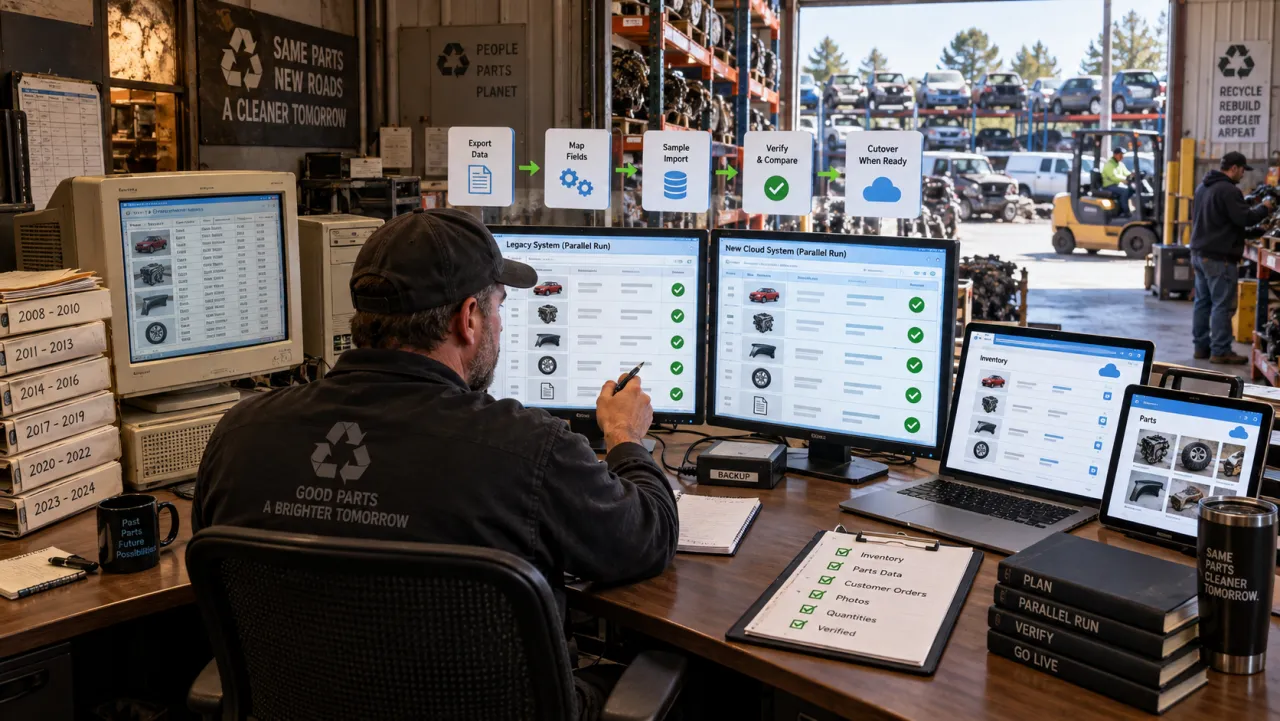
Every gate above reads from and writes to the same record, which only works if that record lives in one place. reParta is built to be that single source of truth: it catalogs each part with its fitment and interchange, holds location and photos, and keeps the donor VIN attached, so the same data that makes a part findable can also support preparing your NMVTIS and title records. On the selling side its multi-channel sync publishes to your connected channels and, when a sale is received or recorded, sends the delisting update to the others - automatically on eBay through the native API, and assisted on Facebook Marketplace through the browser extension, since Facebook has no public listing API - which substantially lowers the risk of a double sale. It is operations software, not a licensing or reporting service: it does not file NMVTIS or obtain permits for you, but its records can support your own.
reParta is one system for cataloging, fitment, location, photos, and multichannel listing - so a part is recorded once and kept in sync across connected channels, with far less double-selling.
That, in short, is how to inventory a salvage yard so it scales: record once at the gate, keep it graded, located, and compliant, and keep it in sync as it sells. reParta is built to manage that donor-to-sale inventory workflow in one place - not to run every function of the yard. If you are still setting the business up, the used auto parts business start-up guide puts inventory in the wider picture. A good system feels like overhead until the first time a customer asks “do you still have it?” and you answer in five seconds. Start a free 14-day trial - no card required - or see plans and pricing.
Frequently asked questions
How do you inventory a salvage yard?
Treat inventory as a system that runs the length of the yard, not a task you do after teardown. Open the record at intake with the donor VIN, title status, and any recall or EV flags; enrich it at teardown with each part's fitment and interchange, condition grade, location, and photos; sync it to your connected channels so a sold part is delisted from the others; and close it when the donor's final disposition is recorded. The goal is one source of truth where a part is recorded once and stays findable and in sync as it sells.
What information should a salvage yard inventory record include?
At the donor level: an internal stock number, VIN, year/make/model/trim/engine, title status, source, date obtained, and cost. At the part level: a unique SKU, the donor stock number and VIN, a standardized part type, the OEM and interchange numbers recorded separately, the application fitment, side and orientation, a standardized condition grade with damage codes, tests performed, a category-specific photo set, a physical location, quantity, price, and status. Link every significant part back to its donor VIN, and track the vehicle's disposition separately from the remaining parts. Those fields are what make a part findable by a buyer and keep it from coming back as a wrong-fitment return.
Does a salvage yard have to report inventory to NMVTIS?
A business that meets the federal definition of a junk or salvage yard - one that acquires or owns junk or salvage automobiles to resell them whole or for parts, to rebuild or restore, or to crush - and handles five or more such automobiles in a year generally has an NMVTIS reporting obligation, usually at least monthly. A report identifies the reporting entity, VIN, date obtained, source, disposition or intended disposition, recipient where applicable, and whether the vehicle is intended for export, with a supplemental report when the final disposition becomes known. Some businesses report through a participating state system instead. It is best handled as an event in your inventory system rather than a month-end spreadsheet. This is general information, not legal advice: reParta does not file NMVTIS or obtain licenses for you, but its records can support your own reporting. Confirm your obligations with your state motor-vehicle authority.