Towing software vs salvage yard software
Search for software as a tow operator who has started selling parts and you land in two aisles that talk past each other: dispatch-and-impound suites on one side, yard management systems on the other. The towing software vs salvage yard software question is not which vendor wins, because the two categories do different jobs on different objects. This guide maps the jobs, shows where the single handoff between them sits, and gives the trigger for when a tow business actually needs the second system. For the business context, start at how towing companies sell used auto parts legally.
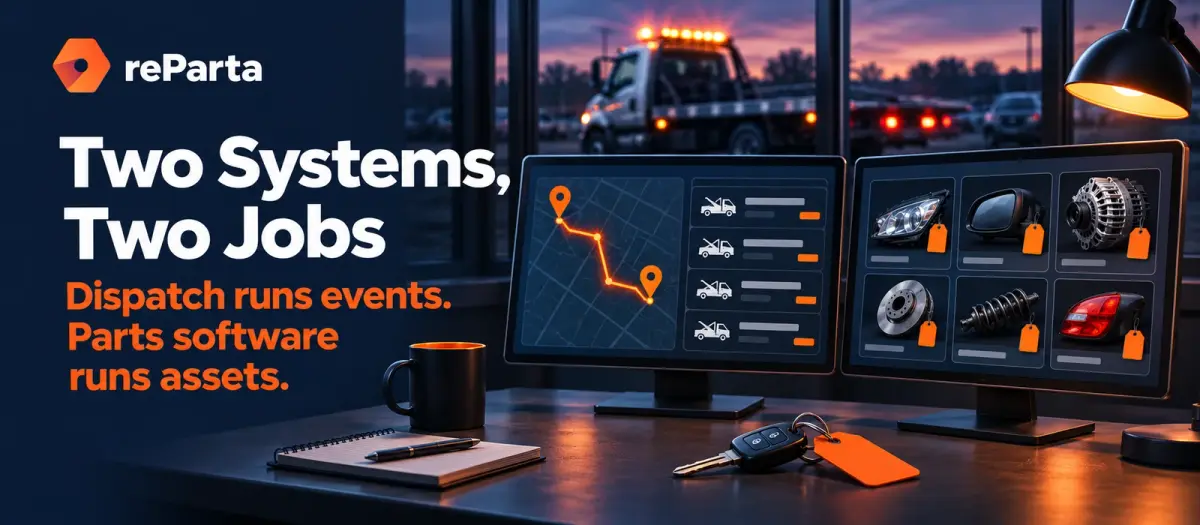
Towing software vs salvage yard software: events versus assets
Towing and impound software runs events. A vehicle enters as a call, becomes a tow ticket, accumulates storage days, generates notices, and exits by release, auction or disposal. The active workflow is measured in days and ends at release, auction or disposition, while the underlying records stay behind for billing, audits and statutory retention.
Salvage yard software runs assets. A vehicle enters as a donor your business lawfully acquired, becomes a projected parts value, then a set of parts with identities, locations and listings, and exits part by part as orders ship, until the ledger closes. The record’s life is measured in weeks or months, and the money arrives across the whole span.
One object is a passing event; the other is inventory. That is the entire towing software vs salvage yard software distinction, and every row in the comparison below falls out of it.
What each side actually covers
| Job | Towing and impound software | Salvage yard software |
|---|---|---|
| Intake | Call, dispatch, driver status | Donor record from the VIN, projected parts value |
| The vehicle | Tow ticket, storage days, impound photos | Teardown plan: which parts justify pulling |
| Records and identification | Storage billing, notices, lien letters, release | Part identity: OEM number, cross-reference and interchange numbers, fitment |
| Money events | Fees charged and collected per vehicle | Listings, orders, returns across eBay, Facebook and the counter |
| Where things are | Lot spot of the vehicle | Storage location of every pulled part |
| The bottom line | Per-event billing | Per-donor P&L from acquisition through final disposition |
| Operational closeout | Release, auction or disposition (records kept for retention) | Last part sold or written off (late adjustments logged) |
Neither column replaces the other: in towing software vs salvage yard software the overlap sits in shared vehicle records and VINs, while the core jobs stay distinct - and one vehicle, at one moment, changes columns.
The handoff: where the two systems meet
The only crossing point is the vehicle that legally becomes yours to dismantle. Until then it is an event in the dispatch system; after, it is an asset on the parts side. The handoff is one record at one moment: the VIN, how the vehicle was acquired, and the actual costs already incurred on it, which seed the donor’s ledger as described in how to calculate profit on a tow yard vehicle. For a small tow yard this is a simple manual handoff, not a software integration: carry the VIN, the source tow or impound reference, the acquisition status and the recorded costs into the donor record, keep the original towing record for billing and documentation, and each system keeps running its own job.
Two cautions at that crossing. First, the legal gate is real: possession is not ownership, and the lien process alone does not make the vehicle yours. You can evaluate a candidate from its VIN and even keep a provisional record earlier; what waits for the gate is the dismantling and selling, so activate the donor workflow only once the state’s requirements are met, per the legal guide. Second, not every eligible vehicle should cross: the exits comparison in tow yard auction vs part out vs scrap and the donor signals in tow yard vehicles worth parting out decide which cars are worth the asset treatment at all.
When a tow business actually needs the parts side
- Not yet: everything you handle gets released, auctioned whole or scrapped. Your dispatch and impound system covers the whole lifecycle; adding parts software would manage an inventory you do not have.
- Now: when you plan to acquire vehicles for dismantling, ideally before the first teardown. Confirm ownership, dismantling authority, licensing, reporting and environmental requirements first; from the first kept car forward you need part-level records, locations, listings and a per-vehicle ledger, and retrofitting those after a shelf of unlabeled parts exists is the expensive way to learn it.
- Overdue: parts already sell from the yard through phone calls and memory, listings live in one employee’s head, and a sold part occasionally gets sold twice. The cost of double sales compounds quietly; part-level inventory is the fix, not more discipline.
For choosing among dedicated yard systems once you are a full-time parts operation, the best software for an auto dismantler covers that market; this page is about the tow-side starting point, where the parts operation is new and runs beside an existing towing company software stack.
How reParta does it - the parts side, beside your dispatch system. reParta does not touch dispatch, tow tickets, storage billing or lien letters: your towing company software keeps its job. When a vehicle legally becomes yours, decode the VIN free, see its projected parts value, and keep it as a donor only when the numbers say so. reParta pulls a part’s cross-reference and interchange numbers from its OEM number, and stores fitment for every part; parts get storage locations and real-photo listings published to eBay and a Facebook Marketplace extension, and when the part sells on any channel, it’s automatically removed from the others. Per-donor profit and loss closes the loop, for operations of any size. The 14-day trial is card-free: start with your next legally acquired vehicle. See auto parts software for towing companies, salvage yard inventory software or pricing.
Sources and data check
Checked November 2, 2026. The category descriptions are operational characterizations of the two software classes, not a review of specific vendors, and no vendor comparison is made or implied. Legal authority to dismantle comes first and differs by state: see the legal guide for towing companies and confirm your state’s requirements. Nothing here is legal advice.
reParta is an independent product and is not affiliated with, endorsed by, or sponsored by eBay or Meta. eBay, eBay Motors and Facebook Marketplace are trademarks of their respective owners.
Frequently asked questions
Can towing software manage a used parts inventory?
Generally no, and not because it is bad software: it is built around a different object. Towing and impound systems track an event per vehicle: the call, the tow ticket, storage days, notices and release or disposition. A parts operation needs a record per part: OEM number, condition, location, listing, order and return, tied back to the donor vehicle it came from. Those are different data models, which is why bolting a parts shelf onto a dispatch system rarely works well in practice.
Do I need salvage yard software if I already run towing software?
Only if you keep vehicles and sell their parts. A tow business that releases, auctions or scraps everything it handles has no parts inventory, so the dispatch and impound system is enough. The trigger is the first vehicle you lawfully acquire for dismantling: at that moment you need donor records, part-level inventory, listings and per-vehicle profit tracking, which is a different job from running calls and storage billing.
What does salvage yard software do that towing software does not?
It manages the asset after the event ends: a projected parts value for the vehicle, the parts pulled from it with OEM numbers and cross-reference data, fitment, storage locations, marketplace listings, orders and returns, and profit and loss per donor vehicle. Towing software typically has no reason to do any of that, the same way parts software has no reason to run dispatch, driver status or storage billing.
When should a tow yard add the parts side?
When you plan to keep vehicles for dismantling, ideally set up before the first teardown rather than after a shelf of unlabeled parts exists. The legal gate comes first: title, disposition and any dismantler licensing your state requires. Once a vehicle crosses that line, start its donor record with the costs already in it; every part you pull gets identified and given a location immediately, and listed once it is inspected and ready to sell.
Does reParta replace towing company software?
No. Dispatch, tow tickets, storage charges, lien letters and vehicle release stay in your towing company software. reParta handles what happens after a vehicle legally becomes yours to sell or dismantle: the donor record, projected and actual parts value, the parts inventory with storage locations, eBay and Facebook listings, orders, and profit and loss per vehicle.
Can one system do both jobs well?
The jobs are different enough that most operations end up with one system per job and a thin handoff between them: the moment a vehicle legally becomes yours, its VIN and accumulated costs start a donor record on the parts side. That handoff is one record at one moment, not a deep integration, which is why running the two side by side is simpler in practice than it sounds.