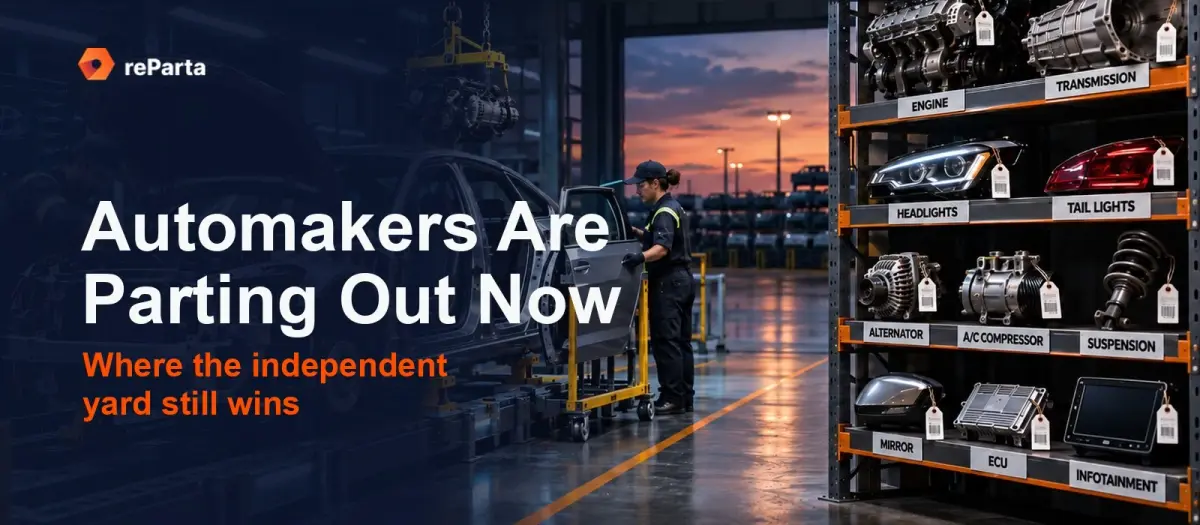
Automakers Are Industrializing Part-Out: What It Means for Independent Salvage Yards
A used car is worth more taken apart than crushed. Independent dismantlers have known that for decades. What is new is that the automakers now agree, and they are spending hundreds of millions to prove it.
In late October 2026, Volkswagen opened an industrial vehicle-dismantling line inside its Zwickau plant, the same factory it spent 1.2 billion euros converting to build electric cars. The line takes vehicles apart and routes the recovered original parts back into the repair market. And VW is not an outlier: Stellantis, Renault, Mercedes-Benz, Toyota and BMW are all building versions of the same thing. For an independent yard, the automakers industrializing part-out is both a warning and an opening. Here is what the big players are actually doing, what the move does and does not prove, and where a small operator still wins.
What VW actually built at Zwickau
Zwickau is a pure-EV plant. It built its last combustion car in 2020 and now assembles six electric models for VW, Audi and Cupra. On top of that, VW has added an eight-stage dismantling line and named the site its central competence center for the Volkswagen Group’s circular economy.
The numbers VW has shared:
- An eight-stage line running two shifts, ramping toward 4,100 vehicles a year, with a modular design meant to scale to up to 15,000 vehicles a year by 2030.
- It opened more than six months ahead of the original mid-2027 plan, and is currently running in with around 500 test vehicles.
- Roughly 100 new jobs now, with a collective agreement providing for up to 1,000 jobs in the circular-economy unit over the long term.
- Up to 90 million euros of planned investment over the coming years, with the state of Saxony adding up to 10.7 million. VW also plans a Europe-wide partner network for industrial circularity.
- Recovered original parts have been on sale since the summer, moving through dealer and service networks, independent workshops and parts retailers. Doors, bumpers, electric motors and transmission components are reported as the highest-demand items.
The stated goal is blunt: keep older cars on the road with affordable original parts instead of writing them off. That is the independent-dismantler value proposition, said by a carmaker.
What the move proves, and what it does not
It is worth being precise, because the headline is bigger than the proof.
What it does validate, strongly: that there is real service-channel demand for original used parts, that dismantling can be turned from a craft into a repeatable industrial process, and that a carmaker now sees enough value in saving components, not just melting metal, to build a line for it. The strategic signal is clear: reuse and selective part-out sit above scrap in the value chain.
What it does not yet prove: that any single dismantled car turns a profit on the open market. VW has not published revenue per vehicle, recovery rates, teardown cost, sell-through or warranty returns. And the first cars down the line are pre-series and test vehicles, not salvage bought at auction, so there is no acquisition cost, the history is known and the parts are newer. That is a much friendlier starting economics than the one an independent faces buying a damaged car sight unseen. So the honest read is this: the market is validated; per-vehicle profitability, on real-world donors, is still the open question. That open question is exactly the independent’s game.
VW is not alone: the industry is building dismantling lines
Line this up next to the rest of the field and it stops looking like one plant’s experiment.
| Automaker | What they built | Scale / detail |
|---|---|---|
| Stellantis (SUSTAINera) | Multi-site dismantling plus engine, gearbox and HV-battery remanufacturing | Original used parts up to 70% cheaper than new; reman parts about 35% below new with the same warranty; recovered parts feed a marketplace with 15 million-plus listings; a third dismantling center in Sao Paulo (up to 8,000 vehicles a year) opened in 2025 |
| Renault (The Future Is NEUTRAL) | Industrial dismantling center, plus refurbishment and remanufacturing | Pulls 25-plus parts per vehicle; the circular arm reports around 400,000 end-of-life vehicles dismantled a year and roughly 10 million reused parts returned to the aftermarket |
| Toyota (Circular Factory, Burnaston) | Vehicle dismantling and parts harvesting | Designed to process around 10,000 vehicles a year, selling reusable parts through retailers and distributors |
| Mercedes-Benz | Battery recycling and materials recovery | In-house battery recycling claiming 96%-plus recovery; reconditioned packs sold as spare parts; more a closed-loop materials play than a broad used-parts seller |
| BMW | Recycling and dismantling center | Run for about 30 years, largely on pre-series and test vehicles, focused on teardown methods and AI-driven material sorting |
Stellantis is the clearest sign this is commercial, not just compliance: it says its SUSTAINera reuse business grew 51% in 2025, driven by online used-parts sales. Even the largest independent-sector operators are scaling the same way: industry reporting describes major groups running dedicated EV and hybrid teardown lines and returning millions of parts to use each year. Different scales and different emphases, one direction: save the parts first, recover the materials second, scrap last.
Why now: margins and regulation
Two forces are pushing this.
EVs pay less, so carmakers need new revenue. Electric vehicles earn thinner margins than combustion cars, and dismantling and reuse is one of the few new lines a carmaker can add without selling another vehicle. Whether it is profitable at scale is still unproven, which is precisely why they are building the capacity now and learning on it.
Regulation is pulling in Europe. The EU’s new End-of-Life Vehicles Regulation came into force in 2026, with its main obligations phasing in across the following years. It pushes design for dismantling, requires that batteries and e-drive motors be removable at any point in a vehicle’s life, phases in recycled-plastic content requirements with a minimum share sourced from end-of-life vehicles, and introduces a Digital Circularity Vehicle Passport to carry parts and material data through a car’s life. With roughly 6.5 million vehicles reaching end of life in the EU each year, it turns circularity from a voluntary ESG line into an operational obligation, and a market. The US has no equivalent mandate today, but the economics, and the insurer-driven flood of total-loss vehicles, travel regardless of the rulebook.
What it means for the independent yard
Read one way, this is a threat. When an automaker sells a reconditioned part with a factory warranty at a third off new, it competes for the same repair dollar you do, with brand trust you cannot match on a listing.
But look at what those industrial lines can and cannot do. A line built for volume runs one brand’s own vehicles on a fixed, standardized flow. It cannot look at the specific wrecked Silverado that rolled in this morning and decide, in minutes, whether this one is worth parting, selling whole, or scrapping today because the lot is full. That per-vehicle decision is the one thing the industrial model structurally trades away for throughput, and it is the independent’s edge.
Your advantages are exactly the ones the big line gave up: every make and model, not one brand; speed and flexibility over fixed capacity; and a call made car by car instead of by factory policy. The move the big players just validated, that reuse beats scrap, is one you can make faster and across more vehicles than they can. The gap was never whether to part out. It is knowing, per car, which exit actually pays, and which vehicles deserve a teardown at all.
The EV wave is the real signal
The deeper message in Zwickau is what is coming down the tow-truck ramp next. EVs are entering the salvage stream, and the industry is pointing at where the value sits: the largest dismantlers now run dedicated EV and hybrid teardown lines and call the battery pack the highest-value reused component, and Mercedes is reselling reconditioned packs as spare parts.
For an independent, EVs are an opportunity wrapped in a hazard. High-voltage batteries and airbags are restricted, hazmat-regulated items that demand trained handling and are not a casual pull, so treat them as specialist work, not shelf stock. But the rest of an EV, including panels, lighting, motors, modules, interior and wheels, parts out like any other donor, and demand for those parts only grows as more EVs age out. The yards that build the muscle now, deciding EV part-out the same disciplined way they decide it on a combustion donor, will be ready when the volume arrives.
Where reParta fits
The automakers’ own playbook makes one thing clear: the defensible part of this business is not a listings catalog, it is the data and the decision. Knowing what a vehicle is worth in parts, which ones to pull, what condition they are in, and where each sells best. That is the layer reParta builds for yards of any size, without the hundred-million-euro line.
Before you buy or commit space to a vehicle, reParta prices the donor: decode the VIN, build a projected parts list with market-based price estimates, and compare the projected part-out recovery against the whole-vehicle and scrap numbers you already have. Keep it as a donor only when the math says so. From there it tracks each part with its storage location, lists once to eBay directly and to Facebook with the extension, removes a sold part from the other channel to help prevent double sales, and shows profit and loss per vehicle. It does not touch titles, liens, hazmat handling or high-voltage batteries, which stay specialist work. What it does is make the part-out-or-scrap call fast, per vehicle, and backed by numbers, for every make that comes through your gate.
The automakers just told the whole market that parts are worth more than scrap. The independent yards that win are the ones who already knew, and who decide it faster, car by car, than any factory line can.
This article summarizes publicly reported figures from the companies named and from trade and regulatory coverage. Several are company-stated and not independently audited, and plans, capacities and timelines can change. It is general industry commentary, not legal, financial or regulatory advice. High-voltage batteries, airbags and other hazardous components are subject to strict handling and disposal rules; confirm your obligations with the relevant authorities and qualified professionals before acting.
See what your next donor is worth before you commit the space. Price a donor with reParta and know, car by car, whether to part it out or let it go.
Frequently asked questions
Are automakers really dismantling cars and selling the parts?
Yes. In late October 2026 Volkswagen opened an industrial dismantling line at its Zwickau plant and has sold recovered original parts since the summer. Stellantis runs a SUSTAINera dismantling and remanufacturing hub in Turin whose recovered parts feed a used-parts marketplace with more than 15 million listings, Renault dismantles hundreds of thousands of end-of-life vehicles a year through The Future Is NEUTRAL, and Toyota, BMW and Mercedes-Benz each operate their own recovery or recycling lines. The common thread is saving usable components first and recovering raw materials second, rather than sending whole cars straight to the shredder.
Does VW's dismantling line prove part-out is more profitable than scrap?
It validates the model, not the per-vehicle profit. The investment shows there is real service-channel demand for original used parts and that dismantling can be run as a repeatable industrial process. But VW has not published revenue per vehicle, recovery rates or teardown costs, and the first cars down the line are pre-series and test vehicles with no acquisition cost and known history, which is far friendlier economics than buying a damaged car at auction. So the market is validated; whether any single real-world donor turns a profit is still decided car by car, which is exactly the independent yard's game.
What does the automakers' move mean for independent salvage yards?
Both a threat and an opening. The threat is competition for the repair dollar: a carmaker can sell a reconditioned part with a factory warranty at a discount to new. The opening is that an industrial line is built for volume on one brand's vehicles and cannot make the per-vehicle decision, part it, sell it whole, or scrap it today because the lot is full. That call, made across every make and model, is the independent's structural edge.
Can a small salvage yard compete with an automaker's dismantling line?
Not on capital, and it does not need to. A yard competes on the things a fixed line gives up for throughput: every make and model instead of one brand, speed and flexibility instead of fixed capacity, and a profit decision made per vehicle instead of by factory policy. The reuse-beats-scrap move the automakers just validated is one an independent can make faster and across more vehicles, as long as the per-car math is right.
Should salvage yards start parting out EVs?
Selectively, and carefully. EVs are entering the salvage stream and demand for their parts will grow as the fleet ages. High-voltage batteries and airbags are restricted, hazmat-regulated items that require trained handling and are not a casual pull, so treat them as specialist work rather than shelf stock. The rest of an EV, including panels, lighting, motors, modules, interior and wheels, parts out like any other donor, and yards that build the discipline now will be ready when EV volume arrives.
How do I decide part-out vs scrap on a specific vehicle?
Compare only future numbers. Decode the VIN to pin the exact configuration, build a projected parts list priced against the current market for those OEM numbers and condition, subtract dismantling labor, fees, shipping, lot space and a returns reserve, and weigh the result against this week's whole-vehicle and scrap offers. The costs you already sank into the car do not change which exit wins. reParta builds the projected list from the VIN in minutes so the call is made before you commit the space, vehicle by vehicle.