The most profitable used car parts to sell
The most profitable used car part is not always the one with the highest selling price. Profit depends on whether the part is likely to sell, how long it takes to remove and test, marketplace fees, shipping, return risk, and how much space it occupies while it waits for a buyer. Based on typical used-parts demand, resale value, removal time, shipping, and storage cost, the strongest profit candidates usually include late-model headlights and tail lights, select electronic modules, factory wheels, clean body panels, engines, and transmissions, plus small OEM sensors, connectors, and key components that are easy to identify and cheap to ship.
There is no universal ranking, though. The same part can be highly profitable on one vehicle and nearly worthless on another, and the priciest part is rarely the most profitable one per hour of labor, per cubic foot of shelf, or per dollar tied up. So this guide does two things: it gives you a repeatable method to rank parts for the exact car in front of you, and it walks the categories with honest, illustrative prices and the traps that decide whether a sale sticks.
A note on the prices below. They are illustrative US used-market ranges to orient you, not quotes. Actual sale prices vary widely by OEM number, vehicle application, trim and engine, mileage, tested-or-not condition, warranty, location, and whether the part ships or sells local. Always check the real used-market price for your exact part before you pull it.
How to rank what to pull: a pull-priority score
Sticker price lies to you. A seat can list higher than a headlight and still lose money. Rank each part you could recover by its expected net contribution, not its price tag:
Pull-priority score = expected net contribution / storage burden
where expected net contribution = chance it sells x (sale price - marketplace fees - shipping - expected return cost - removal and listing labor - allocated donor cost), and storage burden = the space it takes x how long it sits.
It is a heuristic, not a formula to solve to the penny - the point is to rank by contribution per constraint, not by the number on the tag. Three things move it, and only one is the sticker:
- Chance it sells - driven by how many of that model are on the road and how often the part breaks or gets hit.
- Net contribution - the sale price minus fees, real shipping, return risk, and the labor to pull and list it. This is where a big, heavy part quietly turns into a loss.
- Storage burden - cubic feet times weeks on the shelf. Bulky plus slow compounds against you.
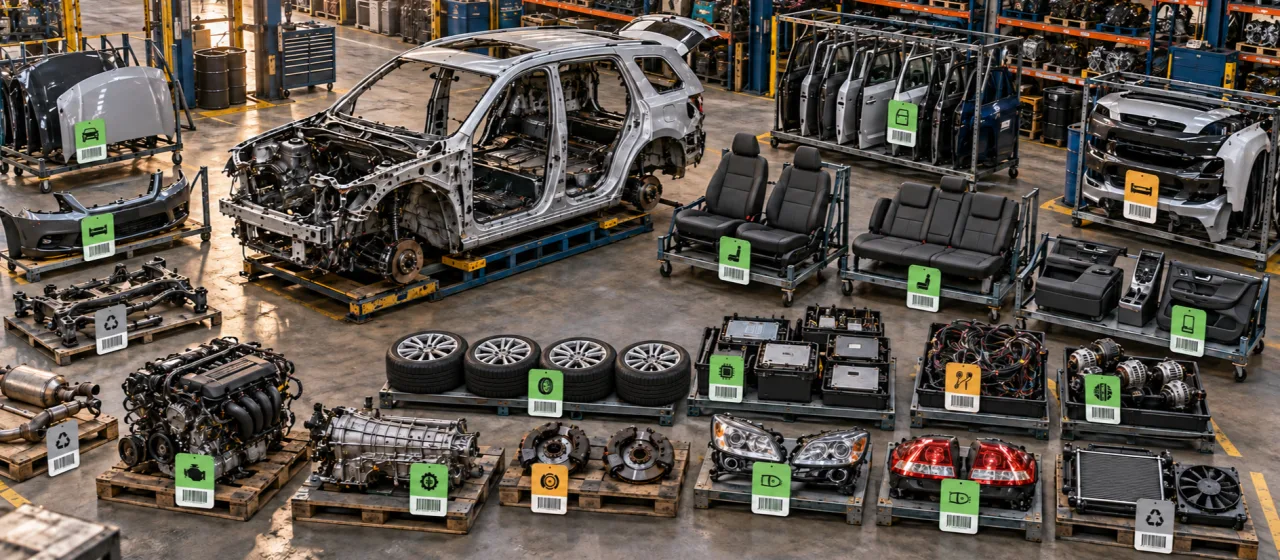
For a common, high-population car (a popular Honda, Toyota, or Ford truck), the pull order usually shakes out like this:
| Part | Illustrative used price | Ships as | Why it ranks here | Pull order |
|---|---|---|---|---|
| Headlight / tail light (undamaged) | $50 to $100+ | small box, cheap | fast, damaged often, margin survives shipping | pull first |
| Electronic module (ECU/BCM/cluster) | $100 to $400+ | tiny, flat rate | best margin per cubic inch (if not locked - see below) | pull first |
| Factory alloy wheel | $100 to $175 each | heavy but stackable | steady demand, sells best as a matched set | high |
| Mirror, sensor, connector | $20 to $120 | tiny box | overlooked, cheap to ship, steady | high |
| Clean body panel (popular model) | a fraction of new | bulky, freight penalty | margin only survives on popular fitment, often local pickup | model-dependent |
| Engine / transmission | several hundred to a few thousand | freight only | high dollar, slow, heavy freight, must be tested | situational |
| Seat / dash / console | moderate sticker | oversize freight | freight and storage can eat the margin | pull last, local pickup |
The rest of this guide is that table, explained - with the traps and the 2026 rule changes that move parts on and off the list. And because those numbers are illustrative, the last section shows how to put your own numbers behind them.
The reliable money-makers
Engines and transmissions. The headline items. A common four-cylinder engine typically brings a few hundred to around $800; V6s, trucks, and diesels run higher, and low-supply units higher still. Transmissions commonly land from several hundred into the low thousands. Depending on the donor, a single sale can cover a large share of its cost. The catch is turnover and freight: they are slow movers, they ship only as palletized freight, and a unit that knocks or a transmission with a bad valve body comes back. Verify condition before you list, and build the freight into the price, not after it.
Doors and body panels. Clean, straight, common-color panels move steadily on collision demand, and trucks are the strongest segment. Used panels sell for a fraction of new, so the margin is real - but they are bulky, they carry a dimensional-weight freight penalty (more on that below), and on a cheap panel the freight can swallow the profit. Lead with popular models and be ready to price for local pickup.
Headlights and tail lights. Small, easy to ship, and commonly damaged in front and rear collisions. High turnover, and vehicle-specific fitment keeps price competition low. Halogen assemblies commonly sell for $50 to $100 used; modern LED, HID, and adaptive or matrix units are worth far more - new they can run into the thousands per side, and clean used ones still command hundreds. Watch for lens fogging, cracks, moisture, and broken mounting tabs, and note that adaptive units may need coding.
Wheels and tires. Factory alloys in good shape sell steadily, and a matched set of four beats singles. Take-offs commonly go for about $100 to $175 each, roughly half of dealer list. Bodyshops, insurers, and certified-used programs often need exact-match wheels for years after a model launches, so demand is durable. Curb rash, bends, and corrosion downgrade them, and note that TPMS sensors are usually not included. Base-model steel wheels move slower, so lead with the alloys.
Electronic modules and clusters. Compact, cheap to ship, and expensive new, so used demand is strong - a used module often saves the buyer hundreds. They are also the category that most rewards doing it right and most punishes doing it wrong, because so many need programming to work on the buyer’s car. That gets its own section next.
High-margin electronics: test it, and know if it needs programming
Electronics are the best margin-per-cubic-inch on the car and the fastest way to rack up returns if you get them wrong. Three things separate the sellers who profit from the ones who eat comebacks. First, keep three different groups straight - they are not the same thing:
- Electrical components - starters and alternators. Bench-testable, and they usually install without programming.
- Climate components - AC compressors. These have real resale, but a compressor is not a plug-and-play electronic part: installation needs proper refrigerant handling and system diagnosis, and a replacement alone may not fix contamination or another failure in the loop.
- Electronic modules and sensors - the group below, where programming and fitment decide everything.
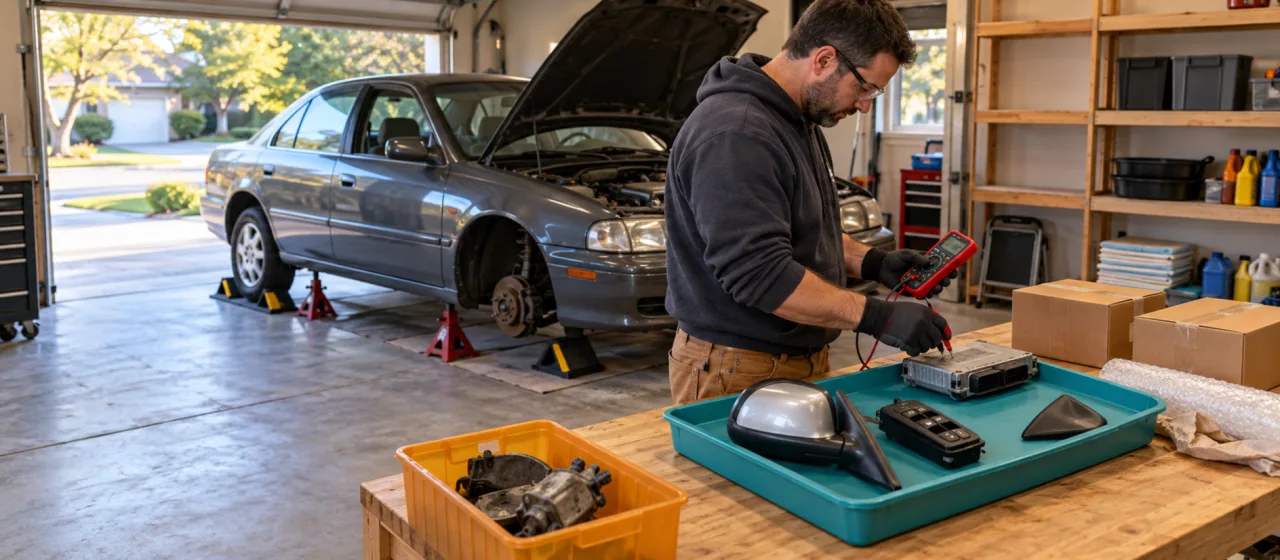
Test it, and be honest about what “tested” means. Bench-testing before you list genuinely cuts returns. It matters because starters and alternators are frequently returned as “defective” when the real fault was a dead battery, corroded cables, a bad ground, the wrong application, or an install error - so verify output and tell the buyer how to confirm the real fault before they blame the part. Use the words carefully: “tested” should mean you powered it up and verified it, “pulled working” means it was on a running vehicle but you did not bench-verify it, and “as-is” means untested. Buyers read those as promises.
Know which electronics need programming. This is the difference between a clean sale and a furious buyer. Sort your electronics by what the buyer will have to do:
| Compatibility class | Typical requirement |
|---|---|
| Direct-install candidate | Verify OEM number and vehicle application |
| Relearn or calibration may be needed | Verify the OEM service procedure (e.g. TPMS, steering-angle, ADAS cameras/radar, occupant sensors) |
| Programming or configuration commonly required | ECU/PCM, TCM, many clusters and radios - a scan tool or dealer/locksmith may be needed |
| Security-linked component | BCM, immobilizer, many smart key fobs - immobilizer relearn or component-protection procedure |
| Mileage-sensitive component | Instrument clusters - programming plus legally compliant odometer documentation |
A module that needs programming powers on but will not work until it is paired to the buyer’s car. Instrument clusters add a second trap: a used cluster shows the donor’s mileage, and replacing one can involve programming and odometer-disclosure requirements, so follow applicable federal and state disclosure rules and describe the mileage honestly. Key-fob programming varies by manufacturer, model, year, key type, and immobilizer system - some remotes support an owner procedure, while many transponder and proximity keys need compatible diagnostic or locksmith equipment. The rule for anything that may need programming: list it with the exact OEM part number and an honest “may require programming / pairing” note, and you keep the margin without the return.
Fitment on electronics has to be exact. A module one part number off is a no-start or a check-engine light, and the return plus return shipping plus negative feedback erases the margin that made electronics attractive. The number stamped on the part is one of the strongest identifiers, but check it together with supersessions, the full vehicle configuration, build date, trim, engine, options, and interchange data - the same car and year can carry different module part numbers by trim or build date. Be wary of tools that let AI guess a part’s compatibility from a photo or a VIN: a confident wrong fitment on a module is a wrong-fitment return generated at machine speed, and it can drag down your eBay account rating. This is where reParta helps: it is designed to capture each part’s OEM number, its fitment (the vehicle configurations it fits), and its interchange (the other vehicles that take the same part), so you can put a locked module in front of more relevant buyers and reduce avoidable fitment-related returns. It does not program or pair the module - that is the buyer’s step - but it gets the identification and compatibility in front of the right buyer.
The overlooked earners: sensors and connectors
Two categories almost nobody pulls on purpose, and both ship for next to nothing.
OEM sensors and small modules. ABS, camshaft and crankshaft, oxygen (O2), and parking sensors and similar small electronics are expensive new and hard to source used, so demand stays steady and the postage is tiny. Individually they are low dollar - often $20 to $100 - so this is a volume play, but the margin-to-shipping math is good and they store in a drawer. Some safety-related electronics carry channel restrictions, so check where you are allowed to sell them (see the airbag note below).
Individual connectors and pigtails. When a harness is damaged, or you are scrapping the loom anyway, cutting off the connectors and bagging and labeling each one turns scrap into money for the repairers who need that exact plug - post-collision, EVAP, crank-sensor, and discontinued connectors are especially wanted. It is a slow, patient niche rather than a fast mover, but the connectors cost you nothing and take almost no shelf.
Fitment precision decides both of these - a sensor or connector that does not match is an instant return - so nail the interchange and part numbers before you list.
The steady singles
Mirrors, starters, alternators, and AC compressors all sell consistently. Mirrors commonly run about $60 to $105 for a basic power or heated unit, and far more for feature-loaded ones with power-fold, camera, blind-spot, or memory (which also have to match and be coded). Alternators and starters have a wide, steady buyer base on high-population makes like Toyota and Honda, simply because so many are on the road - just remember the core glut on old, common units and test before you sell. AC compressors have real resale, with a summer lift in demand, but internal failure is invisible, so document condition and application and be clear that a compressor alone may not fix a contaminated system.
Add the small, cheap-to-ship parts most sellers overlook - sunvisors, interior and exterior door handles, center caps (a matched set of four is worth more than singles), horns, and OEM key fobs. None will make your month, but they ship for a few dollars and add up, so they can be good margin on parts you would otherwise scrap. One caveat on key fobs: they are worth far more when they are programmable to the buyer’s car, because a fob a buyer cannot pair is nearly worthless.
And leave airbags out of your plans. eBay prohibits all airbag, inflator, and steering-wheel airbag-cover listings sitewide effective September 24, 2026, new, used, or deployed. Related non-airbag SRS electronics - airbag control units, crash sensors, diagnostic modules, and occupancy sensors - are not banned but, in the US, may be listed only by pre-approved sellers, so check the current eBay policy and plan your channel before you pull them.
Catalytic converters: high value, heavy rules
A catalytic converter is one of the highest-dollar single pieces on a car, and also the most regulated - so treat it as a special case, not a quick flip:
- The rules. EPA guidance is that a salvage converter generally may not be sold or installed for reuse unless it has been properly tested and labeled. On eBay, a used converter must be recertified for aftermarket sale or listed only as scrap metal under the platform’s requirements. State anti-theft laws add ID, proof-of-ownership, VIN engraving, and holding periods. Verify federal, state, and marketplace rules before you buy, list, ship, or install one.
- The metals. Cat scrap value rides on platinum, palladium, and rhodium, which swing hard and are well off their 2022 highs, so the payout is volatile and depends on the converter code, assay, and buyer - not a fixed number.
So a cat is high value only where documentation and licensing allow it, and it is a sell-locally, sell-legal item, not a shipped flip.
The shelf-space traps, and the freight math behind them
Be honest about the parts that look valuable but rarely pay: interior trim, common brackets, plastic covers, and worn wear-items are cheap, slow, and cost more to store than they sell for. The bigger trap is the bulky stuff - seats, dashes, center consoles, and large interior panels - and the reason is freight.
Carriers can bill oversized parts on dimensional weight: the box’s size, not the part’s actual weight (the major carriers divide length x width x height by 139). Surcharges, service type, account pricing, and route all move the final number, so quote the packed dimensions - not just the part’s weight - before you decide a bulky part is worth shipping nationally. On a big, light item like a seat, the freight can rival the sale price while the part hogs shelf space for months; a headlight that ships for a few dollars and sells in weeks wins on contribution and turnover.
The fix is simple: price seats, dashes, consoles, and large panels for local pickup so the buyer absorbs the transport, and reserve shipping for parts whose margin survives it. For the parts you do ship, get the economics right up front - free shipping vs calculated shipping and how to ship auto parts without losing money cover where the money leaks.
Demand is not flat: season and region can change the answer
The same part is not worth the same thing every month or in every market. These are patterns to confirm against your own inquiries and completed sales, not fixed rules:
Season. AC compressors and condensers can pick up in spring and summer as weak units fail under heat. Heater cores and cold-weather parts tend to move in fall and winter. Headlight demand can climb with shorter days. Collision and body parts track storm and hail seasons. So a part that looks dead in its off-season is not necessarily a dead part.
Region. In the Salt Belt, rust destroys structural and body parts, so rust-free panels, subframes, and bumper reinforcements from Sun Belt donors can carry a premium shipped north. The mirror image: sun-baked interiors and trim from hot, dry regions can be structurally clean but cosmetically tired. Where the donor lived can change which parts are worth pulling and shipping.
If you judge a part by a single 30-day snapshot, you will mis-rank it - an AC compressor in January or a heater core in July reads as “no demand” when it is just out of season. Read demand as a rate over the year, not a headcount in one month.
The business logic: margin times turnover, and your shelf is the constraint
Two ideas from outside the yard explain why the fast, cheap part often wins.
Margin times turnover, not margin alone. The same cash earns more when it turns more often. At the same markup, selling ten $40 headlights in the time it takes to sell one $400 module puts more profit through the same shelf. That is the case for pulling the fast movers first.
Your shelf and your cash are the constraint. A part that sits costs you the whole time it waits - space, tied-up cash, and the risk it gets damaged or outdated. General inventory benchmarks put annual carrying cost at a meaningful share of a part’s value, and in a yard it can run higher once you count space, capital, damage, shrinkage, and obsolescence - so calculate your own. Inventory ties up cash until it sells, so you make the most by turning parts back into money as fast as you can.
Speed is a big part of the profit. Pull what moves.
Put your own numbers behind it
Every price in this guide is illustrative, because the only ranking that matters is the one built on your parts, your fees, and your shipping. That is exactly what reParta is for. Pre-bid ROI projects the parts list and demand for a specific VIN from real used-market prices, so you see the likely pull order and whether the car is worth buying before you bid. After the sale, per-donor profit and loss tracks what each part actually nets after fees and shipping - which is what exposes a shelf-space trap whose “profit” only looked good until the freight came out. Together they turn the method above into your own numbers on the exact donor in front of you. You can start a free trial and run your next donor through it.
Pull the winners. Scrap the rest with a clear conscience.
Related reading
- Best cars to part out: how to choose a profitable donor - pick the right car before you pick the parts.
- How to value a salvage car for parts - putting real numbers on a specific donor.
- Where to buy cars to part out beyond Copart and IAA - cheaper, mostly no-license sourcing channels for donors.
- How to start a used auto parts business - the full business around selling these parts, from licensing to the system that runs it.
Last verified: September 30, 2026.
Frequently asked questions
What are the most profitable used car parts to sell?
Strong candidates usually include engines and transmissions, clean body panels (doors, fenders, hoods, tailgates), headlights and tail lights, factory alloy wheels, and electronic modules and clusters. But there is no universal ranking - the most profitable part on any given car is not the priciest one, it is the one with the best mix of demand, margin, and fast turnover at low storage cost, and that changes by vehicle, condition, location, and sales channel.
Is the most expensive part the most profitable?
No. The most profitable part is the one with the best mix of demand, margin, and fast turnover at low storage cost. A $40 headlight that sells in a week can beat a $400 part that sits for a year once you subtract marketplace fees, real shipping, removal and listing labor, return risk, and the shelf space it tied up while it waited.
How much do used car parts sell for?
It varies a lot, so treat any range as a starting point, not a quote. Illustrative US used-market ranges look roughly like: a common four-cylinder engine a few hundred to around $800 (more for V6, trucks, and diesels), a transmission several hundred to a couple thousand, a used headlight $50 to $100 for halogen and much more for LED or adaptive, a factory alloy wheel around $100 to $175, and an electronic module often $100 to $400 or more. Actual sale prices depend on the OEM number, vehicle application, trim and engine, mileage, tested-or-not condition, warranty, location, and shipping - always check the real used-market price for your exact part before you pull it.
Are sensors and connectors worth pulling?
Often, and most sellers overlook them. OEM sensors and small modules are expensive new, hard to source used, and cheap to ship, so demand stays steady even if they do not turn as fast as a headlight. Individual connectors and pigtails, cut from a damaged or scrap harness and labeled, are a slow but real niche for repairers who need that exact plug. Both take almost no shelf space, so they can be good margin on parts you would otherwise scrap - once you account for the time to identify, test, list, and store them.
Which used electronics need programming before they work?
Alternators and starters usually install without programming, and many conventional sensors do too, but some parts need calibration, a relearn, or coding (TPMS, steering-angle sensors, ADAS cameras and radar, occupant sensors). Engine computers (ECU/PCM), body control modules (BCM), transmission modules (TCM), many instrument clusters, most infotainment or radio head units, immobilizer modules, and many smart key fobs commonly require programming or security access to pair to the buyer's vehicle. Verify by OEM number and the vehicle's service procedure, and list the part with an honest note when programming is likely.
Which parts should I not bother pulling?
The shelf-space traps: interior trim, common brackets, plastic covers, and worn wear-items, plus bulky pieces like seats, dashes, and consoles where the freight cost can rival the sale. Cheap or slow to move, and storage often costs more than the sale. Pull the small ones only on request, and price the bulky ones for local pickup rather than shipping.