How to Value a Salvage Car for Parts: A Part-Out Value Guide
Buying a salvage car to part out is usually a pig in a poke: you bid on a hunch, hoping the parts add up, and only find out what the car was really worth months later once the shelf clears. It does not have to be a guess. For a given year, make, and model you can know - from what parts off the same cars have actually sold for - roughly what a donor will return before you ever bid.
That known number is the part-out value: what the donor’s parts will net you, minus everything it costs to get them sold. Get it before the paddle goes up and bidding turns from a gut call into arithmetic.
Here is the plain formula, then the step-by-step:
Part-out value = total sellable-parts revenue (majors + long tail) - (winning bid + auction and gate fees + transport + the labor to pull, prep, and list the parts + storage + marketplace fees + the parts that never sell).
How to value a salvage car for parts: value the parts, not the whole car
Three numbers get confused, and only one should drive your bid:
| Term | What it answers | Who uses it |
|---|---|---|
| Salvage value | What an insurer or auction would pay for the totaled car | Insurance, Copart/IAA sellers |
| Scrap value | What the car is worth by weight at the yard | The floor under any donor |
| Part-out value | What the intact parts net you after all costs | You, the buyer/recycler |
A donor is worth the sum of what you can realistically pull and sell - not what the whole car would fetch. Two identical-looking cars can be worth very different amounts depending on trim, engine, and how they were wrecked.
Step 1 - Identify the car exactly, from the VIN
Start from the VIN, not the badge. The VIN gives you the precise year, make, model, trim, and engine, and trim and engine change which parts the car has and what they sell for. Decode it with the free VIN decoder so everything downstream is accurate, and check the interchange - the other model years and badges that share the same part - because that widens your buyer pool.
Step 2 - Get the projected parts list and payoff, before you buy
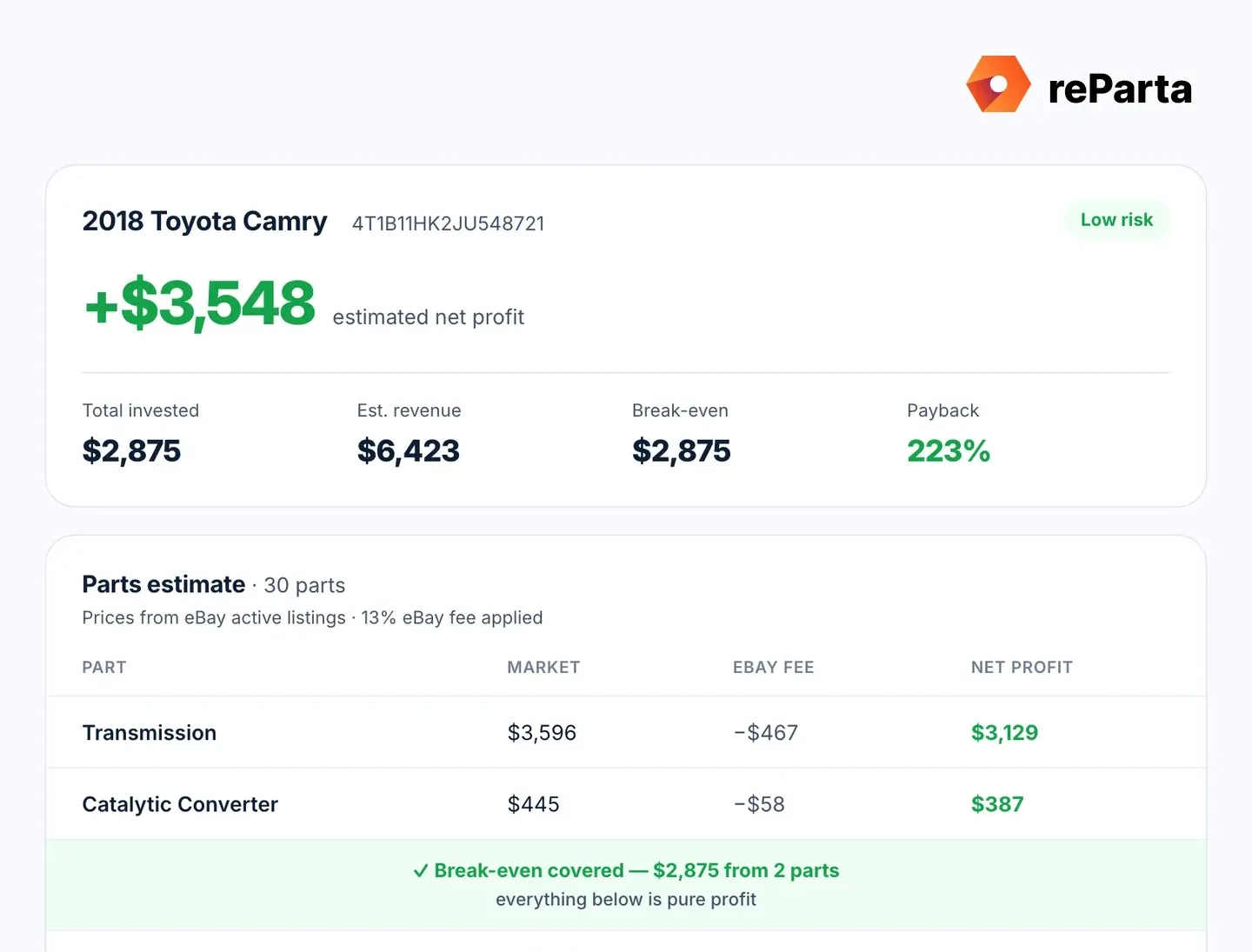
You already know which car you are eyeing. The question is what its parts will realistically bring - and you can answer it in reParta before you bid. From the VIN, Pre-bid ROI projects the parts list for that exact vehicle and estimates the revenue from real sales of the same year, make, model, and trim - so you are working from what donors like this one actually returned, not a guess.
Your judgment still matters in one place: read why it was totaled, because that decides how much of the projected list actually survives:
- Airbag-deployed or front-end totals - a full airbag system commonly runs several thousand dollars, enough to total a nearly-undamaged car, so the drivetrain, interior, glass, and rear clip are often like-new. These are excellent donors. (Do not plan to resell the deployed airbags themselves - counterfeit and non-functional airbag fraud is a real problem, and eBay’s 2026 airbag ban now bars listing any airbag there at all.)
- Theft-recovery and hail/cosmetic totals - mechanicals untouched, highest parts yield.
- Flood - walk away for anything electrical. Water corrodes wiring, connectors, modules, and sensors on a delay (well documented by KBB and AAA), so those parts fail after you have sold them.
- Frame or structural damage - structural parts are suspect; value only the bolt-on items.
Before bidding, Google the VIN to pull up the original Copart or IAA listing photos and see the real pre-repair damage, not the cleaned-up resale shots.
Step 3 - See each part’s price, fees, and payback
This is where reParta does the work. Instead of pricing every part by hand, Pre-bid ROI shows the list of parts you can actually pull and sell - each with its market price, the fees taken out, and the net profit - then rolls them into estimated revenue, break-even, net profit, and your payback. A handful of majors (engine, transmission, the catalytic converter, low-mile electronics, headlights, wheels) carry most of it; the long tail fills in the margin. (For pricing a single part on its own, see how to price used auto parts.)
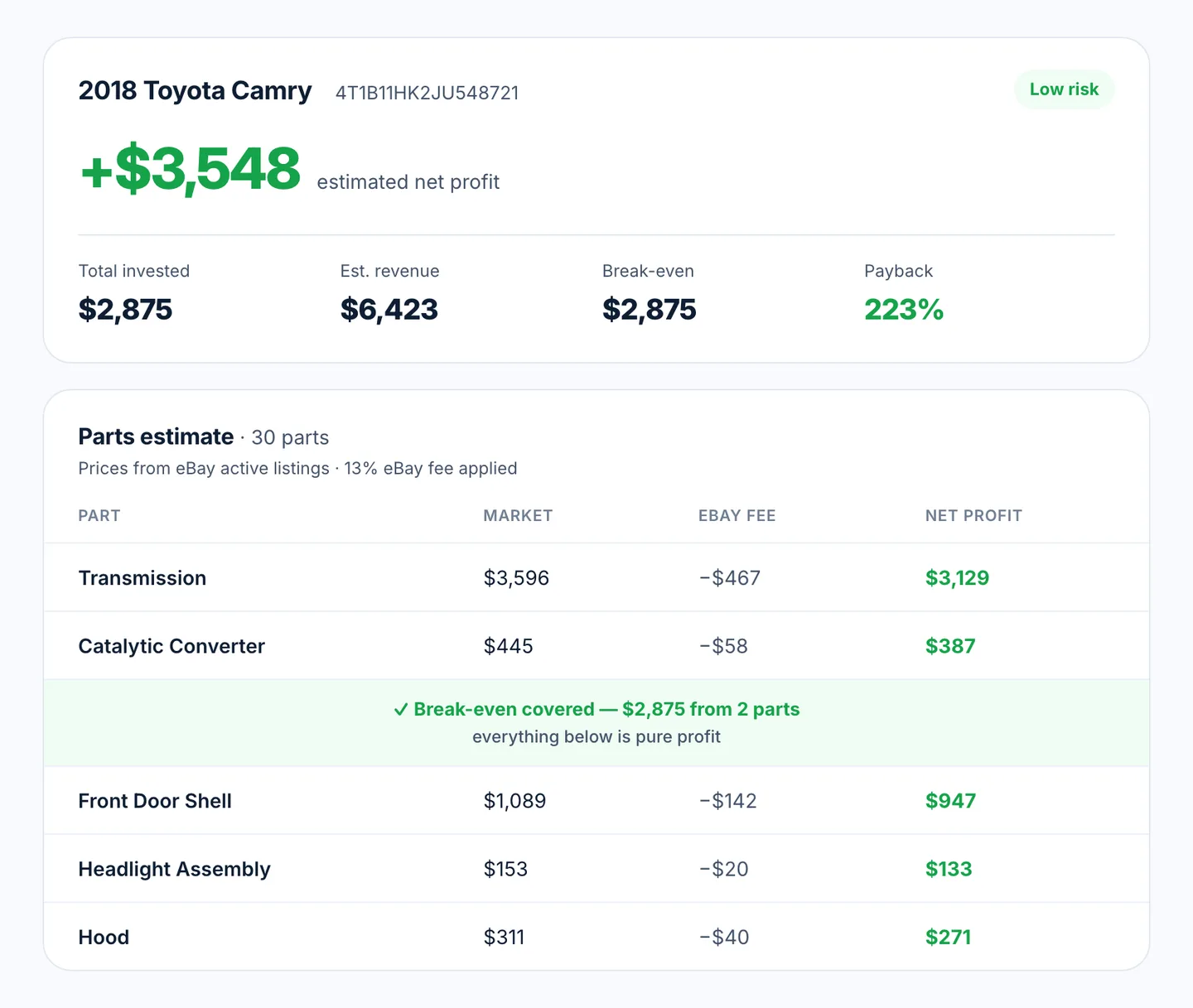
The catalytic converter, the transmission, and the long tail all come priced and fee-adjusted in one pass, with break-even flagged - so you see which parts pay the car off and which are pure profit, without pricing anything by hand.
Step 4 - Add the long tail, weighted by shippability
Mirrors, sensors, modules, switches, small trim. They add up but sell slowly, so weight them lightly. Two rules keep this honest:
- The 80/20 - a few majors set the ceiling; the long tail is the margin, not the headline.
- Shippability is a value multiplier. A small, high-demand module or headlight nets far more than a bumper or hood once freight is in the math. Bulky, oversize, or hazmat parts (airbags, fuel components) get sunk by shipping or can only sell local. A shelf full of doors nobody will pay to ship is not value - it is storage.
Step 5 - Subtract every cost
From the gross parts total, subtract the whole stack: your winning bid, auction/buyer/gate fees, and transport - then the part that most sellers forget, the labor: the wages and hours to pull each part, prep it (clean, test, photograph, and list it), and store it until it sells, plus marketplace fees and a realistic write-off for the parts that never sell. Labor and prep are where a “profitable” car quietly turns into a break-even one, so cost them honestly. What remains is the part-out value, and the ceiling for your bid. Know your ROI before you bid so that ceiling is a number, not a feeling.
A worked example: a midsize donor, before you bid
Illustrative figures only - not a quote. Your market and your data will differ. A mainstream midsize sedan, front-end/airbag total, around 90k miles:
| Line | Example figure |
|---|---|
| Engine + transmission (market data, grade B) | $1,800 |
| Doors, headlights, wheels, seats (majors) | $1,450 |
| Catalytic converter (reusable OEM) | $300 |
| Long-tail parts (modules, sensors, mirrors, trim) | $1,100 |
| Gross parts value | $4,650 |
| Winning bid | -$1,200 |
| Auction + gate + transport | -$550 |
| Labor (pull + prep + list), storage, marketplace fees | -$700 |
| Unsellable / scrap write-off (~10%) | -$465 |
| Estimated net part-out value | ~$1,735 |
Sold whole to a yard, that same donor might bring $500 to $700. The part-out premium is real here - but only after costs, which is exactly why you run the number before bidding, not after.
Do this BEFORE you buy - the pre-bid workflow
Post-purchase math is too late: once the car is in your yard, the bid is already spent. The professionals decide their maximum bid before they bid. Doing that by hand - decode, build the list, price every part, stack the costs - is slow enough that most buyers skip it and bid on instinct.
That is what reParta does for you. Our free part-out value tool ranks the most profitable cars to part out on real used-market prices, and Pre-bid ROI runs the full valuation from the VIN and your max bid: the projected parts list, each part’s price drawn from real recent sales of that part, fees netted out, minus transport and your bid, with a net profit, a payback, and a risk score. It covers Copart, IAA, and private buys, and it does not scrape the auction - you enter the price. Treat it as the fast way to run the math above. And once you win the lot, every part you pull lives in the same salvage yard inventory software - cataloged, priced, and listed from one place.
Try it free - calculate any salvage car’s part-out value before you bid
For the full worked walkthrough, see the pillar guide: Is a salvage car worth parting out? How to know before you bid.
Takeaways
- Value the parts, not the whole car - and only the parts intact on this lot.
- How it was totaled decides the yield: airbag, theft, and hail totals are strong donors; flood and frame damage are traps.
- Let reParta price each part from real market data with fees and payback; the catalytic converter is often the biggest single line; weight the long tail by shippability.
- Subtract every cost to get your bid ceiling - and get that number before the auction closes. reParta’s part-out value tool does it from real market data.
Frequently asked questions
How do you value a salvage car for parts?
Build the list of parts you can pull and sell, price each from real used-market data, add the long tail conservatively, then subtract acquisition, fees, transport, the labor to pull, prep, and list the parts, storage, and the parts that will not sell. The result is the part-out value - what the donor is worth to you, and the ceiling for your bid.
Is it worth parting out a salvage car?
It is worth it when the sum of the shippable, in-demand parts clearly beats your all-in cost and the price you would get selling the car whole. It is not worth it when the value hides in bulky low-demand panels, when the car is flood-damaged, or when you have no room to store slow-moving inventory.
How much is a salvage car worth in parts?
It depends far more on the specific parts than on the car. A few majors - engine, transmission, catalytic converter, low-mile electronics, wheels - set the ceiling, and the long tail is the margin. The same model can be worth very different amounts depending on trim, engine, mileage, and how it was totaled.
What are the most valuable parts on a salvage car?
The catalytic converter is often the single biggest swing on a common car, followed by the engine and transmission, low-mileage electronics and modules, headlights, wheels, seats, and a hybrid or EV battery pack. Small high-demand parts that ship cheaply usually carry better margin than big panels that freight eats.
Are flood-damaged cars worth parting out?
Usually not for the electronics. Flood water corrodes wiring, connectors, modules, sensors, and hidden motors on a delay, so electrical parts test fine at first and fail later. Purely mechanical and some body parts can still be fine, but flood donors are risky inventory - most part-out buyers walk.
How do I know a salvage car's part-out value before I bid?
Do the valuation pre-bid: decode the VIN, project the parts list, price each part from real market data, and subtract every cost to get a net figure and a max bid. reParta's free part-out value tool runs that math from real used-market prices so you decide before the auction closes.