How to Price Used Auto Parts: The Sold-Comp Method That Sells
Knowing how to price used auto parts is not really about the math - it is knowing which number to trust. Whether you run a salvage yard, part out cars as an auto recycler, or flip a few on the side, this pricing and valuation guide is the same: anchor to the median of recent SOLD comps for that exact part, adjust for demand and condition, subtract the fees and shipping you absorb, keep a small reserve for returns, and never drop below the part’s core or scrap value. Price off what buyers actually paid (sold listings, not active ones), let demand set the ceiling, and treat price as a turnover decision, not just a margin one.
The catch is that doing this by hand, for every part off every donor, is a second job. This guide is the manual method - and then the shortcut.
At a glance: Price a used auto part off the real used-market price for that exact part, not a percentage of the new price. Use the median of sold comps, not the average, so one unusual sale does not skew you. Grade condition with the ARA A/B/C/X standard, adjust for demand and shippability, subtract channel fees and a returns reserve, and set a hard floor at the part’s core or scrap value. Reprice on a schedule, not on panic. reParta suggests a price from current real used-market data, so every part is listed to sell.
What this guide covers:
- Pricing method - anchor to sold comps, use the median, price by demand and shippability
- Where to get real price data - your own sales, eBay Product Research, and the recycler tools
- Used auto parts grading system - the ARA A/B/C/X standard buyers already use
- Floor, fees, and reserves - core/scrap floor, channel fees, and a returns reserve
- Read the demand signals - when to raise, when to check, when to stop stocking
- Automation - how reParta pulls the market and suggests a price for you
1. Anchor to the live SOLD market, not the new price
The new-part price is almost irrelevant. What matters is what comparable used auto parts actually sold for on the channels you use. Search SOLD listings, not active ones - active listings are what sellers hope for; sold listings are what buyers paid. On eBay, open advanced search and tick “Sold items” and “Completed items”, search by the OEM or interchange number for an exact match, and set the condition to “used” so a pile of brand-new aftermarket listings does not drag your number in the wrong direction.
Use the median, not the average. Once you have a handful of sold prices, take the middle value, not the mathematical average - because one unusual sale quietly wrecks the average. Say a transmission sold for $1,200, $1,250, $1,300, $1,350, and $2,400. The average is $1,500, dragged up by that single $2,400 outlier - price to it and the part sits. The median, the number in the middle, is $1,300 - what buyers actually paid, not the one lucky sale. Anchor to the median and you price to the real market.
Where to get real price data
Not every source is equally trustworthy. Work down this ladder:
- Your own sold history - the best source. What you actually sold that exact part for, on which channel, and how fast, is truer than anyone else’s data. It only works once you have a track record, so log every sale.
- eBay Product Research (formerly Terapeak), in Seller Hub, is the strongest outside source. Unlike the plain “Sold” filter, it shows up to about three years of sold data including accepted Best Offer prices, average shipping, and the number of sellers - so you see what buyers really paid, not what was asked. One caveat: its sell-through rate covers only the trailing 90 days, not the full three years.
- Recycler tools for professional yards: Car-Part demand data flags parts that may be mispriced, Car-Part Core Pricing compares what core buyers will pay, and CrashLink pulls OE list pricing and history. These are worth knowing if you run an inventory system.
One trap when reading Car-Part comps: each price carries a type. “actual” is the seller’s real asking price in the part’s current condition; “undmg” is an estimate of what it would be worth undamaged (not a claim the part is undamaged); “list” is a list-price basis. Compare actual to actual - lining your part up against an “undmg” number makes the market look richer than it is, and you overprice.
2. The used auto parts grading system: ARA A/B/C/X, and letting demand set the ceiling
Condition matters less than demand. A scratched OEM headlight for a common car outsells a flawless part nobody searches for. So price by demand first: fast movers hold their number, slow movers do not, no matter how clean they are. Then grade condition - but grade to the standard buyers and estimators already speak: the Automotive Recyclers Association (ARA) grading system. It uses four grades - A, B, C, and X. Mechanical parts are graded by mileage; body and sheet-metal parts by repair “units” (one unit = damage coverable by a credit-card-sized area). Grade to the ARA system and your listings match what buyers expect.
| Grade | Mechanical parts (by mileage) | Body / sheet-metal parts (by repair units) |
|---|---|---|
| A | Under 60,000 total miles - or, if over 60,000, under 15,000 miles per model year of age, up to 200,000 total | 1 unit or less of repair (full front/rear assembly: 3 units or less) |
| B | 60,000 to under 200,000 total miles and 15,000+ miles per model year of age | More than 1 and up to 2 units (assembly: more than 3, up to 6 units) |
| C | 200,000 total miles or more, regardless of age | More than 2 units (assembly: more than 6 units) |
| X | Not enough data (mileage unknown) | Not enough data available to grade the part |
Damage is logged with the ARA Damage Locator as a 3-part code - location + damage type + units. Example: a front door with a small parking-lot ding is 5P1; a part with no damage is 000. (Source: ARA Recycled Parts Standards & Codes, Automotive Recyclers Association.) Buyers of used auto parts have been burned before, so honest, standard grading sells faster than optimistic grading.
What does part grade X mean?
Grade X means a used auto part is ungraded: the recycler did not have enough mileage or condition data to assign an ARA A, B, or C grade. It is not a condition score, just a flag that the detail was missing. Treat Grade X as unverified - inspect it, photograph every flaw, and price it conservatively.
3. Price by demand AND shippability
Two parts with the same sold-comp median are not worth the same to you. Small, high-demand, cheap-to-ship parts - sensors, switches, modules, mirrors, lights, sun visors, door handles - carry real margin and move fast. Bulky, low-demand parts - seats, dashes, big interior trim, doors, wheels - get sunk by freight; most buyers will not pay shipping on them. Price those to clear the shelf, or sell them local-only, and put your margin on the small stuff.
4. Set a price floor: never sell below core or scrap
Every part has a floor - the money it is worth even if it never sells at retail:
- Core value. Rebuildable parts - alternators, starters, AC compressors, steering racks, turbos, engines, transmissions, electronic modules, catalytic components where legal - are bought by core buyers to remanufacture, working or not, at a set price with no listing, shipping, or return risk.
- Scrap value. If it will not sell as a core, it is worth its weight in metal.
The rule: your retail price, after fees, shipping, and returns, must net you more than the core or scrap floor - otherwise just sell it as a core. Say a core buyer pays $110 for an alternator, guaranteed. If you list it at $130 but net only about $80 after eBay fees, shipping, and packaging, retail lost you $30 and a week of shelf space. The floor is $110, so retail only makes sense above it. (Car-Part Core Pricing compares what multiple core buyers will pay, so you know the floor before you list.)
5. How to price used auto parts for eBay, Facebook, and local
The same part is worth a different number on each channel, because demand and fees differ. Decide your target net first, then set the sticker per channel:
| Channel | Typical price | Fees | Best for |
|---|---|---|---|
| eBay Motors | Highest (national demand) | ~13% + payment fees (less with a Store) | Small, shippable, high-demand parts |
| Facebook Marketplace | Lower, more local | Low on shipped orders, none on local pickup | Mid-size parts, nearby buyers |
| Local pickup | Lowest sticker, no shipping | None | Bulky parts (seats, doors, panels) |
Build in a returns reserve
Some parts come back, and a return eats the profit from several good sales if you did not price for it. Add a small reserve to every price: reserve = return rate x average return cost. If about 4% of engines come back and each costs you around $800 in return shipping and replacement, that is $32 per sale set aside - so one return does not wipe out the month. Keep the reserve higher on electronics (modules get returned most - failed installs, programming, misdiagnosis) and lower on body parts the buyer inspects in person.
A worked example
A used starter with a $120 sold-comp median, graded B (about -15% off the median), is worth roughly $102 in hand. To net that on eBay you list a little higher to absorb the ~13% fees, shipping, and a returns reserve; on Facebook local you can sticker lower and still net the same, because there is no shipping or fee to give back. Anchor to the median, subtract what the channel takes, keep it above the core floor, and the right number falls out.
6. Reprice on a schedule - and read the demand signals
A part sitting for months can mean the price is wrong. It can also just mean it is not its season - car parts routinely take far longer than 30 days, and demand for many is seasonal. So do not panic-cut. Read what the market is telling you first:
- Selling fast, and more people ask than you have in stock? You are underpriced or short on supply - raise the price 5-15% and buy more of that donor.
- Getting requests but no sales? The problem is usually not the price. Check the price against sold comps, the photos, the fitment and interchange, and the warranty before you cut - a wrong interchange or a bad photo kills more sales than a high price.
- No requests at all? That is a demand problem, not a price problem. Stop stocking that part, no matter its theoretical value.
(Professional systems encode exactly this: Car-Part’s Checkmate flags parts LOW$ when they sell faster than expected, PUSH when demand is weak and stock is high, and NEED when there are sales but nothing on the shelf. Same logic, read from the data.)
How to price used auto parts: the simple formula
Target list price = (SOLD-comp median, adjusted for demand and condition) - (fees + shipping you absorb) + (returns reserve), never set below the core or scrap floor, then nudged for how fast you need the turnover.
The shortcut: let reParta price it for you
Every step above is real work. Pulling the sold comps, filtering out the new-part noise, working out the median so one lucky sale does not fool you, checking it against the floor - for every part off every car - is the part sellers quietly hate and skip. That is exactly what reParta automates.
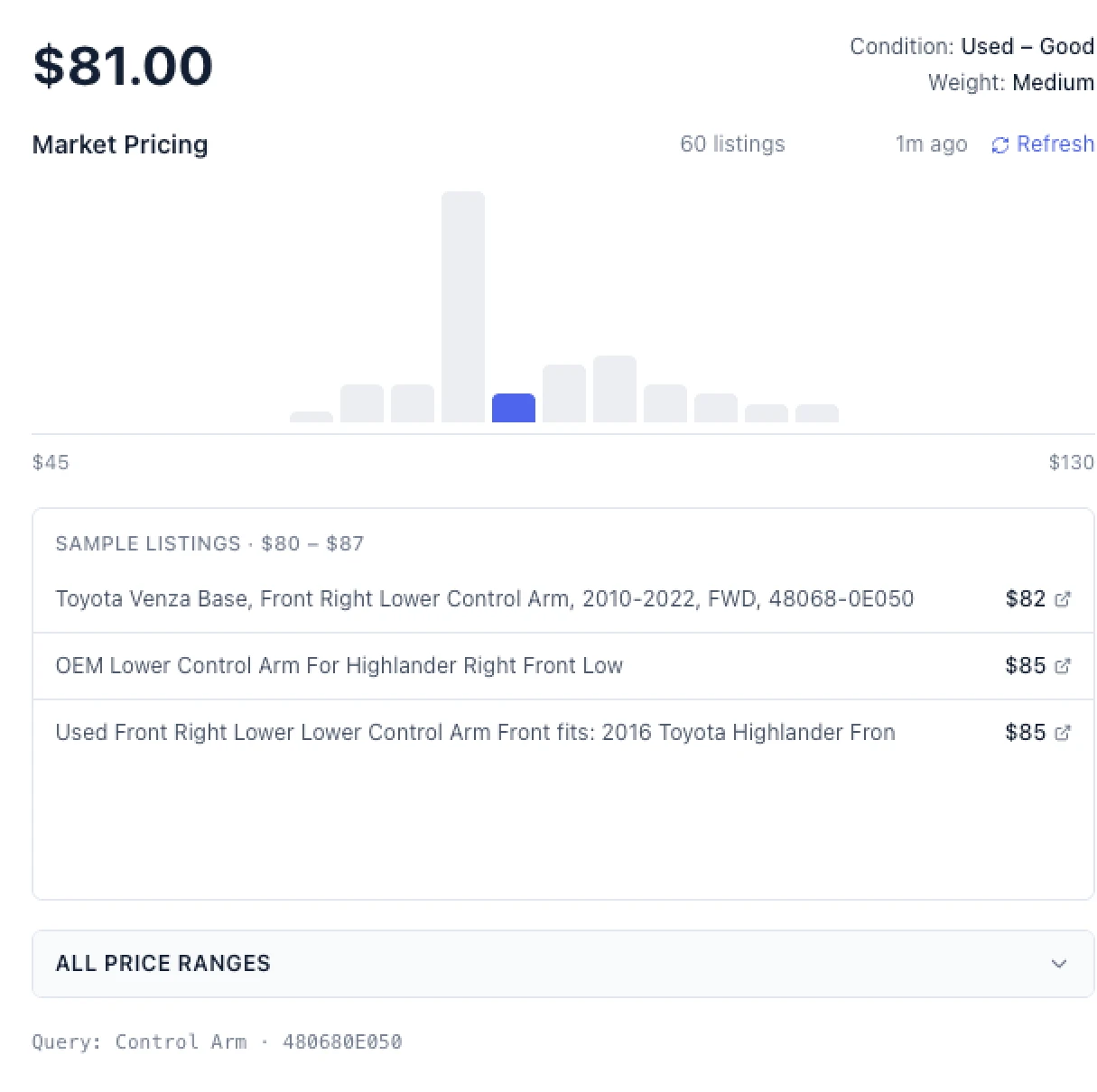
How reParta does it - smart price suggestion. Catalog a part in seconds - name it and pick the donor vehicle - and reParta pulls the current real used-market prices for that exact part and shows a suggested number right under the field:
- A market-median price for that exact part and vehicle, from live used-market data (used condition only - brand-new and for-parts listings are filtered out so one outlier or a pile of new parts does not skew it)
- The median math done for you, so you are not gathering comps and averaging by hand
- Accept it in one click or type your own; the parts list flags the price as “suggested” so you can see which numbers came from the market
Want to see that market data before you commit? Our free part-out value tool ranks the most profitable cars to part out, built on real used-market prices - the same data reParta uses to price the individual parts.
reParta is auto parts inventory software built for salvage yards, so that price rolls straight into per-donor P&L - what you sold for versus the acquisition and fees on that donor is what tells you which cars actually made money. Deciding whether a whole car is even worth parting out is a different question - see how to value a salvage car for parts - and the cheapest pricing win is upstream: buy right with Pre-bid ROI.
Try it free - let reParta price the part for you
What nobody tells you: most yards leave more money in lazy repricing than in the first price. A shelf full of parts priced for last year’s market is silent margin loss. Price to the market median, let demand set the ceiling, keep it above the floor, and reprice the stragglers - leaning on the market number reParta suggests while you pull the next car.
Frequently asked questions
How do you price used auto parts to sell?
Take the median of recent SOLD prices for that exact part on the channels you use, adjust for demand and condition, subtract the fees and shipping you absorb, add a small returns reserve, and never go below the part's core or scrap value. Anchor to sold listings (what buyers actually paid), not active ones (what sellers hope for), and use the median rather than the average so one unusual sale does not skew the number.
What percentage of the new price should a used part sell for?
A rough rule of thumb is 30-60% of the new aftermarket price, and 50-70% for OEM in good condition - but the sold-comp median for that exact part always beats a percentage. Use the percentage only when you have no comps to anchor to.
What does part grade X mean on a used auto part?
Grade X means the part is ungraded: the recycler had insufficient mileage or condition data to assign an ARA A, B, or C grade. It is not a condition score, just a flag that the detail was missing. Treat Grade X as unverified - inspect it, photograph every flaw, and price it conservatively, closer to Grade C than Grade A.
What is the ARA used auto parts grading system?
The Automotive Recyclers Association (ARA) grades used parts A, B, C, or X. Mechanical parts are graded by mileage (A is lowest, C is highest, X is ungraded) and body parts by damage units (roughly one credit-card-sized area of damage per unit). Grading to the ARA standard makes your listings match what buyers and estimators already expect.
Is there a used auto parts price list or valuation guide?
There is no single universal price list - the real number is the recent sold-comp median for that exact part on the channels you sell, adjusted for condition and demand. A fixed list goes stale fast because the used market moves. reParta does this per part for you: it pulls the current real used-market prices for the exact part and suggests a market-median number, so you get the valuation without maintaining a spreadsheet.
Should I price by condition or by demand?
Demand first, then condition. A scratched OEM headlight for a common vehicle sells faster than a mint part nobody searches for. Grade honestly with the ARA scale, but let how many people actually want the part set the ceiling.
How do I price used car parts for eBay vs Facebook Marketplace?
Usually higher on eBay - it has national demand, so the same part often sells for more there than on Facebook Marketplace, which skews local. Factor eBay's fees (around 13% without a Store) into the number. Sell bulky, hard-to-ship parts local instead.
Should I sell a part as a core instead of retail?
If a core buyer pays more than you would net at retail after fees, shipping, and returns, sell it as a core - it is guaranteed money with no listing or return risk. The core (or scrap) value is your price floor: never sell a rebuildable part like an alternator, starter, or compressor at retail for less than the core buyer would pay.
How much can I get for a car sold for parts vs whole?
Parting out usually returns more than a whole-car or scrap offer, but it costs weeks of labor, storage, and listing work. Add up the sold-comp value of the top-demand parts, subtract fees, shipping, and labor, then compare that to the whole-unit offer before you commit. Our free part-out value tool estimates it for you.
How often should I reprice?
Review aging inventory on a schedule and drop prices in steps. But 30 days is not a trend - many parts are seasonal and sell over months. Read the demand signals first: if a part gets requests but no sales, check the price, photos, and fitment before cutting; if it gets no requests at all, the problem is demand, not price.
How do I manage used auto parts inventory and pricing together?
They drift apart the moment you scale: a price is only right on the day you set it, and a part only sells if its stock, listing, and fitment still agree. So tie the price to the part record itself - not a separate spreadsheet - and re-check it against the market as the part ages. reParta is used auto parts inventory software that keeps the market price, the live listings, and the profit-per-donor on one record - and the moment a part sells it comes off every channel at once.