eBay Motors Used-Part Returns: Cut Your Return Losses
If you sell used parts on eBay Motors, returns are not an edge case - they are a line item, and the money in an eBay Motors used-part return rarely stops at the refund. The question that actually decides your margin is a narrow one: when can you keep part of the refund, and when are you handing back every dollar plus shipping both ways? This guide answers that first, then shows what a returned part really costs, untangles the two different “50%” rules sellers mix up, and covers how to defend the returns worth defending.
The short version: you can sometimes keep up to half, but the deduction is tied to how the part comes back, not why the buyer sent it - and it only holds if you keep the case out of eBay’s hands. Here is exactly how it works.
At a glance: When a part comes back used, damaged, or incomplete, a seller who offers free returns and is not rated Below Standard can deduct up to 50% from the refund for the lost value - Top Rated Sellers get the widest version. This keys on the returned item’s condition and your standing, not the buyer’s reason, so it can apply even on a doesn’t-fit or not-as-described (INAD) return if the part comes back worse than you sent it. The catch: the deduction only holds while you and the buyer settle it directly. The moment the buyer escalates and eBay steps in under the Money Back Guarantee, the deduction is gone - eBay refunds the buyer in full and bills you. Two more traps to know before you deduct: there is no final value fee credit, and (since September 2025) the feedback a deduction can trigger no longer gets auto-removed.
Can you keep 50% on a returned used part on eBay Motors?
Yes, and it is condition-based, not reason-based. When a part comes back used, damaged, or incomplete, a seller who offers free returns and is not Below Standard can deduct up to 50% from the refund to recover the lost value, and Top Rated Sellers get the widest version of that protection (eBay Seller Protections). What unlocks it is the returned condition plus your standing - not the reason the buyer picked. So it can apply even on a “doesn’t fit” or “not as described” return: a buyer who installs a part, marks the return “doesn’t fit,” and sends it back scratched and greasy is a return that qualifies for a deduction. The reason label does not take that right away - the returned condition is what matters.
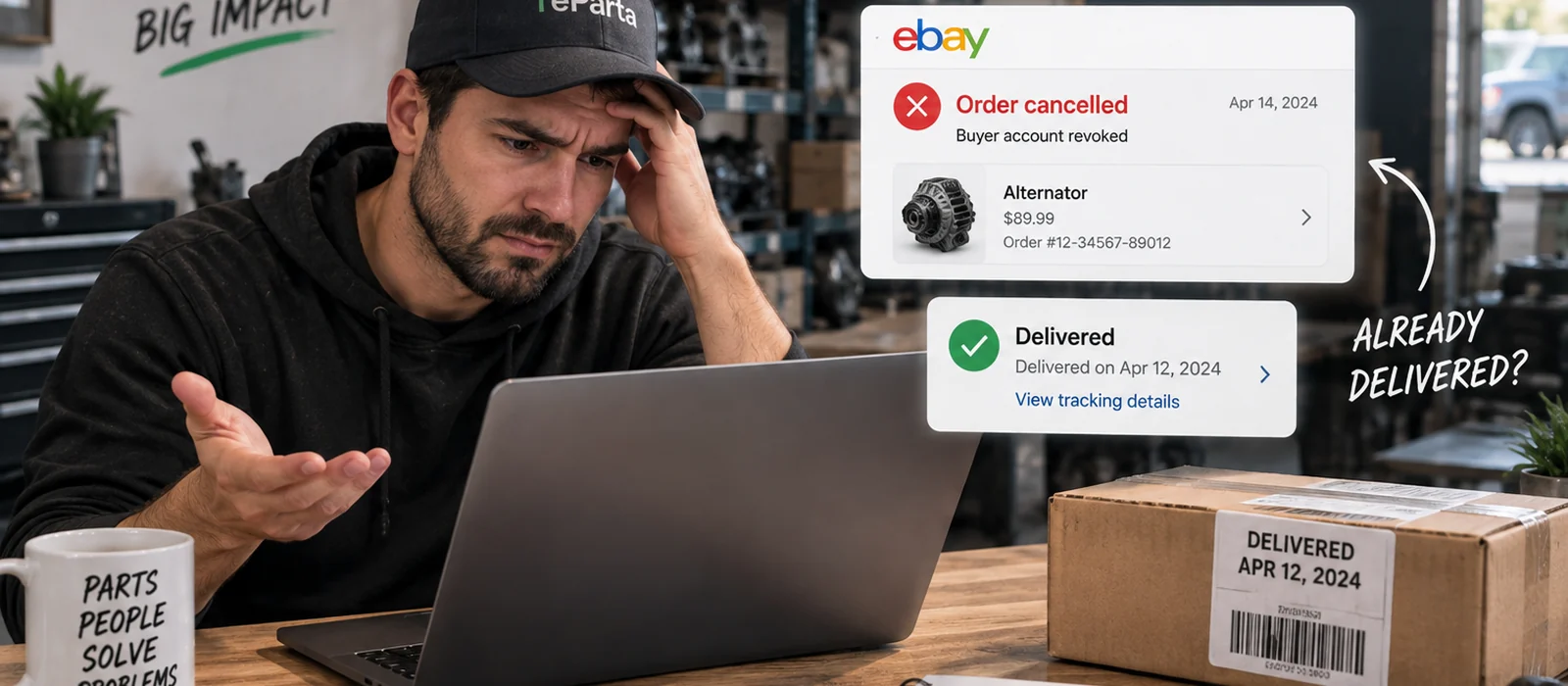
The catch is escalation. The deduction only holds while the case stays between you and the buyer. The moment the buyer escalates and eBay steps in under the Money Back Guarantee, the deduction is gone: eBay refunds the buyer in full and seeks reimbursement from you, and if eBay finds you responsible you can also pick up a “case closed without seller resolution” defect. So the right play is to process the deduction yourself on the return, document heavily, and resolve it directly so the buyer has no reason to escalate - and only open your own case for outright fraud.
Two things sellers get wrong about the deduction. First, there is no final value fee credit on a condition deduction: you keep up to 50% of the item price, but eBay keeps its selling fees on the original sale (condition deductions are on eBay’s list of refunds that do not qualify for a fee credit), so your real recovery is a lot thinner than “half.” As one seller found, “a 30% reduction might get you back 10% of the item-price, due to eBay keeping fees.” Second, since September 3, 2025, eBay no longer automatically removes the negative or neutral feedback a buyer leaves after you deduct - so a deduction can now cost you a feedback hit that used to be scrubbed. Deduct on the cases worth it, not reflexively.
What an eBay Motors used-part return actually costs you
The refund is the number everyone stares at, but eBay Motors used part returns cost far more than the refund - you get the part back, so the refund itself is not the loss. The loss is the stack of unrecoverable costs around it:
- Outbound shipping you already paid to send the part the first time.
- Return freight, which on an INAD you generally pay.
- Handling and relist time - inspecting, repackaging, re-photographing, and relisting.
- Lost value in the part itself when it comes back used, altered, or damaged, or simply no longer sellable as first described.
Add those up and a single avoidable return can erase the margin on several clean sales. The return that never opens is the one that costs you nothing - and booking each return against the exact part it came from is the only way to see the real number.
Illustrative example - hypothetical numbers, not eBay rates. You sell a used alternator for $120. Your cost basis (what you allocated to it from the donor) is $40, and you paid $18 to ship it out. The buyer opens a return and it comes back scuffed and no longer “as pulled.” You refund the buyer, eat the $18 outbound, pay roughly $18 return freight, and spend time re-inspecting and relisting a part now worth less. If the return qualifies and you settle it directly, you keep up to $60 of that refund for the lost value - the difference between a bruised margin and a total loss. Remember two things: eBay keeps its fees on the original sale even after the deduction, so your real recovery is thinner than the headline “$60”; and if the buyer had sent it back in the same condition you shipped it, there is nothing to deduct for, so you would refund in full.
The two “50%s” people conflate
Sellers routinely mix up two completely different eBay mechanics that both happen to involve “50%.” They are not the same money.
| The “50%“ | What it is | When it applies | Whose money |
|---|---|---|---|
| eBay return-label subsidy | eBay covers 50% of the eBay return-label cost | New / New-other listing only, remorse (changed-mind) return, free returns, and you use an eBay label - used listings are not eligible | You pay half the eBay label cost, when it applies |
| Up-to-50% refund deduction | You keep up to 50% of the refund | The item comes back used, altered, damaged, or incomplete; you offer free returns and are not Below Standard (Top Rated gets the widest version) | You keep up to half the item price for the lost value |
One is a New / New-other perk, so a used-part seller rarely sees it - the label subsidy needs a New or New-other listing and an eBay label. The other, the condition deduction, is the only 50% that actually touches your used listings. Knowing which is which keeps you from quoting yourself a discount you will never get.
eBay buyer says not as described but it fits - what can you do?
This is the return that stings, because the part is fine. Here is the reality on eBay Motors:
- An as-is or no-returns policy does not protect you. Under the Money Back Guarantee, you must accept the return and refund on an INAD, even if your listing says no returns, and you generally pay the return shipping.
- If it comes back in the same condition, there is nothing to deduct. A part that fits fine and returns as-sent is a full refund - the deduction is for lost value, and there is none.
- If it comes back worse, you can still deduct. The deduction is condition-based, so even on an INAD return, a part that arrives used, altered, damaged, or incomplete qualifies for the up-to-50% deduction - as long as you settle it directly and do not let it escalate.
- Document condition, then report a pattern. Clear photos and notes at listing and pack-out are your evidence. You can report a buyer who repeatedly files not-as-described on parts that fit, and block them - it builds a documented pattern over time but rarely recovers the specific loss in front of you.
None of this is “eBay and buyers are out to get you.” It is the mechanics of the channel. The winning move is not fighting each INAD - it is removing the reason most of them open (fit) and being ready to defend the ones worth the money.
How to defend a return worth fighting for
When the money justifies it, evidence decides the case - and sellers report eBay weighs some evidence far more heavily than others.
- When the part comes back incomplete, treat it as damaged. Multi-piece assemblies are where return abuse bites hardest: the part comes back with brackets, clips, or sub-components missing. A materially incomplete return justifies the full up-to-50% deduction, and if the missing value runs well above that, open your own case rather than just deducting. Photograph the assembly complete before it ships so “what was in the box” is not your word against theirs.
- Lead with photos, not video. eBay publishes no rule on which evidence formats it accepts, but sellers consistently find that clear, timestamped stills carry the most weight - the serial number, the part number, and your own stock mark, shot at listing and again at packing, then uploaded straight to the case. Video can still help, so keep it; just do not make an unboxing clip the whole of your defense.
- Mark every part so a swap is provable. Put a discreet mark on the item (a UV pen or a dab of nail polish works) plus your own stock number, and make sure that stock number shows in one of your listing photos - ideally not the centered hero shot. This is the fraud sellers describe most bluntly: one recounts sending a “USA quality part” and getting back “some cheap Chinese junk,” and it is common enough that several sellers in the same thread report the identical swap. If a buyer returns a different, broken unit, your mark and stock number are how you prove it. This is your strongest lever on “the item I got back is not the one I sent.”
Does the free-returns requirement even apply to you?
Here is where the 2025 policy news actually fits - and it is smaller than the headlines suggest for used-part sellers. eBay’s US free-returns requirement is New and New other only. Used and refurbished parts are not swept in.
US Parts & Accessories free-returns requirement (verify at each update - policy facts drift). Effective July 15, 2025.
| Listing condition | Category | Price | Free returns required? |
|---|---|---|---|
| New / New other | Most Parts & Accessories | Over $10, fixed-price Buy It Now | Yes |
| Used | Any | Any | No |
| Refurbished | Any | Any | No |
| Any condition in excluded categories (wheels, tires, transmissions, complete engines, door and hood panels, airbags, freight or bulky, local pickup only) | - | - | No |
So if you sell used, the requirement does not force free returns on you. Offering them anyway is a choice - and it is the choice that unlocks the up-to-50% deduction above. This is the US requirement; other markets run on their own timelines, so confirm your own before relying on it.
One risk note, stated once and not as a recipe: some sellers try to sidestep the requirement by miscategorizing a listing or downgrading its stated condition. That violates eBay listing policy and risks listing removal or account restriction. It is not a strategy.
Prevention: fitment discipline beats the deduction
Every section above is loss control after the return opens. The bigger lever is upstream. Sources report that complete fitment data can cut wrong-fit returns by roughly 20-40%, and it costs nothing but discipline: complete year, make, model, trim, and engine plus interchange or MPN on every listing so the buyer confirms the part fits before they buy.
There is a policy payoff too. eBay Guaranteed Fit keys on fitment data, not condition - so unlike the new-only free-returns requirement, it still applies to used listings that carry complete fitment (universal or customized parts with no fitment data are not eligible). When a buyer purchases with the green “Fits your vehicle” check and the part does not fit their specified vehicle, eBay covers the return with an eBay label. The caveats matter: it only applies when an eBay label is available (not oversized or freight, not international, not multi-package), tires and wheels are excluded, and it does not cover a buyer who instead claims damage or not-as-described - those route through the separate eBay Money Back Guarantee, not Guaranteed Fit. Still, a used seller who supplies full fitment can push a genuine doesn’t-fit return onto eBay’s label instead of their own P&L.
We are not going to re-teach fitment here - see how to reduce wrong-fitment returns and eBay Motors fitment and item specifics for the mechanics. And returns are not the only silent margin leak worth closing: selling the same one-of-a-kind part twice is its own cost, covered in the real cost of double sales.
How to correctly deduct up to 50% without losing it
The deduction is won before the return ever opens and kept by handling it cleanly. Five steps:
- Offer free returns and hold your standing. The protection requires free returns and a seller who is not Below Standard; Top Rated Sellers get the widest version. Protect both before you need them.
- Confirm the part came back worse. The deduction is tied to the returned condition - used, altered, damaged, or incomplete - not the reason the buyer picked, so it can apply even on a doesn’t-fit or not-as-described return.
- Document the returned item’s condition on arrival. Photograph and note the damage or wear the moment the part comes back, so the deduction is defensible.
- Apply the deduction within eBay’s window. Take the up-to-50% deduction when you process the refund, sized to the actual loss in value, and remember eBay keeps its fees on the original sale.
- Settle it directly, before it escalates. As covered above, the deduction disappears the moment the buyer escalates and eBay steps in and refunds the buyer in full. Resolve the return with the buyer so they have no reason to escalate, and only open your own case for outright fraud.
Stop paying for returns before they ship
The cheapest return is the one that never ships. Most used-part returns trace back to one thing: the buyer’s vehicle was never a real match. When the year, make, model, trim, and engine on the listing are complete and correct, many wrong-fit returns never open - and the refund, the freight, and the handling never happen.
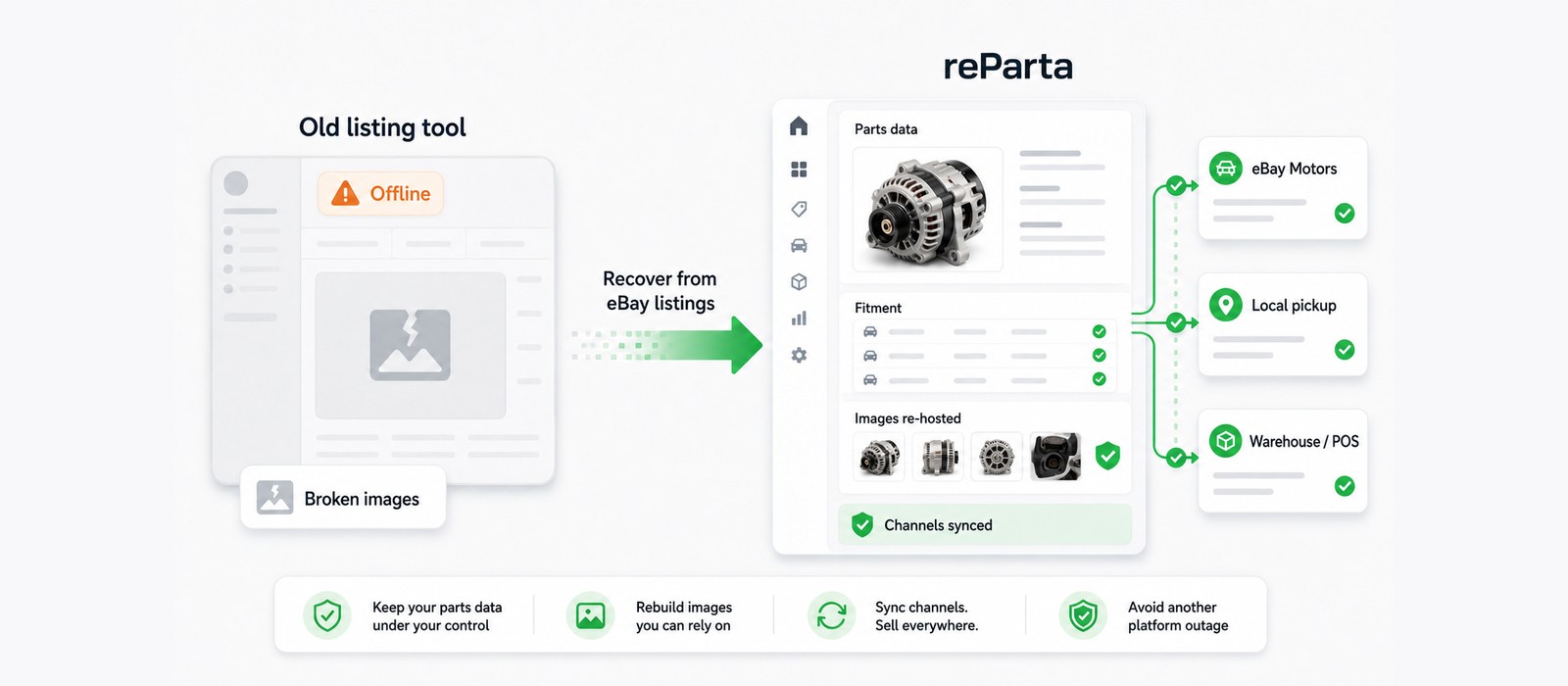
Be clear on what a tool can and cannot do here: reParta does not adjudicate eBay cases or recover a deduction for you. What it does is remove the returns you should never have taken and put a real number on the ones you do:
- Accurate fitment and interchange at listing time. reParta catalogs each part with fitment from a US vehicle database and lists it across eBay and Facebook from one record with multi-channel listing - so many wrong-fit returns never open in the first place.
- Every return booked against the part and donor. When a part comes back, reParta reverses it against the exact part and donor in per-donor P&L - so you see which cars actually made money after returns, not before.
- Buy math that expects returns. reParta’s pre-bid ROI factors a return buffer into the profit projection before you bid, so a lot that only pencils out with zero returns gets flagged before you own it.
One top-rated seller described moving to “listing more places than just eBay” to keep the operation “streamlined and automated” - which is exactly what multi-channel listing does. If you want the buy math to survive real-world returns, run the lot through the free part-out value tool or start a 14-day free trial (no card required) before your next auction.
Last verified: September 21, 2026.
Frequently asked questions
Can you keep 50% on a returned used part on eBay Motors?
Yes, and it is condition-based, not reason-based. When a part comes back used, damaged, or incomplete, a seller who offers free returns and is not rated Below Standard can deduct up to 50% from the refund, and Top Rated Sellers get the widest version. Because it keys on the returned condition and your seller standing, not the buyer's stated reason, it can apply even on a doesn't-fit or not-as-described return, as long as the part comes back worse than you sent it and you settle the case directly. It only falls away if the buyer escalates and eBay steps in.
Can I deduct on a doesn't-fit or not-as-described return?
Yes, if the part comes back used, damaged, or incomplete and you qualify to deduct (Top Rated with 30-day-or-longer returns, or not Below Standard offering free returns). The deduction is tied to the returned condition, not the reason the buyer selected. It only falls away if the buyer escalates and eBay steps in, which refunds the buyer in full.
Does eBay's free-returns requirement apply to used auto parts?
No - eBay's US free-returns requirement covers New and New other condition listings only, so used and refurbished auto parts are not swept in. It targets fixed-price Parts & Accessories items priced over $10 in most categories. Used-part sellers are not required to offer free returns by that rule, though offering them is what unlocks the up-to-50% refund deduction.
An eBay buyer says my part is not as described but it fits - what can I do?
You must accept the return and refund - on eBay Motors an as-is or no-returns policy does not protect you against an Item Not As Described (INAD) claim under the Money Back Guarantee, and you generally pay return shipping. If the part comes back in the same condition, there is nothing to deduct. If it comes back used or damaged, you can still take the up-to-50% deduction even on an INAD, as long as you settle it directly - once the buyer escalates and eBay steps in, that option is gone. Document condition, report a pattern of abuse, and block repeat offenders.
What does a returned used part actually cost a seller on eBay Motors?
A returned used part costs far more than the refund - you lose the original outbound shipping, the return freight, your handling and relist time, and often value in the part itself when it comes back used or damaged. The refund alone understates the hit, which is why one avoidable return can wipe out the margin on several clean sales.
Does a partial-refund deduction give back my selling fees?
No. You keep up to 50% of the item price, but eBay keeps its final value fees on the original sale, so your actual recovery is smaller than half - a 30% deduction can net closer to 10% of the sale once fees are out.
Does eBay remove the bad feedback if I deduct?
Not anymore. As of September 3, 2025, eBay stopped automatically removing the negative or neutral feedback linked to a partial-refund deduction, so factor a possible feedback hit into whether a deduction is worth taking.
What is the difference between eBay's two 50% rules for sellers?
eBay has two separate 50% mechanics sellers routinely confuse. One is a 50% discount on the eBay return-label cost for a changed-my-mind remorse return - but that subsidy is for New and New-other listings, so a used-part seller rarely gets it. The other is the seller's up-to-50% refund deduction when a used item comes back used or damaged, which is the one that actually applies to used listings. Different triggers, different money.
How do you reduce wrong-fit returns on eBay Motors?
Complete fitment cuts wrong-fit returns - listing full year, make, model, trim, and engine plus interchange or MPN data lets buyers confirm a part fits before they buy, and sources report that complete fitment data reduces wrong-fit returns by roughly 20-40%. eBay Guaranteed Fit keys on fitment data, not condition, so a used listing that carries complete fitment can push a doesn't-fit return onto eBay's label.