How to Sell Auto Parts on eBay Profitably
eBay Motors is one of the largest online marketplaces for used auto parts in the US, and for many dismantlers it is a top direct-to-consumer channel. The hard part is not getting sales, it is keeping the margin once fees, shipping, and the occasional return take their cut. This guide walks the whole workflow, from what you are allowed to list to how you defend the margin on every sale, and points to the deeper playbooks for each step.
Is eBay worth it for this part?
eBay’s strength is reach: buyers search by their exact vehicle, which is perfect for used parts. But it is not the only channel, and it is not right for every part. Common, flooded parts grind down to breakeven against every other yard and a wall of new aftermarket listings, while a Car-Part.com listing, a local repair shop, or a wholesale buyer can beat eBay on a heavy or slow-moving part. The honest way to decide is per part, not by habit. For the full comparison, see Car-Part.com vs eBay vs Facebook Marketplace.
What you can and cannot list
Before anything else, know what eBay will not take. As of September 24, 2026, standalone airbags, airbag inflators, and steering-wheel airbag covers are prohibited for all sellers, and certain airbag-related electronic modules can be listed in the US only by pre-approved sellers. Emissions defeat devices are banned, and used catalytic converters must be recertified or listed as scrap metal with no make or model. Marketplace permission does not replace federal, state, or carrier shipping rules either. Two practical points: check eBay’s current Motors and emissions policies before you list, and do not count a banned part toward a donor’s eBay return. The eBay airbag ban covers what changed and what to do with those parts.
Identify the part and every car it fits
The number on a part is not always the one to sell by, so identify it properly: read the OEM number, confirm the service identity, and resolve any supersession. Then widen it. The way out of flooded categories is not cutting your price, it is selling the parts other people never mapped: list against every vehicle a part genuinely fits, using interchange. One clean-pull part listed against its full, verified interchange reaches lower-competition demand and holds a better price than the same part listed against one car. Treat interchange as a compatibility lead, not permission to claim a fit - confirm trim, engine, side, connectors, and any programming before you add a vehicle, especially on ECUs, modules, and ADAS parts.
Fitment, item specifics, and Guaranteed Fit
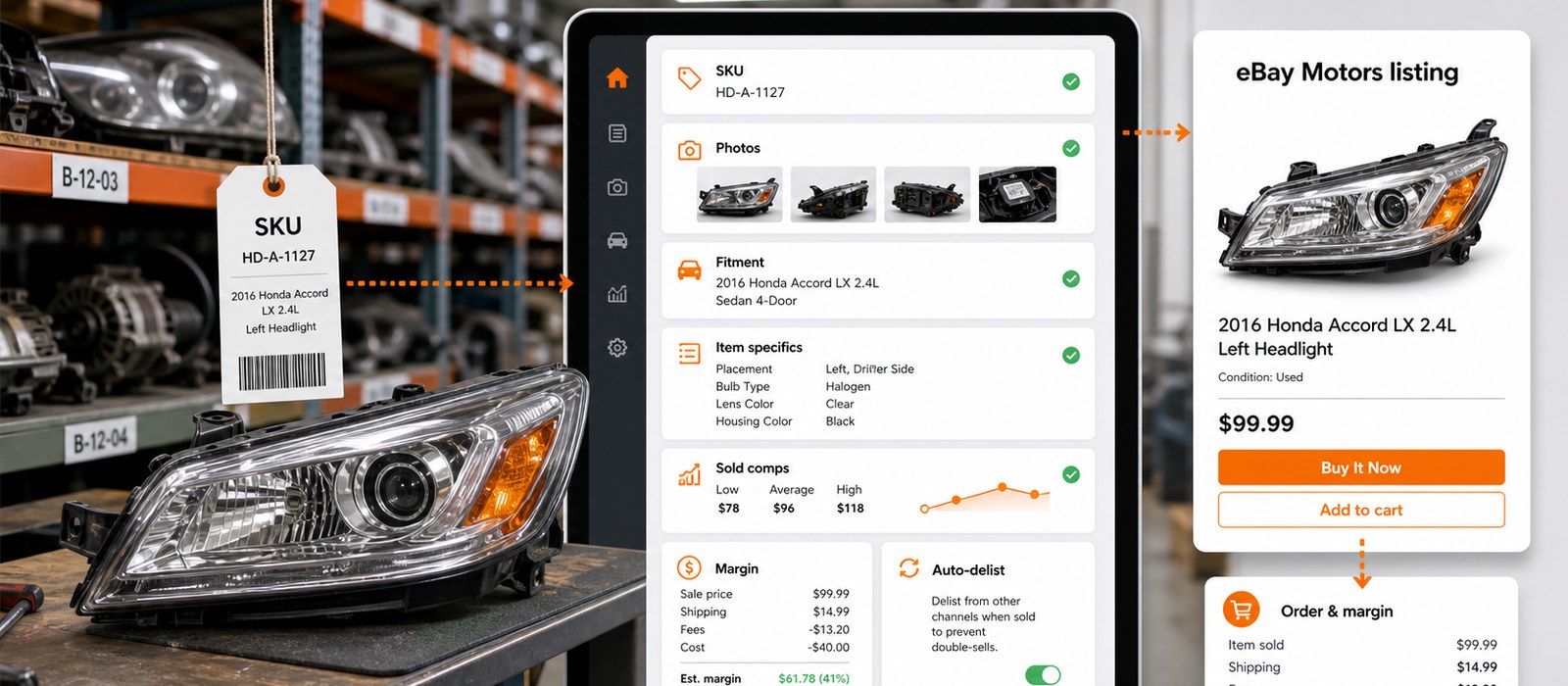
eBay’s parts buyers search by their vehicle, so compatibility is what gets you found. Load the compatible vehicles into the structured fitment and item specifics, not the title or description, so you land in the “Fits” results and place better in Best Match. Structured compatibility does more than help discovery: eligible Parts and Accessories listings where the buyer selects a compatible vehicle can qualify for eBay Guaranteed Fit, and if the buyer opens a “doesn’t fit my vehicle” return, eBay covers the return label. Oversized and freight items, international and multi-package returns, and tires and wheels are excluded, so it is not universal, but for most bolt-on parts it turns accurate fitment into real return protection.
Test, grade, and photograph the part
A used part is a trust purchase, and the honest listing comes back less. Test what you can (switches, motors, modules) and say so. Grade honestly rather than optimistically, and describe known defects, mileage, and what is and is not included. Photograph the actual part you are selling, including the OEM label, the connectors, the mounting points, and any wear, so the buyer is not guessing. The details that cut returns are the same ones that win the sale; see how to photograph parts that sell.
Write the listing
The title carries the brand, part type, OEM number, side, and key attributes; the compatible years belong in structured fitment, not stuffed into the title. Fill every relevant item specific, state the condition and grade plainly, and write a description that answers the buyer’s fit and condition questions before they ask. The full skeleton is in how to write an auto part listing.
Price to sold data, not hope
Price to what comparable parts actually sold for, not what hopeful sellers are asking, and subtract the real costs first: fees, your shipping cost, and a return reserve. If a part is flooded and the sold price sits at breakeven, that is the signal to compete on a less-common interchange instead of racing the price down. The method, including how to read grades and sold comps, is in how to price used auto parts.
Fees and the real margin math
Underestimating fees is the most common margin mistake, so use the real numbers. For a seller without an eBay Store, most Parts and Accessories sales are charged a 13.6% final value fee on the total amount of the sale up to $7,500 per item, then 2.35% above that, plus a per-order fee of $0.40 for orders over $10 (it is $0.30 for orders of $10 or less). Crucially, the percentage is charged on the total the buyer pays - item price, shipping, and sales tax - not just the item. A $40 part with $12 shipping and about 8% tax carries roughly $8 in eBay fees before you have paid the carrier; without tax in the base it is about $7.47. A Basic or higher eBay Store lowers the rate to about 11.5% in this category, which is a material cut at volume, though you weigh it against the subscription cost, insertion fees, and the categories you actually sell. Fee schedules change, so verify the current rate for your Store level before you price. The sellers who stay profitable know the projected margin per part before they buy the donor - that is what Pre-bid ROI is for: it turns a VIN and your max bid into a projected parts list and net estimate, with fees and shipping factored in, so you stop overpaying for inventory that never penciled out. It is an estimate to guide the buy, not a guarantee.
Ship without losing the margin back
Parts are dense, heavy, and awkward, which drops most of them into the most expensive size-and-weight bands, and dimensional weight, freight, and residential surcharges quietly eat the sale if you guess. Price shipping from the packed box dimensions, not the bare part, and know when a part becomes freight. The details are in how to ship used auto parts without losing money.
Cut wrong-fitment returns
After wrong fitment, the biggest controllable return driver is untested or loosely graded parts. A return can consume the outbound and return shipping, your handling labor, and any lost resale value; eBay credits the variable fee proportionally on an eligible seller-handled refund, but the fixed per-order fee is not returned, and you lose the fee credit entirely if eBay steps in against you. So prevention pays: on a low-margin part, one avoidable return can erase the contribution from several clean sales. The full playbook is how to cut wrong-fitment returns.
Protect your seller standing
Returns and cancellations are not just refunds, they hit account health. eBay’s minimum standard is a transaction defect rate no higher than 2% and cases closed without seller resolution no higher than 0.3%; slip below and you face selling restrictions. Separately, if your “item not as described” rate is evaluated as Very High, eBay adds a 5% surcharge on final value fees in those categories the following month, rising to 6% after four consecutive months. Accurate fitment and honest descriptions are how you keep those metrics clean; see eBay service metrics.
List everywhere, sell once
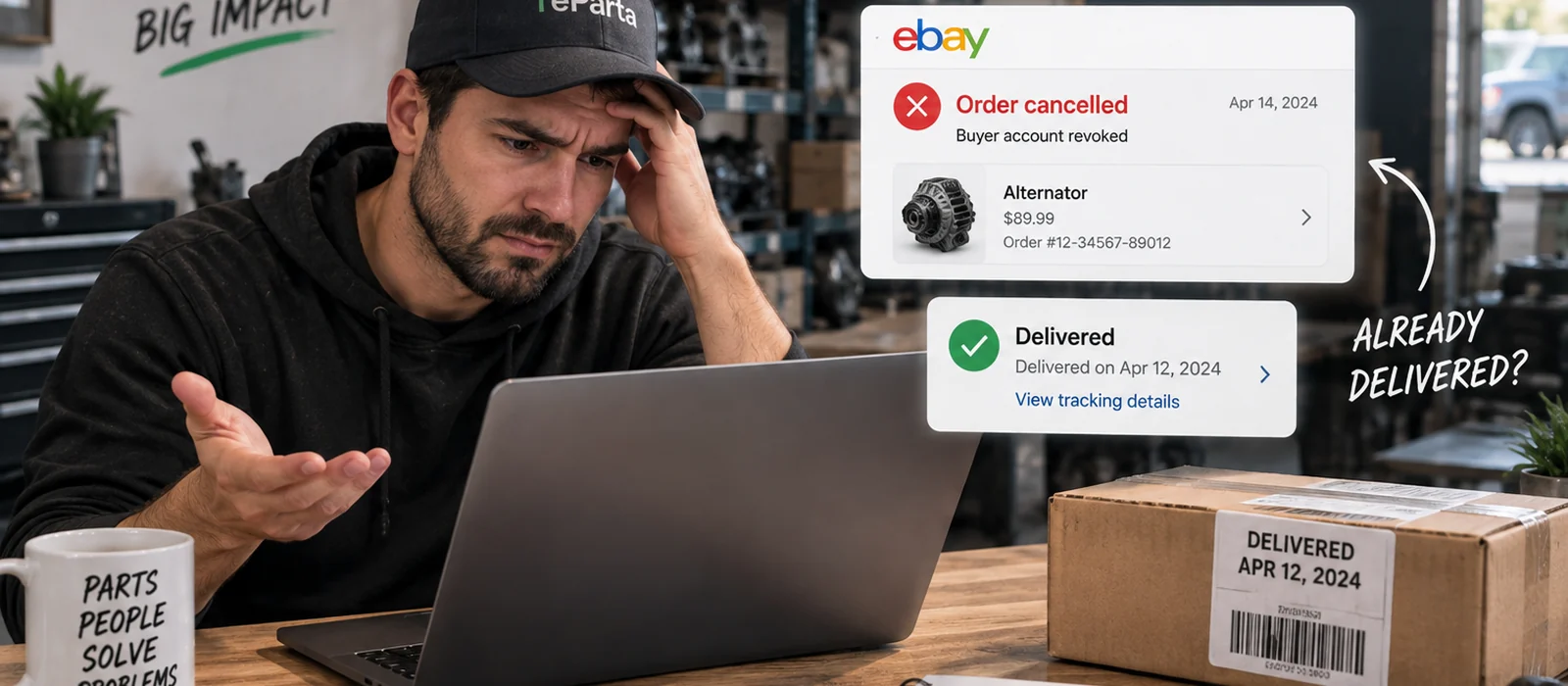
eBay is your biggest channel, not your only one, and listing across more channels reaches more buyers - but it creates the mistake that hurts your eBay standing most: the double-sell. When a part sells on eBay and you have not pulled it from Facebook or a parts network, the second buyer forces a cancellation, which becomes a transaction defect, not just a refund. Keep one source of truth and delist automatically the instant a part sells, so a part is not sold twice across your channels. This is far more dependable than manual delisting, which always lags. See automatic delisting.
Know which parts and donors actually pay
Not every part is worth listing, and not every donor is worth buying. Track which parts sell and what they net, and roll that up per donor, so your next buy is based on margin rather than guesswork. Start with the most profitable car parts to sell, and measure the reality per car with per-donor profit and loss, which tracks the actual net after fees and shipping so you can compare it to what you projected.
How reParta automates the workflow
reParta fills fitment and eBay item specifics from its own structured fitment data (built-in OEM cross-reference and interchange, its own data, not licensed from anyone), so each listing reflects the part’s actual applications instead of an AI’s guess - which matters because AI-guessed fitment drives wrong-fitment returns and the “item not as described” cases that drag down your service metrics. It lists to your own eBay account through eBay’s native API and automatically delists the moment a sale is recorded, against one source of truth; Facebook Marketplace, which has no public listing API, is assisted through the reParta browser extension rather than fully automated. Before you buy a donor, Pre-bid ROI projects the expected contribution margin; after the parts sell, per-donor P&L tracks the realized margin, so you are working from projected numbers before the buy and real numbers after. It all lives in one auto parts inventory management software.
Stop letting fees, wrong-fitment returns, and double-sells eat the margin. Start a free 14-day trial - no card required - or see plans and pricing.
Quick reference
- eBay Parts and Accessories fee (no Store): 13.6% of the total sale (item + shipping + tax) up to $7,500, then 2.35%, plus $0.40 per order over $10. A Store lowers it to about 11.5%.
- Check policy first: airbags are banned, used cats must be recertified or scrap, defeat devices are prohibited. Do not count a banned part toward a donor’s return.
- Fitment is the foundation: load compatible vehicles into structured data, qualify for Guaranteed Fit, and treat interchange as a lead to verify.
- Price to sold comps and subtract fees, shipping, and a return reserve before you list.
- Returns and defects hit account health: keep the defect rate under 2% and watch the INAD surcharge.
- Auto-delist across channels so an eBay sale never becomes a double-sell and a defect.
- Know your projected margin before you buy the donor, and the realized margin after.
Frequently asked questions
How much does eBay charge to sell auto parts?
For a seller without an eBay Store, most Parts and Accessories sales are charged a 13.6% final value fee on the total amount of the sale up to $7,500 per item, then 2.35% above that, plus a per-order fee of $0.40 for orders over $10 ($0.30 for orders of $10 or less). The percentage applies to the total the buyer pays - item price, shipping, and sales tax - so a $40 part with $12 shipping can cost around $8 in eBay fees once tax is in the base. A Basic or higher eBay Store lowers the rate to about 11.5% in this category, which is material at volume. Verify the current schedule for your Store level before you price.
Is selling auto parts on eBay worth it?
For many dismantlers, yes - eBay Motors is one of the largest online marketplaces for used auto parts in the US, so it is a deep pool of buyers searching by their exact vehicle. It is worth it if you price the real costs in (about 13.6% fees, shipping, and a return reserve), lead with accurate fitment, and avoid competing on flooded common parts. The margin lives in accurate fitment, lower-competition interchange, and not giving it back to returns or double-sells.
What auto parts can you not sell on eBay?
As of September 24, 2026, standalone airbags, airbag inflators, and steering-wheel airbag covers cannot be listed by any seller. Some airbag-related electronic modules can be listed in the US only by pre-approved sellers. Emissions defeat devices are prohibited, and used catalytic converters must be recertified or listed as scrap metal with no make or model. Always check eBay's current Motors and emissions policies before listing, and remember a banned part is not part of a donor's eBay return.
How do I avoid returns when selling used parts on eBay?
Two recurring causes are wrong compatibility data and parts that were not tested or described well. List against the correct vehicle compatibility, test what you can, grade honestly, and photograph real wear. Eligible listings with structured compatibility can also qualify for eBay Guaranteed Fit, where eBay covers the return label on a 'doesn't fit my vehicle' return (oversized, freight, international, multi-package, and tires and wheels are excluded). On a normal seller-handled refund eBay credits the variable fee proportionally, but the fixed per-order fee is not returned.
How do I stop a part selling twice when I list on eBay and other channels?
Keep one source of truth and delist automatically. The moment a part sells on eBay it should come off Facebook, your site, and any parts network, because a double-sell forces a cancellation, which becomes a transaction defect on eBay, not just a refund. Near-real-time sync with automatic delisting is far more dependable than manual delisting, so a part is not sold twice across your channels.