Car-Part.com vs eBay vs Facebook Marketplace: where should you list your used auto parts?
Car-Part.com, eBay Motors, and Facebook Marketplace are the three channels most dismantlers weigh, and the honest answer to “which one” is that they are not substitutes for each other. Each reaches a different buyer with a different intent: Car-Part is the trade and wholesale channel, eBay is national retail reach, and Facebook is local cash and heavy parts. For a solo or growing seller, the reach you can build fastest is on eBay plus Facebook, with Car-Part covering trade demand. So the real decision is not which channel to pick, it is which part goes where - and the biggest thing that stops most yards from listing across all of them is the double-sell risk. Here is how each channel actually works, what each one costs, where every part type belongs, and how to run more than one channel without leaving a sold part live somewhere else.
The 30-second answer: which channel wins for what
- Car-Part.com - the trade channel. Professional buyers, repair shops, and other yards search by interchange and buy hard parts. Best for engines, transmissions, and body parts sold into the recycling and repair network.
- eBay Motors - the national retail channel. The widest reach for shippable and rarer parts, at a fee. Best for compact, higher-value, and hard-to-find parts that a buyer two states away cannot source locally.
- Facebook Marketplace - the local cash channel. Free, fast, and local. Best for heavy, bulky, or awkward parts sold cash-on-pickup, where shipping would eat the margin.
If you only take one thing away: route by weight, value, and buyer type, not by habit. The rest of this guide is the detail behind that rule.
Car-Part.com and parts networks: the trade channel
Car-Part is closer to a search network of yard inventories than a consumer marketplace. A buyer looks up a specific part, sees which yards have it with condition, price, and distance, then contacts the seller directly. The Car-Part.com homepage advertises roughly 250 million parts searchable across the network, and its professional tier, Car-Part Pro, is the version repair shops and insurance buyers use to search by grade, interchange, and delivery time.
How it works in practice. You do not list part by part the way you would on a consumer app. Your inventory system - Checkmate, Hollander Powerlink, Pinnacle, or similar - feeds the network on a regular upload, with stock number, mileage, damage code, price, and photos maintained centrally. When a part sells, your yard process removes it. For a catalog of thousands of SKUs, that centralized upload is far more practical than hand-listing every part.
Who it reaches and what it is best for. The buyer is usually a professional who already knows the exact part and interchange they need, so intent is high. It is strongest for hard parts - engines, transmissions, transfer cases, differentials, doors, hoods, fenders, bumpers, rear clips, axle assemblies, steering columns - and for trade and wholesale demand.
Where it falls short. There is no simple public price list; cost depends on your package, inventory system, and add-on services, so you contact a sales rep. Because it is a subscription rather than a per-sale fee, Car-Part rewards volume: the more you move through it, the less each sale effectively costs, and the less it makes sense for a low-volume seller. The buyer base is the recycling and repair network rather than the open consumer market, so you are not reaching the DIY owner. Your price sits next to every other yard’s price on the same screen, which creates real price transparency. And the sale does not close automatically - it takes someone answering the phone, email, and quote requests fast. For a small seller without a real inventory system and a phone that gets answered in minutes, Car-Part is often overkill.
eBay Motors: the national retail channel
eBay is the largest open used-parts marketplace, reaching consumers and DIYers across the country who search by their own vehicle. eBay ended 2025 with about 135 million active buyers and roughly $80 billion in gross merchandise volume (its own FY2025 results), and Motors Parts and Accessories is one of its largest categories. This is the strongest of the three channels for finding a buyer for a rare part far outside your own region.
The real fee math. For a seller without a Store, most categories - including most auto parts - run a final value fee of roughly 13.6% up to $7,500, plus a per-order fee of about $0.30 to $0.40. That fee is charged on the total, including the shipping you collect. With a Basic Store or higher, most auto parts drop to about 11.5% up to $1,000 then 2.35% above that, while tires (about 9.5%) and in-car tech (about 9.35%) have their own rates. You also get 250 free listings a month, then about $0.35 each. eBay changes these numbers, so treat them as a planning estimate and confirm the current rate on eBay’s official selling-fees page before you price.
Where it hurts. The fee drag is brutal on low-dollar parts, heavy parts are expensive and risky to ship, returns and “not as described” claims are a real cost, and each listing takes labor to build correctly. That is exactly why not every part belongs on eBay.
Where it wins. eBay lets you sell a part for far more than you would get locally when it is rare, compact, has a readable OEM number, fits several models, or came off a premium or enthusiast vehicle. The best eBay candidates are modules and electronics - ECU, BCM, TCM, radio and navigation units, climate controls, cameras and radar sensors, instrument clusters, mirrors, switches - plus tail lights, small headlights, interior trim, emblems, and discontinued OEM components.
Returns and fitment. eBay matches the buyer’s vehicle against your compatibility data, and under eBay Guaranteed Fit an eligible part that does not fit a listed-compatible vehicle can be returned, with eBay covering the return label. You set your own return policy on eBay, from no returns up to 30-day free returns, and eBay’s free-returns program for Parts and Accessories only covers eligible listings anyway - new or new-other items over $10, fixed-price, shipped within the US, with engines, transmissions, some body panels, freight, and local pickup excluded - so most used salvage parts fall outside it. Guaranteed Fit does not remove the risk of a wrong interchange, a mislabeled OEM number, a module that needs programming, or a buyer returning a good part after a bad diagnosis - and a buyer can file “not as described” even on a no-returns listing, with the seller usually paying return shipping. Getting fitment and item specifics right up front is what keeps that return rate down.
One time-sensitive rule. Effective September 24, 2026, eBay will prohibit airbags and airbag covers - new, used, rebuilt, deployed, or recalled - and only eBay-approved sellers will be able to list related components like airbag control units and crash sensors. If you part out late-model cars, do not build eBay revenue around airbags. We cover this in detail in the eBay airbag ban guide.
Facebook Marketplace: the local cash channel
Meta reported roughly 430 million items and about 44 million vehicles listed per month on Marketplace in 2026. That is not completed sales, but it shows the sheer volume of local traffic. The typical Marketplace buyer browses within a few dozen miles, compares price, haggles, and wants to pick up today.
Free, fast, and local. For a local-pickup deal, Facebook usually takes no selling fee - payment and handoff happen between the two parties. There are no listing fees and no shipping to arrange. Shipping availability on Facebook varies by account and location and has changed over time, so it is risky to build a national parts operation on Facebook shipping. Treat Facebook as a local lead-generation channel, not an eBay replacement.
Best for heavy and awkward parts. This is the home for bumpers, doors, hoods, glass, seats, wheel and tire sets, truck beds, hatches and liftgates, large interior assemblies, and complete part-out vehicles - anything where shipping would kill the margin or the part needs to be seen in person. A single “parting out a 2018 F-150, send your VIN and the part you need” post can produce several sales from one listing, as long as you keep strict control of what is still available.
The friction that is real. Expect no-shows, lowballs, “is this still available” messages that go nowhere, fake payment screenshots, off-platform payment pressure, and automated listing rejections. There is no real fitment mechanism, so compatibility is on you and the buyer. For a safe local sale: meet at the business, use cameras, write an invoice, record the buyer’s VIN and your stock number, and take verified payment in person - never a screenshot that says “payment sent.”
Head-to-head comparison
| Car-Part.com | eBay Motors | Facebook Marketplace | |
|---|---|---|---|
| Main buyer | Yards, repair and body shops, insurance, pro buyers | DIY owners, shops, collectors, national buyers | Local individuals, mechanics, flippers |
| Reach | Regional and national trade network | National and international retail | Mostly local |
| Selling fees | Subscription or package; no public flat rate | Roughly 13.6% (about 11.5% with a Store); verify current rate | Usually $0 on local pickup |
| Best part types | Engines, transmissions, body, hard parts | Compact, rare, high-value, shippable parts | Heavy, bulky, cheap, pickup-only parts |
| Shipping expected? | Freight, arranged by seller | Yes, parcel shipping is the norm | No, local pickup |
| Returns / scam risk | Seller’s own terms; fewer fitment surprises | Strong buyer protection; real return and INAD exposure | Less platform-managed return exposure; higher flake and scam-DM rate |
| Listing effort | Low per part with an inventory feed | Higher; each listing needs fitment and specifics | Manual, one post at a time |
| Fitment support | Best, interchange-driven | Good, but a fitment error causes returns | Almost none, buyer beware |
Where does each part type go? A routing cheat-sheet
Match each part to a channel by what it is - its weight, how far it ships, who buys it, and what it is worth - not by which channel you already have open.
| Part | Primary channel | Secondary |
|---|---|---|
| Headlights, tail lights, mirrors | eBay | Car-Part |
| ECU, BCM, TCM and other modules | eBay | Car-Part |
| Infotainment, radio, cameras, sensors | eBay | Car-Part |
| Alternators, starters, pumps | eBay only if a rarer OEM part, tested, and profitable after shipping and returns | Facebook local, or bulk for common units |
| Rare, discontinued, or classic parts | eBay | enthusiast Facebook groups |
| Interior trim | eBay | Facebook for full sets |
| Bumpers, hoods, fenders, doors | Facebook local | Car-Part |
| Glass, seats, large assemblies | Facebook local | Car-Part |
| Wheels and tires | Facebook local | eBay for rare sets |
| Engines and transmissions | Car-Part | Facebook local; eBay only with real freight |
| Axles, differentials, transfer cases | Car-Part | eBay if the freight math works |
| Complete part-out vehicle | then individual parts to Car-Part and eBay | |
| Low-dollar small parts | eBay multi-quantity or bundle | Facebook lots |
This cheat-sheet is written for a seller building retail reach, and your business model tilts it. A private seller or e-commerce dismantler leans on the consumer channels above, but a full-service recycler with body-shop delivery, a collision-focused yard, or a self-service yard can make Car-Part the primary channel for many of these same parts - doors, hoods, fenders, headlights, mirrors, axle assemblies, steering columns, wheels, and repairable collision parts included. Read the table as a starting point, then adjust each row to what your own numbers show.
The fee and margin math, on a real part
The “best” channel changes with the part, so run the numbers instead of guessing.
A $120 alternator (a desirable, tested OEM unit, compact and shippable). On eBay without a Store, the fee on $120 plus about $18 shipping runs roughly $19, so you net about $101 before packaging and labor, and you still have to box and ship it. On Facebook local pickup, a buyer hands you $120 cash with no fee and no shipping, but you only reach local buyers and may wait longer. On Car-Part, a shop might pay a wholesale $85 with no per-sale fee, but that assumes you are carrying the subscription anyway and selling to the trade rather than a retail buyer. For a compact, shippable unit a buyer will actually search out, eBay’s reach usually wins even after the fee. A common, low-value alternator that competes with cheap reman is the opposite case - it often nets more sold locally or in a bulk lot, which is why the routing table sends those to Facebook.
A $300 bumper (heavy, awkward). On eBay, dimensional or freight shipping can run $60 to $120, damage-in-transit risk is high, and the 13.6% fee applies to that shipping too. On Facebook local pickup, the buyer inspects it, hands you $300 cash, and there is no fee and no freight. Here Facebook wins outright. Same seller, same day, opposite answer - because the part is different.
That is the whole point: list each part where its economics work, and stop forcing every part down one channel.
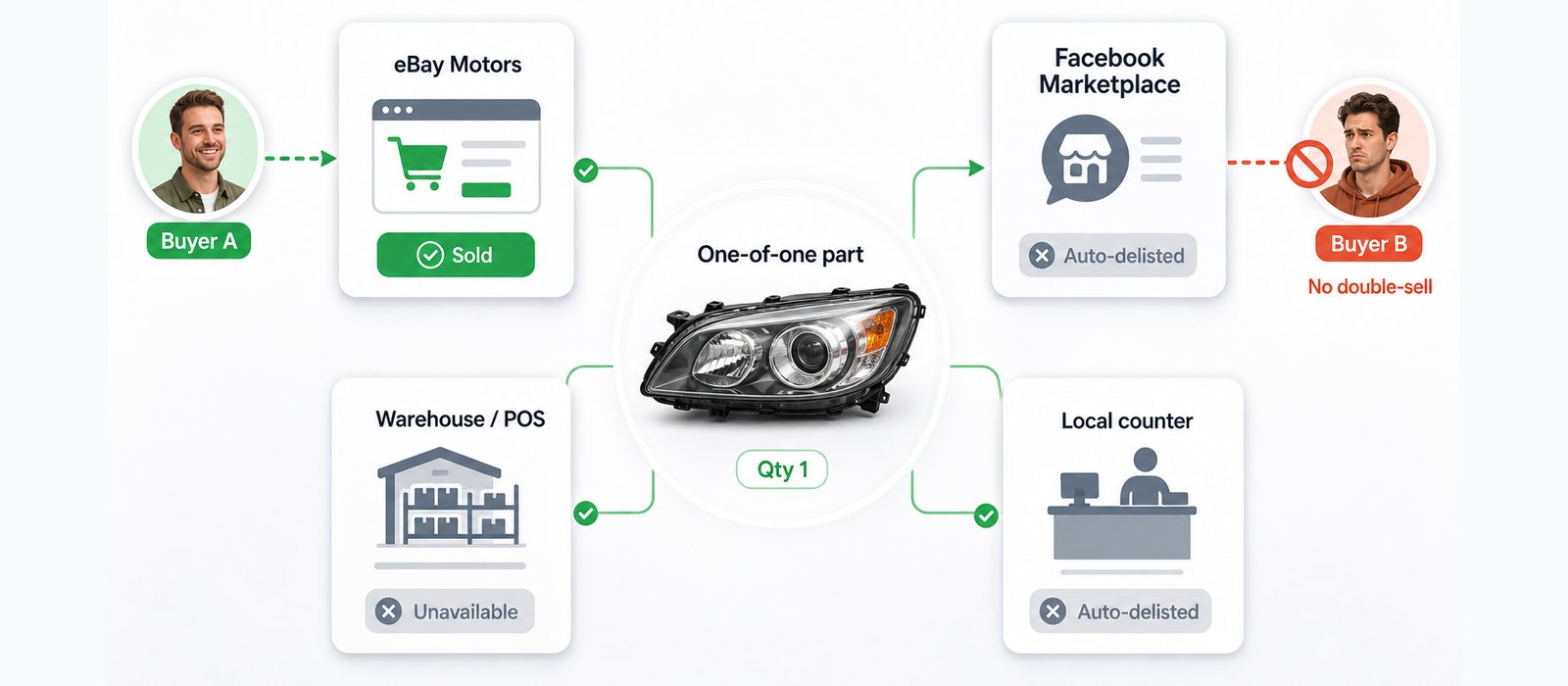
reParta catalogs a part once, with fitment and a real used-market price pulled from the donor, lists it to eBay and Facebook Marketplace, then auto-delists it on the other channel as soon as a sale registers. One record, both channels, no more listings sitting live after the part is gone.
Start free for 14 days →14-day free trial, no card required. See plans and pricing.
Returns, fitment, and buyer protection by channel
The three channels fail in different ways, and knowing which failure mode you are signing up for is part of the decision.
- eBay carries the most return exposure. Fitment errors drive “not as described” claims, and even a no-returns listing can be overridden. The upside is real buyer and seller protection and a fitment system that, when your compatibility data is accurate, can reduce wrong-part purchases - though it will not catch every bad interchange or a buyer’s own misdiagnosis. Eligible Top Rated Sellers, subject to eBay’s protection requirements, may also deduct up to 50% of a refund for an item returned used or damaged.
- Facebook creates less platform-managed return exposure because the buyer inspects and pays on pickup, but that is not the same as no returns - a buyer can still come back, dispute an electronic payment, or claim misrepresentation - and you get a far higher flake rate (no-shows, lowballs, scammers) with no protection worth relying on for a local cash deal.
- Car-Part trade buyers know interchange, so fitment surprises are rarer, but terms, warranty, core charges, and freight are all yours to negotiate and administer.
Across all three, the lever you actually control is fitment accuracy. Complete, correct interchange and item specifics cut eBay returns, help Car-Part buyers trust your listing, and reduce the “will this fit my truck” back-and-forth on Facebook.
Why the real answer is “list on more than one” - and what stops yards
Restricting a part to one channel just shrinks its audience. A clean, shippable headlight belongs on eBay for national reach and can move locally on Facebook too; a bumper belongs on Facebook but might sell into the trade on Car-Part. For a solo or growing seller who does not already have a steady trade pipeline, eBay plus Facebook are usually where reach is easiest to build - eBay for national retail, Facebook for local cash. This is not a universal law: a full-service recycler with body-shop delivery can push far more through Car-Part’s trade demand, and which channel pays for a given part is ultimately something your own margin and sell-through numbers decide. But if you are still building reach, eBay and Facebook are the two channels you can turn on today, while Car-Part stays the specialist trade route.
So why do most yards still pick one and stick to it? The double-sell risk. The more places a part is listed, the more places it can sell while it is still live everywhere else. A part sells on Facebook at 9am, and it is still bookable on eBay until someone remembers to pull it. Manual delisting cannot keep up, and one double-sale means a cancellation, a refund, an angry buyer, and a dented metric. That single fear is what keeps money on the table.
How reParta removes the manual pain of multi-channel listing
The valuable part is the boring one: the listing coming down by itself when a part sells. That single piece of automation - auto-delisting a part on your other channel as soon as the sale registers - is what turns “list everywhere” from a double-sell trap into a manageable default. It is the thing manual cross-posting cannot match, because a person cannot pull a listing in the same minute a part sells somewhere else.
Here is how reParta does it. You catalog a part once, with fitment and item specifics filled straight from the donor VIN, a suggested price from real used-market prices, and the donor attached. reParta lists that one record to eBay and Facebook Marketplace, and as soon as a sale registers on either channel the part is auto-delisted on the other. That one record also spares you the duplicate listing labor and fitment work of building the same part twice, and because a sold part comes down on its own you are not left with stale listings advertising something you no longer have.
No automation makes double-selling physically impossible - a cash sale you take in the yard without keying it in, a platform outage, or two buyers checking out in the same second can still slip through. What auto-delisting kills is the everyday version: a part that sold hours ago and is still bookable everywhere else because nobody has pulled it yet.
Car-Part already runs off your inventory system’s centralized upload, not a part-by-part listing tool, so the place reParta adds real automation is the two consumer channels where you would otherwise be hand-listing and hand-delisting. Your Car-Part sales still flow into reParta’s per-donor profit-and-loss, so the profit picture on each car stays whole. In other words, reParta automates exactly the part that is manual, and does not charge you to duplicate what your inventory system already does.
Two features feed the same funnel from the buy side. Pre-bid ROI tells you a salvage lot’s projected profit before you bid, and per-donor P&L shows the real profit on each car once it is sold. See how the listing side works on the multi-channel sync page, or decode any VIN free with the VIN decoder - no signup. When you want to watch it happen, list a part to eBay and Facebook from one record - free for 14 days, no card.
A cleaner way to test a new channel: split comparable parts into cohorts
The obvious way to test a channel is in sequence - your current channel for a month, add a channel the next month, compare. That is not a fair test. Too much changes between the two periods: your inventory mix, the age of the parts, the season, which donors you bought, demand, prices, even who is on shift. The second month is a different world, not a control group.
Run it as a side-by-side split instead:
- Match the parts. Take comparable SKUs - same part types, price bands, age, and condition - and divide them into two cohorts at the same time.
- Split the channel. Cohort A stays on your current channel; cohort B goes on the new one (or on both, with auto-delist on so a sold part comes off the other). Hold everything else constant.
- Compare on what matters. Net contribution per part and time-to-sale - how fast each cohort actually clears - not gross sales.
Because both cohorts run in the same window on the same kind of parts, the difference you measure is the channel, not the season. Then route each part type by what its own cohort proved.
One number to get right while you test: the return reserve. A flat “5 to 10% of revenue” is too high for a bumper and too low for a programmed module, so estimate it per part type instead. A workable rule is return probability x (unrecovered shipping + average value loss + handling cost), figured separately for body panels, electronics, and complex-fitment modules, and tuned by your own seller history.
KPIs to track, so “list everywhere” is a decision, not a guess
Do not compare channels on gross sales alone. For each channel track:
- Sell-through rate over a fixed period (units sold divided by average active inventory, so exposure time is comparable), or a time-to-sale view
- Median days-to-sale
- Net margin after fees, shipping, and returns
- Double-sell and cancellation rate (target near zero)
- Return and “not as described” rate
- Listing labor minutes per sold part
- Stale inventory over 180 and 365 days
The double-sell and cancellation line is the one that tells you whether your cross-listing is actually under control.
Bottom line
Car-Part is the trade channel, eBay is national retail reach, and Facebook is local cash and heavy parts. If you have to pick one: a large yard with an inventory system and steady B2B demand leans Car-Part, a small seller with rare shippable parts leans eBay, and a local part-out operation leans Facebook. For a solo or growing seller still building reach, eBay plus Facebook are usually the most accessible channels, with Car-Part as the trade layer on top. Running all of them adds real work - listing labor, per-channel rules, fees, and returns to manage - but the cost that most often stops yards is the double-sell risk, and it is the one you can automate away. Take that off the table, and listing on more than one channel becomes a straightforward decision instead of a scary one.
For the broader view of every channel, see the best marketplaces to sell used auto parts. To understand the one feature that makes multi-channel safe, read how auto-delisting kills the double-sell. When you are ready to list on eBay and Facebook from one place and stop losing parts to slow manual delisting, start a free 14-day trial.
Frequently asked questions
Is Car-Part.com or eBay better for selling used auto parts?
Car-Part reaches professional trade buyers who search by interchange, while eBay reaches far more consumers nationally. Car-Part wins for wholesale and hard parts, eBay wins for reach and rarer shippable parts, and many yards use both rather than choosing one.
What are eBay's fees for selling auto parts?
eBay Motors Parts and Accessories runs roughly a 13.6% final value fee up to $7,500 plus a small per-order fee, and the fee is charged on the shipping you collect too. With a Store subscription most parts drop to about 11.5% up to $1,000. Always verify the current rate before you price.
Is it better to sell car parts on eBay or Facebook Marketplace?
Use eBay for shippable, higher-value, or rare parts where national reach matters, and Facebook Marketplace for heavy, awkward, or fast local cash sales where you avoid both shipping and selling fees.
Does Car-Part.com cost money for a salvage yard?
Yes. Car-Part is a paid subscription and network service for yards rather than a free consumer marketplace, so it pays off mainly when you have steady trade demand and an inventory system feeding it.
Can I list the same part on Car-Part, eBay, and Facebook at once?
Yes, and it maximizes the part's audience. The catch is you have to pull it from every other channel as soon as it sells, which is what cross-listing software with auto-delist handles for you.
How do I avoid double-selling when I list parts on multiple marketplaces?
List from one source of truth and use auto-delisting, so a part comes off the other channels as soon as a sale registers there. Manual delisting is too slow once a part is live in more than one place.
Which channel is safest against scams and returns?
Facebook cash-on-pickup carries less platform-managed return exposure because the buyer inspects before paying, but expect more no-shows and scam DMs; eBay carries return and not-as-described exposure but real buyer and seller protection; and Car-Part's trade buyers cause fewer fitment surprises. On eBay, keep payment and messaging inside eBay; on Car-Part and local Facebook deals, use traceable invoices and verified payment methods suited to the sale.
What is the best way to sell used auto parts online overall?
There is no single channel. Route each part to Car-Part, eBay, or Facebook by weight, value, and buyer type, list on every channel that fits, and keep them in sync so a sold part comes off the others.