Sell used auto parts on eBay and Facebook automatically (without listing twice)
The two biggest channels for most dismantlers are eBay and Facebook Marketplace, and they reach different buyers - eBay’s national shippers and Facebook’s local cash buyers. The obvious move is to list on both. The reason most yards do not is the manual work and the double-sell risk. Automating it removes both, but “automatically” means something more specific than the pitch usually admits. Here is how it actually works, channel by channel and step by step. It is one piece of how to sell auto parts on eBay profitably.
The manual version, and why it breaks
Done by hand, selling on both channels means entering the same part twice, with photos and details, in two different interfaces - then remembering to pull it from Facebook the moment it sells on eBay, and the reverse, while you are also pulling parts, packing orders, and intaking cars. The double entry is tedious. The manual delisting is dangerous: a unique part that sells on eBay but stays live on Facebook for an hour is a double sale waiting to happen, which is exactly why manual delisting causes double-sells.
The automatic version: one record, two channels
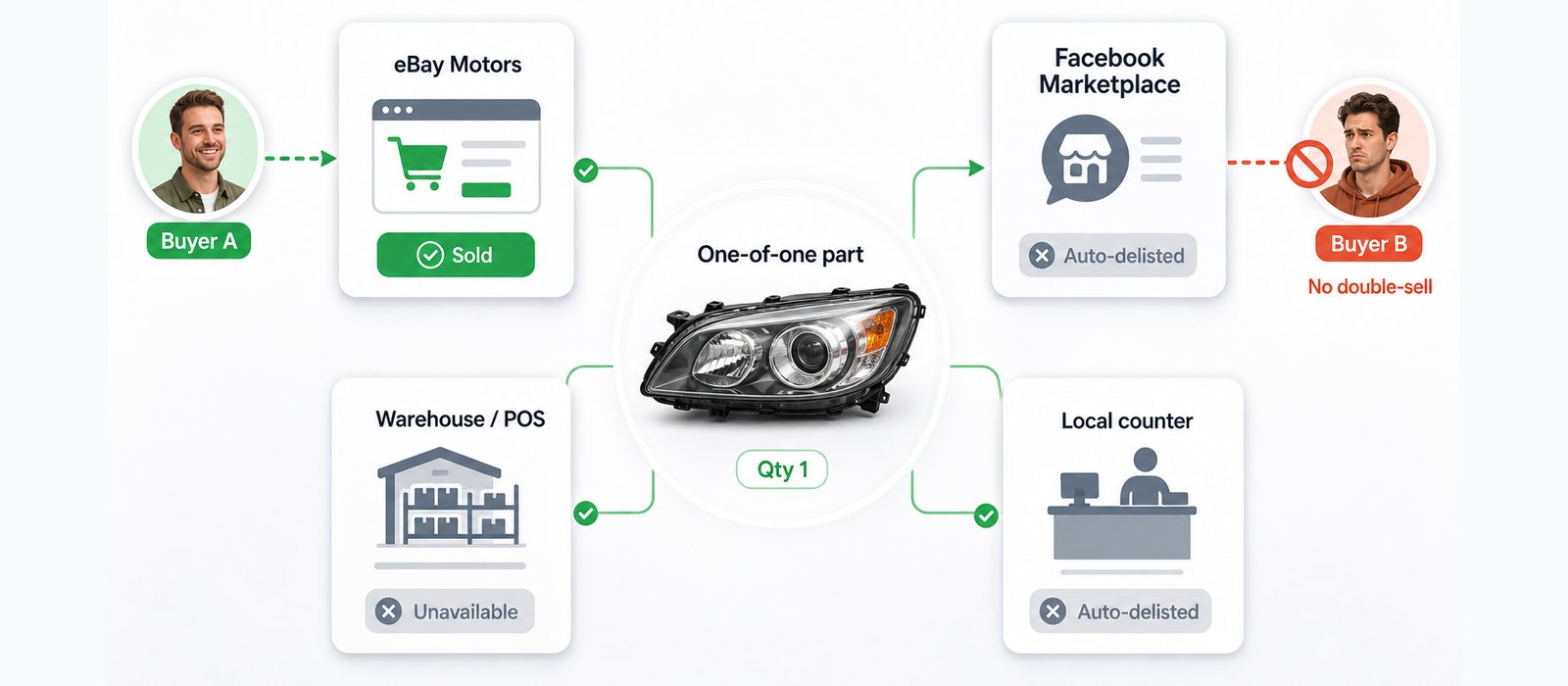
Automatic multichannel selling flips the model. Instead of two listings you maintain separately, there is one authoritative record of each part - quantity, fitment, photos, price, condition - and the channels are downstream mirrors of that record, never the master. You catalog the part once, it publishes out to your channels, and when it sells anywhere the same record drives its removal everywhere else. For used parts, where quantity is almost always one, that single-record design is the whole game: there is exactly one of the part, so there must be exactly one source of truth for whether it is still available.
eBay automatic vs Facebook assisted: the honest mechanics
Here is the part the word “automatically” usually glosses over. The two channels are not symmetric, because the platforms are not equally open.
- eBay is genuinely automatable. eBay publishes official Sell APIs, so a tool can list to your own eBay account, fill fitment and item specifics, read your orders, and end a listing programmatically. Sale detection can be push-based through eBay’s order notifications. On eBay, both the listing and the delist-on-sale can be fully automatic. (Ending a listing has its own rules and edge cases - how ending an eBay listing works covers them.)
- Facebook Marketplace has no public listing API for a general seller. Meta’s only official offering is a restricted, partnership-gated catalog program, not a self-serve listing endpoint. So any tool that “lists” and “delists” on Facebook does it through an assisted or browser-extension flow in your own logged-in session - guided listing and assisted delist, with a human in the loop where the platform requires one.
That asymmetry is not a flaw to hide, it is a fact to design around. Treating both channels as if they were one fully automated push is how tools overpromise. The criteria for judging multichannel software name this distinction; here we show how it plays out in the actual delist.
How the delist actually fires
This is the mechanism the marketing skips. When a part sells, a reliable system does not just “remove it instantly” - it runs a short, verifiable pipeline:
- Source of truth. The tool holds the authoritative availability record for the part. Every channel reads from it; none of them is the master copy.
- Sale event detected. On eBay, through an order or transaction notification (with short-interval order polling as a backstop if a notification is missed). On Facebook, through the assisted flow or a manual mark-sold, because there is no sanctioned webhook.
- Delist job queued. The system queues a removal to every other channel the part is live on - withdrawing the eBay offer, and firing the assisted delist on Facebook.
- Retry with backoff. API calls fail sometimes - a rate limit, a timeout, a brief outage. The job is not fire-and-forget; it retries rather than giving up after one miss.
- Reconciliation sweep. After the push, the system re-checks each channel’s actual state to confirm the listing really came down. This verification, not a promise of instant magic, is the honest answer to “how do you know it worked?” For what a real-time claim should even mean, see what real-time inventory sync should mean.
- Conflict handling. If two buyers hit the same quantity-of-one part at nearly the same moment on two channels, a first-wins lock on the single record lets only one sale stand; the second goes to an exception queue for a human to resolve, instead of silently confirming two sales of one part.
- Manual fallback. For an API outage, or any channel with no API, you can force a delist by hand. The system degrades to assisted rather than failing silently.
Notice what is missing from that list: the word “instant.” Cross-system delisting is a queued network job over third-party APIs, so the honest standard is near-real-time - usually seconds to a minute or two - with retry and reconciliation behind it. A tool that promises instant, guaranteed, simultaneous removal is promising something no web integration controls.
Why the delisting half matters most
Anyone can push a listing to two sites. The hard, valuable part is the reliable removal when a part sells - especially for the quantity-of-one parts that make up most used inventory. When it fails, a part sells on Facebook, stays live on eBay, an eBay buyer purchases it, and you cancel out of stock - a cancellation eBay records as a transaction defect that drags down your service metrics and costs real money in refunds, fees, and ratings. The delist is not the boring half of multichannel. It is the half that protects the business.
What it changes for the business
- You actually use both channels instead of picking one to avoid the hassle - and you can decide which part belongs on which channel on the merits, not on how much manual work it adds.
- Parts get maximum exposure, so they sell faster.
- You stop losing refunds, fees, and ratings to double sales.
- You add channels as you grow without adding risk, and each teardown’s real result rolls up into per-donor profit-and-loss.
How reParta does it
reParta was built for exactly this problem - selling the same physical part in two places without ever double-selling it. It is not a listing tool with delisting bolted on afterward. Everything runs off one source of truth for availability: each part exists once in your inventory, and every channel reads from that single record.
On eBay, it is fully automatic. reParta lists to your own eBay account through eBay’s native API, then watches for the order notification; the moment eBay reports the sale, a delist is queued and pushed near-real-time, with automatic retry if a call fails and a reconciliation sweep that catches anything the live event missed. Facebook Marketplace has no public listing API, so reParta assists there through its browser extension - guided listing and assisted delist from that same record. When two buyers hit a quantity-of-one part at nearly the same moment, reParta resolves it against the single record so only one sale stands, and you can force a manual delist anytime as a fallback. One record in, both channels honest. It fills eBay’s fitment and item specifics from that record using reParta’s own built-in OEM cross-reference and part-level fitment - the U.S. vehicle-configuration data pins down the exact donor, it does not invent compatibility - so what a buyer sees is grounded in the real part, not an AI guess that turns into a return. It is all one auto parts inventory management software built for used-parts sellers, not adapted to them after the fact - alongside the deeper eBay inventory tooling a recycler should expect.
Selling on eBay and Facebook should not mean doing everything twice and watching for double sales. The fastest way to see it is on your own inventory: start a free 14-day trial - no card required - or see plans and pricing.
Frequently asked questions
Can you list a used part on eBay and Facebook at the same time automatically?
Partly, and the honest answer is asymmetric. eBay publishes official Sell APIs, so a tool can list to your own eBay account and end the listing programmatically. Facebook Marketplace has no public listing API for a general seller, so tools work there through an assisted or browser-extension flow - guided listing from the same inventory, not a fully automated push. So you can list once from one record, but eBay is automated and Facebook is assisted.
How does auto-delisting across channels actually work?
The tool keeps one authoritative record of each part's availability. When a sale is detected on a channel - on eBay through an order notification, on Facebook through the assisted flow or a manual mark-sold - it queues a delist job to every other channel the part is live on, retries if a call fails, then runs a reconciliation sweep to confirm the listing actually came down. It is near-real-time with verification, not an instant guarantee.
How fast does a part come off the other channel after it sells?
Near-real-time - usually seconds to a minute or two - not instant. Propagation runs over third-party APIs with their own rate limits and queues, so no tool can promise simultaneous removal. What a good system promises instead is fast delisting plus automatic retry and a reconciliation check, with a manual force-delist for the rare outage or a channel with no API.
What happens if the same part sells on both channels at once?
That is the quantity-of-one conflict case, and it is what separates real automation from a demo. A sound system holds a first-wins lock on the single availability record, so only one sale stands and the second drops into an exception queue for a human to resolve - a refund or an offered alternative - rather than silently confirming two sales of one part.
Why does a missed delist hurt my eBay account?
If a part sells on Facebook but stays live on eBay, an eBay buyer can purchase what you no longer have. The only honest cancellation reason is out of stock, and eBay records that as a transaction defect against your seller standing. That is the whole reason near-real-time cross-channel delisting matters - it keeps those cancellations from ever happening.