eBay Service Metrics: The 5% Fee Auto-Parts Sellers Miss
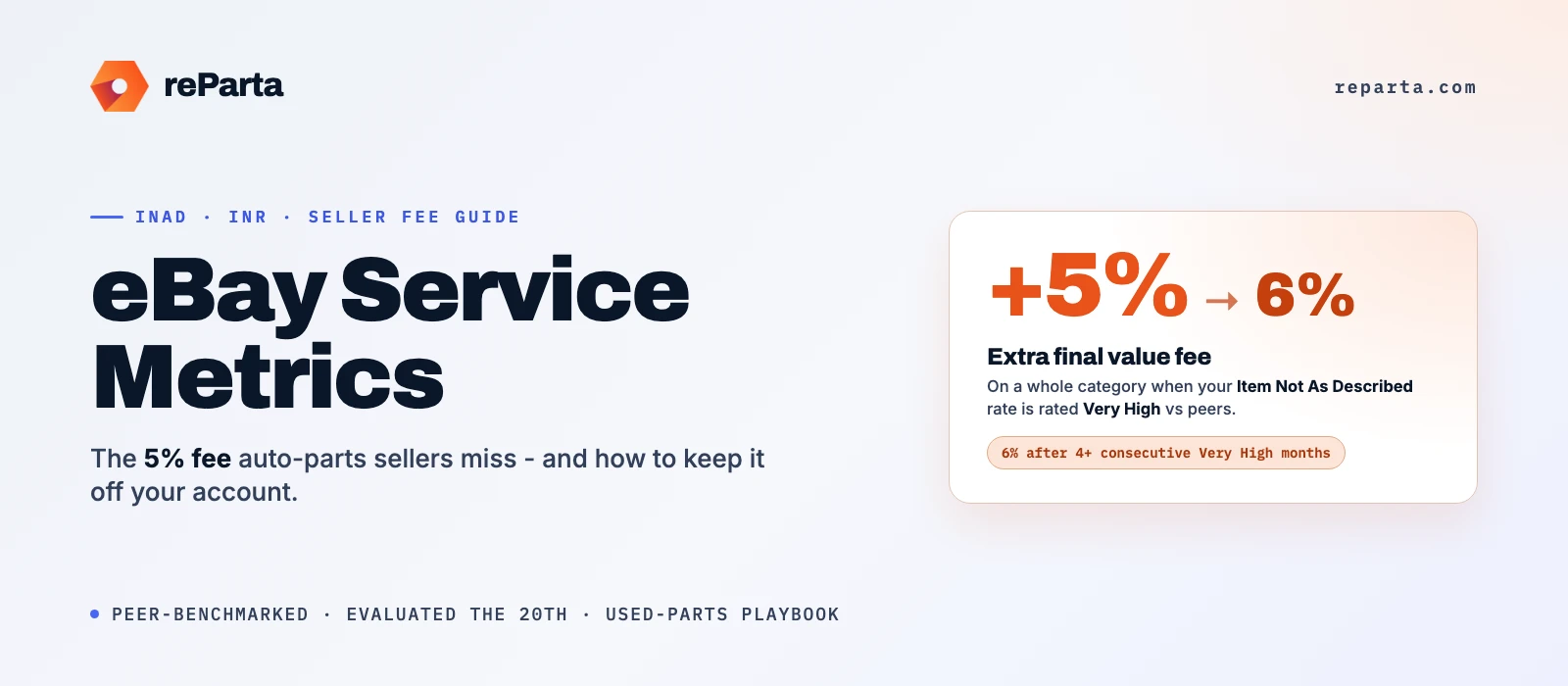
Most auto-parts sellers watch their feedback and their Seller Level. Fewer watch the number that quietly adds 5% to their fees: eBay service metrics. If your “item not as described” rate lands in the Very High band versus your peers, eBay charges an extra 5% final value fee on that whole category the next month - and for used parts, the most common trigger isn’t a bad part, it’s a fitment mismatch that eBay now counts as “not as described.” This guide covers exactly how service metrics work, a reference table you can keep, what the fee costs, and the levers that keep you out of the penalty band.
What eBay service metrics actually measure
eBay tracks two service metrics, each compared to a peer group of sellers with similar items, prices, and policies - not against a fixed percentage:
- Item not as described (INAD): the rate at which buyers open a return request saying the item doesn’t match the listing.
- Item not received (INR): the rate at which buyers report an item didn’t arrive.
Each metric is rated Low, Average, High, or Very High relative to that peer group. Only Very High carries consequences.
eBay service metrics at a glance
Keep this reference handy:
| Item not as described (INAD) | Item not received (INR) | |
|---|---|---|
| What it measures | Return requests where the buyer says the item doesn’t match the listing | Reports that the item never arrived |
| Benchmarked against | Peers with similar sales volume, the same categories, similar price and item condition, and similar return policies | Peers with similar volume, the same eBay site, similar item price, and the same shipping destinations |
| Consequence at “Very High” | +5% final value fee on the affected category next month, rising to +6% after 4+ consecutive Very High months | No fee - but eBay may extend the delivery estimates buyers see and hold payouts until tracking shows movement |
| Where you see it | Seller Hub → Performance → Service metrics (per category) | Seller Hub → Performance → Service metrics (per category) |
| Evaluated | On the 20th of each month | On the 20th of each month |
| Window | Last 3 months if 400+ transactions, otherwise last 12 months | Last 3 months if 400+ transactions, otherwise last 12 months |
| Safe harbors | Rate under 1% is treated as Average; only bites at 10+ requests from 10+ unique buyers | Rate under 1% is treated as Average; only bites at 10+ reports from 10+ unique buyers |
How the rating works - and the two safe harbors
A few mechanics decide whether a bad stretch actually costs you:
- It’s peer-relative, not a fixed line. You’re ranked against sellers like you, so the threshold moves. You can have a low absolute rate and still be rated High if your peers are lower - and vice versa.
- The 20th of the month is the checkpoint. Whatever your trailing rate is on the 20th sets your rating, and the fee applies for the following calendar month - though some consequences (payout holds, padded delivery dates) can start right at evaluation.
- The window depends on your volume. More than 400 transactions in the last 3 months? eBay uses the last 3 months. Fewer? It uses the last 12 - so for a small yard, a rough patch lingers far longer.
- Two safe harbors protect small and clean sellers. A rate under 1% is treated as Average no matter what, and a Very High rating only affects your account once there are at least 10 requests from 10 unique buyers. One or two bad returns will not tank you.
The catch for parts sellers: “doesn’t fit my vehicle” is now INAD
Here is why this metric hits used-auto-parts sellers harder than almost anyone. eBay moved the car-parts return reason “doesn’t fit my vehicle” out of buyer’s-remorse and into “item not as described.” That single reclassification means a fitment mismatch now feeds your INAD rate - and typically puts the return shipping on you.
Used parts stack return triggers that a t-shirt never will, and each one lands as INAD:
- Fitment / “doesn’t fit my vehicle” - the big one, and often a buyer picking the wrong vehicle as much as a listing error.
- Wrong or superseded part number - parts sell by interchange across many years and trims; one bad mapping looks like a wrong item.
- Condition worse than described - used wear is subjective; any gap from the buyer’s expectation reads as “not as described.”
- Missing hardware - the bolt, clip, sensor, or connector “that should have come with it.”
- Dead-on-arrival electronics - a used module that was fine off the donor can fail in transit or on install.
- Cosmetic-versus-functional - the part works, but the buyer wanted show quality.
And the metric counts the case the moment it’s opened, by the reason the buyer picks, regardless of how it’s resolved. Win the case, and it still counts. That’s the part sellers find hardest to accept.
The money: what Very High actually costs
The only direct fee comes from INAD. When your item-not-as-described rate is Very High in a category, eBay adds 5% to your final value fees on sales in that category the following month - on top of your standard fees. If the rate stays Very High for four or more consecutive months, that surcharge rises to 6% until your rate improves to High or better. It’s charged on the sale amount, so it comes off the top line, not the profit line.
On thin used-parts margins, that is brutal. A worked example, one affected category:
| Monthly sales in the category | Extra 5% fee | Per year if uncorrected |
|---|---|---|
| $10,000 | $500/month | $6,000 |
| $30,000 | $1,500/month | $18,000 |
On a single $200 part, the surcharge is $10 - and if that part nets you $30, the fee just ate a third of your profit. Because the rate is measured over a trailing window, a cluster of bad returns can keep you in the penalty band for months after the month that caused it.
Item not received carries no fee, but a Very High INR rating can pad the delivery dates buyers see and hold your payouts until tracking updates - which is its own cash-flow problem on heavy, slow-moving parts.
How reParta helps - accurate listings, fewer “not as described” returns. The cheapest way to avoid the 5% fee is to stop the INAD before it happens. reParta builds accurate year/make/model/trim/engine fitment, complete item specifics, and the OEM/interchange number into every listing, so the buyer gets the part they expected.
- Catalog-driven fitment, not hand-typed compatibility
- The exact part number in its own field, with interchange
- The same accurate data pushed to eBay and Facebook, auto-delisted when it sells
The whole system on one printable page - the 5% (and 6%) fee, the safe harbors, and the six fixes that keep your INAD rate low. Enter your email and we’ll send it over.
Email me the cheat sheet →You’ll also join the reParta list for occasional tips for used-parts sellers. Unsubscribe anytime.
What you can and can’t do about a case
There is no per-transaction appeal of a service-metric count - unlike a Seller-Level defect, which you can appeal, a service metric counts the opened request and isn’t individually disputable. Reports come off your rate only in narrow, mostly automated cases:
- Reports from a buyer eBay finds in violation of its abusive buyer policy are removed - but that finding isn’t automatic on your say-so, so report abusive buyers promptly. If eBay confirms a false “not as described” claim, it can also subsidize your return label (up to about $6) and strip the related negative or neutral feedback.
- Under eBay’s separate seller protections, when something outside your control happens - widespread carrier delays or severe weather - eBay removes related negative and neutral feedback and defects and adjusts late-shipment rates.
Everything else stays on your rate. One important caution: sellers widely report that an INR can still count in the metric even when tracking shows on-time delivery and the buyer’s own case is closed in your favor - the help pages don’t promise that valid tracking removes an INR from the metric, only that it protects your case and your money. Upload tracking within your handling time, and add signature confirmation on any order totaling $750 or more (item plus shipping and tax), where eBay requires it for full INR protection.
Service metrics vs Seller Level vs feedback - don’t confuse them
These are three separate systems, and conflating them leads sellers to the wrong fix:
- Service metrics are peer-benchmarked (INAD/INR) and drive the 5% INAD fee and delivery/payout holds.
- Seller Level (Top Rated / Above Standard / Below Standard) uses fixed thresholds - the transaction defect rate, cases closed without seller resolution, late shipment rate - not peer comparison. Below Standard carries its own separate surcharge of 6% on final value fees (rising to 7% after four or more consecutive Below Standard months) plus reduced visibility. The two surcharges don’t stack: if you’re both Below Standard and Very High for INAD in the same month, eBay applies only the Below Standard fee. And you can be Above Standard overall and still get the 5% service-metrics fee, because your INAD is high relative to your peers even when your fixed-threshold defects look fine.
- Feedback is public buyer opinion. It’s a reputation signal, but it does not by itself set your fees or your level.
This is also where the “eBay is shadowbanning me” idea falls apart: account-health demotions are disclosed in Seller Hub, not hidden. If you want that argument in full, see why eBay isn’t shadowbanning your auto parts.
How to check and lower your service metrics
Check them monthly, right after the 20th: Seller Hub → Performance → Service metrics. Read your rate against the peer benchmark, per category, and watch the projected rate for anything trending toward High.
Lower them at the root cause, since you can’t appeal individual cases:
- Fitment first. Build the compatibility table with year, make, model, trim, and engine, validate against eBay’s vehicle list, and encode option traps (with tow package, hybrid only). Fitment is the number-one INAD driver on parts. See eBay Motors fitment and item specifics and how to write an auto part listing.
- Part number in the MPN field, with interchange and any supersession checked before you list.
- Defects-first descriptions with photos of the actual part - the crack, the scuff, the casting number - and an honest condition grade.
- Complete item specifics (brand, placement on vehicle, type) so the wrong buyer never lands on the listing. More on cutting returns in reduce wrong-fitment returns.
- Tracking within your handling time and fast shipping to keep INR low; report buyers who abuse the system.
- Resolve problems before a case opens - a message handled directly never becomes a metric hit.
A note on eBay Guaranteed Fit, because parts sellers lean on it wrongly: on eligible listings that carry compatibility data, when a buyer selects “doesn’t fit my vehicle,” eBay gives the buyer a prepaid return label at no cost to you - but you still have to accept the return even if you don’t offer returns, and, crucially, it does not remove that return from your item-not-as-described metric. Guaranteed Fit protects your return-shipping cost, not your service metric. It also excludes universal and customized or remodeled parts, oversized and very heavy items, international and multi-package returns, and the wheels and tires category - so it’s a reason to get fitment exactly right, not a shield to lean on. (Verify current terms on eBay before you rely on it.)
Price the risk in before you buy the car
Returns and fees are a cost of doing business on eBay, and the sellers who stay profitable price that cost in. reParta’s Pre-bid ROI and per-donor P&L let you factor return and fee risk into whether a car or a part is worth your money in the first place - so a thin-margin category doesn’t quietly go net-negative under a 5% surcharge you didn’t see coming.
Try reParta free
reParta is the pre-bid, list-everywhere, know-your-profit operating system for used-auto-parts sellers. Build accurate fitment and item specifics into every listing to keep “not as described” returns down, list the same inventory across eBay and Facebook, and know a part’s real profit before you spend time on it.
Start your 14-day free trial - no card required
Takeaways
- eBay service metrics rate your “item not as described” (INAD) and “item not received” (INR) against category peers, on the 20th of each month, over the last 3 months (400+ transactions) or 12 months.
- Very High INAD = an extra 5% final value fee on that category the next month (6% after four or more consecutive Very High months); Very High INR = no fee but padded delivery estimates and payout holds. Two safe harbors: under 1% is treated as Average, and it only bites at 10+ requests from 10+ unique buyers.
- For parts sellers, “doesn’t fit my vehicle” now counts as INAD, and the metric counts every case when it opens regardless of outcome - so accurate fitment is the real fix.
- You can’t appeal individual cases; prevent them with airtight fitment, item specifics, honest condition, and fast tracked shipping - start free and build that accuracy in.
Frequently asked questions
What is a service metric on eBay?
It's one of two performance measures eBay tracks against your category peers: your 'item not as described' (INAD) return-request rate and your 'item not received' (INR) rate. eBay rates each Low, Average, High, or Very High relative to sellers with similar items, prices, and shipping - not against a fixed percentage. Only a Very High rating carries consequences.
Why is eBay charging me an extra 5% fee?
Because your 'item not as described' rate was rated Very High versus your peers in one or more categories on the 20th-of-month evaluation. eBay then adds 5% to your final value fees on sales in those categories for the following calendar month, rising to 6% if the rate stays Very High for four or more consecutive months. It's category-specific and temporary - it lifts once your rating improves to High or better at a later evaluation.
What counts as 'item not as described' on eBay?
A return request where the buyer says the item doesn't match the listing. For auto parts that includes 'doesn't fit my vehicle,' wrong or superseded part number, condition worse than described, missing hardware, and dead-on-arrival electronics. eBay counts the request when it's opened, by the buyer's chosen reason, regardless of how the case is resolved.
Does 'item not received' hurt my seller rating?
A Very High INR rating does not add a fee, but eBay may add extra days to the delivery estimates buyers see and hold your payouts until tracking shows the item shipped. Upload valid tracking within your handling time and ship fast to keep it low. An opened case tied to a buyer eBay finds abusive is removed from your service metrics, and eBay removes feedback and defects when problems are outside your control, like weather or carrier delays.
How do I lower my 'item not as described' rate?
Fix the root cause: accurate fitment in the compatibility table (year, make, model, trim, engine), the exact part number in the MPN field, complete item specifics, and defects-first descriptions with photos of the actual part. Resolve buyer problems before they open a formal return. You can't appeal individual cases, so prevention and clean volume are the only real levers.
How much do I need to sell before service metrics count against me?
eBay only rates a metric when it has enough data, and a Very High rating only affects your account once there are at least 10 reports or requests from 10 unique buyers. Any rating where your rate is under 1% is treated as Average. Your evaluation window is the last 3 months if you had more than 400 transactions, otherwise the last 12 months.