Selling Used OEM Parts on eBay Motors: Getting Found Past the Aftermarket Flood
If you sell genuine used OEM parts on eBay Motors, you have watched this happen. A buyer searches for an original equipment part, and the results are a wall of brand new aftermarket listings, half of them marked “Used” with a description that says “open box, 90% new, may have a scratch or two.” Your actual pulled-from-the-car OEM part is buried pages deep under a wall of mislabeled aftermarket listings. You did nothing wrong, and you are still invisible - one of the more maddening listing visibility problems on eBay.
Short version: you cannot report your way out of this, but you can out-structure it. The aftermarket flood is real and eBay’s tools to fight it are weak. The durable fix is making your listings win the filtered searches that the knockoffs cannot honestly follow you into. Here is how it actually works.
Why eBay Motors is flooded with aftermarket parts listed as “Used”
The New condition in Motors Parts & Accessories got so overrun with aftermarket product that a brand new listing just drowns. So a chunk of dropshippers do something sneaky: they list a brand new aftermarket part under the Used condition, then cover themselves in the description with “85% new” or “open box.” Listing under Used is where they get seen, and the vague description is their fig leaf against a not-as-described claim. There is a second payoff: since around July 2025 eBay has forced free returns on New and New-other Motors parts listings while Used stays exempt, so tagging a new part as Used also ducks that returns cost.
It is against the spirit of eBay’s condition and category rules, but for eBay these are still sellers paying final value fees, so the platform is in no hurry to purge them. The result is a used-parts search experience that buries the people actually selling used parts. It also weakens the one label you are entitled to use: when new parts keep turning up tagged Used, the Used filter stops being a reliable signal, and a genuine seller’s honest Used tag gets discounted along with the fakes, which is why out-structuring the flood beats leaning on the condition tag alone.
Can you report aftermarket parts miscategorized as used OEM?
This is the part most sellers waste time on, so be realistic about it.
There is no clean “wrong condition” or “wrong category” button in eBay’s report flow. What you can do is open the question-mark icon in the bottom-right of a listing, choose Report content, and work down through the listing-practices and search-manipulation options to the closest condition or category match. Fair warning that it is a workaround: a new part dumped into Used is really a condition problem, and eBay’s search-manipulation policy is aimed more at keyword and traffic games than at condition, so it does not map cleanly. It is worth firing off on the truly blatant ones, but set your expectations low: those reports get screened by eBay’s automation first, it is hit-or-miss on condition mislabeling, and the community consensus (and most sellers’ lived experience) is that a single report usually goes nowhere. Mass-reporting mostly just burns your afternoon.
A few things that do NOT help, so you can stop chasing them:
- VeRO won’t touch this. eBay’s Verified Rights Owner program is for trademark, copyright, and counterfeit issues, not for a competitor putting a new part in the Used category. You have no standing there.
- You can’t force anyone to recategorize. Only the listing’s seller or eBay can change a condition, and there is no external lever a rival can pull.
- Posting on the eBay forums won’t reach a category manager. There is no evidence that community threads feed enforcement decisions, so treat that as venting, not a fix.
Reporting is a coin flip at best. So spend your energy where you actually have control: your own listings.
How to win the filtered search for genuine used OEM parts
Serious parts buyers do not scroll 600 results. They filter. And the filters are exactly where an honest OEM listing beats a mislabeled aftermarket one, because the aftermarket seller cannot honestly populate the fields you can.
Set the Brand item specific to the actual OEM manufacturer. On Motors, Brand is supposed to be the maker of the part. A genuine part carries the real OEM brand (Ford, Toyota, BMW, ACDelco, Motorcraft, and so on). A lot of dropshippers just leave Brand as “Unbranded” or “Generic,” or stuff in a throwaway house brand. eBay also exposes a Brand Type filter (Genuine OEM, Aftermarket Branded, Private Label, Unbranded). So when a buyer filters by the actual manufacturer or sets Brand Type to Genuine OEM, most of that Unbranded pile drops right out of their results, and your correctly-tagged listing is still standing.
Honest caveat: this thins the junk, it does not kill it. Some aftermarket sellers falsely stuff the OEM brand into their listings to piggyback on that filtered traffic. The Brand filter cuts out the lazy sellers, not the ones deliberately gaming it. Which is why the next lever matters more.
| Brand Type value | What it means | Set it when | Survives a “Genuine OEM” filter? |
|---|---|---|---|
| Genuine OEM | Made by the vehicle or original-equipment manufacturer | Your part is a real OE piece pulled from a vehicle | Yes |
| Aftermarket Branded | A named non-OE maker (Dorman, Bosch, and the like) | It is a reputable aftermarket brand | No |
| Private Label | A seller’s own house brand | Rare for used parts | No |
| Unbranded | No brand given | The maker is genuinely unknown, which is where a lot of the miscategorized dropship parts sit | No |
Part numbers are your moat. Put the genuine OEM number, the OE/interchange number, and the MPN into the title and the item specifics, not just the description. The buyers who specifically want original parts (independent shops, restorers, people fixing the exact car) search by the number. A generic aftermarket part cannot honestly carry the real OE part number for the piece it is imitating, so when someone searches that number, you surface and the knockoff does not. The interchange number is doubly useful because one number can match your part to every equivalent application, widening how many exact-number searches you show up in. Getting the interchange number right is one of the highest-leverage things a used-OEM seller can do, and it starts with an accurate OEM part-number cross-reference.
Fill every fitment and item-specific field. eBay’s parts search and the “shop by vehicle” filters read your structured item specifics, not your prose. A half-empty listing drops out of exactly the filtered searches serious buyers use. This is the same discipline that decides whether your parts get found at all, and when fitment data falls off your listings you fall straight out of those filtered results with it.
Keep your titles clean. Buyers who are sick of the flood use the minus-sign trick, searching things like -fits -for to strip out the aftermarket listings that describe compatibility as “fits [vehicle]” or “for [vehicle].” It is not a perfect filter, but it is common. So keep that filler out of your own titles and lead with the real part name and number, and you survive those exclusion searches instead of getting swept out with the knockoffs.
Put genuine OEM listing discipline on autopilot
None of this is exotic. It is discipline: the real OEM brand, the genuine OE and interchange numbers, the MPN, and complete fitment, filled out correctly on every single listing. That is tedious at any real volume, which is exactly where it slips, and a half-finished listing is an invisible one. You cannot clean up the category, but you can make sure the buyers who genuinely want real used OEM land on you instead of scrolling past you.
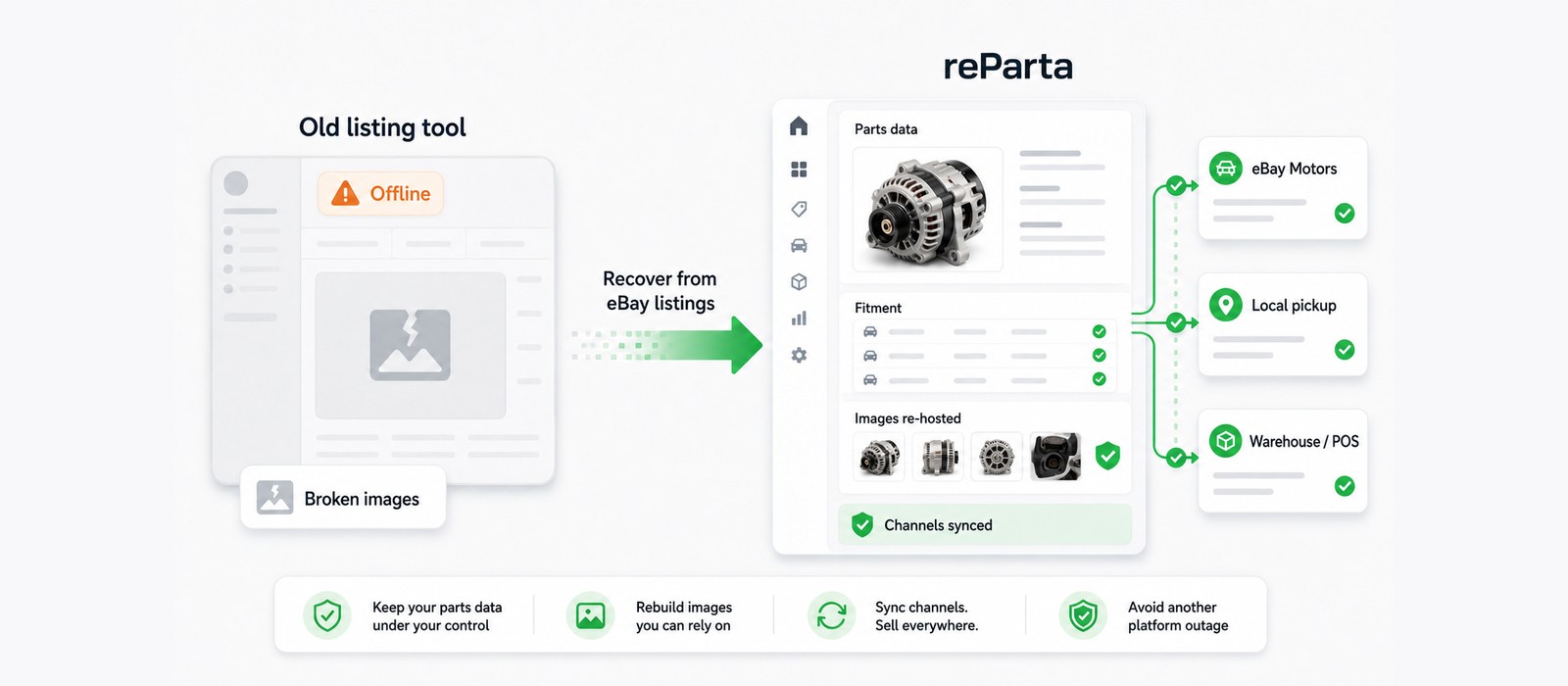
Keeping that part data complete and consistent across every listing and every channel is exactly what reParta does for dismantlers: it catalogs each part with the OE, interchange, and MPN numbers and complete fitment, then lists it across eBay and Facebook from one record with multi-channel listing, so no listing goes out half-finished and nothing double-sells. (reParta is an independent product, not affiliated with eBay.) You do not need software to do this - you need to actually do it on every part, which is the hard part.
If you want to see the profit side before you buy the car, try the free part-out value tool or start a 14-day free trial (no card required).
Last verified: September 11, 2026.
Frequently asked questions
Why can't buyers find my genuine used OEM parts on eBay Motors?
Because the results are flooded with aftermarket listings, many of them new parts mislabeled as Used to get seen. Your listing is not hidden, it is out-ranked and out-numbered. The fix is to win the filtered searches: set Brand to the real OEM maker, put the genuine OE and interchange numbers in the title and item specifics, and fill every fitment field so you surface for the buyers who filter and search by number.
How do I report an aftermarket part that is listed as Used?
Open the question-mark icon at the bottom-right of the listing, choose Report content, and work down to the listing-practices and search-manipulation options, picking the closest condition or category match. Be realistic: it is a workaround, since condition abuse does not map cleanly to that policy, the reports are automation-screened, and they are rarely acted on for condition mislabeling, so do not build your strategy around reporting.
Does filtering by Brand actually exclude the aftermarket junk?
Mostly. Genuine parts carry the real OEM brand; a lot of dropshippers leave Brand as Unbranded or Generic, so a buyer filtering by the manufacturer (or setting Brand Type to Genuine OEM) drops those out. It thins the junk rather than eliminating it, because some aftermarket sellers falsely tag the OEM brand, which is why part numbers matter even more.
Genuine OEM, Aftermarket Branded, or Unbranded: what should I set?
If you are selling a real original equipment part pulled from a vehicle, set Brand to the actual manufacturer and, where eBay offers it, Brand Type to Genuine OEM. Accurate condition and brand are also what keep you out of trouble, unlike the sellers gaming it.
Will VeRO help me get a miscategorized listing removed?
No. VeRO is for intellectual property (trademark, copyright, counterfeits), not for a competitor putting a new part in the Used category. There is no lever to force another seller to recategorize.