Auto Parts Not Selling on eBay? How Best Match Ranks Parts
If you’re pulling salvage cars and listing the parts, auto parts not selling on eBay is a problem you have almost certainly hit. You’re the cheapest on the exact same module, it’s a clean listing, and it just sits. Meanwhile the forums are full of people swearing eBay is dead or deliberately hiding them.
Short answer: eBay isn’t hiding your parts, and it isn’t dying (its overall sales are still growing, with Motors a named strength). Your listings are getting out-ranked in Best Match, mostly by promoted and better-optimized ones, and dropping your price won’t fix a listing nobody can see. The rest of this is how the ranking actually works for parts and what you can change.
Auto parts not selling on eBay? It’s ranking, not hiding
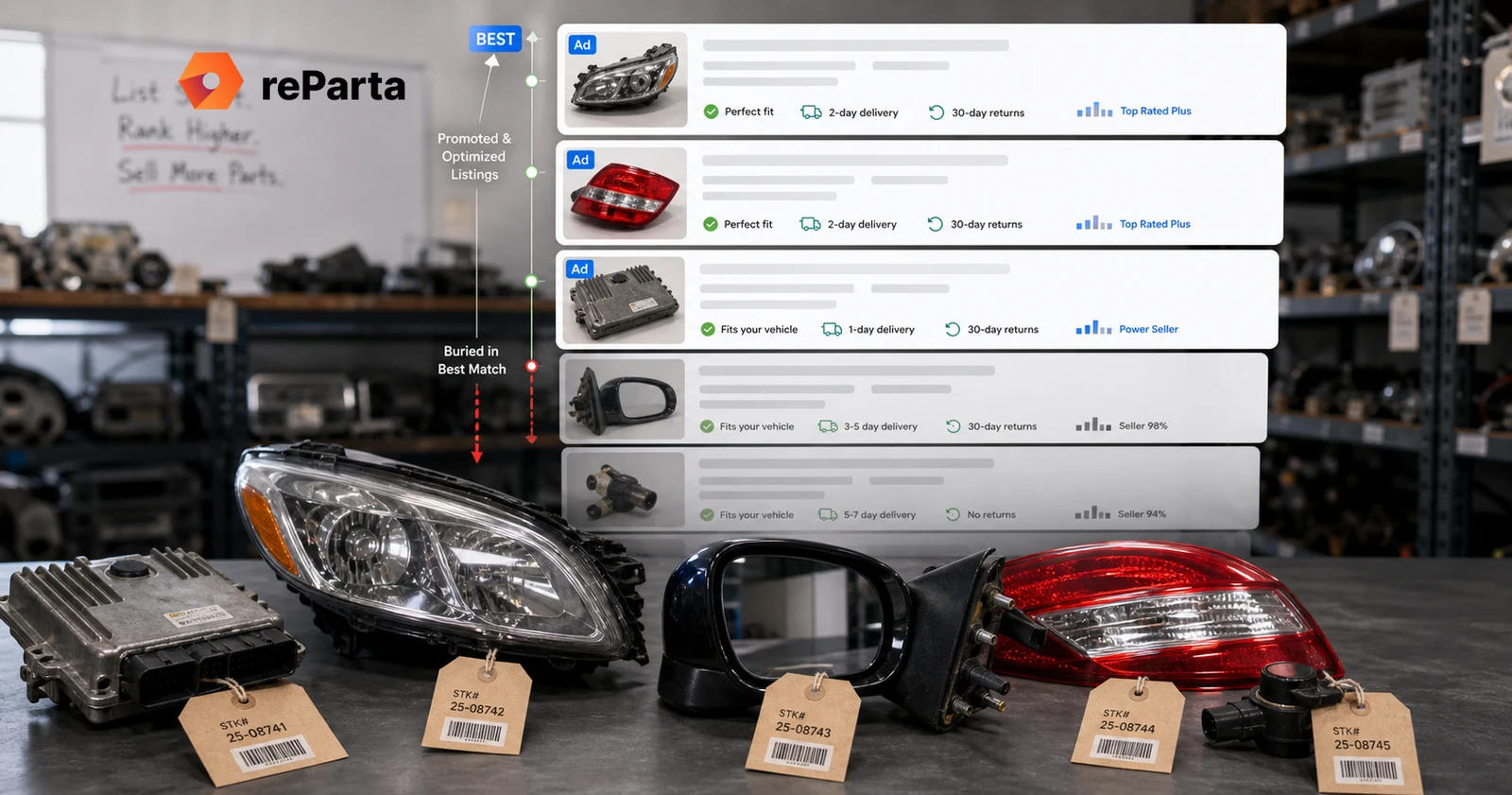
Auto parts not selling on eBay looks, from where you sit, exactly like eBay may be shadowbanning your auto-parts listings, deliberately hiding them. It’s the wrong frame. eBay’s search runs on an algorithm (historically known as Cassini, with the buyer-facing ranking eBay calls Best Match) that decides which listings to show and in what order, based on what it thinks is most likely to sell. Promoted listings get prime placement and push everything else down. So in a category where a big share of sellers are promoting, your unpromoted part isn’t deleted, it’s sitting several pages deep where almost nobody scrolls. From your seat that looks identical to hidden. It isn’t. It’s ranking.
That distinction matters, because “they’re hiding me” leads to rage and quitting, while “I’m getting out-ranked” leads to things you can actually fix.
How does eBay Best Match rank auto parts?
eBay keeps the exact recipe under wraps, but the main ingredients are well understood. Here’s how they translate for a part, and what to do about each.
| Ranking factor | Why it matters for parts | Your fix |
|---|---|---|
| Relevance (fitment + item specifics) | Best Match reads your whole listing, and buyers search by exact number. Miss the number and you don’t exist to them | Put the OEM/interchange number and full fitment (year, make, model, trim, engine) in the title AND item specifics |
| Listing quality | Complete details and real photos feed both the match and the buyer’s trust | Don’t rush a Sell Similar you never checked |
| Price | Competitive converts better and ranks better, but lowest is not a magic slot | Price to real sold comps, not to the bottom |
| Handling time | eBay names fast handling as a Best Match input; low or free shipping cost is widely believed to help too, though eBay doesn’t confirm the cost itself as a signal | Quick handling; lowest shipping the math allows, free where it pencils |
| Returns | eBay names your return policy as an input, and offering returns converts better | Offer them if wrong-fit returns won’t sink you |
| Seller performance | Defect rate, late shipment, tracking upload and Below Standard status all gate your visibility | Keep metrics clean, aim for Top Rated |
A few of those deserve a longer word for parts specifically.
Relevance is the one parts sellers most often leave money on. Best Match starts with the buyer’s search words and matches them against your entire listing, not just the title. A buyer searching an exact interchange number will not find a listing that doesn’t carry it, and if your item specifics are half-empty you’re invisible to the exact people looking for your part. Getting the listing itself right is step one, and when fitment data falls off your listings your relevance and your sales drop with it.
Handling and shipping pull double duty. eBay names fast handling time as a Best Match input, and quick dispatch is squarely in your control. Free shipping (cost baked into the price, not paid out of your pocket) is widely believed to help ranking too, though eBay doesn’t confirm the shipping cost itself as a signal, and for heavy parts that math is brutal, which is why how you ship used parts and the 2026 USPS rate changes decide whether free shipping is even survivable.
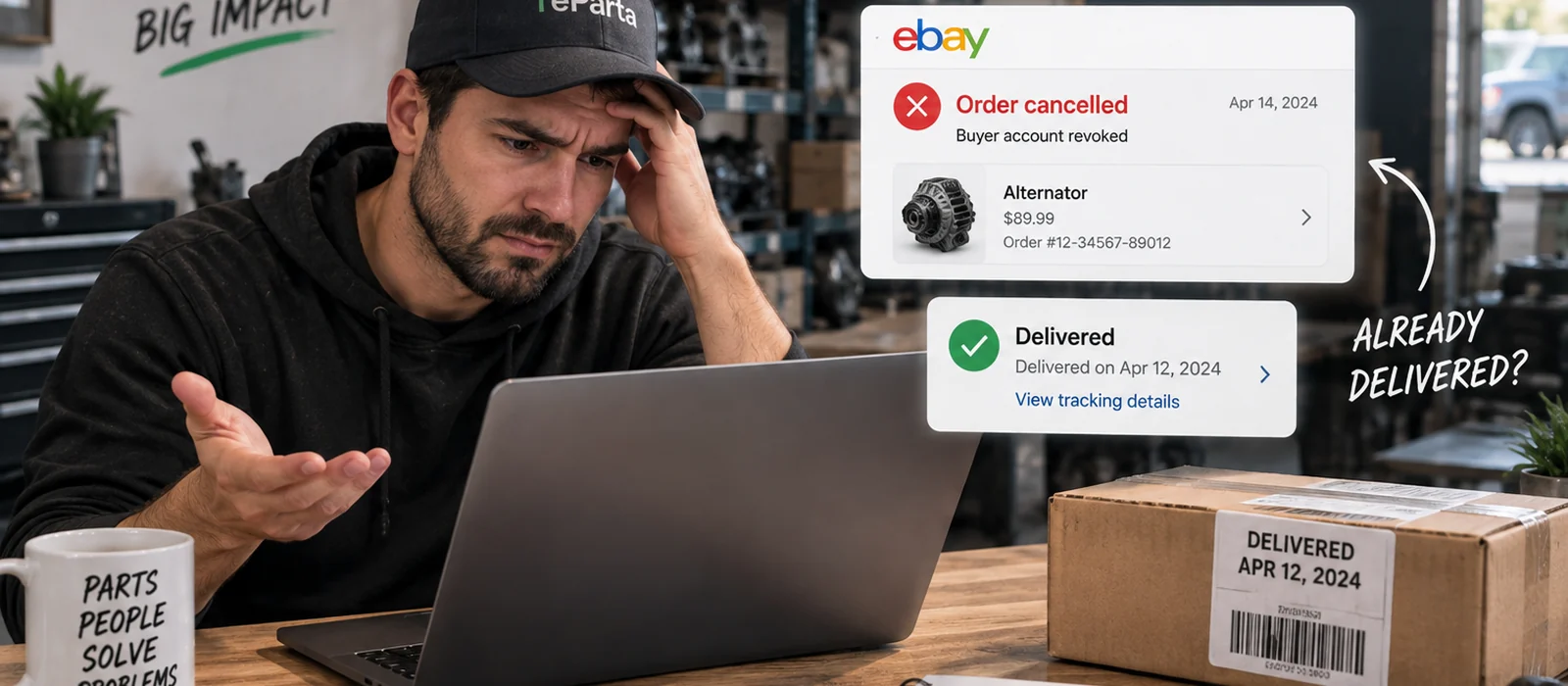
Seller performance quietly gates everything. Out-of-stock cancellations and cases closed against you drag you toward Below Standard, which demotes every listing you have. Clean metrics aren’t just a badge, they’re a ranking lever.
Relisting is a tactic, not a ranking factor. eBay’s Best Match doesn’t reward newness for its own sake, the modern algorithm deliberately moved away from the old recency ordering, so there’s no confirmed age penalty. What ending and relisting actually does is mint a genuinely new item ID (unlike eBay’s automatic monthly renewal, which keeps the old ID and its history), and that can reset a stale, sale-less listing that had quietly stopped converting. Use it that way, and remember parts skew long-tail, a specific part can take months to meet its buyer, so don’t panic-relist a niche piece at 25 days just because a general reseller would.
eBay Best Match vs lowest price: why cheapest doesn’t win
This is the one that frustrates good sellers most. You checked, you’re the cheapest on the exact part, and it still sits. Here’s why: most buyers never re-sort. They type their part in, they get the default Best Match order, and they buy from what’s in front of them. Few switch to “Price + Shipping: lowest first,” and for parts the first thing a buyer narrows by is usually fitment and condition, not price. So if your cheaper listing is buried on page three because everything above it is promoted or better optimized, the buyer never sees your price at all. Being cheapest only wins when the buyer is looking at a sorted-by-price list, and in parts most of them aren’t. Cheapest is dead weight until something gets you onto page one, and then your price does the closing.
eBay Promoted Listings: what changed on January 13, 2026
Promoting is the one factor strong enough to jump the line past most of the others. You set a rate, eBay pushes your listing toward the top, and in saturated parts categories it’s often the difference between sitting and selling. (eBay renamed the two ad products in 2026: the pay-when-it-sells option, formerly Promoted Listings Standard, is now General, and the cost-per-click option, formerly Advanced, is now Priority.) A few things changed on January 13, 2026 that every parts seller should understand:
- The top search slot is now reserved for cost-per-click ads (Priority, formerly Promoted Listings Advanced). The pay-when-it-sells listings (General) fill the slots below it. So the very top of a competitive parts search is increasingly a paid auction.
- The old cross-item “halo” billing is gone. It used to be that if a buyer clicked your promoted listing and then bought a different item from you, you paid the ad fee on that too. That specific billed mechanic was removed.
- The fee now triggers on any click, any buyer, same item. If your item is promoted, anyone clicks it, and that same item sells within 30 days, you pay the ad fee. One catch: sellers click each other’s listings while doing research, so promoted items catch more of those clicks now. Watch your effective ad rate.
That last change also matters for the “halo” you’ll hear about, the idea that promoting or selling a batch lifts your other listings. The real version is behavioral: the paid traffic pulls buyers into your store, and some of them browse and buy your unpromoted parts while they’re there. A burst of sales activity can also nudge your whole store’s organic standing, though that’s a gradual lift over days and weeks, not overnight. What’s gone is only the old billed halo (a click on one promoted part, a purchase of a different one, still charged you the ad fee). So promoting can help your other listings indirectly, just don’t bank on it as a guaranteed boost, and don’t assume you’re now paying an ad fee on the parts you didn’t promote.
Is promoting worth it for used auto parts?
For the common, competitive stuff, usually yes. Here’s the honest part though: in saturated categories, and a lot of common parts and electronics qualify, it’s effectively pay to play now. If most of the competition on a given part is promoting, an unpromoted listing is structurally disadvantaged no matter how good or how cheap it is. That’s not a conspiracy, it’s the math of a results page where paid slots come first. (It’s also part of why running the same part on Facebook Marketplace alongside eBay is worth it, different buyers, no eBay ad rate to fight.)
Two practical reads. First, don’t chase the high suggested rate. eBay may nudge you toward rates as high as 40 percent, but that suggestion is optimized for eBay’s revenue, not your margin. In precise-search niches like parts, where the buyer is hunting an exact number, a modest 2 to 5 percent usually does the real job, which is just getting you back into the visible rows. You’re not fighting a bidding war over a generic keyword the way a phone-case seller is. Test it on your own inventory before you pour money in.
Second, where it’s not worth it: genuinely rare or specific parts. If you’re the only listing (or one of a few) for an oddball interchange, the buyer who needs it will find you because there’s nothing above you to bury it, and promoting a part nobody else is searching for just burns money. Promote the common, competitive stuff. Let the rare stuff ride.
What actually moves parts: the checklist
If you want to fix auto parts not selling on eBay, these are the levers, in order of how often sellers neglect them:
- Full fitment and the OEM/interchange number in the title and the item specifics, every time.
- Complete listing details and clear photos, not a rushed Sell Similar you never checked.
- Priced competitively against real sold comps, not cheapest for its own sake.
- Fast handling and the lowest shipping you can manage, free where the math works.
- Returns on if you can stomach it, and metrics kept clean enough to hold Top Rated.
- End and relist stale common parts, but let long-tail rarities sit.
- Promote the competitive stuff at a modest rate, skip promoting the rare stuff.
No single one is a magic bullet except promotion, and even that only works on top of a good listing.
Where this ties back to your numbers
Notice that almost none of this is free. Promoting, free shipping, returns, it all comes out of the same margin. So the number that matters most isn’t your promote rate, it’s what each part actually nets you after fees, shipping, and ad spend, and whether the lot you pulled it from ever penciled out in the first place. If you’re deciding how hard to promote a part, you need to already know its real per-part economics.
This is where reParta helps, on both halves of the problem. It builds each part’s listing the way eBay’s Best Match actually rewards it, with full fitment, item specifics and OEM/interchange numbers pulled in automatically, so your parts read as relevant and get found instead of buried, and it lists to eBay and Facebook from one inventory with auto-delisting so you never double-sell. And it tracks each part’s real economics, projected profit before you bid and actual profit per donor after fees and shipping, so you know which parts are worth promoting and how hard, instead of guessing at an ad rate. reParta is an independent product, not affiliated with eBay. List the way eBay’s algorithm rewards, and know your numbers - start a free 14-day trial.
Frequently asked questions
Is eBay hiding my unpromoted auto parts?
No. They're not deleted, they're out-ranked. Promoted and better-optimized listings sit above yours, so in a saturated parts category your listing lands pages deep where buyers rarely scroll. It looks like hiding, but it's ranking, and ranking is something you can influence.
Why aren't my auto parts selling on eBay even though I'm the cheapest?
Because most buyers don't sort by price, they buy from the default Best Match order, and they narrow by fitment and condition before price. If you're cheapest but buried, the buyer never sees your price. Get visible first, then competitive pricing closes the sale.
Is it worth promoting auto parts on eBay?
For common, competitive parts, usually yes, at a modest 2 to 5 percent, because it gets you back into the visible rows. For rare parts nobody else lists, no, the buyer will find you anyway and you'd be paying for placement you don't need.
How do I rank auto parts higher in eBay Best Match?
Fitment and item specifics filled out completely, a competitive price, fast and cheap shipping, returns enabled, clean seller metrics, fresh listings, and promotion on the competitive items. No single one is a magic bullet except promotion, and even that only works on top of a good listing.
Did eBay change Promoted Listings in 2026?
Yes, on January 13, 2026. The top slot shifted to cost-per-click ads, the old cross-item halo billing was removed, and the fee now triggers on any click and any buyer purchasing that same promoted item within 30 days. Don't chase the high suggested rates, in parts a modest rate usually does the job.