How to Ship Auto Parts Without Losing Money
Auto parts sit in the worst possible spot for shipping. They are dense, heavy, and oddly shaped, but often not big enough to go freight, which drops most of them into the most expensive grey zone carriers have. Get the setup wrong and shipping quietly eats your margin on every sale, or a single damage claim wipes out a week of profit. This is a complete, plain-English guide to how to ship auto parts without bleeding money, built around the problems sellers actually run into.
Part 1: Small to medium parts (the stuff you can actually ship)
Dimensional weight, or why a light part costs like a brick
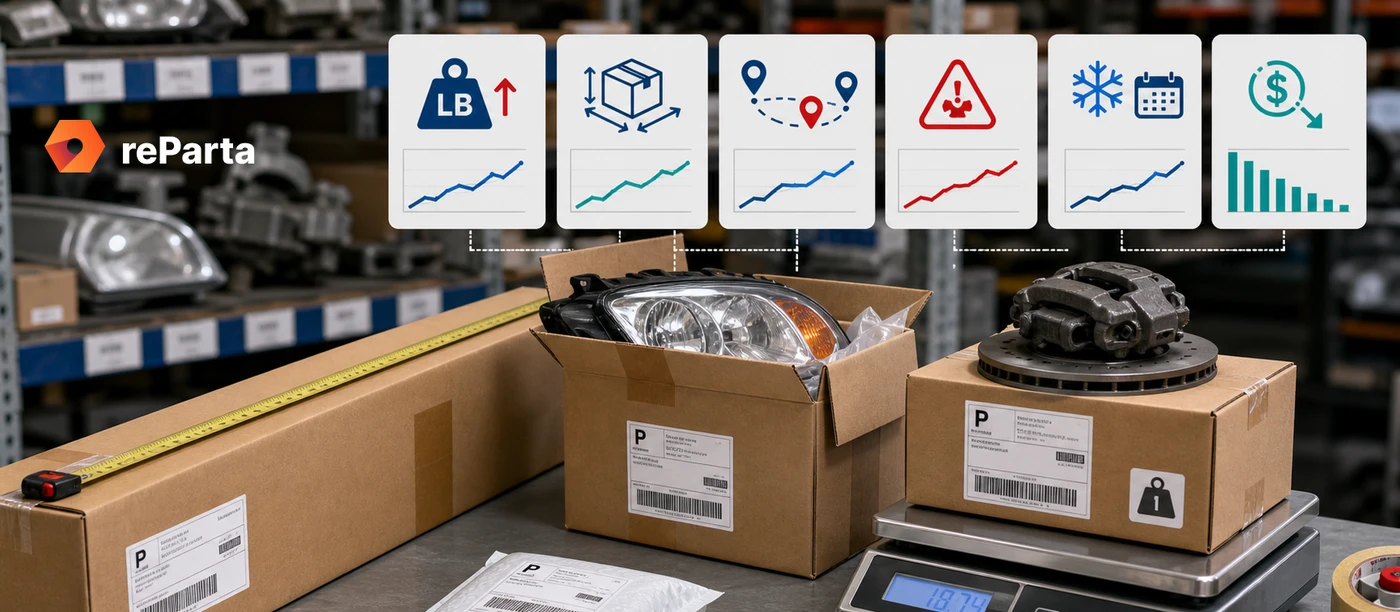
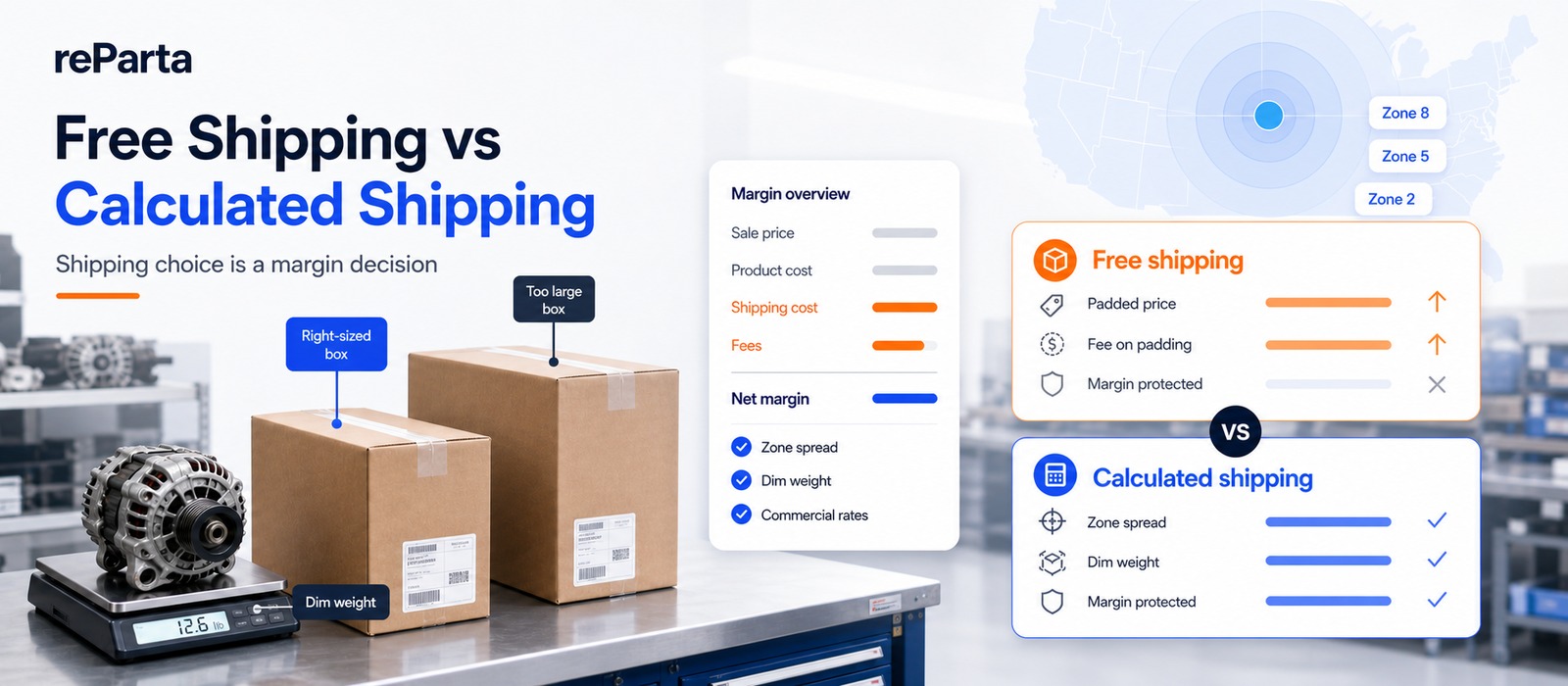
Carriers price on size as much as weight. Once a box passes roughly one cubic foot, dimensional weight kicks in and a light bulky part - a trim piece, a plastic cover, a small bumper - gets billed as if it were much heavier than it is. Small dense parts like alternators, modules, and brackets are where shipping is genuinely cheap. So the first question on any part is not just what it weighs, it is how big is the box, because that is what actually sets the price.
Set up calculated shipping so YOU are not the one eating it
The most common quiet money-leak: a seller thinks calculated shipping is on, but every buyer pays the same flat amount while eBay charges the real, higher zone rate on distant orders. That difference comes straight out of your pocket. With calculated shipping working correctly, the far-zone buyer pays the far-zone price, not you. Check that:
- Your policy is set to Calculated, not Flat.
- Package weight and dimensions are actually entered - blank fields make eBay fall back to a flat default.
- Your ship-from ZIP is set.
- No fixed shipping cost is typed in that overrides the calculation.
Fix those and distant buyers pay their true rate.
Match the carrier to the weight
USPS Ground Advantage is great for small, dense parts and includes up to $100 of insurance by default. As the weight climbs, USPS stops being competitive and UPS or FedEx Ground usually wins. For compact but heavy items, flat rate boxes can beat everything because they ignore weight and zone entirely. The move is to price the same package a few ways rather than defaulting to one carrier out of habit.
Flat rate and regional rate are your friend on compact heavy parts
Flat rate and regional rate boxes are zone-blind: one price to anywhere. That matters most if you ship from a far corner of the map. If you are in Hawaii, Alaska, or the edges of the lower 48 where nearly every destination is a high zone, anything that fits a flat or regional rate box should default to it, because calculated rates will ding you on distance every time.
Part 2: The big stuff (when it becomes freight)
When a part is freight, not a package
Roughly 150 pounds or genuinely oversized - an engine, a transmission, a full front clip - and you are into LTL freight, not a normal label. LTL means your item shares trailer space with other shipments. Freight marketplaces like uShip and freight brokers let you compare quotes instead of paying retail. To get a quote you need accurate length, width, height, and weight, so measure before you list.
Engines and transmissions: drain the fluids and crate it
Two things sink people here. First, drain all fluids before shipping. Residual oil or trans fluid leaks in transit and triggers hazmat charges or outright rejection. Second, most LTL carriers require the unit fully secured, so bolt it to a skid or an engine stand that is bolted to the pallet. A loose engine on a pallet is a claim waiting to happen.
Body panels and bumpers: ship on edge, protect the corners
Hoods, fenders, and bumpers should ship on edge, not flat. Edge orientation resists flex damage and uses pallet space better. Wrap the piece in heavy plastic with real padding, and pad every sharp or pointed corner, because that is where the box gets punctured and where scratches start.
The oddball oversized stuff
For crazy-shaped items that will not box cleanly, some sellers use options like Greyhound bus freight, which can move awkward pieces without a perfect crate. It is not the first choice, but it is worth knowing about when nothing else fits.
Part 3: The hazmat rules you cannot ignore
This is where sellers get fined, delayed, or suspended without realizing they broke a rule.
Airbags
Only never-deployed airbags may be sold, and they are hazardous material. They cannot go through USPS at all, they require hazmat-compliant packaging and labels, and eBay requires sellers to hold active Automotive Recyclers Association (ARA) certification and membership, plus a specific certification statement in the listing that the airbag is not subject to recall and will ship under hazmat rules. If you sell airbags, treat this as a hard checklist, not a suggestion. Note that airbags are now banned on eBay as of September 24, 2026, so those eBay-specific rules apply only to other channels - the hazmat handling still applies.
The auto parts that secretly count as hazmat
The trap is that a lot of normal-looking parts are restricted and you would never guess it. Before you ship, check whether the part is actually one of these:
- Gas-charged struts and shocks. They are pressurized with nitrogen, which makes them a restricted pressurized item, not a plain metal part.
- Fuel-system parts with any residual fuel. Fuel pumps, tanks, injectors, carburetors, and fuel rails that have ever had gas in them count, because gasoline is flat out prohibited by USPS. Purge and air them out, and even then some carriers still say no.
- Airbag inflators and seatbelt pretensioners. Like airbags, these contain an explosive charge, so they are prohibited through USPS and need full hazmat handling on another carrier.
- Aerosols in your parts lot. Touch-up paint, brake and carb cleaner, spray lube, and small tire-inflator cans are flammable and ground-only.
- Mercury switches and older sensors. Some vintage hood, trunk, and ABS switches contain liquid mercury, which USPS bans in any amount.
- Lead-acid and lithium batteries. Car batteries are a problem for weight and acid; lithium is ground-only with special labeling.
If you do ship a hazmat part, do it right
Some of these are shippable if you follow the rules. Lithium batteries and battery-containing parts generally go USPS Ground Advantage only, and you cannot drop them in a collection box, they have to go to the counter or a scheduled pickup. Any legit hazmat package has to be separated from your other parcels, in a container marked HAZMAT, with a handling surcharge on top (currently $0 on Ground Advantage, $7.50 on Priority). When in doubt, drain, purge, and check USPS Publication 52 before you ship, not after it gets rejected.
New in 2026: the $50 USPS hazmat noncompliance fee
As of July 12, 2026, USPS enforces a $50 hazmat noncompliance fee. If they decide your shipment is noncompliant, that $50 lands on you. The single most common way sellers get hit is one that parts sellers do constantly without thinking: reusing a box that still has old hazmat labels or markings that do not match what is now inside. That battery box, oil box, or aerosol box you saved gets flagged even though the part in it is harmless.
The fix takes ten seconds. Before you ship in a reused box, remove or completely cover any old hazmat markings, diamonds, or warning labels, and make sure the box’s markings match its actual contents. If you reuse boxes to save money, and most of us do, make blacking out old hazmat labels part of your packing routine so a saved box never costs you fifty bucks.
Part 4: Protect yourself from the claims that erase profit
Insure the expensive small stuff
For a turbo, an alternator, or anything pricey that fits in a box, insurance is cheap relative to the item and covers you if it is lost or smashed. Ground Advantage already includes $100, so you are really deciding how much over that you need.
Pack so a damage claim never gets off the ground
Most damage claims trace to two things: parts moving inside the box and fragile pieces with unprotected corners. Immobilize everything so nothing shifts, double-box anything brittle, and for higher-value items take a 30-second packing video. That one habit ends most “arrived damaged” arguments before they start.
Do not let a buyer hand you their own label
A buyer-provided label voids a lot of your protection - they control the shipment and can reroute it, then claim non-delivery. Legitimate freight-account buyers exist, but the safe rule is you buy the label to the address on the order, or the deal does not happen.
Some parts are not worth shipping at all
For big, heavy, low-value pieces where shipping and return-shipping would swallow the profit, sell them local pickup only. On an item-not-as-described claim you can be stuck paying return freight worth more than the part, so for the truly bulky stuff, local is not a limitation, it is protection. This is exactly where a free channel like Facebook Marketplace for used car parts earns its keep.
How to ship auto parts profitably: it comes down to margin, not postage
Every one of these costs - dimensional weight, freight, hazmat handling, insurance, the occasional claim - is real money that comes off the top of each part. The sellers who stay profitable are the ones who know their true margin per part before they ever buy the car, shipping included.
That is exactly what reParta is built to do. Instead of guessing what is left after shipping, our pre-bid part-out ROI projects what a Copart or IAA lot will actually return in profit with real costs factored in, and per-donor P&L tracks what each part actually nets you. You stop overpaying for inventory that never penciled out once the shipping bill landed - and you learn fast which of the most profitable parts to sell are the ones that also ship cheaply.
Try the free part-out ROI calculator or see how reParta tracks true per-part profit.
Quick reference
- It is the box size, not just the weight. Watch dimensional weight past one cubic foot.
- Make sure calculated shipping is actually on, or you eat the far-zone difference.
- Small dense: Ground Advantage. Heavier: UPS/FedEx Ground. Compact heavy: flat or regional rate.
- Shipping from a high-zone area: default to zone-blind flat and regional rate boxes.
- 150 pounds or oversized: LTL freight, get quotes on a freight marketplace.
- Engines and transmissions: drain fluids, crate or skid them.
- Panels and bumpers: ship on edge, pad every corner.
- Airbags: never-deployed only, no USPS, hazmat plus ARA certification and a listing statement.
- Some normal-looking parts are secretly hazmat: gas-charged struts, fuel-system parts, mercury switches, aerosols. Check before you ship.
- Lithium batteries: Ground Advantage only, counter drop-off, never a collection box.
- Reusing boxes? Cover or remove any old hazmat labels, or risk the new $50 USPS noncompliance fee.
- Immobilize, double-box, and video high-value packs to kill damage claims.
- Never accept a buyer’s own label.
- Big, heavy, low-value: local pickup only.
Frequently asked questions
How much does it cost to ship auto parts?
It depends on the box size as much as the weight. Once a package passes about one cubic foot, carriers bill on dimensional weight, so a light bulky part can cost like a heavy one. Small dense parts like alternators and modules are cheap on USPS Ground Advantage; large parts over roughly 150 pounds go LTL freight; and hazmat parts add surcharges. The real question on any part is how big the box is, because that is what sets the price.
What is the cheapest way to ship auto parts?
Match the carrier to the part. Small dense parts are cheapest on USPS Ground Advantage; compact but heavy parts are often cheapest in flat rate or regional rate boxes because those ignore weight and zone. Make sure calculated shipping is actually turned on so distant buyers pay their own zone rate instead of you eating the difference. If you ship from a high-zone area like Hawaii, Alaska, or the edges of the lower 48, default to zone-blind flat and regional rate boxes.
How do you ship an engine or transmission?
Once a part is around 150 pounds or genuinely oversized it is LTL freight, not a normal label, so get quotes on a freight marketplace like uShip instead of paying retail. Drain all fluids first - residual oil or trans fluid leaks in transit and triggers hazmat charges or rejection. Then bolt the unit to a skid or an engine stand that is bolted to the pallet, because most LTL carriers require it fully secured and a loose engine is a claim waiting to happen.
Can you ship airbags?
Only never-deployed airbags may be sold, and they are hazardous material. They cannot go through USPS at all, they require hazmat-compliant packaging and labels, and eBay requires active Automotive Recyclers Association (ARA) certification and membership plus a specific listing statement that the airbag is not subject to recall and ships under hazmat rules. Treat it as a hard checklist, not a suggestion.
What auto parts are considered hazmat?
More than you would guess: gas-charged struts and shocks (pressurized nitrogen), fuel-system parts with any residual fuel (pumps, tanks, injectors, carburetors, fuel rails), airbag inflators and seatbelt pretensioners (explosive charge), aerosols like touch-up paint and brake cleaner, mercury switches in some older sensors, and lead-acid and lithium batteries. Check each part against this list before you ship it.
How do you ship large or heavy car parts?
Body panels and bumpers ship on edge, not flat, wrapped in heavy plastic with every sharp corner padded. Engines and transmissions get drained and crated or skidded. Anything around 150 pounds or oversized goes LTL freight with accurate length, width, height, and weight for the quote. And for big, heavy, low-value pieces where shipping would swallow the profit, sell local pickup only.
What is the USPS $50 hazmat noncompliance fee?
As of July 12, 2026, USPS charges a $50 fee if it decides your shipment is hazmat-noncompliant. The most common trigger for parts sellers is reusing a box that still has old hazmat labels or markings that do not match the harmless part now inside. Before you ship in a reused box, remove or completely cover any old hazmat diamonds or warning labels so the markings match the actual contents.