USPS Rate Changes 2026, Explained for Auto-Parts Sellers
If you sell parts off salvage cars, 2026 has been a moving target at the label printer. Rates changed, then changed again, and the forums filled up with people convinced USPS had lost its mind. Some of that is real, some of it is misread. Here’s the honest version of the 2026 USPS rate changes, sorted for the two things you actually ship: small dense parts like modules and sensors, and heavy awkward stuff like bumpers and doors.
What the August 22, 2026 change actually is
Start here, because it’s the one people get backwards. The “USPS rate update effective August 22, 2026” that showed up in your eBay shipping was an eBay platform rate update, not a USPS-wide price hike. And it was a decrease, not an increase. Per eBay’s own seller announcement, on August 22 Ground Advantage rates dropped for 2 lb packages across Zones 1 through 8, and Priority Mail dropped for packages up to 10 lb going to Zone 8. Rural ZIP codes were excluded, and eBay didn’t publish dollar figures, just the direction.
Don’t confuse it with the separate August 8 eBay update, which went the other way and raised some 3 to 5 lb rates to Zones 5 through 8. So if you shipped a 2 lb part after August 22 and it was a little cheaper, that’s why. It is not the thing that reshaped your shipping costs this year. That was July.
The bigger story: the July 12, 2026 overhaul
The change that actually moved money was the USPS structural update effective July 12, 2026. It didn’t land on empty ground either. It stacked on top of a January 18 general increase and a temporary 8% transportation surcharge that’s been running since April 26 and is set to expire on January 17, 2027. A separate holiday surcharge runs from October 4 through mid-January on top of all of it.
The practical result is that both kinds of parts you ship got touched, in different ways. Small parts lost some of their cheap sub-pound pricing. Bulky parts got hit by a dimensional-weight change that quietly raised what a big light box costs. The rest of this walks through each one so you know where your money is going.
The 2026 USPS rate changes, on one timeline
| When | What |
|---|---|
| Jan 18, 2026 | General USPS price increase across Ground Advantage, Priority, and Parcel Select |
| Apr 26, 2026 - Jan 17, 2027 | Temporary 8% transportation surcharge on those services |
| Jul 12, 2026 | The structural overhaul: dimensional-weight change, sub-pound tier changes, new fees |
| Aug 22, 2026 | eBay platform rate decrease on 2 lb Ground Advantage (Zones 1-8) and Priority to Zone 8 |
| Sep 19, 2026 | USPS-wide adjustment on select Ground Advantage and Priority Mail - a small increase; rural ZIPs excluded |
| Oct 4, 2026 - Jan 17, 2027 | Holiday peak surcharge |
One note on percentages, because the headline numbers get mixed up constantly. The “+11.8%” you’ll see is the July 12 Ground Advantage commercial average. The “+7.8%” floating around is actually the January general increase, not July. They’re different rate books (retail vs commercial vs platform), so there is no single headline number that fits your account. What matters is your weight and your zone, not the press-release percentage.
The September 19, 2026 USPS adjustment
September 19 brought another change, and this one is the opposite of August 22 in two ways. It’s an increase, not a decrease, and it’s a genuine USPS-wide rate adjustment, not an eBay platform move. That trips people up, because both landed as eBay announcements with nearly identical “USPS Rate Update” titles. The difference: August 22 was eBay’s own platform pricing, while September 19 is USPS changing its own rates - it just reaches you through the same eBay Labels calculator, which updated automatically on the 19th. It’s targeted and weight-and-zone specific, not another structural overhaul like July:
- Ground Advantage, 0-2 lb (Zones 1-8): +$0.10
- Ground Advantage, 3-5 lb (Zones 1-8): +$0.27 to $2.28 (separate from the August 8 platform bump on 3-5 lb to Zones 5-8)
- Priority Mail, up to 10 lb to Zone 8: +$0.73 to $4.35
- Priority Flat Rate (Zones 1-8): +$0.30
Rural ZIPs are excluded. The increase is roughly flat across the bands, so it doesn’t change the sub-pound cliff described below - and for the parts you ship most, sub-pound modules and sensors, it’s a dime, not a reprice. Where it’s worth a fresh look is 3-lb-and-up Ground Advantage and long-zone Priority, where that Priority band can move up to $4.35 a label.
How Ground Advantage weight tiers work now
Ground Advantage prices sub-pound parcels in ounce bands, and everything over 16 oz by the pound, rounded up. That last part trips people constantly: a package that weighs 1 lb 1 oz bills at the 2 lb rate. There’s no in-between. Max weight is 70 lb.
The July change collapsed the cheap sub-pound bands on commercial pricing - the 4 oz and 8 oz tiers are gone, so anything under a pound now bills at the 15.999 oz rate. Shaving a module down from 10 oz to 6 oz doesn’t save what it used to. But one line still matters a lot: the jump from under a pound to a pound is a real cliff. So for a small dense part, the move is to keep the total packed weight at or under 15.999 oz. Fifteen-point-nine ounces and one pound are two different prices, and the lighter one wins.
You will also notice rates that seem to change by buyer ZIP for the same part. That’s partly zones (below) and partly that rural and territory addresses bill off a higher rate table.
The 1 lb “it costs more” myth
Somewhere in every shipping thread, someone swears a 1 lb package cost them more than a 2 lb one. Above a pound, that isn’t how it works. The published pound tables are monotonic - rates climb with weight, and 1 lb 1 oz already rounds up to the 2 lb rate. What people are actually bumping into is the opposite and correct lesson: under a pound is a flat-ish band now, and crossing into a pound steps the price up. The only real inversions show up right at that sub-pound consolidation boundary on some platform calculators, not because the base table runs backwards. Keep dense small parts under a pound and you capture the cheaper band. That’s the whole trick, and it’s a legitimate one.
Dimensional weight: the change that punishes bumpers and panels
Here’s the one that hurt if you ship anything big and light. USPS cut its dimensional-weight divisor from 166 to 139 on July 12. Bigger cut than it sounds, because a smaller divisor means a bigger billable weight, roughly 19% more on affected boxes. And fractional dimensions now round up to the next whole inch before the math runs.
The saving grace: dimensional weight only applies to packages larger than one cubic foot, which is 1,728 cubic inches (length times width times height). At or under that, you pay for actual weight, full stop. That threshold is the single biggest lever you have.
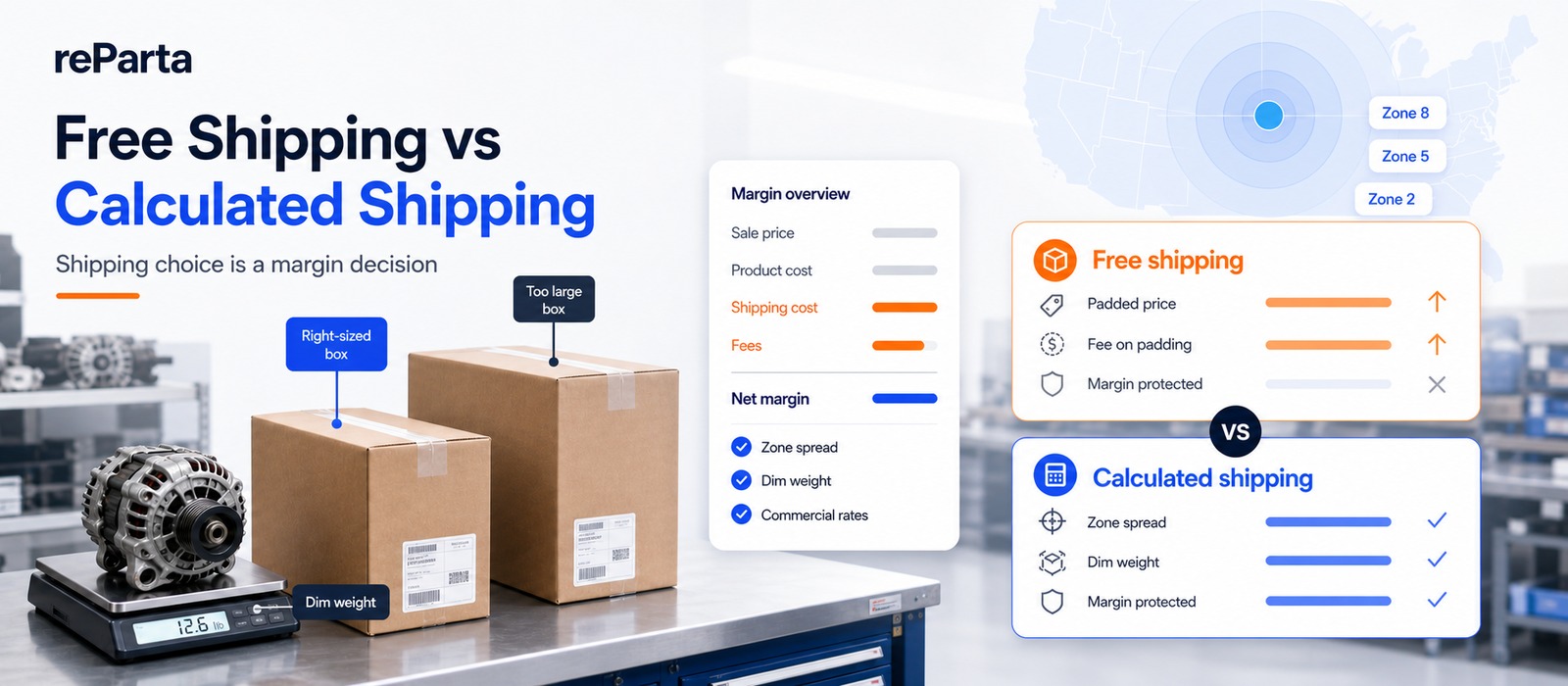
A real example. A 14 by 12 by 11 inch box is 1,848 cubic inches, just over a cubic foot. Put a 3 lb part in it and you no longer bill 3 lb. Under the old divisor it billed 12 lb, and under the new 139 it bills 14 lb, for a part that weighs three. Shrink that same part into a box under 1,728 cubic inches and you’re back to paying the true 3 lb. For light-but-bulky parts, headlights, tail lights, small trim, boxing tight is worth real money now, not pennies. This is the same dimensional-weight trap that makes shipping big parts expensive, just with the divisor turned meaner.
Zones, and what “the rural rate” really is
Your zone is just distance from your ship-from ZIP to the buyer’s, on a 1 to 9 scale (Zone 1 is local, Zone 8 is cross-country, Zone 9 is territories and military). Same part, farther buyer, higher rate at every tier. Nothing new there, it just makes calculated shipping matter more.
The thing to get right, because it’s all over the forums wrong: USPS Ground Advantage does not have a line-item “rural surcharge.” That’s a UPS and FedEx thing - their named Delivery Area Surcharge. What USPS does instead is bill defined rural and less-populated ZIP codes off a higher rate table, in place since September 2024, on packages up to 20 lb. And since July, sub-pound packages to those ZIPs bill at a single flat rate rather than by the ounce. So when a small part to a remote Zone 8 ZIP suddenly costs a few dollars more, that’s the higher rural table doing the work, not a separate fee someone tacked on. It reads like a surcharge. It isn’t one. That distinction matters when you’re deciding whether to eat it or pass it to the buyer.
Cubic pricing: the cheapest lane for small heavy parts
If you ship dense heavy parts that still fit a small box, alternators, starters, compressors, calipers, this is the one to learn. Ground Advantage Cubic prices by box volume and zone, not by weight, up to 20 lb, and it is never touched by dimensional weight. Which means the 139 divisor that just hurt big light boxes doesn’t apply here at all. On a heavy compact part, cubic often beats weight-based by a wide margin.
The cap is one cubic foot for a rigid box (and a 22 inch longest side). Note that July trimmed the softpack, padded-envelope version of cubic down to half a cubic foot, so for cubic pricing on a heavy small part, use a box, not a mailer. You can’t get cubic at the post office counter either. It’s a commercial lane through eBay Labels, Pirate Ship, and similar tools, and eBay will pick the cheaper of cubic versus weight-based automatically if you enter accurate weight and dimensions. Enter both, every time, and let it choose.
Can you just type a higher weight to pay less?
This one went around hard in 2026, because the sub-pound tier consolidation briefly made some platform calculators show a heavier entry pricing the same or lower than a lighter one. People started entering a false higher weight to buy the cheaper label. Do not do this.
USPS runs packages through Automated Package Verification, which re-weighs and re-measures them in processing and re-rates to the actual package. It is not tier-shopping on your behalf. If you declared a weight that doesn’t match, it calculates what the real package should have cost and charges you the difference. Sellers who tried the trick got back-charged for it. The verification runs both directions, so it also credits genuine overpayment and, annoyingly, sometimes generates a wrong overcharge you have to dispute. You get 60 days to file that dispute, which is exactly why it’s worth keeping your own weight and dimension records.
The honest takeaway: declare the true weight and true dimensions. If a part genuinely weighs into a cheaper band, ship it there. Never fake the number, because the machine checks.
Routing by part type
| Part | Best lane | Watch out for |
|---|---|---|
| Small dense (modules, sensors, relays, mirrors, lights) | Ground Advantage, keep packed weight under 1 lb | The 1 lb cliff |
| Dense and heavy but compact (alternators, starters, calipers, 8-20 lb) | Ground Advantage Cubic | Enter real dimensions so it rate-shops cubic |
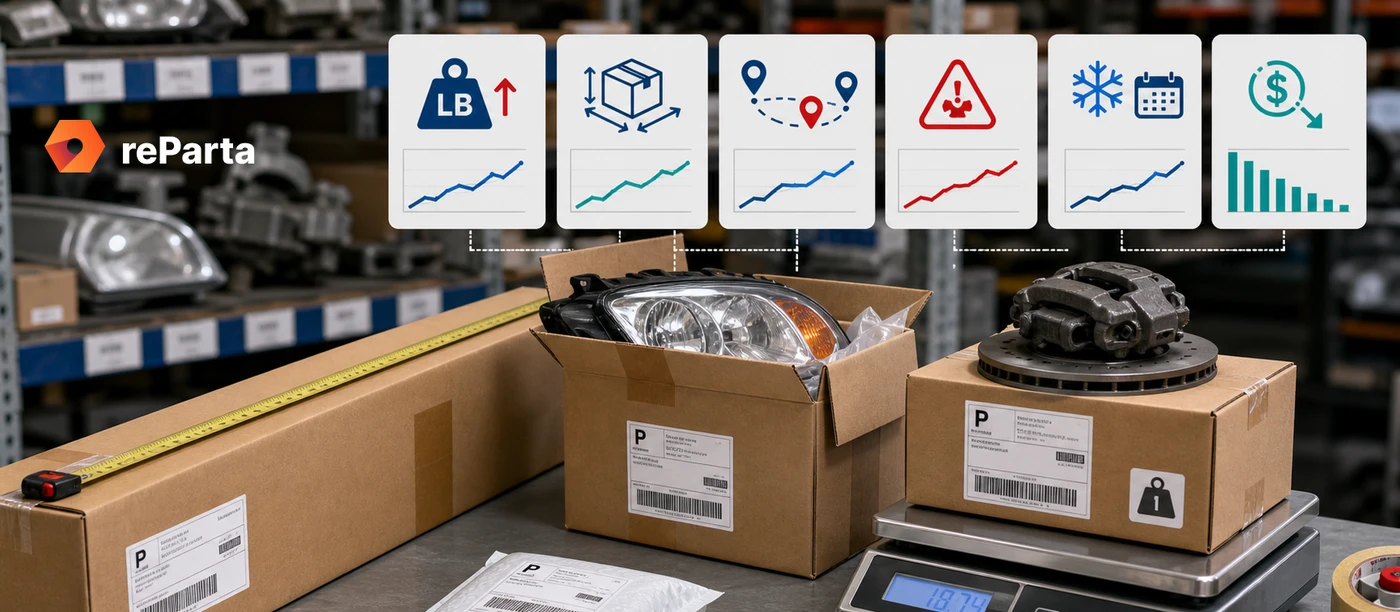
| Light but bulky (headlight assemblies, trim, 2-5 lb) | Ground Advantage, box tight, stay under 1 cubic foot | The 139 dimensional-weight penalty |
| Heavy panels (bumpers, fenders, hoods, doors, 10-50+ lb) | UPS Ground or FedEx Ground, right-size the box | 70 lb cap and the oversize fee on USPS |
| 70+ lb or over 130 in length plus girth | LTL freight | Drain fluids, palletize, ask about a liftgate |
USPS wins for the small stuff for one structural reason: it charges no residential surcharge, while the private carriers add about $6.50 per residential package in 2026. Since eBay Motors and Facebook buyers are overwhelmingly residential, that surcharge is usually the whole ballgame for 1-3 lb parts. The private carriers pull ahead once you’re past roughly 10-15 lb, on long zones, or shipping to a business address, where that residential fee doesn’t apply and their weight pricing catches up.
Fees that can surprise you
A few new or raised charges from the July change are worth knowing before one lands on an invoice:
- A $200 oversize fee applies to packages over 70 lb or over 130 inches in combined length and girth, and in 2026 it’s assessed anywhere in the network, not just at the counter. This is a real risk on bumpers and full assemblies, so measure before you ship and right-size to stay under it.
- Undeclared hazardous materials now carry a $50 non-compliance fee per shipment (separate from the handling fee on properly declared hazmat). For an auto-parts seller that means airbags and inflators, lithium batteries, gas struts and shocks, and anything with fluid in it - including a reused box that still has old hazmat markings on it. Declare it or don’t ship it. (Note that eBay separately banned listing airbags and inflators as of September 24, 2026, so on eBay that particular question is moot.)
- Signature confirmation increased in the January change. Minor, but it adds up if you require it on higher-value parts.
What doesn’t work for parts
Two “cheap shipping” ideas come up constantly and neither fits real parts. Media Mail is for books and media only, and functional auto parts don’t qualify, though a printed shop or repair manual does count as a book. eBay Standard Envelope is flat lettermail with tight thickness and weight limits across its eight eligible categories, so a physical part can’t use it regardless. If you sell flat decals or stickers alongside parts, those can sometimes qualify, but a solid part cannot.
Where this ties back to your numbers
All of this is really one point: your true shipping cost per part moved in 2026, and it moved differently for a sensor than for a bumper. If you’re pricing a salvage lot to part out, that per-part shipping number feeds straight into whether the lot pencils out, so it’s worth re-checking against current rates rather than last year’s gut feel. That is part of what Pre-bid ROI does - it puts marketplace fees, transport, and your bid against real used-market resale prices so you buy on a net number. Full disclosure: reParta is an independent product, not affiliated with USPS, eBay, or Facebook/Meta. You don’t need software to do the math, a spreadsheet and current rates work fine - you just have to actually redo it now that the 2026 USPS rate changes have landed.
Frequently asked questions
Did USPS raise rates on August 22, 2026?
No. The August 22 change was an eBay platform decrease on 2 lb Ground Advantage (Zones 1-8) and Priority to Zone 8. The rate increases people felt this year came from the January 18 general increase, the temporary 8% transportation surcharge that started April 26, the July 12 structural change, and a small September 19 adjustment on select Ground Advantage and Priority Mail.
Did USPS raise rates on September 19, 2026?
Yes, but a small, targeted one - not another overhaul. And unlike the August 22 eBay platform change, this was a genuine USPS-wide adjustment; it just reaches you through eBay Labels. Ground Advantage 0-2 lb rose $0.10 (Zones 1-8), 3-5 lb rose $0.27 to $2.28, Priority up to 10 lb to Zone 8 rose $0.73 to $4.35, and Priority Flat Rate rose $0.30 (Zones 1-8). Rural ZIPs were excluded and eBay's calculator updated automatically.
What changed on July 12, 2026 that affects shipping auto parts?
The dimensional-weight divisor dropped from 166 to 139 (raising the cost of big light boxes), the cheap sub-pound ounce tiers were collapsed on commercial Ground Advantage, dimensions now round up to the whole inch, and new fees appeared - a $200 oversize fee and a $50 undeclared-hazmat non-compliance fee.
What's the cheapest way to ship a small heavy part like an alternator?
Ground Advantage Cubic, which prices on box size instead of weight (up to 20 lb, rigid boxes to 1 cubic foot) and is never hit by dimensional weight. Enter accurate weight and dimensions and let eBay or your shipping tool pick the cheaper of cubic versus weight-based.
Should I keep parts under a pound?
For small dense parts, yes. Crossing from under a pound to a pound steps the price up, so keeping the packed weight at or under 15.999 oz captures the cheaper band. Anything over 16 oz rounds up to the next whole pound, so 1 lb 1 oz already bills at the 2 lb rate.
Can I type a higher weight to get a cheaper label?
No. USPS runs packages through Automated Package Verification, which re-weighs and re-measures and re-rates to the actual package, then back-charges the difference. Declare the true weight and dimensions; you have 60 days to dispute an adjustment if it is wrong.
When should I stop using USPS for a part?
Once it's heavy (past roughly 10-15 lb), bulky, going a long distance, or headed to a business address, price UPS Ground or FedEx Ground - they add a residential surcharge (about $6.50) that USPS does not, so they win once the base rate gap covers it. Past 70 lb or 130 inches combined length and girth, look at LTL freight.