eBay Shadowbanning Auto Parts? What Zero Views Really Mean
Short answer, before the story: eBay shadowbanning auto parts is almost never what’s happening. When your eBay listings get no views, it almost always means eBay’s search never pulled your part into the results for the searches that matter, usually because your item specifics and fitment don’t tell it clearly what the part is. That’s a data problem you can fix, not a secret ban.
Now the story, because it’s worth understanding. You list a good part, priced right, clean photos, and it gets nothing. Zero views for weeks, while someone else’s near-identical listing moves. So you land where half the forum lands: eBay must be hiding me. It almost certainly isn’t. Here’s how the search actually works for parts, and how to get found again.
Is eBay shadowbanning auto parts?
No, not the way people mean it. eBay shadowbanning auto parts would imply eBay is secretly suppressing you while pretending nothing’s wrong, and that’s not a mechanic eBay has. No views usually means eBay’s search didn’t surface your listing for the buyer’s query, not that it’s being punished in the dark.
One honest caveat, because the opposite claim is also false: eBay does openly demote sellers for policy or performance problems. Fall to Below Standard on your defect rate, late shipments, or unresolved cases and eBay reduces your search exposure across the whole account. But that’s disclosed, you can see your status in Seller Hub, which is the opposite of a shadow anything. So: no secret bans, but real and visible consequences for bad account health.
Why do my eBay listings get no views?
Here’s the piece that reframes everything. Large-scale search, eBay included, works in two steps.
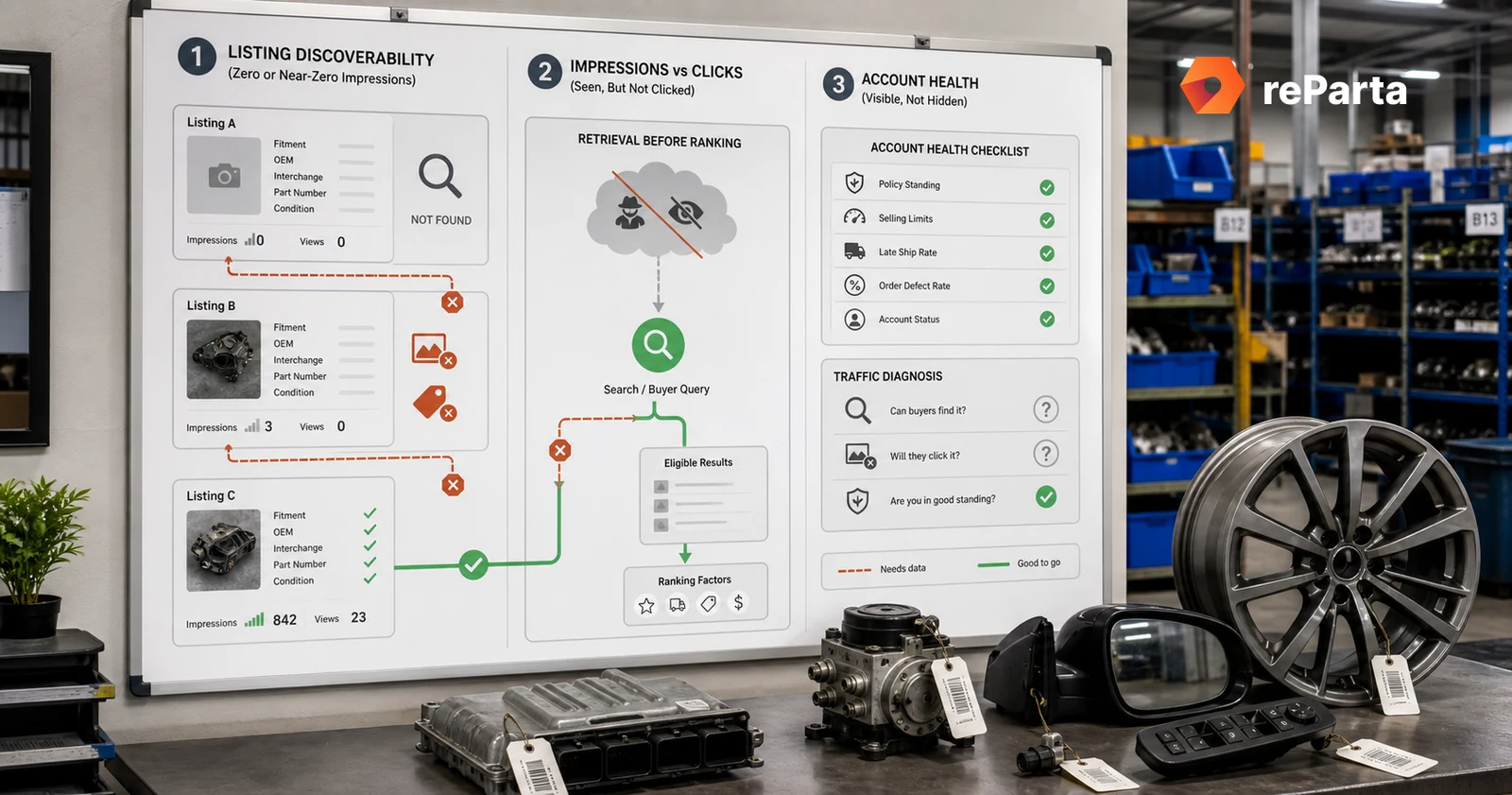
First, retrieval: out of millions of live listings, eBay pulls a candidate set relevant to what the buyer typed. Second, ranking: it orders that set, and only now do price, shipping, feedback, returns, and promotion decide who lands on top. (How Best Match ranks that candidate set is its own topic.)
The trap almost every struggling seller falls into is fixing step two while failing step one. You drop your price, turn on free shipping, fret over feedback, and nothing moves, because your listing was never in the candidate set to begin with. You can’t win a race you didn’t qualify for. If eBay didn’t retrieve your part for that search, nothing you do on price or shipping changes that search.
Some sellers call the pile of listings that never get pulled in “the mud.” Whatever you call it, it isn’t permanent or personal. Retrieval is recalculated for every search, so a part that’s invisible for one query can show for another, and fixing what you tell eBay about the part can pull it out.
Why parts fail retrieval on eBay: your item specifics
Retrieval runs on relevance, and for auto parts relevance lives in your structured data more than your prose. This is the single biggest thing parts sellers get wrong, and the most fixable.
Here’s the key mechanic, scoped honestly. The filters and Shop-by-Vehicle tools buyers use (year, make, model, part type, placement) are matched against your item specifics, not your title or description. Leave the relevant specific blank and your listing drops out of that filtered or compatibility search entirely, even if the word sits in your title. A plain keyword search still reads your title and specifics, so a missing field isn’t total invisibility, but it knocks you out of exactly the searches serious part buyers use to narrow to their car. And that’s most of them.
So for a part, fill every Motors field that applies:
- OEM, MPN, and especially the interchange part number (the interchange alone widens how many equivalent searches you match).
- Fitment: year, make and model at minimum, then trim, engine, and placement on vehicle. Trim and engine aren’t required fields, but leaving them blank costs you filtered searches and invites wrong-fit returns.
- Part type and the terms a buyer would actually type.
Put the key part number and part type in the title too, but the heavy lifting for retrieval is the structured fields. Writing the listing itself properly is where this lives, and when fitment data drops off your listings you fall straight out of those filtered searches.
Do photos, AI, or relisting change your ranking?
There’s a lot of folklore here, so let’s calibrate it.
The AI and vector-search claims. You’ve probably seen videos saying eBay ripped out keyword search in 2023 and replaced it with AI that reads the “meaning” of your listing. The grounded version: eBay genuinely uses AI embeddings and vector similarity, and has published about it, but the documented uses are mostly recommendations and image-to-image similarity (the “you may also like” rows, and snap-a-photo visual search), not a confirmed replacement of how buyer text search ranks you. Text search is still hybrid, keyword and item-specifics relevance is the backbone. So treat “eBay stopped caring about keywords” as an overstatement.
Photos. eBay’s image AI does read your photos, but at listing-creation time, to auto-suggest a title, category, and item specifics from the picture. That’s a convenience you have to check, because it guesses wrong and leaves specifics blank. The photo’s content is not an ongoing signal that ranks your live text listing. In plain terms: a clear photo of the part number does not get you found for that part number, the part number typed into your specifics and title does. (Photos of the part can surface it in eBay’s separate buyer image-search feature, but that’s not your text-search ranking.) Good photos still matter, they win the click once you’re visible, and clicks and sales feed ranking indirectly.
The 48-hour boost and the relist trick. New listings get a little lift from being new, but eBay itself calls recency a minor factor next to relevance and engagement, and it has never published a fixed “48-hour window,” so treat that number as a seller estimate. Ending and relisting to “refresh” a stale part is the contested one: plenty of sellers swear by it and it does mint a new item ID, but eBay has publicly called relisting-for-visibility a myth that hurts you by dumping your accumulated sales history. If you relist, do it because you genuinely improved the listing, not as a magic button.
How to check impressions vs views in Seller Hub
You’re not flying blind. An impression means your listing was surfaced in search results. A view means a buyer actually clicked in. The view count on the listing itself is a rolling 30-day number, but Seller Hub’s traffic report goes back much further.
Sort your active listings by views, find the ones with zero, and check their impressions:
| What you see | What it means | The fix |
|---|---|---|
| Few impressions + no views | Visibility problem: eBay is barely surfacing it (retrieval) | Weak title keywords, wrong category, thin item specifics. Fix the data. |
| Lots of impressions + no views | Click problem: shown but not clicked | Usually price, main photo, or title against the competition. Sometimes shown in the wrong searches, but check price and photo first. |
| Steady impressions + some views + no sales | Ranking/conversion problem | You’re visible and clicked, now it’s price, terms, and trust |
Click-through rate is widely believed to feed ranking, so a listing that’s shown a lot and never clicked can slide over time. There’s no secret “traffic waster” flag, so don’t chase that ghost, just fix the real bucket.
When it’s your whole account, not one listing
If it’s one listing, fix the listing. If it’s most of your listings, look at account health. Genuinely bad metrics, high defect rate, late shipments, cases closed against you, pull down visibility across everything, and eBay tells you when you’re there. What is not a real eBay rule, despite the forums, is that some percentage of zero-view listings automatically sinks your account. Dead listings lose their own visibility, but account penalties come from service and defect metrics, not a headcount of quiet listings.
Fix your eBay parts listings in this order
- Fill every applicable Motors item specific, especially OEM/MPN/interchange numbers and fitment. This is the retrieval gate, do it first.
- Mirror the key part number and part type into the title.
- Keep title, specifics, and description consistent so you aren’t contradicting your own data.
- Then, and only then, work the ranking levers: competitive price against real sold comps, fast handling, reasonable shipping, returns, clean metrics.
- Use clear photos to win the click once you’re visible.
- Keep defect, late-shipment, and case metrics clean so the whole account stays in good standing.
The order is the point. Relevance gets you retrieved, ranking decides where you land, and fixing step two while step one is broken is why so many good, cheap parts sit unseen. And if a part genuinely has almost no demand, that’s not a visibility bug, it may just belong on a different channel like Facebook or Car-Part instead.
Where this ties back to your operation
The reason eBay shadowbanning auto parts feels real is that the true cause, thin and inconsistent listing data, is invisible from the seller’s seat. None of the fix is exotic, it’s discipline: complete, consistent listing data on every part you pull. That’s tedious at any real volume, which is exactly where it slips.
This is where reParta helps. It builds complete, consistent listing data into every part you pull, accurate fitment, item specifics and OEM/interchange numbers from a U.S. vehicle dataset, so your parts clear eBay’s retrieval gate and actually get found, and it keeps that data consistent across eBay and Facebook from one inventory. reParta is an independent product, not affiliated with eBay. Get every part found instead of buried - start a free 14-day trial.
For the broader picture of selling parts on eBay as a yard, retrieval is just the front door.
Frequently asked questions
Is eBay shadowbanning my listings?
Almost certainly not. There's no secret suppression switch. No views usually means eBay didn't retrieve your listing for the buyer's search, most often because your item specifics or title don't clearly say what the part is. eBay does openly demote sellers with bad performance metrics, but it shows you that in Seller Hub, it doesn't hide it.
Why do my eBay listings get no views even though the listing looks good?
Because good looks and findability aren't the same thing. If your fitment and item specifics aren't filled out, eBay drops you from the filtered and Shop-by-Vehicle searches buyers actually use to find parts. Complete the structured fields first.
Does eBay's AI read my photos to rank my listing?
No, not to rank it. eBay's image AI reads photos at listing-creation to auto-suggest a title, category, and item specifics, which you should double-check. The text you end up with is what gets indexed. Clear photos help by earning clicks, not by being read for text search.
Will ending and relisting fix a part that won't sell?
Maybe, but it's not the free reset it's made out to be. eBay calls relisting-for-visibility a myth, and it dumps your listing's sales history. Relist when you're genuinely improving the specifics or title, not as a magic button.
How do I know if a listing is buried?
In Seller Hub, sort active listings by views. Zero views plus almost no impressions means it isn't being surfaced, so fix the item specifics and title. Zero views but lots of impressions means it's shown but not clicked, so check price, main photo, and title.
My eBay listing shows up on Google but I can't find it in eBay's own search. Is eBay hiding it?
Almost certainly not. Google and eBay are separate systems: Google crawls your listing as a public web page and keeps its own copy, which can lag or go stale, so a part showing on Google tells you nothing about whether eBay retrieved it for a buyer's search. eBay's search only ranks your listing after it matches your title and item specifics to what the buyer typed, so if those don't line up - or you're looking in a category or filter the part doesn't fit - eBay just doesn't pull it, which looks identical to hiding. One more thing that fools the test: eBay personalizes results per logged-in account, so searching your own part from your own login isn't the order a typical buyer sees. Search logged out or in a private window, and check that your title and item specifics match the exact part - year, make, model and fitment - buyers actually search.