What is this part? How to identify a used auto part
Whether you are a buyer holding a mystery component or a dismantler cataloging a pile of pulls, the question is the same: what is this part, and what does it fit? The honest answer is that identification is a sequence, not a single guess. A photo can suggest what a part is; the markings, the donor vehicle, OEM references, and a physical check establish exactly what it is and what it fits. Here is that sequence, and where the shortcuts fail.
(Guided photo-and-donor identification in reParta is in development. The manual workflow below is what works today.)
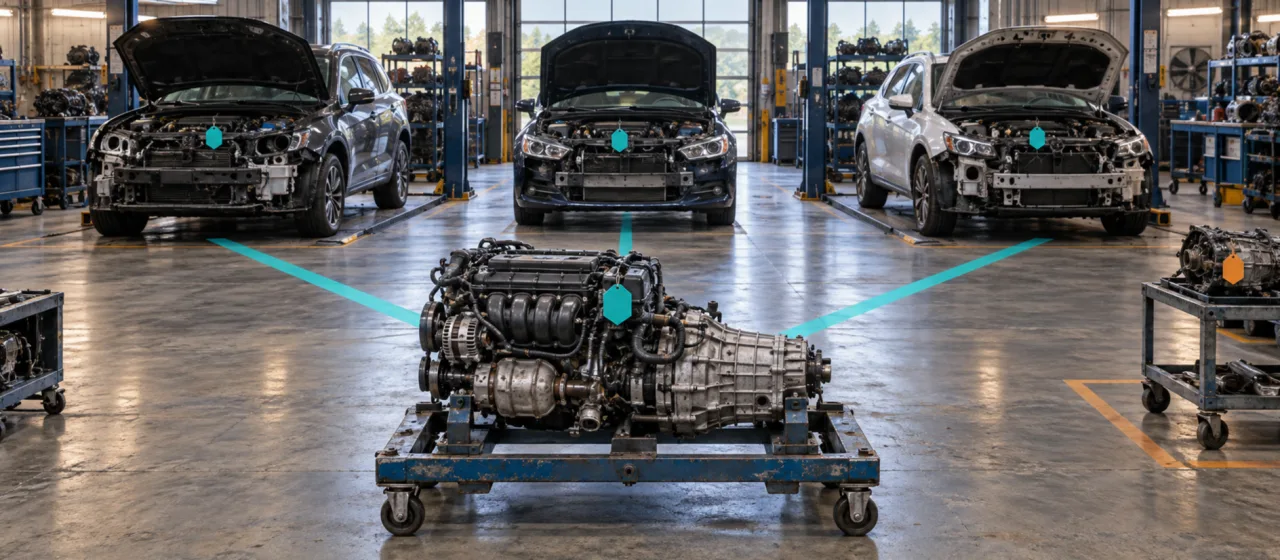
Start with the donor vehicle, if you know it
If you know the car the part came off, you have the strongest starting context, though not necessarily the exact part identity. Capture the VIN and the year, make, model, trim, engine, drivetrain, body style, and build date, and note where on the vehicle the part was mounted. Decode the VIN to pin the donor with a free VIN decoder, and use the U.S. vehicle-configuration data to narrow and document the donor’s likely configuration. Just remember what a VIN can and cannot do: it narrows the candidate set, but it does not prove a loose part came from that car, and it will not always reveal every factory option, a mid-year production split, or a part swapped after the factory. Under the hood, a VIN is only as complete as the data the manufacturer submitted to NHTSA’s vPIC decoder, and coding differs by make.
Photograph the part before you clean it
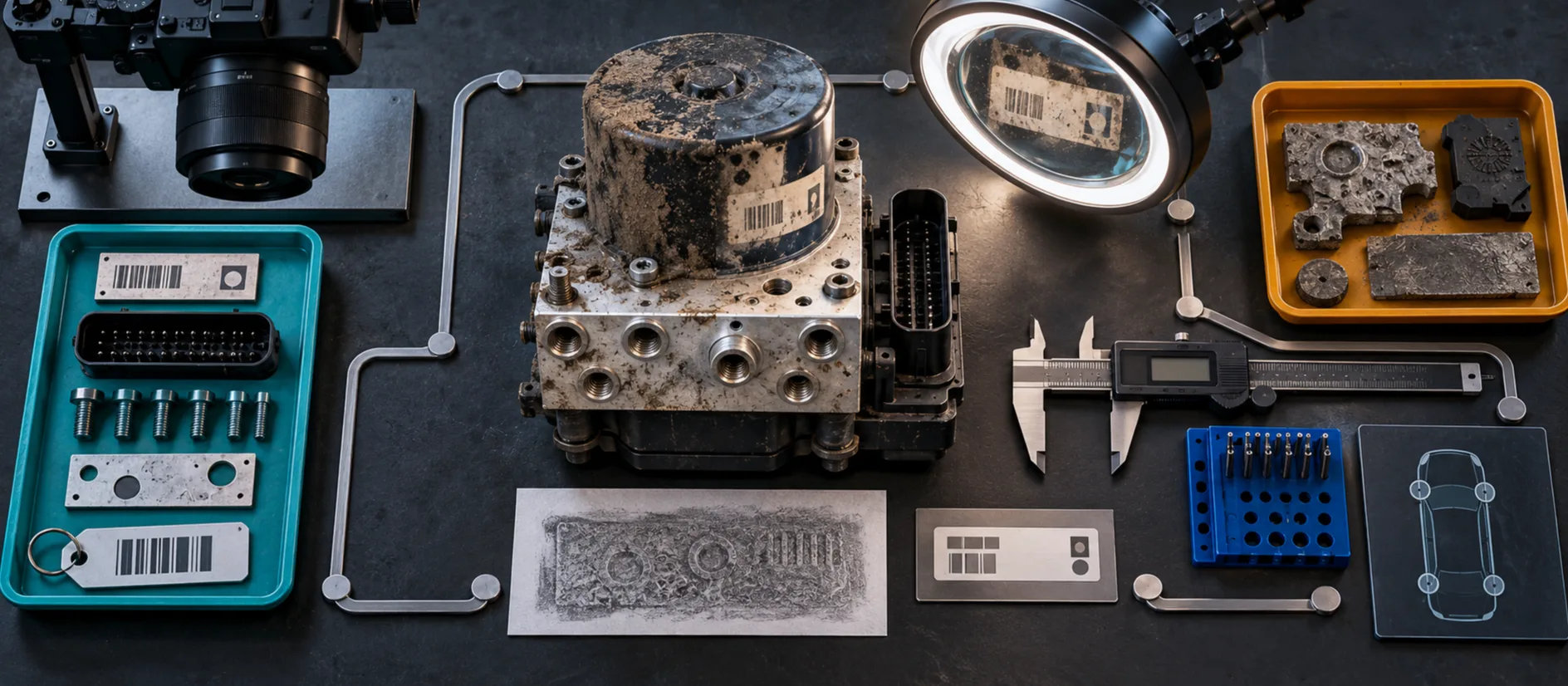
Some of the best evidence washes off. Before you scrub or solvent anything, photograph the whole part and every label, barcode, stamp, casting mark, ink code, connector, and mounting point, plus any damage. Paper labels and chalk or ink codes can be destroyed by cleaning. A complete photo set is also what a good listing is built on - how to photograph parts that sell covers the shots that matter.
Find every number, then find the real one
Most parts carry several numbers, and not all of them identify the part. You may see an OEM service number, an engineering number, a casting or mold number, a supplier number, a barcode or Data Matrix, a serial number, a date code, and a hardware or software revision. The critical mistake is calling the first number you find the part number.
A casting number is not a service part number. One casting can appear in several finished assemblies, revisions, and vehicles under different service numbers, so a casting mark is a strong search clue, not a complete identity. The same goes for electronic modules that share a housing but not the software or calibration. The number you actually order and sell by is the OEM service part number, which is often on a label or stamp rather than cast into the metal - the distinctions are laid out in the OEM part-number cross-reference guide.
Search the number the right way
Once you have a candidate number, search it in more than one form: in quotes for an exact match, with and without dashes, with spaces, and with just the base number without the revision suffix. Try the number with the visible brand and with the suspected vehicle. Do not treat a repeated marketplace description as proof - sellers copy each other’s mistakes. A number that resolves to an official or licensed OEM catalog entry, with its application notes and production-date ranges, is worth far more than a dozen matching listings.
What if the part has no readable number?
This is the case that sends people looking in the first place: the label is gone, the number is worn, the casting mark finds nothing, or the donor is unknown. Work it in order:
- Identify the broad category and mounting position.
- Record dimensions, connectors, ports, mounting points, and side.
- Search by visual characteristics plus the suspected vehicle family.
- Compare against OEM exploded diagrams.
- Search any supplier marks separately.
- Compare against known donor configurations.
- Ask a dealer, a specialist recycler, or a category expert.
- Do not publish an exact fitment while the identification is unresolved.
The rule that keeps you out of returns: if you cannot tell two materially different candidates apart, list neither as an exact match until you have more evidence.
Compare the physical details
Numbers get you a candidate; the physical part confirms it. Check the shape and dimensions, mounting points, connector type and pin count, hose or port layout, bracket orientation, and any included modules, then the side. Two parts that look identical from the front can differ in technology, market, facelift, connector, or side. For side, use LH and RH as viewed from the driver’s seated position. For US-market listings you may clarify “LH / driver side” and “RH / passenger side,” but do not use driver or passenger side without the market context, because those labels reverse on right-hand-drive vehicles.
Confirm fitment, then interchange
These are two different facts, and mixing them up is how wrong-fitment returns happen. Fitment is the list of vehicle configurations this exact part fits. Interchange is which other parts or numbers can functionally replace it. An interchange can be conditional - it may need a bracket transferred, an axle ratio or emissions package matched, or a module coded - so note the conditions, do not just publish a longer vehicle list. The mechanics are covered in how auto parts interchange works, and the number-family side in what a Hollander interchange number is.
Record condition separately from identity
Identifying a part and grading it are different jobs. Once you know what it is, record separately whether it is tested or untested, the test method and result, cosmetic damage, bent tabs or damaged connectors, missing pieces, mileage, and any water or fire exposure. No photo can confirm that an electronic module, a transmission, or a sensor works internally, so never let a picture stand in for a condition check.
Assign a confidence level, not one number
The most useful habit is to say how sure you are, and about what. Keep these separate:
- Suggested - you know the likely type only (“likely an ABS control unit”).
- Probable - shape, markings, and vehicle context agree (“probably the module used on this family”).
- Verified identity - a readable number, a catalog reference, and the physical details all match.
- Verified fitment - the application and its exceptions are confirmed from a reliable source.
A single “95% confident” number hides the real question: 95% sure it is an alternator is not 95% sure it fits a given car. Part-type confidence, exact-number confidence, and fitment confidence are different things. And “verified” only holds if you keep the evidence: for a verified identity, save the OEM number, the source and catalog date, the donor VIN, the physical attributes checked, and who checked them and when, so the record still makes sense a year later.
What each clue is actually worth
| What you found | What it may be | Is it an exact identification? |
|---|---|---|
| General shape | Part type | No |
| Casting number | Housing or casting family | Usually no |
| Supplier number | Component maker’s number | Sometimes |
| OEM / service number | The catalog part | Strong evidence when the label belongs to the complete assembly |
| Serial number | One specific unit | Does not set fitment on its own |
| Donor VIN | Vehicle configuration | Does not prove the exact part |
| OEM catalog match | Application | Needs notes and split checks |
| Number + catalog + physical details | Exact identity | The most reliable result |
A worked example: an unknown headlight
Say you pull a headlight with no obvious donor. The photo suggests a right-side unit. The housing label yields a candidate OEM number, and the donor VIN narrows the vehicle and model year. The connector and an attached module point to an LED adaptive configuration, and the lens marking confirms a US-market beam pattern. The OEM catalog then shows a pre- and post-facelift production split, and the candidate number has a supersession to a newer part. You record the fitment, add an interchange note about whether the module transfers, and log the damage and test status separately. That is the whole system in one part: a photo started it, evidence finished it.
Category-specific and restricted parts
Some parts need extra attributes: electronic modules (supplier and hardware number, software or calibration, connector, immobilizer or coding status); engines (engine code, displacement, aspiration, emissions configuration); transmissions (code, gear count, drive type, bellhousing, axle ratio); body panels (body style, door count, wheelbase, facelift, sensor or camera openings, paint code); wheels (diameter, width, bolt pattern, offset, center bore); and lights (side, technology, adaptive or not, market, connector, facelift).
Two categories need a hard stop. Effective September 24, 2026, eBay prohibits listings for airbags and airbag covers, including new, used, deployed, rebuilt, and recalled units, and only approved sellers may list certain related components such as specified control units, sensors, and diagnostic modules - check the current eBay vehicle parts policy before listing any restraint-system component. Used catalytic converters are sharply restricted too: EPA policy generally bars marketing a converter pulled from a salvage vehicle as a replacement just because it looks functional, unless applicable testing, labeling, documentation, and state requirements are met, and on eBay a used converter must be properly recertified for reuse or listed only as scrap. See the EPA guidance on used catalytic converters.
How AI photo identification helps, and where it fails
“Why not just upload a photo to ChatGPT or Google and get the part for free?” It is a fair question, and worth answering plainly. A general-purpose model or an image search can often suggest a likely part type and surface visually similar products, labels, or catalog pages, which makes it genuinely useful for generating a lead. What an image alone normally cannot establish is that the item has a particular OEM service number, came from the claimed donor, matches a specific production split, uses a particular calibration, or fits every vehicle in a proposed compatibility list. On a one-of-a-kind used part, a confident guess is how you get a return - the exact conclusions still require readable markings, donor-vehicle context, authoritative application data, and agreement between the connectors, mounting points, dimensions, side, and other physical details.
reParta is built by the team behind Waveo, an AI product company that has spent years turning complex physical-world operations into production software with computer vision and automation, and we are putting that to one job: a model built specifically for used-parts identification, not a general chatbot asked to moonlight as a parts expert. The planned workflow will combine image analysis and OCR with donor-vehicle data, OEM references, fitment, and interchange to present candidate matches, the evidence behind them, and the attributes that still need seller confirmation, rather than one answer presented as certainty. This functionality is in development and is not available in the product today.
How reParta fits
Today, reParta can use a supplied OEM number to retrieve the part records, cross-references, fitment, and interchange relationships available in its own dataset - its own built-in cross-reference, using the U.S. vehicle-configuration data to identify the donor rather than to guess a fit. Coverage varies by vehicle, model year, and part category, so the seller verifies the proposed match against the physical part, the donor configuration, production notes, and any category-specific exceptions before publishing. Once the seller confirms it, the selected identity, fitment, interchange notes, condition, photos, and donor relationship stay attached to the part’s inventory and listing record - so an identified pull becomes a listing that reaches the right buyers and comes back less often, instead of a note in a spreadsheet. Guided photo-and-donor identification is the next planned layer, built on that structured record rather than a single visual guess. It is one connected auto parts inventory management software that scales from a solo garage to a multi-location yard, on Garage, Yard, and Yard Pro, and identity plus fitment is exactly what turns a pull into a listing that sells on eBay and stays sold by cutting wrong-fitment returns.
Identifying a part is part detective work, part data lookup. Start with the numbers and the donor, confirm the physical details, and keep identity, condition, and fitment as separate, confirmed facts. Start a free 14-day trial - no card required - or see plans and pricing.
Reviewed for used-parts workflow accuracy by the reParta product and data team. Marketplace and legal requirements checked September 30, 2026; confirm current agency and marketplace rules for your own operation before listing.
Frequently asked questions
Can I identify a car part from a photo?
A photo can suggest what a part is - its class, and sometimes its family, like a right-side LED headlight. It rarely proves the exact OEM number, the side, the trim, the calibration, or the full list of vehicles it fits. Those come from the markings on the part, the donor vehicle, an OEM catalog, and physical checks. Treat a photo as a lead, not a final answer, especially on a one-of-a-kind used part where a confident guess turns into a return.
Is a casting number the same as a part number?
No. A casting or mold number identifies the raw casting, and one casting can appear in several finished assemblies, revisions, and vehicles under different service part numbers. It is a strong search clue, but it does not by itself identify the complete service part. The number you order and sell by is the OEM service part number, which is often on a label or stamp rather than cast into the metal.
Can a VIN tell me exactly which part I have?
A VIN identifies the donor - year, make, model, and often trim and engine - which narrows the candidates. It does not confirm every factory option, a part swapped after the factory, a mid-year production split, or a module's exact calibration, and it does not prove a loose part actually came from that vehicle. Use the VIN to narrow the set, then confirm with the markings, an OEM catalog, and the physical details.
What is the difference between fitment and interchange?
Fitment describes the vehicle configurations on which the identified part can be used. Interchange describes alternative part numbers or assemblies that can replace it, sometimes only under stated conditions. One part may have fitment across many vehicles, while several different stock or OEM numbers may interchange for some, but not necessarily all, of those applications. List the fitment for buyers, and use interchange to widen reach with the conditions noted.
Can two identical-looking parts have different numbers?
Yes, and this is where returns come from. Two headlights can look the same but differ in halogen versus LED, adaptive versus static, US versus EU beam pattern, whether a module is included, pre- versus post-facelift, connector, and side. The same is true of electronic modules that share a housing but not the software or calibration. Compare connectors, mounting points, and markings before you call two parts the same.
What parts should not be sold on visual identification alone?
Safety-critical and restricted parts. As of September 24, 2026, eBay prohibits airbags and airbag covers - new, used, deployed, rebuilt, or recalled - and only approved sellers may list certain related components such as specified control units and sensors. A used catalytic converter is sharply restricted and can only be sold for reuse if applicable testing, labeling, and requirements are met, otherwise it is scrap. Screen for these before listing, and never rely on a photo to confirm that a safety part is the right, undamaged, legal-to-sell item.