The US vehicle configuration database
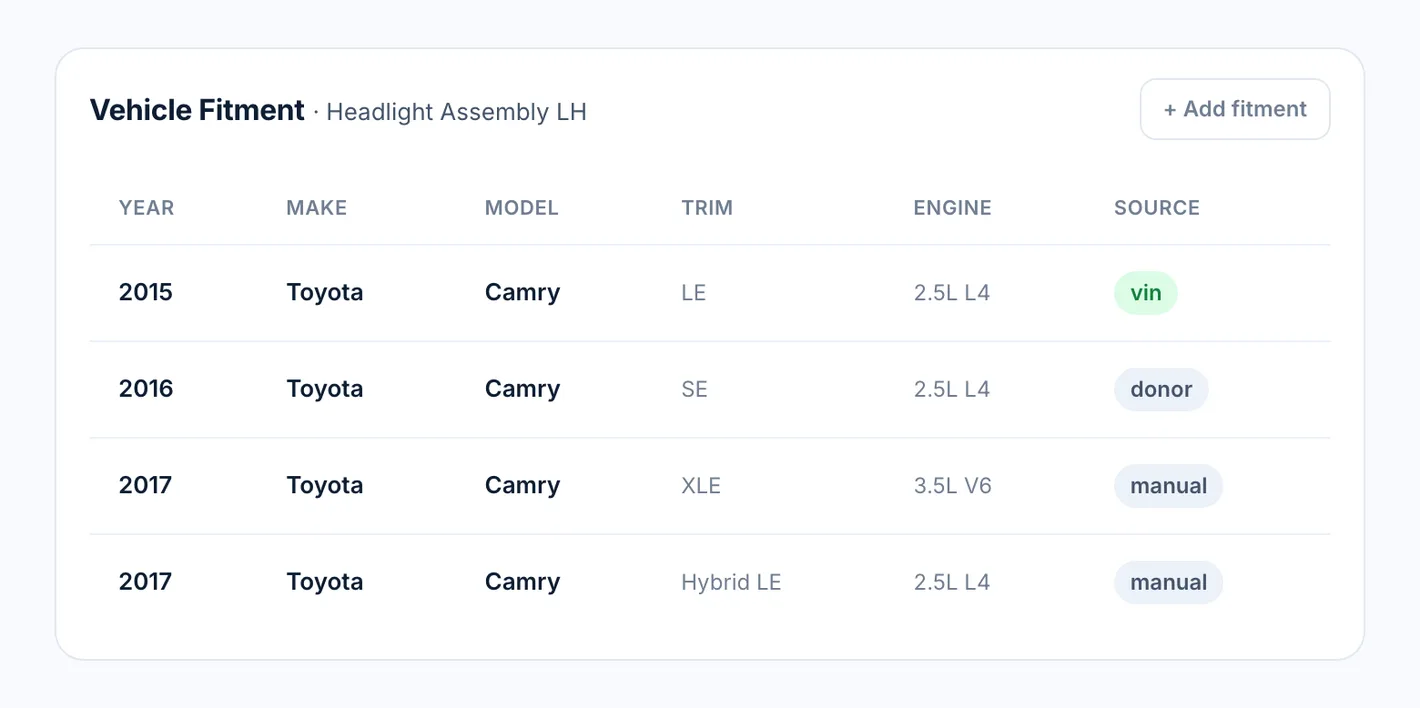
A US vehicle configuration database organizes the vehicles it covers by year, make, model, trim, and powertrain. It identifies a vehicle's configuration precisely - the input that decides which parts it takes, because two cars that look identical can need different parts thanks to one trim or engine difference.
The attributes that define a vehicle
A configuration database goes deeper than a make and model lookup. Each attribute narrows the vehicle to a cataloged configuration - an important input to parts matching, though not proof on its own that a given part fits.
The combination of trim and powertrain is what makes this more than a make/model lookup - and it is a common source of fitment mistakes.
Configuration, fitment, and interchange
People search for a "vehicle database" wanting very different things, and mixing them up is how a part ends up on the wrong car. Three layers, three jobs.
Describes the car - year, make, model, trim, engine. It identifies what the vehicle is.
Links a part to the vehicle configurations it belongs on. It answers which vehicles a part fits.
Links a part to the other vehicles it can be reused on, subject to notes, options, and exclusions. It answers what else the part swaps with.
The honest, important point: a configuration database on its own is not a fitment or interchange dataset. It identifies the vehicle configuration precisely, which is the first and essential step - but turning that into "which vehicles does this used part fit" takes a fitment and interchange layer on top. Each world has its own references: aftermarket application standards for new parts, the federally regulated VIN system for identification, and the long-standing commercial Hollander interchange used in auto recycling for used parts.
From a donor VIN to the buyers a part fits
reParta pairs its US vehicle configuration data with built-in fitment and interchange, so the reference does real work at every step of a part-out.
It is the same data behind reParta's auto parts inventory management software, so cataloging, listing, and fitment run from one system.
Why used parts need more than a vehicle list
New-parts catalogs start from a clean part number. Used parts start from a car on the yard - you identify the donor, then work outward to every vehicle the part fits.
Superseded part numbers - a replacement pointer, not automatic proof of interchange - so used stock listed under an old number still surfaces.
Interchange - one dismantled part can legitimately fit a set of vehicles across years, makes, and models.
Build-date splits - the same year, make, and model can change mid-production, so a part fits "up to" or "from" a build date.
Connector, sensor, and bracket variations - superficially identical parts differ by a plug, a sensor, or a bracket, so "same model" is not always "same part."
Vehicle data, answered
What is a US vehicle database?
It is a structured catalog of the vehicles sold in the US market, broken down by year, make, model, trim, and powertrain. It describes vehicles, not parts - it is the reference that lets you identify the exact vehicle configuration before you decide which parts it takes.
How is a vehicle configuration database different from a fitment or interchange dataset?
A configuration database describes vehicles (year, make, model, trim, engine). A fitment dataset links a part to the vehicles it fits, and an interchange dataset links a part to the other vehicles it can be reused on, subject to interchange notes, options, and exclusions. Fitment and interchange are relationship layers built on top of vehicle configurations - a configuration database on its own identifies the car; matching parts to it is the next step.
Why do trim and engine change which parts a vehicle takes?
Two cars that look identical can need different parts because of a trim or engine difference - a different alternator, bracket, cooling part, module, or harness. Pinning a vehicle to the full year, make, model, trim, and powertrain, instead of make and model alone, is what makes "which part does it take" answerable instead of a guess.
How does precise vehicle identification reduce wrong-fitment returns?
Wrong-fitment returns ("it did not fit") are a leading cost for used-parts sellers. Identifying the configuration, then matching each part by OEM number, fitment, and interchange, puts the part in front of the buyers it actually fits and helps the wrong buyers self-select out - so fewer parts come back.
Can I download the database or get an API?
You cannot download it or plug into a public API, and you do not need to. As a reParta user you put the data to work live inside the app: decode a VIN, catalog each part by fitment and interchange, and project the parts on a donor before you bid. Start a free trial to use it on your own inventory.
Put the data to work on your inventory
You cannot download this database, but you can use it inside reParta: decode a lot free, then let precise vehicle identification and interchange reach the right buyers and reduce wrong-fitment returns.