Interchangeable Car Parts: Find Every Car It Fits
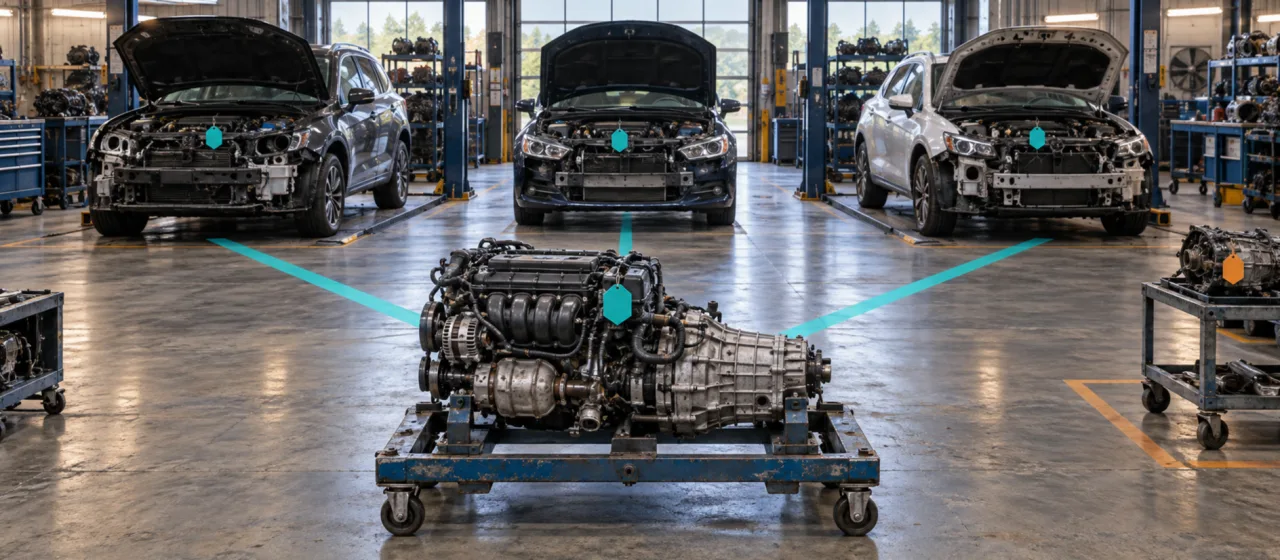
Interchangeable car parts are the single biggest lever a used-parts seller has, and most sellers only use a fraction of it. The idea is simple: one physical part often fits more than one vehicle. A door, a headlight, an engine, a mirror - the same component is frequently shared across several year-make-model-trim combinations, and sometimes across sibling badges from the same manufacturer. Learn to find every car a part fits, and you stop selling “a part off a 2015 sedan” and start selling “the part that fits all of these cars.” That is a far bigger market for the exact same shelf.
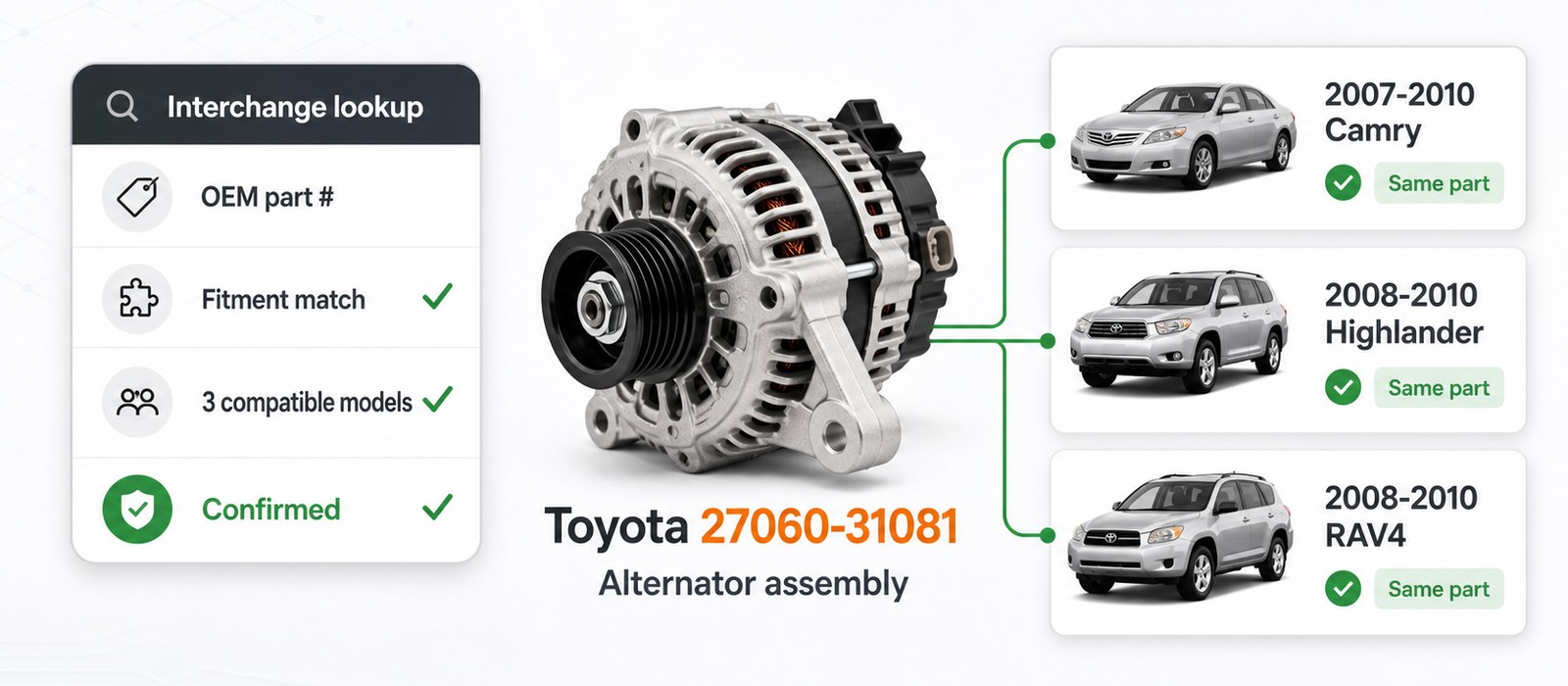
A car parts interchange is the reference that makes this reliable: it maps which vehicles share the same physical component, so you can list one part against every car it fits. The question sellers actually ask - “how do you quickly find what other cars use the same part?” - has three good answers, and this guide walks all of them, plus the math on why it matters and the two ways it goes wrong.
How to find every car a part fits, in three steps
A car parts interchange tells you which vehicles share the exact same physical part, so a used-parts seller can list one part against every car it fits instead of only the donor it came off. To find every car a used part fits:
- Look up the Hollander interchange number - the recycling industry’s standard reference for groups of interchangeable parts.
- Run a Car-Part.com interchange search - it surfaces the same component across other vehicles that use it, built on real yard data.
- Cross-reference the OEM part number - to pin down the exact part and catch a supersession (the newer number that replaces an old one).
Each method gives you a candidate list of compatible vehicles to confirm, not a guaranteed fit - always check the sub-variations a group can hide (connector, sensor, bracket, drivetrain, production date) before you list. The rest of this guide explains each step, the profit math behind interchange, and the two ways it goes wrong.
What “interchangeable” actually means
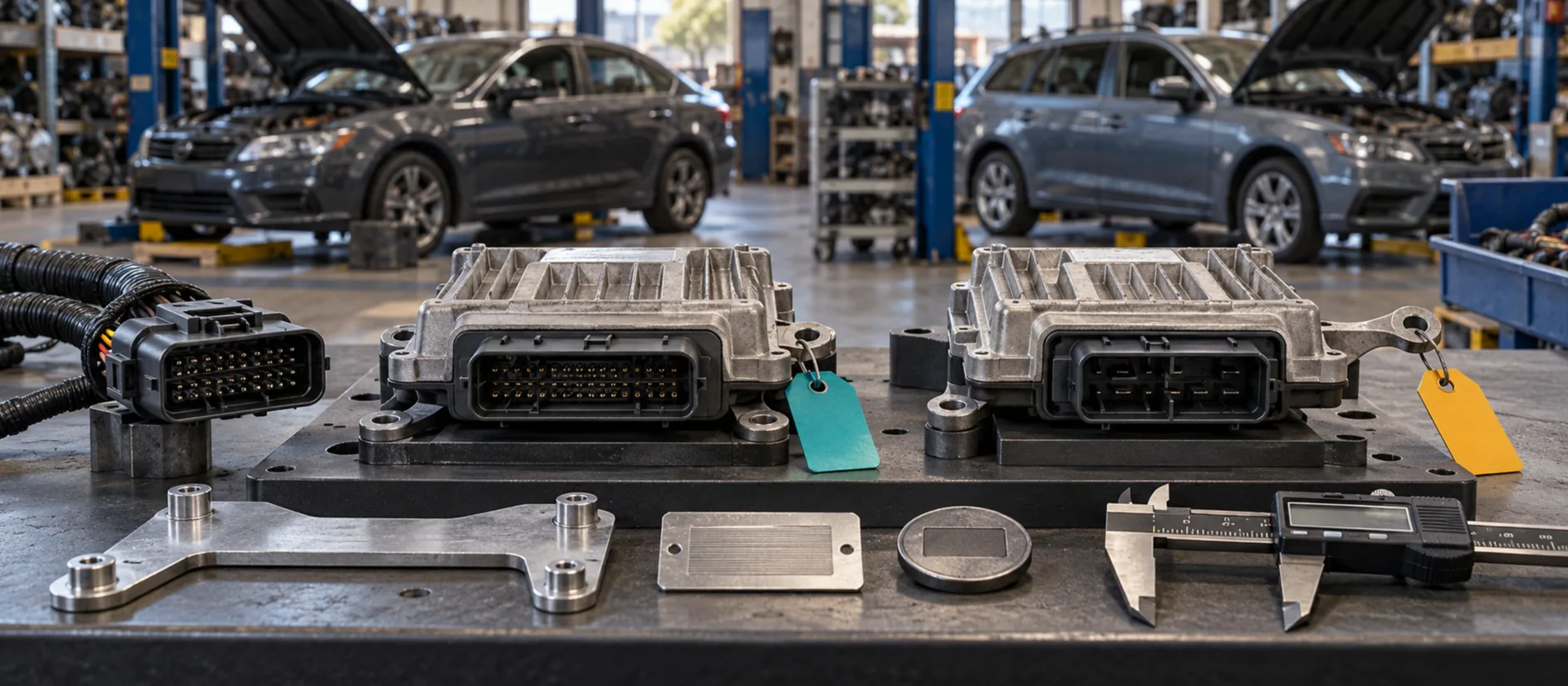
A part is interchangeable when it physically fits and functions the same across more than one vehicle. That usually happens when vehicles share the same manufacturer and the same generation, platform, or drivetrain, so the mounting points, connectors, and dimensions match. Some parts interchange widely (a common alternator or module), some barely at all (a trim-specific bumper), and many have a catch: the group looks identical but hides a sub-variation - a different connector, a sensor, a bracket. “Interchangeable” is a confirmed relationship, not a guess, which is why sellers use a system instead of eyeballing it.
List of commonly interchangeable car parts (and how far each one swaps)
Some used parts bolt onto dozens of vehicles; others fit exactly one trim of one model year. No part interchanges universally, and breadth varies by category, because parts follow engine families, platforms, and shared badges, not the name on the tailgate. The table below ranks the interchangeable car parts a salvage yard actually sells from widest to narrowest typical interchange, and names the specific sub-variation that causes wrong-fitment returns in each case. Treat breadth as a starting point, then confirm the flagged detail against a Hollander interchange or the part’s own casting or tag number before you list it.
Ranked from widest to narrowest typical interchange, the parts that most often cross vehicles are alternators, starters, A/C compressors, engines, transmissions, radiators, and wheels; sheet metal, lighting, seats, and control modules interchange far more narrowly.
| Part | Interchange breadth | Why | Confirm before listing wide |
|---|---|---|---|
| Alternator | Wide | Follows the engine family, not the vehicle, so one unit spans many models and badges that share that engine. | Amperage rating, pulley type (V-belt vs serpentine vs clutch pulley), connector shape and pin count, mounting ear position, and regulation type: a standard internally-regulated unit and a PCM- or LIN-controlled “smart” alternator can look identical but will not swap without a charging fault. |
| Starter | Wide | Tied to the engine family and its bellhousing and flywheel, which carry across models. | Tooth count, mounting bolt pattern, solenoid plug and stud orientation, manual vs automatic application. |
| A/C compressor | Moderate | Chosen per engine family and refrigerant system, so it follows the engine across models, though many are model-bracket specific. | Clutch pulley groove count and diameter, connector, refrigerant era (R-134a vs R-1234yf), port style. |
| Engine (long or short block) | Moderate | The core casting is typically shared across vehicles in the same engine family; the accessories differ. | Exact engine family and displacement, generation revision, emissions calibration, and casting or machining differences (oil pan, sensors, mounts); accessories, intake, sensors and the matching PCM usually swap over. |
| Transmission or transaxle | Moderate | The same case shares across models on the same engine, but internal and electronic revisions happen mid-generation. | Tag, RPO or casting code, engine pairing, bellhousing pattern, gear ratio, valve-body or lockup revision and connector. |
| Radiator | Moderate | Often shared across trims and engines on one platform generation. | Engine and transmission-cooler provision, inlet and outlet side and size, auto vs manual, core thickness, mounting style. |
| Wheels and rims | Moderate (crosses makes) | Fit is defined by measurable specs, not by brand, so wheels interchange across unrelated makes when the numbers match. | Bolt pattern, offset or backspacing, center bore, diameter and width, TPMS sensor (transfers with a relearn), caliper clearance. |
| Window regulator | Moderate | Platform and body-style specific, but shared across trims within that body. | Door position (front or rear, left or right), 2-door vs 4-door, manual vs power, motor connector and clip pattern. |
| Suspension (struts, control arms, knuckles) | Moderate, varies by component | Shares across trims on a platform, but a control arm interchanges wider than a strut, and drivetrain and brake package change the part. | FWD vs AWD, sport or heavy-duty suspension, brake size, ABS or ADAS sensor bosses, electronic damper option. |
| Fuel pump and sending unit | Narrow to moderate | The module is often shared within a fuel-tank or platform family, but tank shape and calibration vary. | Tank shape and capacity, sending-unit calibration, fuel-pressure and output rating (returnless vs return-style), connector, in-tank vs frame-mount, fuel type. |
| Hood and fenders | Narrow to moderate | Sheet metal is generation-specific but usually shared across trims within that generation. | Exact generation (pre- or post-facelift); fender antenna, side-marker and molding holes; hood scoop or emblem provisions. |
| Seats | Narrow | Body-style and interior-code specific, and safety electronics complicate reuse. | Occupant-sensor and airbag module and connector; heated, cooled, memory or power options; trim color and material; 2-door vs 4-door frame. |
| Doors | Narrow | Platform and body-style specific, and hardware content varies by trim. | Body style, front or rear and left or right, mirror and regulator and latch content, side-airbag wiring, color. |
| Mirrors | Narrow | Same shell shape, but option content varies widely by trim. | Power vs manual, heat, turn-signal repeater, blind-spot or camera, power-fold, memory, connector pin count, paint code. |
| Headlight and taillight assemblies | Narrow | Frequently revised at facelifts and split by bulb technology. | Pre- vs post-facelift, halogen vs HID vs LED vs projector, connector, body style, adaptive or leveling option. |
| Bumper cover | Narrow | Reshaped at facelifts and drilled differently for each trim’s sensor and lighting content. | Facelift year range, fog-lamp cutouts, parking or ADAS sensor holes, tow-hook and washer provisions, appearance package. |
| Infotainment or climate head unit | Narrow | Feature and software tied, and often paired to the car and its network. | Screen size and feature tier, connector and CAN architecture, region and software version, and whether it is VIN or network coded (many are). |
| ECU, PCM and control modules | Narrowest | Programmed to the specific vehicle: the VIN, immobilizer and calibration are stored inside. | Exact hardware part number; expect reprogramming to the VIN and an anti-theft relearn, since many modules will not run as a plain plug-and-play swap. |
Breadth tells you where to look; it does not confirm the fit. Every row above has a catch that turns reach into a return if you miss it, so confirm the flagged detail and pin the exact donor before you list against the whole group. The three methods below are how you turn one part into its full, confirmed list of compatible vehicles.
How to find every car a part fits
There are three reliable methods. Most sellers end up using more than one.
1. Hollander interchange numbers (the industry standard)
The Hollander interchange is the automotive recycling industry’s reference, and it assigns a number to each group of interchangeable parts. How to read it:
- Same Hollander number for a part = a strong candidate to fit both vehicles - the starting point, not the final word. Confirm the full identifier, application notes, side, and options before you rely on it.
- The full number, including the letter suffix, narrows the group further, but read the record’s notes and qualifiers rather than trusting the suffix alone.
- It is a shared language. Thousands of recyclers inventory and sell by Hollander number, so quoting one lets any yard search across the vehicles in their system instantly instead of guessing by make and model.
For a seller, the Hollander number is the fastest way to turn one part into its candidate list of compatible vehicles, which you then confirm.
2. Car-Part.com interchange search (free)
Car-Part.com puts much of this in a free search. Its interchange-based search surfaces the same component across other vehicles that use it, with live inventory at yards. The enhanced coverage (Car-Part Pro’s Interchange Plus) is a paid trade product. The free search shows a part’s cross-vehicle candidates and lets you look up Hollander numbers, but it is a search tool, not the full proprietary Hollander record with every note and qualifier - so treat its results as candidates to confirm.
3. OEM part number cross-reference
Every original part carries a manufacturer part number. Find it on the part itself, in the vehicle’s records, or in an OEM electronic parts catalog (EPC), then cross-reference that number to see the equivalents and, crucially, the supersessions. Two cautions:
- OEM catalogs are the authority on original numbers and supersessions, but they do not map aftermarket equivalents. You get the correct OE number, not the interchange.
- Watch supersession. Manufacturers re-number parts. Quoting an old, superseded number can make a part look discontinued when it is actually current under a new number. A good cross-reference resolves the supersession so you list the part that ships today.
A fourth shortcut: many self-service yards (Pull-A-Part, U-Pull&Pay, and others) publish free interchange lookups on their sites, handy for a quick check on a common part.
The interchange math: one part, many cars
Here is why this is the biggest lever you have. Reach on a single part is not linear - it multiplies with every vehicle it fits.
Say you pull a clean headlight and list it only against the car it came off: one model, one or two years. Now you run the interchange and find the same headlight fits four model years across two sibling models. Your addressable pool of vehicles just went from one to several, for the exact same part on the exact same shelf. It will not translate into exactly that many times the buyers - each vehicle has its own parc, demand, and competition - but more compatible vehicles listed means far more searches your part can show up in. Do that across a donor’s ~10 sellable parts and the compounding is real: interchange is how a small yard’s inventory reaches a national buyer base instead of a local one.
That is also why interchange is one of the rare levers that raises reach and cuts returns at the same time. More compatible vehicles listed means more buyers see it; buyers who find it by their exact vehicle get a part that actually fits.
Where interchange goes wrong (and how to not eat returns)
Most interchange-driven returns come down to two failure modes:
- Over-trusting the group. Some interchange groups contain sub-variations - a different connector, a sensor, a mounting bracket, a pre- or post-facelift change. The group says “fits,” the physical part does not. Always confirm the details a buyer would care about before you list against the whole group. This is the core of cutting wrong-fitment returns.
- Sloppy donor identification. Interchange is only as good as the vehicle data you feed it. Get the trim or engine wrong and the entire lookup is wrong. Decode the VIN and pin the exact configuration before you look anything up.
Get those two right and the interchange works for you. Get them wrong and it multiplies your mistakes across every vehicle in the group.
Put it on the listing correctly
Finding the interchange is half the job; the buyer has to be able to find your part by their vehicle. On eBay, that means loading the compatible vehicles into the structured compatibility (fitment) data, not burying them in the title or description - only structured data gets you into the “Fits” results. Accurate fitment strengthens your case on a return, but eBay is clear the seller is responsible for the compatibility they publish, so it is not an automatic shield - the defense is listing only vehicles the part genuinely fits. The recycler’s guide to fitment and interchange covers the listing side in depth.
Skip the manual lookup: let it happen at cataloging
Every method above works, and every method above is manual: a paid Hollander subscription, a per-part search on Car-Part.com, a cross-reference tab open in another window. That is fine for one part. It does not scale to a yard cataloging dozens of parts a day, which is exactly where sellers stop running interchange and start leaving reach on the table.
reParta’s yard inventory system handles the matching as part of cataloging. It ships with its own built-in OEM part-number cross-reference and part-level fitment - data reParta builds and maintains itself, not licensed or resold from Hollander - working alongside a US vehicle-configuration dataset that pins down what the donor is. reParta does not license the Hollander interchange; it built its own, native to a workflow that also handles pricing and listing, so the fitment logic lives where you work instead of in a separate per-part lookup. Decode a VIN to pin the exact configuration, and to see a donor’s projected parts before you buy the car, run it through Pre-bid ROI.
Try the free VIN decoder or start listing parts against every car they fit.
Quick reference
- Interchangeable car parts = one physical part that fits several vehicles, usually same manufacturer and generation.
- Fastest lookups: the Hollander interchange number, Car-Part.com’s free search (built on Hollander), and OEM part-number cross-reference.
- Hollander rule: same number = a strong candidate to fit; read the full identifier, notes, and qualifiers, then confirm before you list wide.
- OEM cross-reference: great for pinning the exact part, but watch supersession - an old number can hide a current part.
- The math: one part listed against every compatible vehicle puts it in far more searches, for the same shelf (more vehicles, not exactly that many times the buyers).
- Two ways it burns you: over-trusting a group that hides a sub-variation, and identifying the donor wrong. Confirm details, decode the VIN.
- List it right: load compatible vehicles into structured eBay compatibility data, not the title.
Frequently asked questions
What is a car parts interchange?
A car parts interchange is a reference that groups the vehicles a single physical part fits, so a used-parts seller can list one part against every car it works on instead of only the car it came off. The recycling industry's standard is the Hollander interchange number, and Car-Part.com runs an interchange-based search on top of real yard data. A car parts interchange gives you a candidate list of compatible vehicles to confirm, not a guaranteed fit.
What are interchangeable car parts?
Interchangeable car parts are components that physically fit and function across more than one vehicle - usually the same part shared by several year-make-model-trim combinations from the same manufacturer and generation, and sometimes across sibling badges. Because the part is one physical component, you can list it against every vehicle it fits instead of only the car it came off.
How do I find what other cars use the same part?
Three fast ways: look up the part's Hollander interchange number (the recycling industry's reference for groups of interchangeable parts), run a free Car-Part.com search (its interchange-based search surfaces the part across other vehicles that use it), or cross-reference the OEM part number in a catalog. For a used-parts seller, the Hollander number and a Car-Part.com search are the quickest, because they are built on real recycler data. Each gives you a candidate list to confirm, not a guaranteed fit.
Is Car-Part.com interchange free to use?
Car-Part.com's part search is free, and its interchange-based search surfaces the same component across other vehicles that use it, along with live inventory at yards. The deeper, enhanced coverage (Car-Part Pro's Interchange Plus) is a paid trade product. The free search shows a part's cross-vehicle candidates, but it is a search tool, not the full proprietary Hollander record with every note and qualifier.
What is the difference between OEM cross-reference and interchange?
OEM cross-reference maps a manufacturer's part number to its equivalents and supersessions (the newer number that replaces an old one). Interchange maps which vehicles share the same physical part. You often use both: the OEM number pins down exactly which part you have, and interchange tells you every car it fits. Watch for supersession - quoting a superseded number can hide the fact that the part is current.
How does interchange cut wrong-fitment returns?
Correct interchange lists your part only against vehicles it genuinely fits, so the buyers who find it get a part that actually works. Returns come from over-trusting a group that hides a sub-variation (a different connector, sensor, or bracket) or from feeding the lookup the wrong trim or engine. Confirm the details a buyer cares about and identify the donor precisely, and interchange raises reach and cuts returns at the same time.