OEM part number cross-reference for used parts: a seller's guide
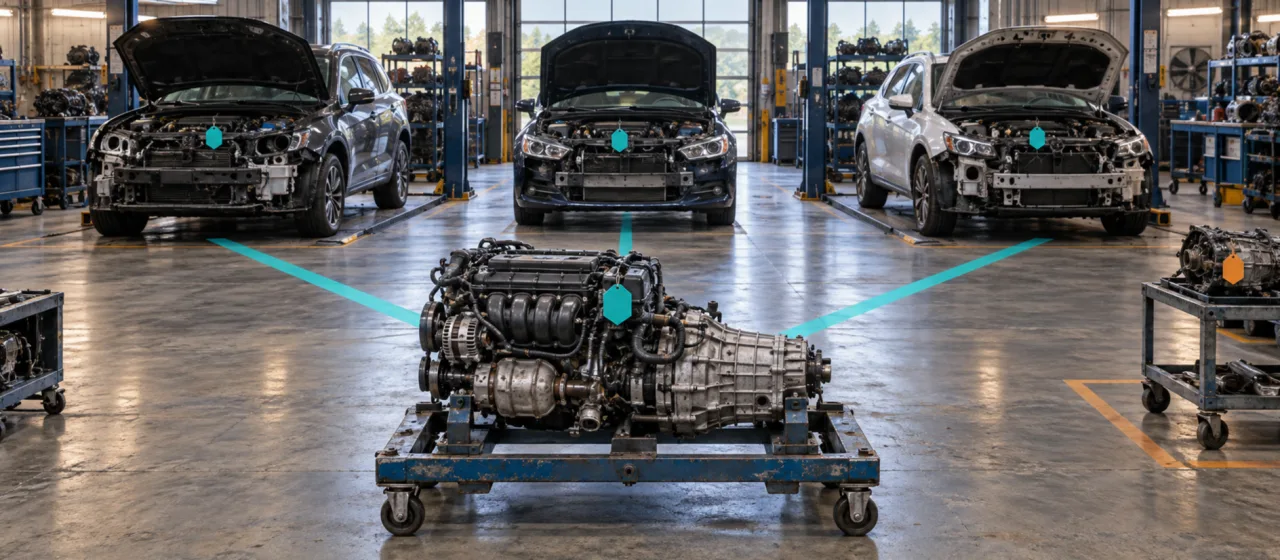
OEM part number, cross-reference, and interchange are three different tools, and mixing them up is how a part ends up on the wrong car. An OEM part number identifies a specific factory part (identity). A cross-reference links that number to related numbers - a supersession, a sibling-brand equivalent, or an aftermarket claim (alternate identity). Interchange works at the fitment level - which vehicles can use the part - not the number level. Get the roles straight and your listings become both precise and broadly findable, the two things that sell used parts.
What an OEM part number is
The OEM (original equipment manufacturer) part number is the manufacturer’s own identifier for a component. Used well, it is the most reliable anchor for what a part is - but only once you have the right number, because the number on the part is not always the one you can order or sell by. That is the catch most guides skip.
The numbers on a part
A part can carry several numbers, and they are not the same thing. Before you trust one, classify what you are looking at:
- Service part number. The number the manufacturer releases the part under for sale. This is the one buyers order and match - but it often lives only in the parts catalog (EPC) or on the box, not stamped on the part itself.
- Engineering or production number. Assigned when the part is designed and built. It identifies the as-built part and can change independently of the service number.
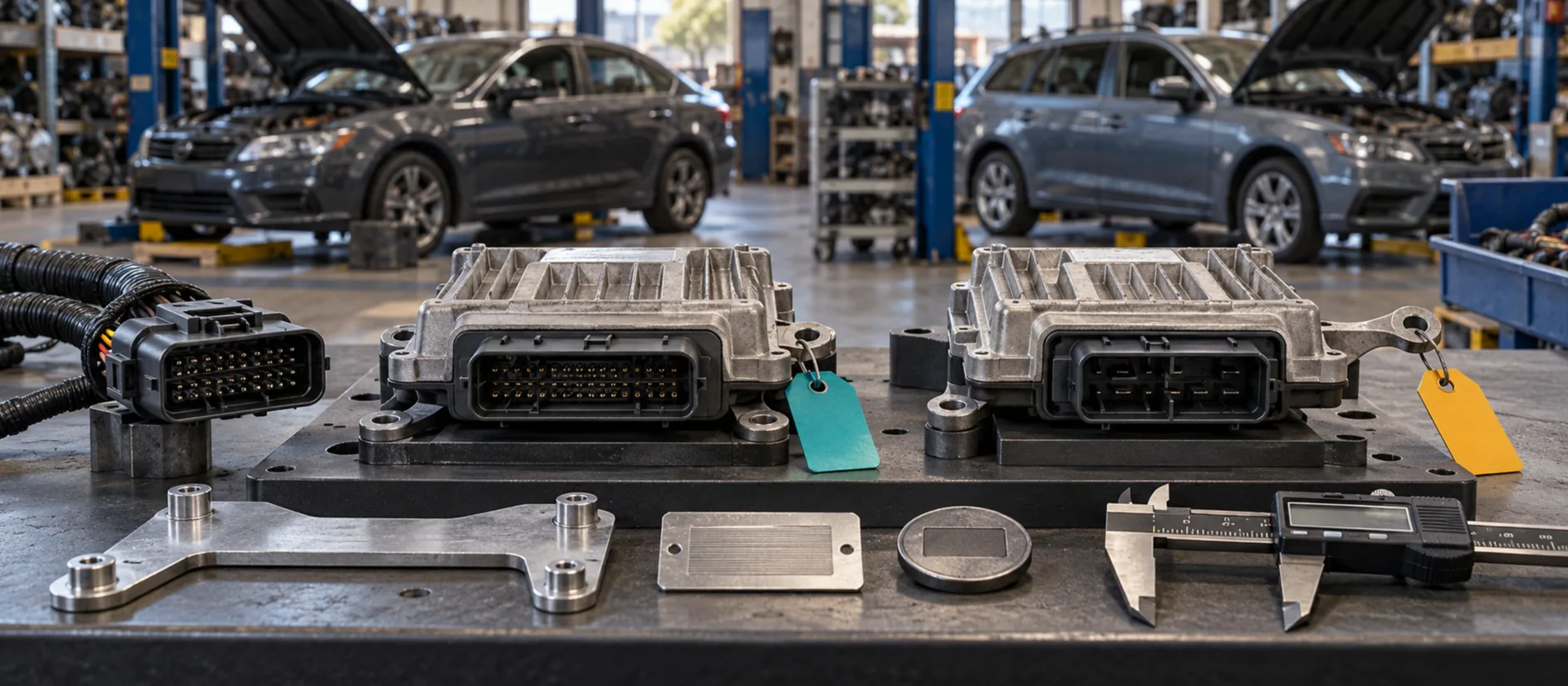
- Casting or mold number. Cast or molded into metal or plastic to identify the tool used in manufacturing. It usually is not the orderable number, and one casting can outlive several service-number changes.
- Supplier number. The number of the company that actually made the component. Useful for cross-referencing, but it is the supplier’s identity, not the automaker’s order number.
- Assembly or subcomponent number. A marking on one piece of a larger assembly. You may only be able to order at the assembly or kit level, not by the marked subpart.
The takeaway: a marking tells you a number, not necessarily the number. Classify it, then confirm the service identity in an OEM catalog before you build a listing on it. (Formats are manufacturer-specific, so a scheme you learn on one make will not map digit-for-digit to another.)
What a cross-reference is - and its types
A cross-reference links one number to another, but “linked” can mean several different things, and they do not all carry the same weight. Whether a cross-reference lets you claim fitment depends entirely on which type it is:
| Cross-reference type | What it means | Does it prove fitment? |
|---|---|---|
| OEM supersession | The maker replaced an old service number with a newer one | Strongest signal, but it is a numbering update, not a build guarantee - confirm it fits the specific vehicle |
| Sibling-brand equivalent | Shared design across badges from the same maker | Not on its own - it shows the parts are related, not that they are an orderable equivalent |
| Aftermarket competitor cross | A brand’s catalog claims its product replaces another number | No - it is a marketing claim that needs spec and application validation |
| Recycler interchange | A licensed, part-type-specific mapping (e.g. Hollander) | Strong within its group, but read the notes: a partial match comes with conditions, not a clean fit |
| Seller-created alias | A number or keyword you linked by hand | No - it is a search hypothesis until you verify it |
Use the word “equivalent” carefully. Two numbers being cross-referenced does not make the parts equivalent in fit and function until you know the type of relationship and confirm it.
Supersession, specifically
A supersession is when the manufacturer retires an old part number and points it forward to a current one. It matters for two reasons. First, quoting the old, superseded number can make a part look discontinued when it is actually current under a new number - a buyer searching the old number may never find yours. Second, supersession can be one-to-one or one-to-many (an old part replaced by a kit or assembly), and a part can be superseded several times down a chain, sometimes with a design or hardware change along the way. Resolve the chain to the current number, and do not assume the newest number drops in without checking the vehicle.
Cross-reference vs interchange
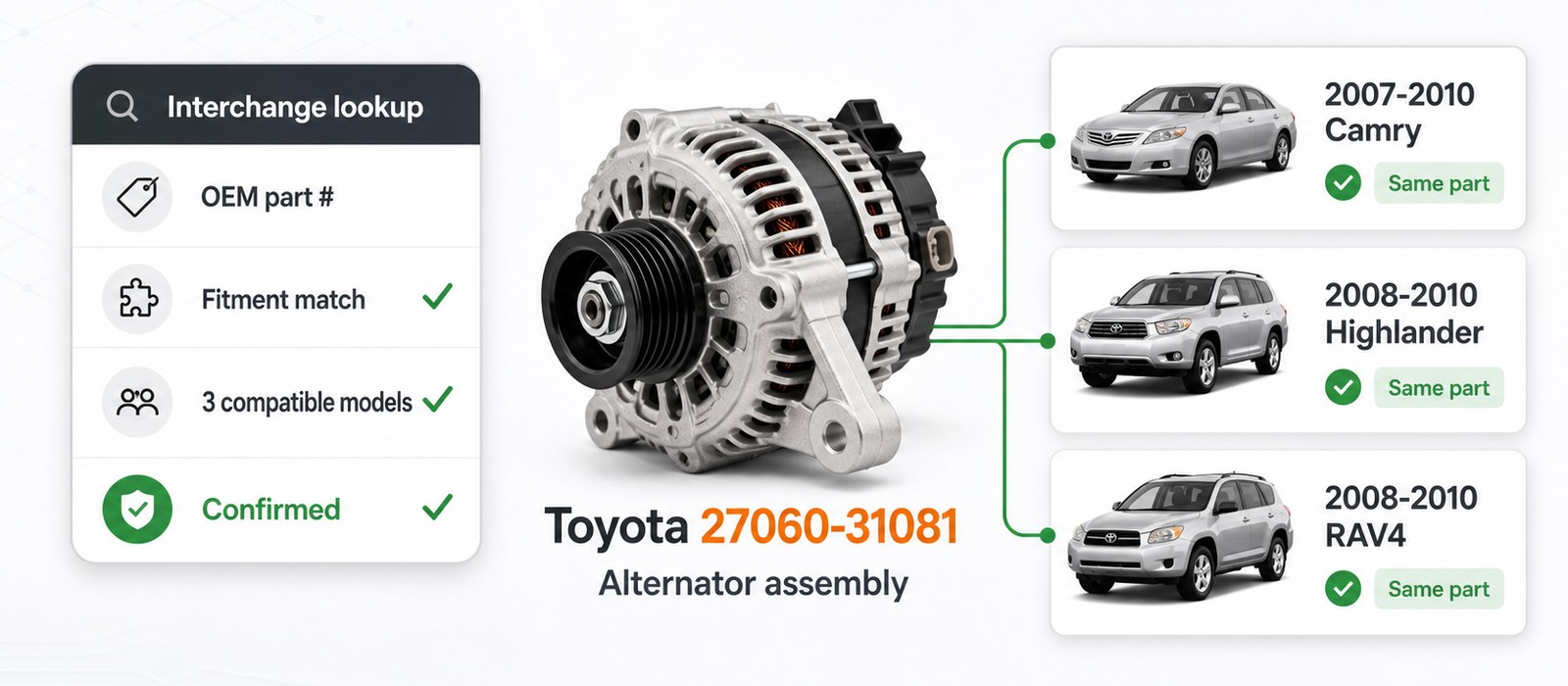
These get conflated constantly. A cross-reference works at the number level (what other numbers describe this part). Interchange works at the fitment level (which vehicles can use this part). You often use both, but they answer different questions. For how interchange actually works and how to find every car a part fits, see how auto parts interchange works; for the industry’s proprietary interchange reference, see what a Hollander interchange number is. The recycler’s guide to fitment and interchange ties the whole picture together.
How to use all three together
A strong used-parts listing uses each where it is best:
- OEM number to prove exactly what the part is.
- Cross-reference so buyers searching an alternate or superseded number still find it.
- Interchange so the part reaches every vehicle it genuinely fits.
Used together, they make a listing both findable and trustworthy. The failure mode is feeding any of them the wrong input: wrong number in, wrong car out. That is the core of cutting wrong-fitment returns, and it is why you confirm the details a buyer cares about before you publish. On eBay specifically, the seller is responsible for the compatibility they list, so accuracy is on you, not the catalog.
A worked example
Say you pull an alternator with two numbers on the case. Here is the reliable path:
- Read every marking on the part and write them all down.
- Classify each number - is it a casting number, an engineering number, a supplier number, or the service number? Rule out the ones you cannot order by.
- Confirm the service identity in an OEM catalog, which may show a service number that is not stamped on the part at all.
- Resolve supersession - walk the old number forward to the current one, noting any kit or one-to-many replacement.
- Get the fitment - use the application data and interchange to list the vehicles it fits, treating any partial-interchange notes as conditions to check, not clean fits.
Do that once, correctly, and the listing is precise and broad at the same time.
How reParta helps
reParta ships with its own built-in OEM part-number cross-reference and part-level fitment - its own data, not a licensed third-party interchange - wired directly into cataloging, pricing, and listing. When you catalog a part, reParta resolves supersessions and cross-references at that moment, so you are not stopping to hand-look-up a number, chase what replaced a discontinued part, or guess which vehicles share it. Its US vehicle-configuration dataset works alongside this to pin down the donor - the exact year, make, model, trim, and powertrain the part came off - so identification and cross-reference reinforce each other. The result is a cross-referenced, correctly-fitted part record built once, at catalog time, instead of reconstructed by hand every time you list.
Hollander interchange is the reference many yards know well. reParta takes a different route: rather than licensing an outside interchange, it builds cross-reference and fitment into the cataloging workflow itself. And because that fitment comes from structured data rather than an AI’s guess at what a part fits, the parts you list across channels go up fast and stay accurate - which is what keeps wrong-fitment returns, and the eBay seller-rating hit that follows them, off your back. To see a donor’s projected parts before you buy the car, run the VIN through Pre-bid ROI, all inside one auto parts inventory management software.
Know which tool answers which question, and your listings get sharper immediately. Start a free 14-day trial - no card required - or see plans and pricing.
Frequently asked questions
What is the difference between an OEM part number, a cross-reference, and interchange?
An OEM part number is the manufacturer's identifier for a specific factory part (identity). A cross-reference links that number to related numbers - a supersession, a sibling-brand equivalent, or an aftermarket brand's claimed replacement (alternate identity). Interchange works at the fitment level - which vehicles can use the part - not the number level. They answer different questions, and treating them as the same is how a part ends up on the wrong car.
Is the number stamped on a part the number I can order or sell by?
Not always. A marking cast or stamped on a part can be a casting or mold number, an engineering or production number, a supplier number, or a subcomponent number - none of which is necessarily the orderable OEM service number, which often lives only in the parts catalog or on the box. Classify the marking first, then confirm the service identity in an OEM catalog before you rely on it.
Does a cross-reference prove a part will fit?
No, not on its own. A supersession is the strongest signal but is still a numbering update, not a build guarantee. Sibling-brand and aftermarket crosses are catalog claims that need spec and application checks. A recycler interchange match is strong within its part group but can carry conditions in the notes. Treat every cross-reference as a candidate to confirm against the actual vehicle, and remember that on eBay the seller is responsible for the fitment they publish.