The recycler's guide to fitment and interchange
Fitment and interchange are the two ideas that quietly run the entire used-parts business. Get them right and one part on your shelf reaches buyers across many vehicles while rarely coming back. Get them wrong and you are invisible to the right buyers and flooded with returns. This is the overview, and each piece below links to a deeper guide when you want to go further.
The two questions every part has to answer
Every part you sell has to answer two questions:
- What is it? The part’s identity - its type, condition, and the right number.
- What does it fit? The vehicles it can correctly go on.
Fitment is the answer to the second question, the one every buyer is really asking: will this used part fit my car? That is where most of the money, and most of the mistakes, live.
Fitment: more than year, make, and model
A part’s fitment depends on year, make, and model, but also on trim, engine, drivetrain, body style, and build date, and sometimes on options. It can split further by market or emissions package, wheelbase, axle ratio, ADAS equipment, electrical architecture, and mid-cycle VIN breaks. Two cars that look identical can take different parts because of an engine or trim difference. The sellers who win treat fitment as all of these, not just the badge on the back.
Identity and part numbers
Before you can map what a part fits, you have to know exactly what it is, and that is less obvious than it sounds. A single part can carry several different numbers - a service part number, an engineering number, a casting number, and a supplier number - and they are not the same thing, so it matters which one you are matching on. The orderable service number often lives only in the catalog or on the box, not stamped on the part. The full breakdown, plus how a cross-reference differs from interchange, is in OEM part-number cross-reference for used parts.
Interchange: how one part reaches many vehicles
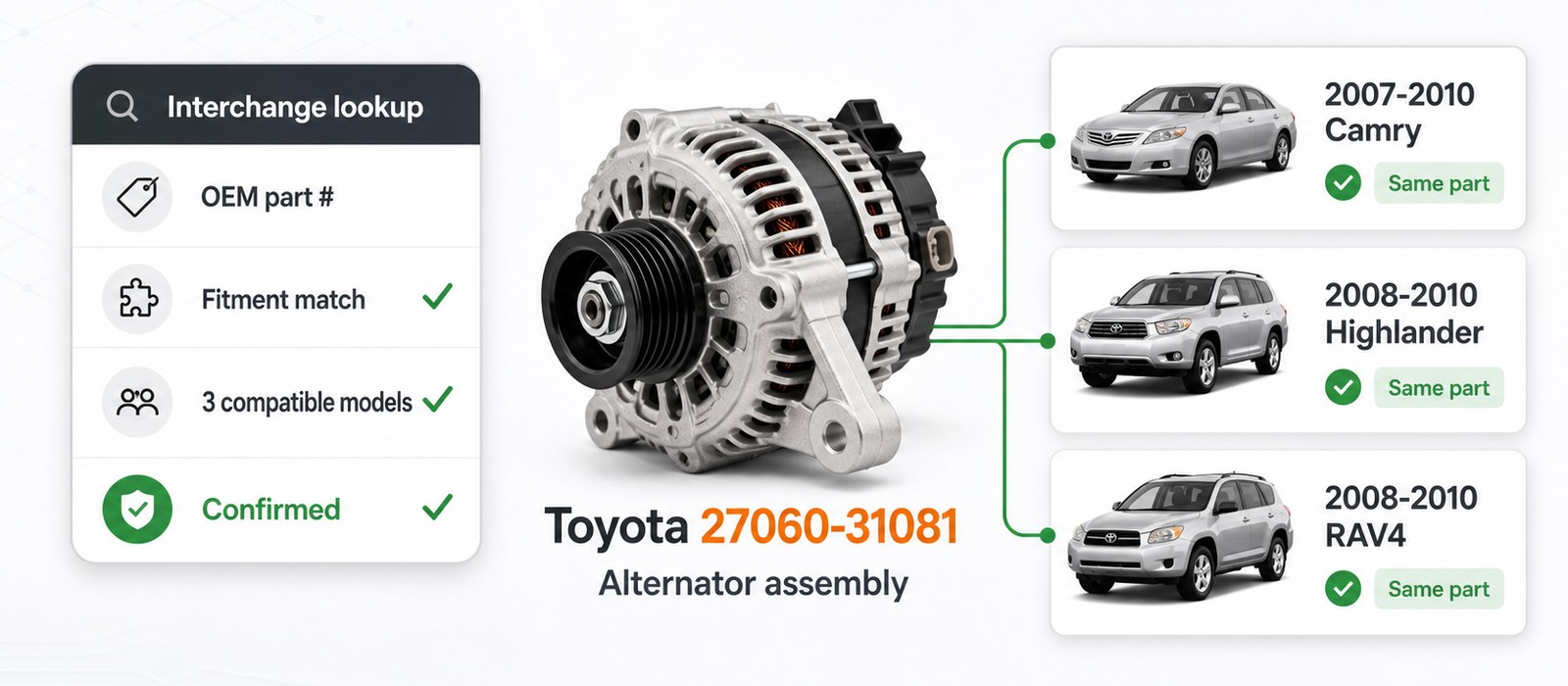
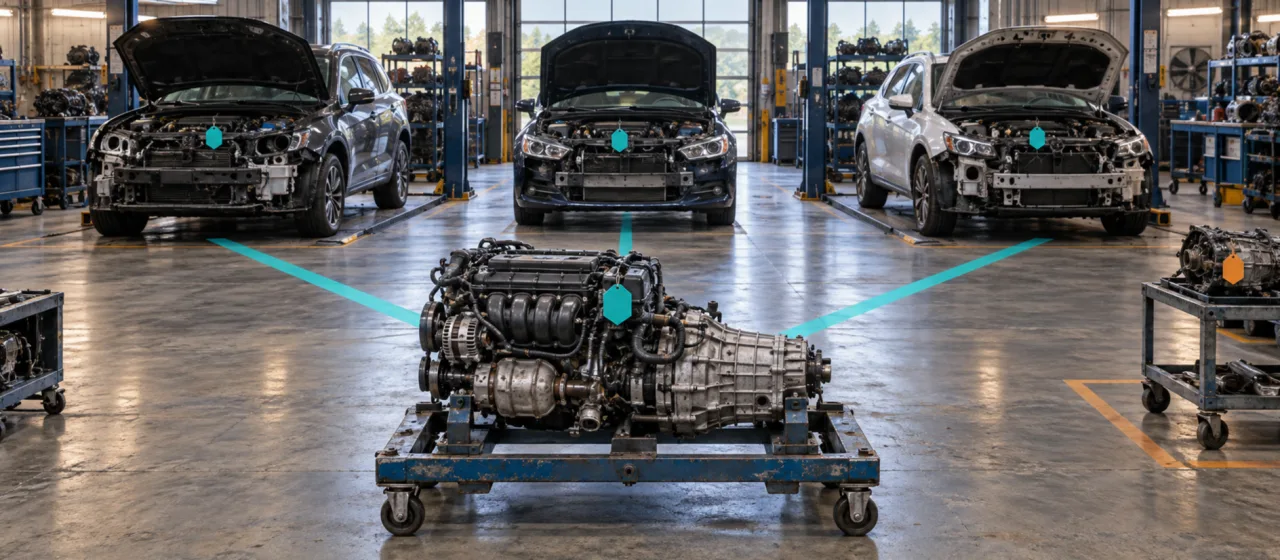
Interchange maps which parts are functionally equivalent across different vehicles. List by interchange and your part shows up for every compatible vehicle, not only the donor it came off - the lever that turns a narrow listing into a broad one. In North American auto recycling the common reference is the Hollander Interchange, a long-standing proprietary database maintained and licensed by Hollander, a Solera company, that gives yards a shared, standardized language for which parts swap across vehicles. Two cautions the pros never skip: an interchange match is not automatically a clean drop-in - many matches are conditional, carrying notes or requirements - and the full identifier, not just a few digits, is what you compare. Start with what a Hollander interchange number is, and for the actual lookup and the parts that swap widest, see how auto parts interchange works.
The electronics and programming caveat
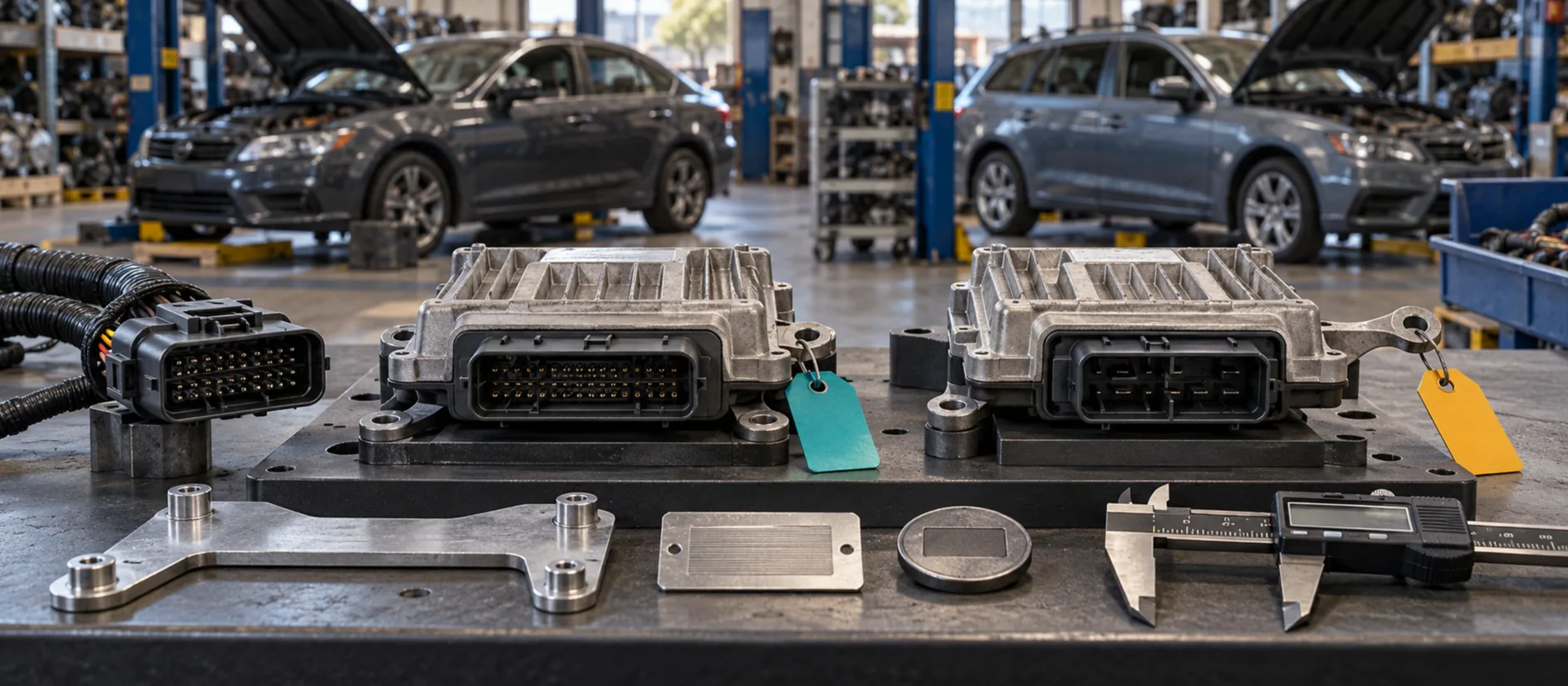
Interchange gets more conditional the more electronic the part is. For ECUs, transmission and body modules, and ADAS components like radar and cameras, a matching part number is often not enough: the part may still need programming or flashing to the buyer’s VIN, immobilizer or key pairing, or calibration after install, and some are anti-theft-locked to their original vehicle. A physically identical, correct-number module can still fail to run, which reads to the buyer as a fitment failure. Disclose these requirements up front, and capture the variances in your structured fitment and item specifics so the right buyer self-selects in and the wrong one self-selects out.
Some parts are restricted regardless of fitment
Fitment is not the only gate. Some parts face marketplace and legal limits no matter what they fit: eBay barred standalone airbags and inflators from US listings effective September 24, 2026, and used catalytic converters are restricted - eBay allows them only as recertified units or as scrap metal with no make or model, and California’s CARB effectively bans used converter sales. Confirm current policy before you count a part toward a donor’s return.
Reach and returns, honestly
Here is the part most people get slightly wrong. Accurate, verified fitment can do two useful things: widen the pool of vehicles a listing legitimately matches (more reach), and cut the returns that come from wrong-fit parts. But they do not move in lockstep. Reach does not grow proportionally to the number of applications you attach - more listed fits is not linearly more sales - and returns have causes beyond fitment: condition, an inaccurate description, shipping damage, missing programming, and plain buyer error. A careless mass-expansion of applications cuts both ways, lifting impressions while also raising wrong-fitment returns. So the win is verified fitment, not simply more fitment, and reach and returns are worth judging as two separate numbers. For how this plays out across the whole eBay workflow, see how to sell auto parts on eBay profitably.
The returns loop
When fitment is wrong, it shows up as returns, and the yards that stay ahead of it run a simple loop: record the reason for every return, trace it to a root cause, then fix it at the source - the master interchange mapping - and push that correction to every affected listing, not just the one that came back. One mapping error usually sits on many listings. The full prevention playbook, including the return-cause taxonomy, is in how to cut wrong-fitment returns, and the losses show up by listing and donor in per-donor profit and loss.
How to put it into practice
- Identify the donor precisely at intake - decode the VIN and capture trim and engine. Everything downstream depends on it, and the U.S. vehicle-configuration dataset is what pins the donor down.
- Catalog each part with its fitment, not just a name.
- List by verified interchange so the part reaches all compatible vehicles - as a lead you confirm, not a guarantee.
- Flag sub-variations - connectors, sensors, brackets, programming - that change fitment within an interchange group.
- Keep it consistent across your whole catalog and every channel.
How reParta helps
reParta fills fitment and item specifics from its own structured data as you catalog, so you are not hand-cross-referencing every part against a book or a spreadsheet. It identifies the donor from the U.S. vehicle-configuration dataset, then draws on its built-in OEM cross-reference and interchange - reParta’s own data, not licensed from Hollander - to suggest which vehicles the part fits, and you confirm it at catalog time rather than building it from scratch. Because that fitment comes from structured data instead of an AI’s guess, it is designed to widen the set of buyers who can find the listing and to cut the wrong-fitment returns that come from cross-referencing by hand under time pressure - and on eBay, guessed fitment is exactly what drives the returns and cases that drag down your service metrics. Run a VIN through Pre-bid ROI to project a donor’s parts before you buy, list across channels with multi-channel sync, and it all lives in one auto parts inventory management software.
If you only master one thing in this business, master fitment. Everything else gets easier when the part reaches the right buyer and stays sold. Start a free 14-day trial - no card required - or see plans and pricing.
Frequently asked questions
What is the difference between fitment and interchange?
Fitment answers which vehicles a specific part correctly goes on, based on year, make, model, trim, engine, drivetrain, body style, build date, and sometimes options. Interchange answers the wider question of which parts are functionally the same across different vehicles, so one part off one donor can be listed against every vehicle that shares it. Fitment is about a part and its vehicles; interchange is about parts that substitute for each other. You use both: interchange widens the candidate list, and fitment confirms it.
Does an interchange match guarantee a part will fit?
No. Many interchange matches are conditional, carrying notes or requirements that must be met before the swap works, and a match found by number still needs the vehicle specifics confirmed - trim, engine, side, options, and any programming. Electronic parts like ECUs, modules, and ADAS components can share an interchange and still need coding, calibration, or immobilizer pairing to function. Treat an interchange match as a strong candidate you confirm, not a guaranteed drop-in.
Why does fitment matter so much for used-parts sellers?
Because it drives two things at once: reach and returns. Accurate, verified fitment can widen the pool of vehicles a listing legitimately matches and cut the returns that come from wrong-fit parts. The two do not move in lockstep - reach does not grow proportionally to the number of applications you attach, and returns have other causes like condition and shipping damage - but getting fitment right is one of the few levers that helps both sides instead of trading one for the other.