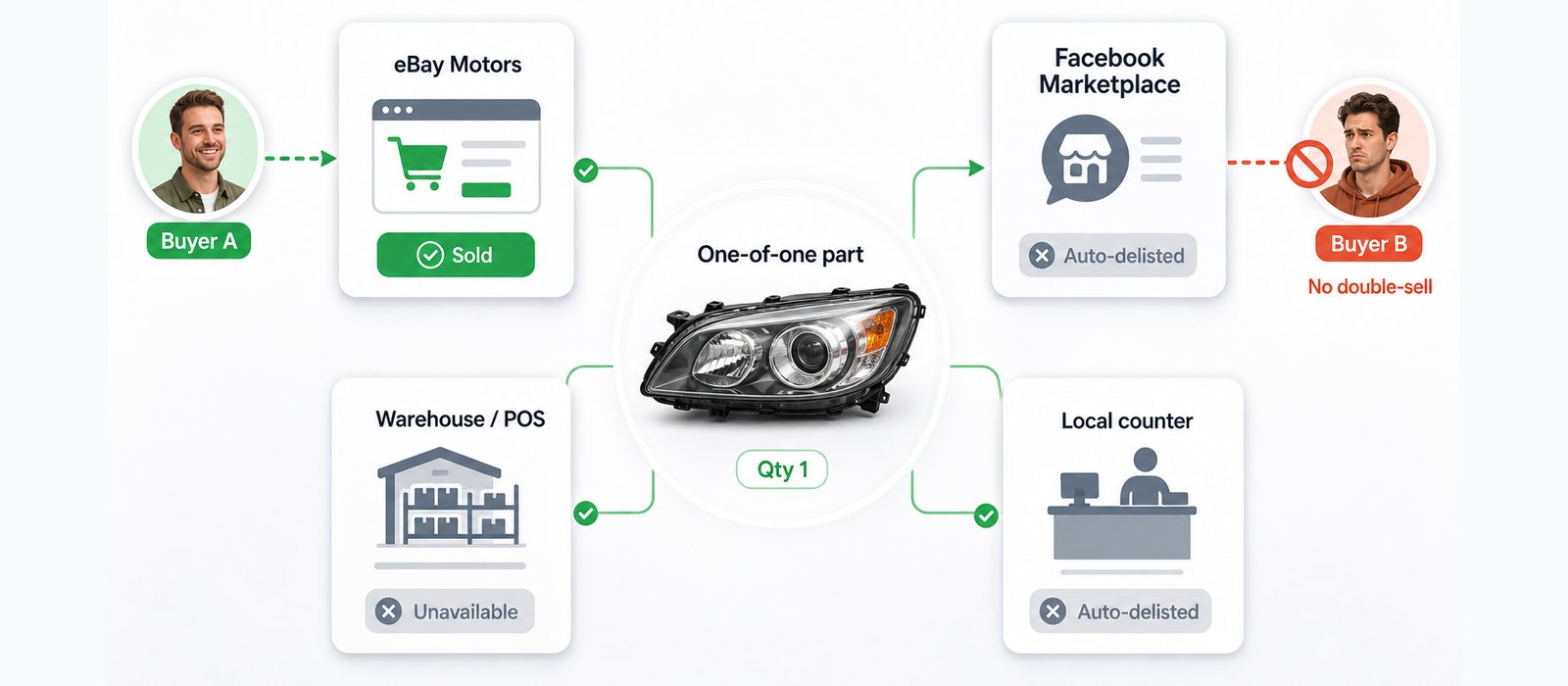
How to Stop Double-Selling Across Channels
If you sell used parts on more than one platform, double-selling is not a matter of if, it is a matter of when. You list a part on eBay and Facebook Marketplace. It sells on eBay. Twenty minutes later, before you have pulled it from Facebook, someone buys it there too. Now you have one part and two paying buyers, and one of them is about to have a very bad day, along with your seller account.
It is the most avoidable expensive mistake in multichannel parts selling, and almost every seller learns it the hard way. Here is exactly why it happens, what it actually costs you (more than you think), and how to stop double-selling for good.
First, you are right to be crosslisting
Before the fix, the premise: listing the same part on several channels is the correct strategy, not the problem. Different channels do different jobs, and for used parts the split is sharp.
- eBay and eBay Motors are where buyers search on purpose. Someone types a part number or their year, make, and model, and your listing shows up. It is the best channel for anything searchable and shippable.
- Facebook Marketplace, Craigslist, and Nextdoor are where local buyers are, and where the bulky stuff moves. Bumpers, doors, glass, and full assemblies that would cost a fortune to ship sell locally for cash. (See the Facebook Marketplace playbook for recyclers.)
- Car-Part.com is the trade channel, where yards and other sellers look for parts by interchange.
- Some sellers add Amazon or their own site on top - and every channel you add is one more place a sold part has to disappear from the instant it sells.
Every channel you add is more eyeballs and a faster sale, and deciding where to list which part is its own skill. That part is smart. The trap is not crosslisting. The trap is keeping all of those listings in sync when one of them sells.
The real cost of a double-sell (it is worse than a refund)
Most sellers think a double-sell just means an awkward apology and a refund. On eBay, it means a lot more.
When you cancel the order you cannot fulfill, your only honest reason is “out of stock.” That cancellation is recorded as a transaction defect, and it sticks to your account for a full year. Defects are not cosmetic. Pile up enough and eBay lowers your search visibility, cuts your selling limits, and can suspend the account outright.
And “enough” is a smaller number than you would guess. Sellers have reported that a handful of out-of-stock cancellations was enough to strip Top Rated status from a low-volume account, and to push it toward Below Standard once the defects came from five or more different buyers. Here is why so few can do it: Top Rated allows a defect rate of just 0.5 percent - one per 200 sales - from no more than three different buyers. A smaller seller moving 50 parts a month blows past the percentage with a single cancel, so the buyer count is what stands between you and a demotion. One lazy afternoon of not delisting can genuinely dent your standing on the channel that matters most.
There is one narrow exception, and it will not rescue a double-sell. If a buyer genuinely asks to cancel, eBay removes any negative or neutral feedback tied to it and applies no seller defect at all. But a double-sell is not that case: you are the one canceling because you oversold, which eBay records as an out-of-stock seller defect. You cannot relabel it as a buyer request to escape the mark, because using the wrong cancellation reason to dodge a defect is itself against eBay policy. In a double-sell, the defect is yours to keep.
Stack on the rest of it: the buyer on the losing end may leave feedback anyway on the platform you did not cancel through, Facebook tracks seller reliability the same way and quietly buries flaky sellers, and a frustrated buyer can file a card chargeback that costs you the fee and the fight. A double-sell is not a $40 inconvenience. It is a swing at your account health, your search placement, and your standing on every channel at once. (We break the full number down in the real cost of double sales.)
Why it happens: manual delisting always trails reality
Here is the uncomfortable truth. No matter how disciplined you are, manual delisting lags reality by minutes to hours, and the double-sell lives in exactly that gap.
The part sells on eBay at 1:14. You do not see the notification until 1:35 because you were driving, eating, or pulling another order. You open Facebook to delist at 1:40. Somewhere in those 26 minutes, a Facebook buyer hit Buy. You never had a chance. The sale on one channel and the delisting on the others can never be truly simultaneous when a human is the link between them.
And the failure modes multiply the more real your business gets:
- Volume. Tracking 30 SKUs by hand is doable. Tracking 300 is not.
- More than one person listing. The moment a partner or an employee also posts parts, nobody has the full picture of what just sold.
- Simple human lag. You are asleep, off the clock, or heads-down pulling parts. The channels do not wait for you.
- Simultaneous buyers. Two people buy the same one-of-one part on two channels within the same minute. No human reflex wins that race.
Why parts are worse than clothing
This is where general reselling advice stops applying to you, and it is the part most articles miss.
Every used part is one of one. A clothing reseller who oversells can often reorder or has near-duplicates. You cannot restock a specific used taillight off a specific donor car. When it sells, it is gone, which means it has to come off every other channel instantly, not eventually. The margin for error is zero.
On top of that, parts sellers run high SKU counts and a channel mix that the popular crosslisting tools do not even cover. The well-known crosslisters, the ones built for Poshmark and Depop and general resale, do not connect to Car-Part.com or handle eBay Motors fitment. So the exact tools that solve double-selling for a clothing seller leave a parts seller’s real channels unprotected. You are told “just use a crosslisting app,” and then find out it does not speak your channels.
The manual playbook, done honestly
If you are doing this by hand, there is a right way, and you should run it until you outgrow it.
- Make delisting a reflex, not a task. The instant a part sells anywhere, the very first thing you do, before you pack, before you print a label, before anything, is pull it from every other channel. Packing can wait five minutes. A double-sell cannot be undone. (If you are unsure how, here is how to remove an eBay listing.)
- If more than one person lists, keep a shared live status sheet. One row per part, a status column, and a rule that you update it before you touch the item. It is clunky but it keeps two people from selling the same part blind.
- Delist first, communicate second. Get it off the channels, then message the buyer you are fulfilling.
This works. It is also fragile by design, because it depends on a human being awake, present, and disciplined every single time, across every channel, forever. It holds until the day you are busy, and that is the day it costs you.
The tool trap: not all “sync” is real sync
The obvious answer is software that delists automatically. It is the right instinct, with two cautions.
First, coverage. Most crosslisting tools were built for general resale and do not support the channels parts sellers actually use, so they will happily sync your eBay and Poshmark while leaving Car-Part.com, eBay Motors, and your local channels wide open. A sync tool that does not cover your channels is not protecting you.
Second, the sync logic has to actually be correct. There are documented cases of integration apps that, when an item sells, set the quantity to zero and then immediately relist it with one unit back in stock, recreating the exact oversell they were supposed to prevent. And this is not a parts-only problem: even the mainstream crosslisting tools draw the same complaint, that the delist simply does not fire. One review of a widely used tool warns that it “doesn’t always delist your items, you will have double sales and have to cancel orders.” “It has auto-delist” is not enough. The delist has to fire the instant the sale happens, across every connected channel, and stay down.
Done right, this is the only approach that closes the gap for good, because it removes the human from the critical path. The sale event on one channel triggers the delist on all the others in the same moment, not whenever you next check your phone.
The fix that makes double-selling impossible
This is the problem reParta was built to end. You list your parts across your channels, and the moment a part sells anywhere, it comes off every other channel automatically and instantly. Because each used part is one of one, that single rule - sell once, delist everywhere, the same second - makes a double-sell physically impossible rather than merely less likely. It runs inside reParta’s auto parts inventory software, so listing and delisting are one system, not two apps you reconcile by hand.
And it is built for the way parts sellers actually work: the parts channel mix, the one-of-one single-quantity reality, and the high SKU counts, instead of a clothing tool bolted onto a business it was never designed for. You get the reach of selling on multiple marketplaces without the account-killing risk of being everywhere.
See how reParta keeps your parts in sync or start selling everywhere without double-selling.
Quick reference
- Crosslisting is the right move. Losing track when something sells is the problem.
- A double-sell forces an out-of-stock cancel, which is a transaction defect that sticks for a full year.
- The Top Rated defect threshold is 1 in 200 (0.5%), from no more than 3 different buyers. A handful of these can cost a low-volume seller Top Rated status.
- A genuine buyer-requested cancel removes both feedback and the defect - but a double-sell is your own out-of-stock cancel, which you cannot relabel to dodge the defect.
- Manual delisting always lags the sale. That lag is where every double-sell happens.
- Used parts are one of one. When it sells, it has to come off everywhere instantly - there is no restock.
- Most crosslisting apps do not cover Car-Part.com or eBay Motors, so they do not protect parts sellers.
- If you sync by hand: delist everywhere first, the second it sells, before you do anything else.
- The only permanent fix is automatic delisting across every channel the instant a part sells.
Last verified: September 21, 2026.
Frequently asked questions
What is double-selling, and why is it worse for auto parts?
Double-selling is when the same item sells to two buyers across two channels before you delist it. It is worse for used parts because every part is one of one - you cannot restock a specific used taillight off a specific donor car. When it sells, it has to come off every other channel instantly, not eventually, so the margin for error is zero.
What happens if you cancel an eBay order because you are out of stock?
The only honest cancellation reason is out of stock, and eBay records that as a transaction defect that stays on your account for a full year. Defects are not cosmetic: enough of them and eBay lowers your search visibility, cuts your selling limits, and can suspend the account outright.
How many out-of-stock cancellations before eBay suspends you?
Fewer than you would guess. Top Rated allows a defect rate of just 0.5 percent (one per 200 sales) from no more than three different buyers, and a low-volume seller busts that percentage with a single cancel - so the buyer count is the real gate. Sellers report a handful of out-of-stock cancels was enough to cost a small account its Top Rated status, dropping it toward Below Standard once the defects span five or more buyers.
Does a buyer-requested cancellation remove the eBay defect?
A genuine buyer-requested cancellation removes both the feedback and the defect - when the buyer truly asks to cancel, eBay applies no seller defect. But a double-sell is not that situation: you are canceling because you oversold, which is an out-of-stock seller defect, and eBay bars relabeling it as a buyer request. So the exception is real, it just does not cover the double-sell you are trying to avoid.
How do you avoid double-selling when you list on eBay and Facebook?
The instant a part sells anywhere, delist it from every other channel first - before you pack, print a label, or message anyone. Manual delisting always lags the sale by minutes to hours, and that lag is where every double-sell happens, so the only permanent fix is automatic delisting that fires the moment the sale does.
Do crosslisting apps prevent double-selling for auto parts?
Most do not. The well-known crosslisters are built for general resale (Poshmark, Depop) and do not connect to Car-Part.com or handle eBay Motors fitment, so they leave a parts seller's real channels unprotected. Some integrations even set quantity to zero on a sale and immediately relist at one, recreating the oversell. Check both coverage and that the delist fires instantly and stays down.
Is it worth listing on multiple marketplaces if double-selling is the risk?
Yes. Listing the same part on several channels is the correct strategy - different channels reach different buyers and sell faster. Crosslisting is not the problem; losing track when one channel sells is. The fix is automatic delisting, not fewer channels.
Does inventory software stop double-selling?
Only if listing and delisting are the same system. Generic inventory and crosslisting tools track a quantity, but a used part is one of one - so the risk is not a wrong count, it is the lag between the sale on one channel and the manual delist on the others. It is solved only when the sale itself fires the delist everywhere the same second. reParta is software for used-parts sellers that works that way by design.