How to start a used auto parts business
Plenty of used auto parts businesses started with one person, one donor car, and a driveway. The path from there to a real operation is well-worn - but it is not one path, and the first mistake most people make is treating a used auto parts business as a single thing. It is really several very different businesses stacked on top of each other, and each one you climb into adds licenses, rules, and cost.
This is the honest version: what the models actually are, what the law expects at each level, and the order that keeps you out of the most expensive holes.
First, decide which used auto parts business you are actually starting
Selling used parts spans a ladder of models, from almost no regulatory footprint to a full industrial operation:
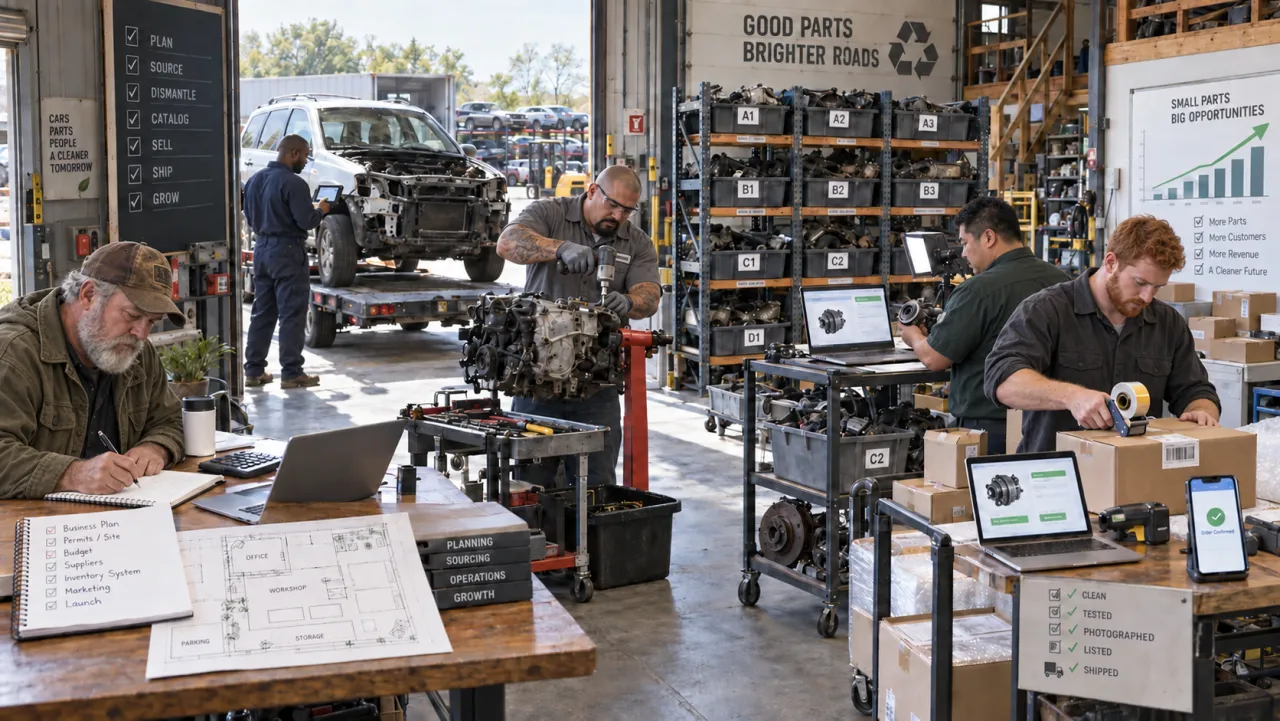
- Reseller of already-removed parts. You buy parts that were already legally pulled and documented, then inspect, test, photograph, store, and sell them. You do not buy whole salvage vehicles, drain fluids, or dismantle. This is the most realistic garage start.
- Broker or consignment. You list and organize the sale without owning or dismantling. Marketplace rules and consignment contracts apply, and you cannot use it to mask dealer or dismantler activity.
- Parts warehouse. You buy pallets and lots of already-removed parts and resell wholesale and retail from a commercial space.
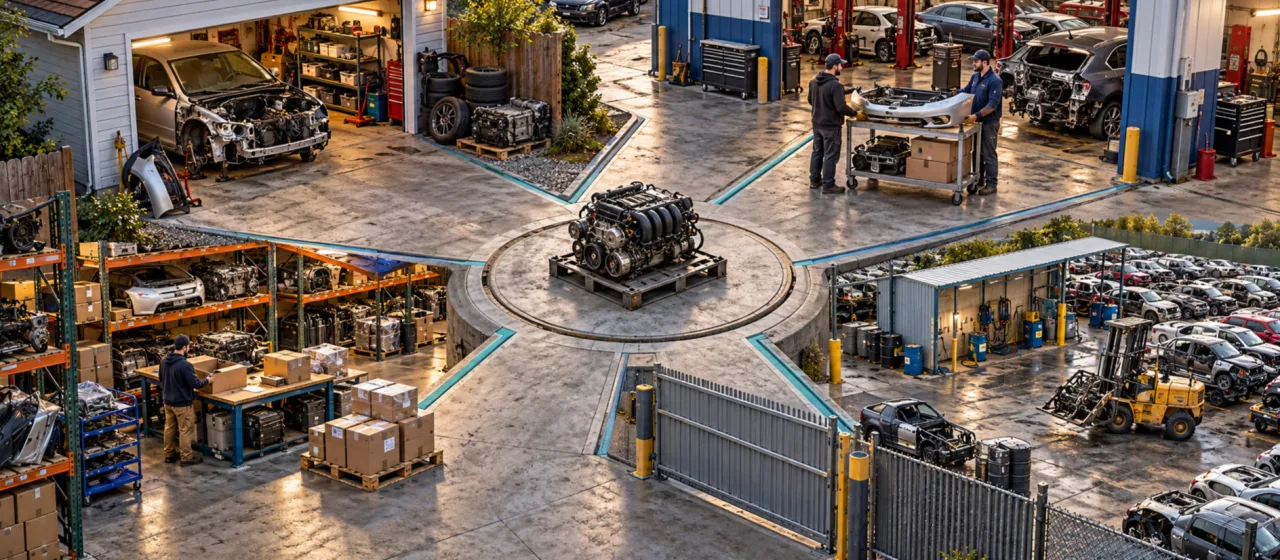
- Licensed dismantler or recycler. You buy donor vehicles, depollute them, dismantle, test, and sell parts. This is an industrial operation, not e-commerce.
- Self-service / pick-and-pull yard. Customers pull parts themselves. Land, visitor safety, heavy equipment, and environmental compliance dominate.
- Rebuilder or salvage vehicle dealer. You sell whole salvage or rebuilt vehicles. Title branding and dealer rules differ from dismantling.
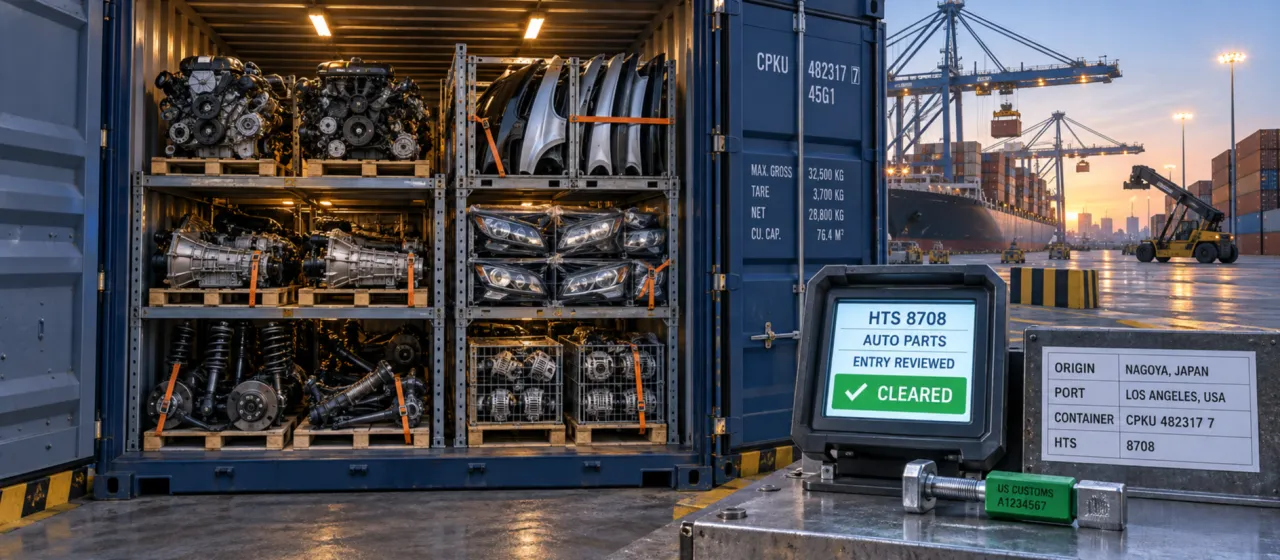
- Importer. You bring parts in from abroad and add customs, classification, origin, duties, and admissibility on top of everything else.
The single most dangerous assumption is that forming an LLC, getting an EIN, or gaining auction access lets you buy and dismantle whole cars. It does not. An LLC, a sales-tax permit, auction membership, a dismantler license, zoning approval, and environmental permits are all separate things, and you can have several while still missing the one that matters.
If you want the lightest-footprint start, the safest model without a dismantler license is to buy only already-removed parts from licensed, verifiable suppliers, keep the paperwork (invoice, donor VIN, supplier license) where you can, and never take in whole salvage vehicles, drain fluids, open A/C systems, or handle airbags and high-voltage batteries. Even then, some states require a used-parts, secondhand, or scrap dealer permit, so the answer still comes down to your state and your actual activity - not your company name.
The license question: ask before you buy, in writing
Run your plan through these questions, because any “yes” can add a separate license:
- Are you buying whole vehicles, salvage vehicles, or major body parts?
- Will you store two or more inoperable vehicles?
- Will you dismantle them systematically to sell parts?
- Are you buying from the public, tow companies, insurers, or auctions?
- Are you selling whole or rebuilt vehicles, or only parts?
- Are there customer vehicles on site, or any towing, storage, repair, crushing, or self-service access?
- Are there regulated materials - fuel, oil, coolant, refrigerant, batteries, airbags, tires?
The requirements genuinely vary by state, and they change:
- California requires a DMV Vehicle Dismantler license to buy or sell nonrepairable vehicles for dismantling or to deal in used motor vehicle parts. There is a narrow exception for acquiring parts for resale from vehicles that were already cleared for dismantling - it does not let you do the clearing yourself. The application pulls in a seller’s permit, a stormwater permit, a CalEPA ID, zoning verification, fingerprints, and site photos.
- Texas licenses a Used Automotive Parts Recycler (UAPR) through TDLR, and it licenses the business and the employees who buy or sell parts. A UAPR business must carry general liability insurance of at least $250,000, and a salvage dealer whose used-parts activity is “more than incidental” needs the UAPR license too.
- New York requires a separate DMV registration for junk and salvage businesses and vehicle dismantlers.
- Florida issues a Salvage Motor Vehicle Dealer license through FLHSMV under its motor-vehicle dealer program.
Those are four examples, not a fifty-state survey. Registering your LLC in a business-friendly state does not change the laws of the state where the vehicles physically sit and get dismantled. The right move is to write one plain paragraph describing your address, volume, sources, whether you will store vehicles outside, exactly which fluids and devices you will remove, and whether you sell parts or whole vehicles - then send it to your state DMV or vehicle-dealer division, your city or county zoning office, and the fire marshal, and get the answer in writing. Do not ask abstractly whether “an online store needs a license.” Describe the facts.
The federal layer nobody warns you about
Above the state license sits a federal layer that is trigger-based, not volume-based - most rules switch on with a specific activity, shipment, or transaction, and only a few (like NMVTIS) have an explicit annual vehicle count:
- NMVTIS. Handle five or more junk or salvage vehicles in a year and you generally must report to the National Motor Vehicle Title Information System at least monthly - VIN, date obtained, who you got it from, and disposition. We break the threshold and the fields down in NMVTIS reporting for dismantlers; build it into your inventory workflow, not a month-end scramble.
- Title, VIN, and stolen-property control. For every donor vehicle: verify the seller, get a valid ownership document, check the VIN on the car against the paperwork, follow your state’s title surrender or notice process, and do not dismantle until you have clear authority to. Never “correct” a VIN or accept a part with a destroyed number without escalating.
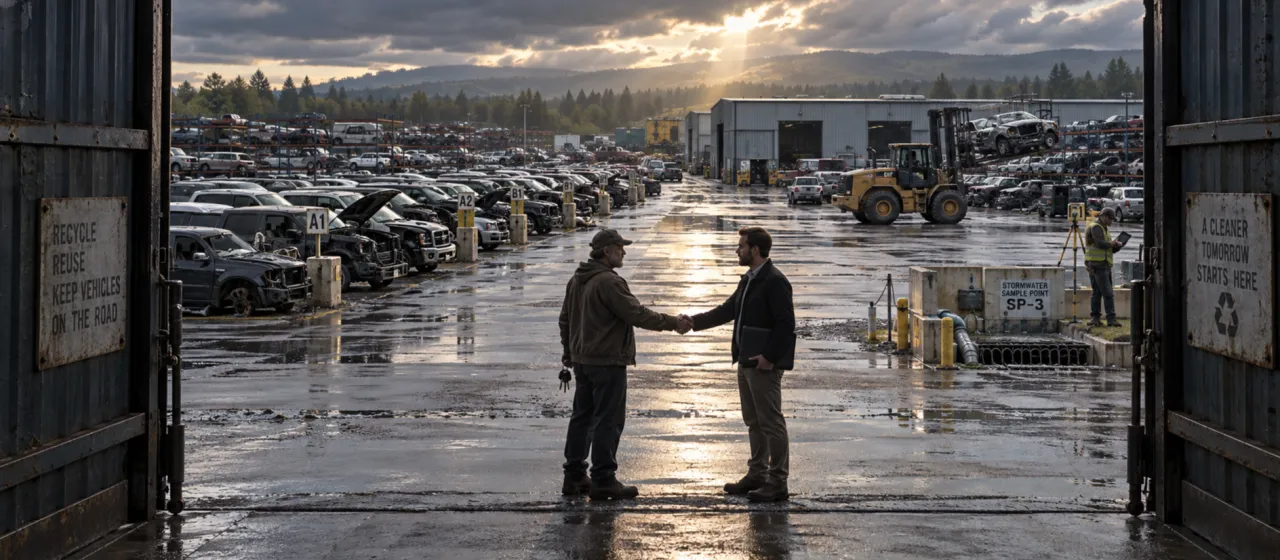
- EPA and environmental. A salvage yard falls under EPA’s industrial stormwater program (auto salvage is “Sector M”), which generally needs a stormwater permit and a written SWPPP - usually from your state, since most states run the program, though a yard that keeps all parts, fluids, and dismantling under a storm-resistant shelter may instead file a no-exposure certification. Used oil is regulated under 40 CFR Part 279, with containers clearly marked “Used Oil” and kept separate from solvents and hazardous waste, since mixing can pull the whole volume into stricter rules. The SPCC rule can apply once you have more than 1,320 gallons of aggregate aboveground oil capacity (counting only containers of 55 gallons or more), or more than 42,000 gallons completely buried, with a reasonable expectation of discharge to navigable waters. Refrigerant: intentionally venting it is prohibited under the Clean Air Act (Section 608), and paid A/C service requires a Section 609-certified technician with approved equipment. Used catalytic converters are their own trap: one can be resold for reinstallation only if it meets EPA’s aftermarket conditions (tested, matched to the vehicle, labeled), and selling an unqualified one for installation is treated as illegal tampering. We break this whole layer down in salvage yard EPA compliance.
- OSHA. There is no single universal OSHA checklist - the programs you need follow your actual hazards, and OSHA is an employee-safety law: a genuine solo owner with no employees is not covered by federal OSHA (though state OSHA, fire, and environmental rules can still apply). The most common program once you hire is Hazard Communication (29 CFR 1910.1200): once you have employees who may be exposed to a hazardous chemical (solvents, paint, fuels), you need a written HazCom program - a chemical list, labels, safety data sheets, and training before anyone starts. The others switch on with the equipment and work they cover, which a dismantling yard almost always has: powered-industrial-truck (forklift) training if you run a forklift, lockout/tagout for servicing equipment, and vehicle stabilization for working under lifted cars.
- DOT / PHMSA hazmat. Airbag inflators, airbag modules, and seat-belt pretensioners ship as UN3268 (Class 9) only when they have been tested and approved through a PHMSA-authorized process (with an EX number where required); otherwise they ship as the more restrictive UN0503 (Division 1.4G) - it is not a pass/fail call you make yourself. Either way, packaging, marking, shipping papers, and recordkeeping apply, and anyone who classifies or ships them is a “hazmat employee” who needs PHMSA training. Lithium batteries are regulated too, and damaged ones are barred from aircraft. A normal carrier label is not enough - see our guide on how to ship used auto parts and the 2026 eBay airbag rules.
- Recalls. The NHTSA VIN lookup does not show a complete recall history - it misses completed recalls, some very recent ones, and some older than fifteen years - so treat it as one control, not the whole check, and keep a stop-sale policy for open recalls and safety-critical parts.
- Cash. Take in more than $10,000 in cash in one or related transactions and you generally must file IRS Form 8300 within fifteen days, give the payer a written statement by January 31 of the next year, and e-file once you file ten or more information returns in a year. Breaking a sale into smaller pieces to dodge it is illegal.
The site is the costliest irreversible step
For anything beyond resale, the address decides your fate. Before you sign a lease or purchase, make it contingent on written zoning or use confirmation, license feasibility, environmental permits, fire and building approvals, and - for a property purchase - a satisfactory Phase I Environmental Site Assessment. A Phase I under ASTM E1527-21 satisfies EPA’s All Appropriate Inquiries and, done before you acquire the property and paired with the ongoing “continuing obligations” the protections require, can preserve important liability protections under federal cleanup law. A lease clause that says “the landlord is responsible for contamination” does not protect you from a regulator or a cleanup order. We walk the whole site decision, zoning through Phase I, through salvage yard zoning and Phase I ESA.
This is also why a residential garage almost never works for dismantling. Home-occupation rules typically cap outdoor storage, hazardous materials, noise, employees, signage, and traffic, and regular teardown can change the property’s lawful use and fire load even if one car physically fits.
Entity, tax, and BOI
Little of the business stack is a federal precondition to selling - you can operate as a sole proprietor where your licenses allow, and an EIN is strictly required only in specific cases (employees, certain taxes, or a partnership or corporation), though banks and states often ask for one anyway. The usual setup is still worth doing: form an entity for liability separation, get an EIN directly from the IRS (it is free - ignore sites that charge for it), register for state and local tax accounts, get a sales-tax permit and resale certificate, open a dedicated business bank account, and set up accounting and an inventory policy with a CPA.
Two things trip people up. First, sales tax: a marketplace collecting tax on your behalf does not automatically clear all of your obligations - your own website sales, registration, and filings can still be on you, and both physical presence and economic nexus (sales thresholds that vary by state) can create tax duties. Second, beneficial-ownership reporting: as of a permanent FinCEN rule effective in August 2026, entities created in the US and their beneficial owners are exempt from Corporate Transparency Act BOI reporting, while certain foreign entities registered to do business in the US still report their foreign beneficial owners. This area has changed repeatedly, so confirm the current status before you rely on it.
Insurance that actually covers used parts
Get a broker who understands the whole operation in writing, and read the exclusions rather than trusting a summary. Depending on your model you may need commercial general liability, product and completed-operations liability, property and business interruption, cargo, commercial auto, garage and garagekeepers coverage if you handle customer vehicles, workers’ compensation, and pollution or environmental liability. A homeowner policy should not be assumed to cover a business, and a supplier’s certificate of insurance does not cover you. Watch specifically for exclusions on used parts, airbags, tires, salvage vehicles, pollution, and fitment advice.
Sourcing and the number you stop bidding at
Once you can sell, sourcing becomes the game. Most small operations buy from salvage and insurance auctions, tow and lien sales, dealers, fleets, and private sellers - and auction access is not the same as authority to dismantle on your site. Start where you can inspect before you buy, because bidding blind is how you learn expensive lessons. We go deep on this in where to buy cars to part out and how to value a salvage car for parts.
The discipline that separates profitable buyers from the rest is a hard ceiling on every bid. Do not add up optimistic list prices for every part. Work from a probability-weighted expected recovery - what each part realistically sells for, times the chance it sells, plus scrap and core value, minus fees, shipping, and returns - then subtract your labor, storage, disposal, target profit, and an uncertainty reserve. What is left, minus auction fees and transport, is your maximum bid. Our piece on what number to stop at walks the math.
Where and how you sell
You make the money on the sell side, so decide where your parts go before you drown in inventory. Most small operations run a mix:
- eBay Motors for national demand and long-tail parts, with built-in payments and shipping - but you live or die on accurate fitment, service metrics, and return handling. See how to sell auto parts on eBay.
- Facebook Marketplace for local pickup and bulky, heavy, low-value parts that would cost too much to ship. See selling used car parts on Facebook Marketplace.
- Local and wholesale - repair shops, body shops, and other yards - for repeatable B2B demand once you have the volume.
Which channel wins for a given part depends on the part; our breakdown of where to list a part walks through the trade-offs.
Two things decide whether selling is profitable. The first is fitment: every listing is a compatibility claim, and the fastest way to bleed margin is wrong-fitment returns, so capture every number on the part at teardown, but do not treat a stamped or interchange number alone as proof - validate fitment against a licensed interchange source or the manufacturer catalog, and treat “will it fit” as something you prove, not guess. The second is price: do not discount off MSRP - price from what the part actually sells for after fees, shipping, and returns. Our guide on how to price used auto parts has the method.
The system, before the spreadsheet breaks
A notebook works for the first dozen parts. It falls apart the moment you have multiple donors, parts on several channels, and customers asking “do you still have it?” That is the point where the business needs a real system - and in this business the system is not just a catalog, it is your compliance and cash-flow backbone.
That is exactly the stage reParta is built for - the solo dismantler and small yard doing 1 to 50 donors a month who has outgrown the spreadsheet but does not want the cost and complexity of legacy systems. In practice that means:
- Every part tied to its donor. VIN, title, and the fields NMVTIS asks for live on the inventory record, so the data you need for traceability and monthly reporting is captured as you work, not reconstructed at month-end.
- Double-sale protection across channels. Stock lives in one place, so a part that sells on eBay comes down from your other channels automatically, and a Facebook or local sale clears with one tap - a sold part does not sit live in two places.
- Per-donor profit you can see. Cost, labor, fees, shipping, and proceeds roll up per donor vehicle and per channel, so you know which cars and which parts actually made money and you buy your next lot on real numbers.
You can read more on the operational side in what auto dismantling really involves and how to inventory a salvage yard.
The path that works for most used auto parts business owners
- Do not buy donor vehicles yet.
- Start with a narrow catalog of already-removed parts from licensed suppliers.
- Use a commercial micro-warehouse if your residential rules are shaky.
- Prove contribution margin and inventory accuracy on 100 to 300 SKUs.
- Get your traceability and inventory system to where it could handle a thousand SKUs.
- Then decide: stay an asset-light reseller, or go into licensed recycling.
- If you go for a yard, lock down the address, zoning, Phase I, and license feasibility before the lease, equipment, and donors.
This is slower only on paper. In practice the order prevents the costliest mistakes - an illegal use, a contaminated site, dead inventory, unsellable title types, and negative unit economics. Start small, learn to sell, then scale the buying. A used auto parts business rewards patience, and the order you do things in matters more than how fast you move.
This guide is general information, not legal, tax, environmental, or immigration advice. Requirements depend on your state, county, city, zoning district, and specific address, and they change. Get written answers from the relevant agencies - and, where the stakes call for it, a licensed attorney or CPA - before you buy a donor vehicle, sign a lease, or take in your first car.
Ready for the stage where the spreadsheet breaks? reParta keeps every part tied to its donor VIN and title, syncs your stock across eBay and Facebook for double-sale protection, and shows per-donor profit so you buy on real numbers. Start a free 14-day trial - no card required - or see pricing.
Frequently asked questions
Do I need a license to sell used auto parts?
It depends on your state and on what you actually do. Reselling parts that were already legally removed from a vehicle is the lightest-footprint model and may need only a business license and sales-tax registration - though some states still require a used-parts, secondhand, or scrap dealer permit. The moment you buy whole salvage vehicles and dismantle them, most states require a dismantler or recycler license (California's Vehicle Dismantler license and Texas's Used Automotive Parts Recycler license are two examples), which is separate from forming an LLC or getting auction access. Requirements vary by state and change over time, so send a written description of your exact activity and address to your state DMV or licensing agency and get the answer in writing before you buy anything.
Can I run a used auto parts business from my garage?
You can start a resale business from a garage if you only handle already-removed parts and your local zoning or home-occupation rules allow it. Regular dismantling from a home garage is a different story: home-occupation rules usually limit outdoor storage, hazardous materials, employees, traffic, and signage, and draining fluids or storing salvage vehicles can change the lawful use of the property. Get written zoning or home-occupation confirmation for your address before you rely on it.
How much does it cost to start a used auto parts business?
There is no single number, because the two ends of the spectrum are worlds apart. An asset-light reseller can start with an entity, insurance, shelving, a photo and test station, packaging, and a small initial inventory. A licensed dismantling yard adds site costs, zoning and permits, environmental engineering, containment and drainage, fencing, recovery and depollution equipment, lifts and forklifts, and many months of working capital - often an order of magnitude more. Pick your model and address first, then build the budget around it.
What is NMVTIS and do I have to report to it?
NMVTIS is the National Motor Vehicle Title Information System. Federal rules generally require a business that handles five or more junk or salvage vehicles in a year to report to NMVTIS at least once a month, including the VIN, the date the vehicle was obtained, who it was obtained from, and its disposition. Insurance carriers that send total-loss vehicles to such businesses are reporting entities too. If you are dismantling at volume, NMVTIS reporting should be a built-in event in your inventory system, not a spreadsheet you remember at month-end.
Should I start by buying cars or by selling parts?
Sell first. The skill that makes or breaks this business is moving inventory - listing, pricing, and shipping parts profitably after returns - not acquiring it. Learn to sell a narrow catalog of already-removed parts well, prove positive contribution margin, then scale your buying. Buying cars before you can sell parts is the most common and most expensive beginner mistake.
What parts should a beginner avoid selling?
Until you have the competence, equipment, and compliance in place, hold off on airbags, inflators, and seat-belt pretensioners (hazmat and heavily regulated), high-voltage and lithium batteries, fuel tanks and parts with residual fuel, refrigerant-containing assemblies, catalytic converters without spotless provenance, and safety-critical brake or steering parts without a testing and liability policy. Start with compact, non-hazardous, easy-to-test parts that have a readable OEM number and acceptable return rates.
How do I keep from double-selling a part across eBay and Facebook?
The most reliable, scalable way is a single source of truth for stock. If your inventory lives in one system and every channel reads from it, a part that sells on one channel comes down from the others instead of staying live in two places. reParta is built around this: an eBay sale takes the part down from your other channels, and a Facebook or local sale clears it with one tap, so you get double-sale protection instead of angry buyers and cancelled orders.
Where should a beginner sell used auto parts?
Most beginners do best with a mix: eBay Motors for national demand and long-tail parts, where accurate fitment and fast shipping matter most; Facebook Marketplace for local pickup and bulky, heavy parts that cost too much to ship; and local repair and body shops for repeatable wholesale once you have volume. Start on one channel, get your listing, fitment, and shipping right, then add a second - and keep stock synced so a part that sells on one channel comes down from the others.
How do I price a used auto part?
Do not discount off the new-part MSRP. Price from what the part actually sells for on the used market, then subtract marketplace and payment fees, your shipping subsidy, and a returns allowance to find the real contribution. Adjust for condition, mileage, and scarcity, and set a floor that covers your cost basis, pick-and-pack labor, and fees so you never sell below water.