Do you need a license to sell used auto parts? A state-by-state guide
The honest answer to “do you need a license to sell used auto parts” is: it depends on what you actually do, and on which state you do it in. Those are two different questions, and people usually get burned on the second one.
This is a screening guide, not permission to start. It gives you each state’s typical credential and the agency that issues it, so you know what to ask about. It is not legal advice, the rules change, and one business can need more than one credential at once. Before you buy a donor vehicle or sign a lease, confirm the current requirements with the agency for your exact address.
What triggers a license to sell used auto parts
Whether you need a license to sell used auto parts hinges on one thing above all: are you buying and dismantling vehicles, or just reselling parts that came off them? Reselling parts that were already legally removed from a vehicle is the lightest-footprint model. It may need only a business license and sales-tax registration - though some states still want a used-parts, secondhand, or scrap dealer permit on top. What changes everything is buying whole vehicles and taking them apart. Run your plan through these questions, because any “yes” can add a credential:
- Are you buying whole salvage, junk, or nonrepairable vehicles?
- Will you store two or more inoperable vehicles?
- Will you dismantle them systematically to sell the parts?
- Are you buying from the public, tow companies, insurers, or auctions?
- Are you also selling whole or rebuilt vehicles, not just parts?
- Is there towing, crushing, scrap processing, or self-service access on site?
A used auto parts business that only flips already-removed parts sits at one end. A yard that buys salvage cars and dismantles them sits at the other, and that is where the dismantler and recycler licenses live.
The words are not interchangeable - and you may need several at once
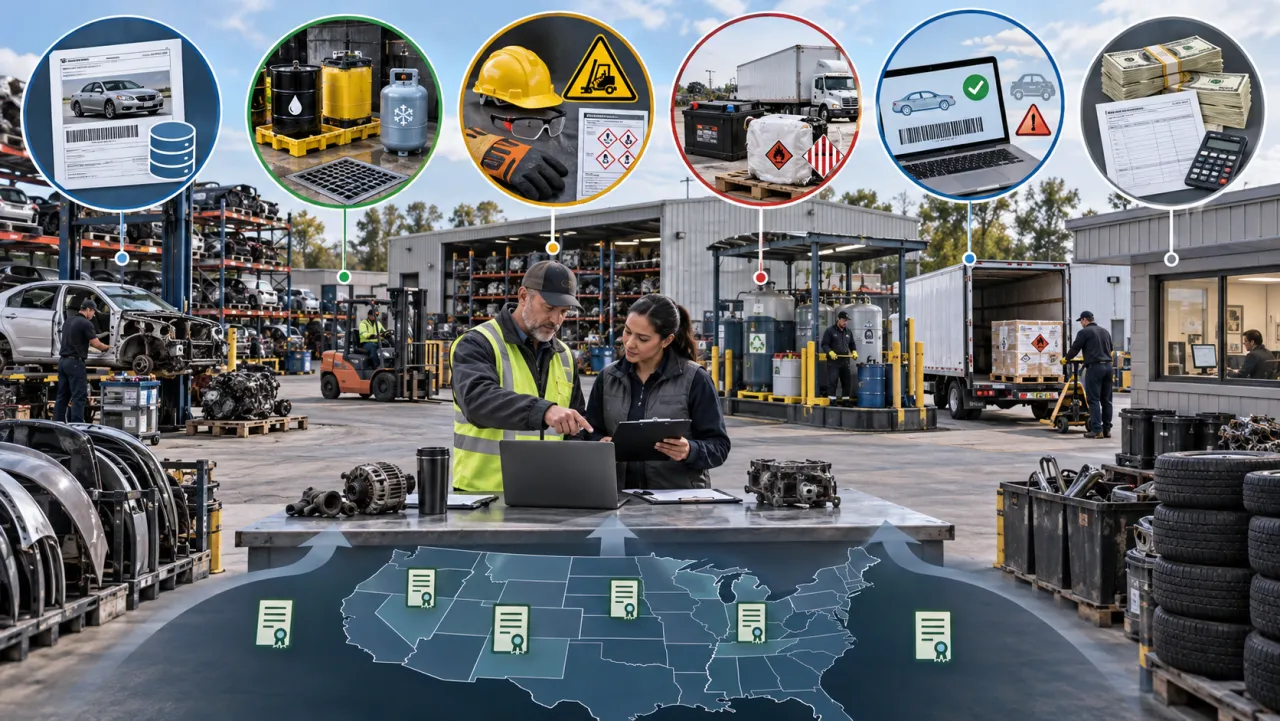
“Dismantler,” “recycler,” “salvage dealer,” “wrecker,” “used parts dealer,” “demolisher,” and “salvor” are not synonyms. They are distinct credentials with distinct rights, and one operation can need several: a recycler or dismantler license to break cars for parts, a dealer license to sell whole vehicles, a scrap or secondhand-dealer permit to buy from the public, and environmental permits for the site. Forming an LLC, getting an EIN, or holding a Copart account does none of this - and most dismantler and yard approvals are tied to the physical location where you dismantle (while some buyer, employee, or tax credentials attach to the person or entity), so a Delaware LLC does not displace the law of the state where the cars actually sit.
A federal duty sits on top of every state
No matter which state credential you hold, if you handle five or more junk or salvage vehicles in a year you generally must report each one to the National Motor Vehicle Title Information System (NMVTIS) at least monthly. That is a federal requirement under the Anti-Car Theft Act, separate from and additional to your state license, and some states layer a stricter reporting timeline on top of it.
License to sell used auto parts, state by state
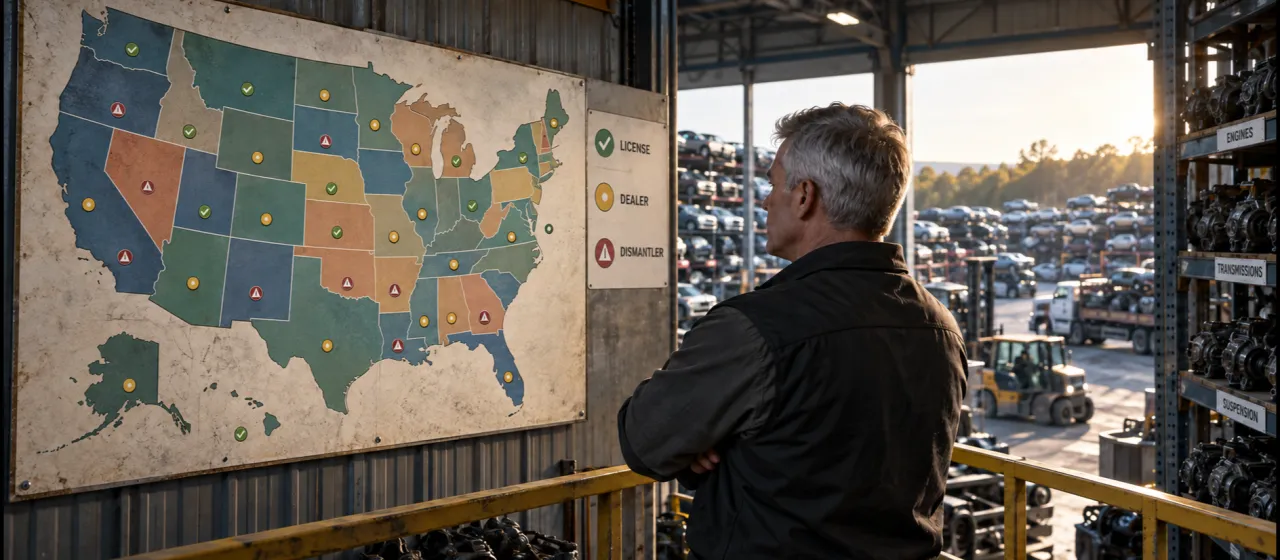
Use the table below to see whether your state requires a license to sell used auto parts and which agency issues it. It is a starting point for research, not a substitute for the agency’s current application packet and a written answer. Credential names, fees, and thresholds change; confirm before you apply. It lists the primary dismantler-type credential per state - a full operation can still need several at once (a dealer license to sell whole vehicles, a secondhand or scrap permit to buy from the public, local and environmental permits). A “no dedicated license” row means the state has no single dismantler-named license, not that you need no credential: a dealer, secondhand, scrap, title, or local permit can still apply.
| State | Typical credential | Issuing agency |
|---|---|---|
| Alabama | Automotive Dismantler & Parts Recycler License | Department of Revenue |
| Alaska | No dedicated license - general Alaska business license + salvage-title rules; a DMV dealer license only if you sell 5+ whole vehicles a year; local junk-dealer rules | AK DMV / local |
| Arizona | Automotive Recycler License | ADOT Motor Vehicle Division |
| Arkansas | Used Automotive Parts & Accessories Dealer License (DFA); whole vehicles need a used vehicle dealer license via State Police | DFA Special License Unit / State Police |
| California | Vehicle Dismantler License | DMV |
| Colorado | Automobile Recycler License | DOR, Auto Industry Division |
| Connecticut | Motor Vehicle Recycler License | DMV |
| Delaware | Automotive Recycler License | Division of Motor Vehicles |
| Florida | Salvage Motor Vehicle Dealer License | FLHSMV |
| Georgia | Used Motor Vehicle Parts Dealer License | Secretary of State board |
| Hawaii | County-issued, no statewide license - each of the 4 counties licenses separately (e.g. Honolulu “Used Vehicle Parts” / “Wrecking, Salvaging”); confirm with your county | County governments |
| Idaho | No dedicated license - salvage-title + local junkyard/zoning rules; an ITD dealer license only if selling whole vehicles | ITD DMV / local |
| Illinois | Automotive Parts Recycler certificate of authority | Secretary of State |
| Indiana | Automotive Salvage Recycler License | Secretary of State |
| Iowa | Authorized Vehicle Recycler License | Iowa DOT |
| Kansas | Salvage Vehicle Dealer License | Department of Revenue |
| Kentucky | Restricted / Automotive Recycling Dealer License | Motor Vehicle Commission |
| Louisiana | Automotive Dismantler & Parts Recycler License | Used Motor Vehicle Commission |
| Maine | Vehicle Salvage Dealer & Recycler License (+ municipal junkyard permit) | Bureau of Motor Vehicles |
| Maryland | Automotive Dismantler & Recycler License | MDOT MVA |
| Massachusetts | Class 3 motor vehicle junk dealer - issued locally | City / town (RMV framework) |
| Michigan | Automotive Recycler License (Class R) | Secretary of State |
| Minnesota | Used vehicle parts / scrap metal license | Public Safety (DVS) |
| Mississippi | Motor Vehicle Dismantler License (“Dismantler Only”) - within the used-dealer framework; cannot sell whole vehicles | Department of Revenue |
| Missouri | Salvage Business License (salvage dealer or dismantler) | Department of Revenue |
| Montana | Motor Vehicle Wrecking Facility License | Dept of Environmental Quality |
| Nebraska | Wrecker or Salvage Dealer License | Motor Vehicle Industry Licensing Board |
| Nevada | Automobile Wrecker License | DMV |
| New Hampshire | Automotive Recycling Dealer License | DMV |
| New Jersey | No state license - municipal junkyard permit (+ MVC dealer if selling whole vehicles) | Municipality / MVC |
| New Mexico | Auto Recycler License | Motor Vehicle Division |
| New York | Vehicle dismantler / junk & salvage registration | DMV |
| North Carolina | Salvage Dealer License | DMV (License & Theft) |
| North Dakota | No single dismantler license - NDDOT permit for a yard within 1,000 ft of a state highway (NDCC 24-16) + salvage titles + DEQ + local zoning | NDDOT / ND DEQ |
| Ohio | Salvage Motor Vehicle Dealer License | Public Safety (BMV) |
| Oklahoma | Automotive Dismantler & Parts Recycler License | Used Motor Vehicle, Dismantler & Mfd. Housing Commission |
| Oregon | Vehicle Dismantler Certificate | DMV (ODOT) |
| Pennsylvania | Vehicle Salvage Dealer (MMVB) | PennDOT |
| Rhode Island | Auto Wrecking & Salvage Yard License | Dept of Business Regulation |
| South Carolina | Demolisher / Secondary Metals Recycler registration + county license | SCDMV |
| South Dakota | No dedicated license - per-vehicle junking certificate | Department of Revenue |
| Tennessee | Automotive Dismantler & Recycler License | Motor Vehicle Commission |
| Texas | Used Automotive Parts Recycler (UAPR) - business + employees | TDLR |
| Utah | Dismantler License | Motor Vehicle Enforcement Division |
| Vermont | Salvage Yard Permit | Agency of Natural Resources (DEC) |
| Virginia | Salvage Dealer License | DMV |
| Washington | Motor Vehicle Wrecker License | Department of Licensing |
| West Virginia | Wrecker / Dismantler / Rebuilder License | Division of Motor Vehicles |
| Wisconsin | Motor Vehicle Salvage Dealer License | WisDOT |
| Wyoming | Vehicle Storage & Disposal Facility License | WYDOT |
| Washington, D.C. | No dedicated used-parts license - basic business license (a Secondhand Dealer endorsement may apply) + zoning; DMV dealer registration only if selling whole vehicles; DOEE only if dismantling | DLCP / DC DMV |
The states that surprise people
A few patterns catch people who assume “it’s the DMV, and it’s called a dismantler license”:
- Some states have no dedicated dismantler license - but “no dedicated license” is not “no license needed.” Alaska, Idaho, and New Jersey regulate the activity through other credentials - a dealer license for whole vehicles plus local, title, or environmental rules - rather than a single dismantler license. But even where there is no “dismantler” title, a specific credential can still apply: Arkansas issues a Used Automotive Parts and Accessories Dealer License through its DFA, and Mississippi issues a Dismantler-Only license through its DOR. South Dakota uses a per-vehicle junking certificate instead of a business license, and North Dakota has no single license but still gates yards near state highways through NDDOT.
- It is often not the DMV. Rhode Island runs it through the Department of Business Regulation, Montana and Vermont through their environmental agencies, Tennessee, Kentucky, Louisiana, and Oklahoma through standalone motor-vehicle commissions, several states through the Department of Revenue or the Secretary of State, and Hawaii at the county level.
- The credential name can trip you up. Virginia’s “demolisher” cannot resell usable parts - a used-parts business needs the salvage-dealer credential. In Pennsylvania the parts credential is the Vehicle Salvage Dealer registration, while a separate “salvor” certificate lets you take in abandoned vehicles - the code defines a salvor as one who takes vehicles apart to sell parts, so it is a real dismantling term, not just towing. And a single license can bundle roles, like West Virginia’s combined wrecker/dismantler/rebuilder.
- Local approval is frequently the real gate. Maine, Massachusetts, New Jersey, Rhode Island, and many others require a municipal junkyard permit, zoning approval, or a certificate of approved location on top of any state credential.
Red flags when you read any state list
- “In the next state over it’s allowed” is not a defense.
- Registering an LLC in a business-friendly state does not change the law where the cars are dismantled.
- Buying through a broker does not transfer the broker’s license to you.
- Marketplace or auction approval is not a DMV, zoning, or environmental permit.
- No page titled “dismantler license” does not mean no dealer, junkyard, scrap, secondhand, or local permit applies.
- A personal-vehicle exemption does not cover systematic commercial activity.
- A state license does not cancel the federal NMVTIS duty for a covered junk or salvage business.
How to get the real answer for your address
Do not ask abstractly whether “an online store needs a license.” Describe the facts. Write one plain paragraph: the address, how many vehicles a month you will handle, whether you will store them outside, exactly which fluids and devices you will remove, and whether you sell parts, whole vehicles, or both. Send it to your state licensing agency, your city or county zoning office, and the fire marshal, and ask for the answer in writing. That paragraph turns a vague “maybe” into a real go or no-go.
Where reParta fits
Licensing gets you the right to operate. Staying compliant while you run is a records problem - and that is where the software matters. reParta ties every part to its donor VIN and title, so the identifiers a salvage title and NMVTIS report need are captured as you work instead of reconstructed at month-end. Stock lives in one place and syncs across eBay and Facebook, so a part that sells on one channel comes down from the others - double-sale protection, not angry buyers. And per-donor profit shows which cars actually paid off, so you buy your next lot on real numbers.
For the full startup path - models, federal rules, site and zoning, tax, insurance, and sourcing - see how to start a used auto parts business.
This guide is general information for screening only, not legal advice. Licensing requirements depend on your state, county, city, and specific address, and they change - the names and agencies here are starting points, not confirmations. Get written answers from the relevant agencies, and a licensed attorney where the stakes call for it, before you buy a donor vehicle, sign a lease, or take in your first car.
Getting licensed, or already running? reParta keeps every part tied to its donor VIN and title, holds the records a licensed yard needs, and syncs stock across eBay and Facebook for double-sale protection. New to this? Start with how to start a used auto parts business. Ready to run it right? Start a free 14-day trial - no card required - or see pricing.
Frequently asked questions
Do you need a license to sell used auto parts?
It depends on what you do and which state you are in. Reselling parts that were already legally removed from a vehicle is the lightest model and may need only a business license and sales-tax registration, though some states still require a used-parts, secondhand, or scrap dealer permit. The moment you buy whole salvage vehicles and dismantle them for parts, most states require a dismantler, recycler, salvage-dealer, or wrecker license. A few states have no dedicated credential and regulate the activity through a dealer license plus local rules. The name, the agency, and the trigger differ by state, so confirm with your state agency in writing before you buy anything.
Can I sell used car parts online without a license?
Often yes, if you are only reselling already-removed parts and your local zoning allows it - many people start on eBay or Facebook that way with just a business entity and a sales-tax permit. What you generally cannot do without a dismantler or recycler license is buy whole salvage vehicles and take them apart for parts. Selling online does not change the licensing question; buying and dismantling vehicles is what triggers most licenses, regardless of where you list the parts.
Which agency issues a used auto parts or dismantler license?
It varies by state. In most states it is the DMV or motor-vehicle division, but plenty of states use a different agency: the Department of Revenue (Alabama, Kansas, Mississippi, Missouri, South Dakota), the Secretary of State (Georgia, Illinois, Indiana, Michigan), a standalone motor-vehicle commission (Kentucky, Tennessee, Louisiana, Oklahoma), the Department of Environmental Quality or Natural Resources (Montana, Vermont), a business-regulation department (Rhode Island), the Department of Finance and Administration (Arkansas used-parts license) or the state police (Arkansas whole-vehicle dealer licensing), or the county (Hawaii, and locally in Massachusetts and New Jersey). Check the table below for your state.
Does an LLC or auction access let me dismantle cars for parts?
No. Forming an LLC, getting an EIN, or opening a Copart or IAA buyer account are all separate from a dismantler or recycler license. Auction access is a contractual account, not a government credential, and a license is issued per business and per location and generally cannot be transferred - so buying through a broker does not put you under the broker's license. Registering your LLC in a business-friendly state also does not override the laws of the state where the vehicles are physically dismantled.
Is there a federal license to recycle auto parts?
There is no federal license, but there is a federal reporting duty. Under the Anti-Car Theft Act, a business that handles five or more junk or salvage vehicles in a year must report to the National Motor Vehicle Title Information System (NMVTIS) at least monthly. That duty sits on top of whatever your state requires, and some states layer stricter reporting on top of the federal floor.
What happens if I dismantle cars without the right license?
It varies by state, but it is commonly a violation that can carry fines or worse, and operating without the right credential can also void insurance, block you from getting salvage titles cleared, and expose you to stolen-property liability. Because the rules and penalties differ by state and change over time, the safe move is to describe your exact activity and address to the state agency in writing and get confirmation before you start.