Importing auto parts into the US: HTS codes, the tariff stack, customs clearance, and the admissibility traps for resellers
Importing an auto part into the US requires four separate determinations: what the product is under the HTS, what its customs value and country of origin are, which ordinary and additional tariffs apply, and whether it is admissible under CBP and other-agency rules. Those questions are related but not interchangeable - an HTS code does not by itself prove origin or NHTSA compliance, a shipment below the formal-entry threshold is not automatically duty-free, and cargo release does not end your exposure.
Two things changed the math of importing auto parts in 2026, and this guide leads with them because they can wipe out an importer’s margin: a much bigger tariff stack (Section 232 auto-parts duties on top of the ordinary rate) and the end of duty-free de minimis. The importer of record carries the reasonable-care responsibility throughout, even when a broker files. This is general information, not customs or legal advice, and it does not quote duty rates, which are line-specific and change. It is a spoke of how to start a used auto parts business, for the importer model.
Before importing auto parts, know who the importer of record is
The importer of record is legally responsible for correct classification, valuation, origin, and admissibility under a “reasonable care” standard set by CBP. Hiring a licensed customs broker under a power of attorney does not transfer or remove that responsibility - the broker has its own professional and regulatory duties, but you should review and approve the facts, HTS codes, values, origin claims, and other-agency statements filed in your name. “The supplier told me” is not a defense.
Classify every part under the HTSUS
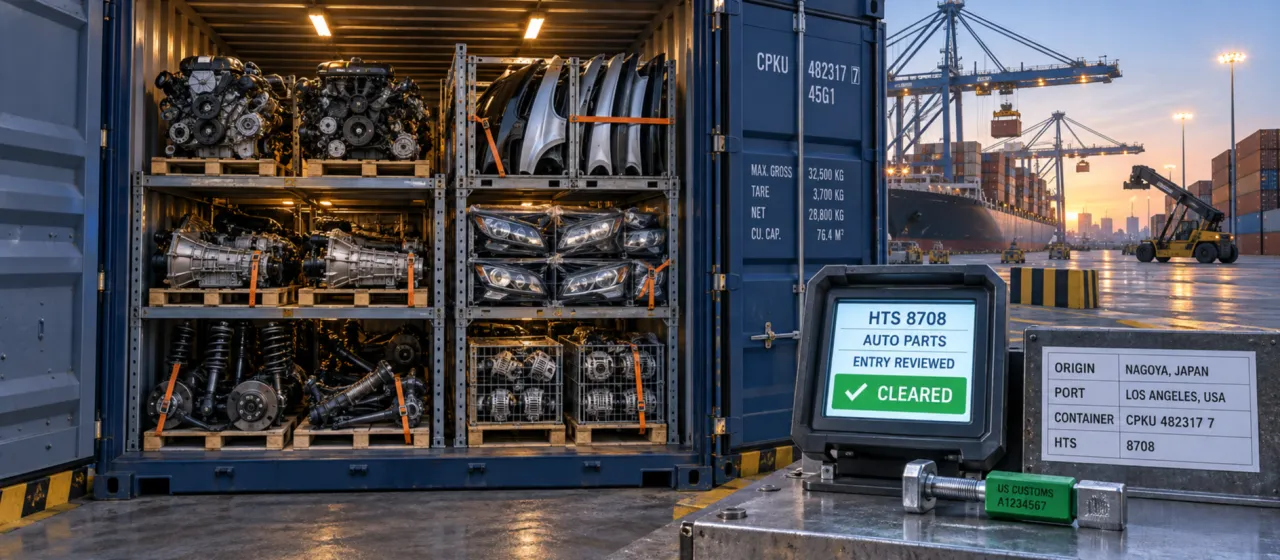
Every part has a code in the Harmonized Tariff Schedule of the US (HTSUS), published by the US International Trade Commission, and classification follows the General Rules of Interpretation and the Section and Chapter Notes - not just what a part looks like. Many vehicle parts sit in Chapter 87 (heading 8708, parts and accessories of motor vehicles), but a large share classify elsewhere by what they are: electricals in Chapter 85, engines, pumps, and filters in 84, rubber hoses in 40, glass in 70. A product’s automotive use alone does not place it in 8708, and a “parts” provision can be displaced by a more specific heading or a statutory exclusion.
Getting the 10-digit code right is your duty under reasonable care. Search CBP’s CROSS rulings database for how similar parts were treated, or request a binding ruling - which is authoritative only for the product as accurately described and can be modified or revoked. Classification sets tariff treatment and can trigger other-agency data, but admissibility depends on the actual product, condition, certification, origin, and markings, not the code alone.
The tariff stack: the base duty is only the start
This is the 2026 trap. Beyond the ordinary HTS duty, check whether the part is hit by a Chapter 99 trade remedy or national-security tariff:
- Section 232 automobile-parts tariff. A 25% tariff on many automobile parts took effect May 3, 2025, applied through Chapter 99 in addition to the ordinary duty, covering parts across HTS chapters (40, 70, 73, 83, 84, 85, 87, and more). USMCA-qualifying parts get special treatment rather than the ordinary approach, and there are non-stacking rules with certain other measures. Verify coverage on the current CBP Section 232 guidance.
- Section 301 (China). Many China-origin goods carry additional duties, with exclusions that come and go - verify current status on USTR and CBP.
- Antidumping / countervailing duties (AD/CVD). Certain parts from certain countries fall under Commerce Department orders and can carry very large additional duties; whether you are covered changes constantly, so check active orders and request a scope ruling if unsure. Note AD/CVD is paid at entry as a cash deposit and the final rate can change at liquidation, so it is a long-tail exposure, not a fixed cost.
- Steel, aluminum, and other measures, plus country-specific arrangements, may also apply.
Do not assume these stack, or do not stack, without checking the current Chapter 99 notes and CBP instructions for your exact HTS line, origin, and entry date. This is why the base rate can be a small part of the total, and why pricing and tax treatment have to start from the real landed number.
Customs value is not just the invoice
Duty is generally a percentage of the customs value, which often starts with transaction value (the price actually paid or payable) - but that is not necessarily the supplier’s invoice total. Required additions can include packing costs, selling commissions, assists (tooling, molds, dies, or designs you provide the maker for free or at reduced cost), certain royalties or license fees, and proceeds of a later resale that go back to the seller. Related-party sales, consignments, free samples, and used goods can require extra analysis or another valuation method. Get this right, because undervaluation is a penalty exposure.
Country of origin is purpose-specific, and USMCA is its own test
There is no single origin answer. Substantial transformation (origin changes when processing yields a new name, character, or use) governs non-preferential origin and country-of-origin marking under 19 U.S.C. 1304, which requires each imported article to be legibly and permanently marked in English with its origin. But marking, USMCA preference, Section 301, Section 232, and AD/CVD can each apply different rules, and one part can have different origin answers for different purposes. “Made in Mexico” does not automatically mean USMCA-qualifying, zero ordinary duty, or exemption from every additional tariff - ask whether the part merely ships from Canada or Mexico or actually qualifies as originating under the applicable USMCA product-specific rule, which for auto parts can be demanding.
De minimis is gone, and ocean cargo needs an ISF
Two process points importers get wrong:
- The $800 duty-free de minimis is suspended. Effective August 29, 2025, duty-free de minimis treatment was suspended for shipments from all countries, so a low-value shipment is now subject to applicable duties, taxes, and fees. Low value no longer means duty-free. Informal versus formal entry still turns roughly on a $2,500 value, but that is an entry-process question, not a duty one, and eligibility is not automatic - commercial use, AD/CVD, quotas, regulated products, or a port director’s call can require formal entry regardless of value.
- Ocean shipments need an Importer Security Filing (ISF 10+2). For vessel cargo, the ISF data must generally be transmitted before the cargo is loaded at the foreign port, and it is a separate filing from the customs entry. Late or missing ISF can bring holds and liquidated damages, so fix responsibility for it in writing with your broker or forwarder.
Formal entries also need a customs bond (single-entry or continuous). Watch bond sufficiency: Section 232, Section 301, and AD/CVD deposits can push your annual duties past what an existing continuous bond covers.
The entry process and its two clocks
Entry runs on two timeframes that new importers merge: entry documentation is generally required within 15 calendar days after arrival, and the entry summary (CBP Form 7501) with estimated duties is generally due within 10 working days after entry. In practice, do not treat 15 days as your lead time - give your broker complete classification, value, origin, and other-agency data before arrival (and before foreign loading for an ocean ISF), or the cargo racks up demurrage, storage, exam, and General Order risk. Entries are filed electronically through CBP’s ACE system.
The admissibility traps unique to auto parts
Importing auto parts means clearing more than CBP. Each of these is another agency whose rules ride along with the entry, and each is where an auto-parts shipment gets seized or refused:
- NHTSA and FMVSS. Equipment covered by a Federal Motor Vehicle Safety Standard - lighting (108), glazing (205), tires (109/139), brake hoses (106), seat belts (209), and occupant protection including airbags (208) - must meet the standard and is declared on the DOT HS-7 form. NHTSA generally relies on manufacturer self-certification, not pre-approval of each part; confirm the correct HS-7 basis on the current form.
- Airbags need their own review. Beyond FMVSS, airbags and inflators involve recall and defect obligations, counterfeit risk, hazmat transport, and marketplace prohibitions - an HS-7 box alone is not proof a unit is lawful or safe to sell. See the 2026 eBay airbag rules.
- EPA - vehicles and engines, not every part. EPA declarations (Form 3520-1 for light-duty vehicles and engines, 3520-21 for heavy-duty and nonroad engines) apply to specified vehicles and engines, not automatically to every emissions-related replacement part; a group of parts that amounts to a disassembled vehicle, or an engine, needs product-specific review. Other parts remain subject to Clean Air Act prohibitions, including on defeat devices and tampering. Used engines especially need their own check (highway vs nonroad, certification label, model year, whether the shipment is effectively a vehicle).
- Refrigerant depends on the form. An empty part, a part with residual refrigerant, a pre-charged component, a complete system, and bulk refrigerant trigger materially different EPA, AIM Act, labeling, reporting, allowance, and hazmat requirements - verify the category.
- Counterfeit versus gray-market. CBP can detain, seize, and destroy goods bearing a counterfeit trademark recorded with CBP. Genuine branded goods imported outside an authorized channel are a different gray-market analysis (trademark ownership, common control, material differences, CBP recordation) - do not call every parallel import counterfeit, and do not import counterfeit-marked parts.
- Tires. A federal excise tax applies to certain taxable highway tires based on load rating, with the importer often treated as the manufacturer (reported on IRS Form 720) - check the IRC category and load rating; it is separate from DOT marking.
- Hazmat. Airbag inflators, seat-belt pretensioners, lithium and lead-acid batteries, residual fuel, compressed gas, and refrigerants can all be regulated in transit under DOT/PHMSA and international rules (IMDG, IATA); a broker is not automatically a hazmat expert.
- Forced labor and sanctions. Screen your supply chain before ordering: UFLPA and Withhold Release Orders can bar goods tied to forced labor, and OFAC sanctions and denied-party lists can bar the transaction outright.
- Used parts and wood packaging. Used engines, axles, and off-road parts often arrive with soil, grease, or plant debris and can be held for agriculture cleanliness, and untreated wood pallets and crates must meet ISPM 15. Used inventory also needs proof of lawful ownership, recall and contamination checks, and care that a shipment billed as “parts” is not treated as a disassembled vehicle.
The domestic side of this compliance is in federal regulations for auto recyclers, the shipping-hazmat layer in how to ship used auto parts, and whether you need a dealer or recycler license in the licensing guide.
What importing auto parts really costs: build the full landed-cost stack
Model the landed cost of importing auto parts before you buy, and include more than duty: purchase price and assists, export packing and foreign inland freight, ocean or air freight and insurance, the ISF fee, the customs bond, brokerage, MPF (an ad valorem fee on formal entries with a CBP-set minimum and maximum, from the CBP user-fee table) and HMF (on ocean cargo), the ordinary duty, Section 232 and Section 301, any AD/CVD cash deposit, exam and demurrage risk, drayage and domestic delivery, and any testing, relabeling, or disposal of nonconforming goods. Because an AD/CVD deposit can change at liquidation, keep a reserve rather than treating the deposit as final. For a full unit-economics view, pair this with the salvage yard financial model.
After release: liquidation is not the end
Cargo release is not final acceptance. CBP liquidates the entry later, duties can change, and you can correct errors through a Post Summary Correction before liquidation or a protest after it. Review the entry packet, monitor liquidation, correct mistakes promptly, and hold reserves for unresolved AD/CVD or tariff issues.
Recordkeeping and reasonable care
Keep import records for at least five years from the date of entry (19 CFR Part 163): commercial invoices and proof of payment, entry summaries, your HTS classification and how you reached it, valuation support (including assists and royalties), origin analysis and any USMCA certifications, bills of lading and packing lists, ISF confirmations, other-agency declarations and test reports, binding rulings, and post-entry corrections. CBP can demand them, and misclassification, undervaluation, or failure to produce records can bring penalties. Document how you decided classification and value, because reasonable care is the standard you will be judged against.
Where reParta fits
reParta is not a customs broker and does not classify HTS codes, file entries, calculate duties, or determine customs value - that work stays with your broker and CBP. Where it helps is downstream, once the parts clear and land. reParta can record your purchase price and the shipment and per-part costs you enter, and roll them into lot-level and per-part economics, so you get an operational cost picture - which is only as complete as the costs you enter and is not a customs valuation or a tax-basis determination (confirm accounting and tax treatment with a CPA). It records the fitment and interchange data available for a part, with its source and verification status, and lists across eBay, Facebook, and direct from one stock record, which helps reduce a sold unit sitting live on more than one channel. Imported lots are tracked through lot-level and per-part economics alongside your donor-based inventory, without treating a container as a donor vehicle.
This guide is general information, not legal, customs, or tax advice. Tariff classifications and rates, Section 232 and Section 301 status, AD/CVD, de minimis and entry rules, valuation, origin, and other-agency requirements are specific to your product and change often. Confirm your HTS codes, the full tariff stack, valuation, origin, and admissibility with a licensed customs broker and the current CBP, USITC, NHTSA, and EPA guidance before you import.
Once your parts are stateside, run them like real inventory. reParta records what each part cost you, tracks your entered costs across an imported lot, matches parts to the vehicles they fit, and lists across eBay, Facebook, and direct so a sold unit does not sit live in two places. Start a free 14-day trial - no card required - or see pricing.
Frequently asked questions
How much duty will I pay to import auto parts in 2026?
There is no single rate, and the ordinary HTS duty is often only the start. On top of it, many automobile parts now carry a Section 232 tariff of 25% (effective May 3, 2025, with special treatment for USMCA-qualifying parts), and China-origin goods may carry Section 301 duties, while certain parts from certain countries face antidumping or countervailing duties that can exceed 100%. These are applied through Chapter 99 provisions and change often, so you must check the exact HTS line, the origin, and the entry date against the current HTSUS and CBP instructions. Do not assume the base rate is your total, and do not assume the additional tariffs stack or do not stack without checking.
Is there still a duty-free threshold for small auto-parts shipments?
No. Duty-free de minimis treatment for shipments valued at $800 or less was suspended for all countries effective August 29, 2025, so low value no longer means duty-free - low-value shipments are subject to applicable duties, taxes, and fees. Separately, informal versus formal entry still turns roughly on a $2,500 value, but that is an entry-process question, not a duty question, and eligibility is not automatic. Verify both the current de minimis status and the entry type for your shipment, country, and product.
Do I need a customs broker to import auto parts?
A broker is optional, but most importers use one because entry is technical. What a broker cannot do is remove your responsibility: under the reasonable-care standard, the importer of record is responsible for correct classification, valuation, origin, and admissibility, and hiring a broker under a power of attorney does not transfer that. The broker has its own professional and regulatory duties, but you should review and approve the classifications, values, origin claims, and other-agency statements filed in your name.
How do I find the HTS code for an auto part?
Look it up on the current Harmonized Tariff Schedule at hts.usitc.gov, using the General Rules of Interpretation and the Section and Chapter Notes, not just what the part looks like. Many vehicle parts fall under Chapter 87 (heading 8708), but a lot classify elsewhere - electricals in Chapter 85, engines and pumps in 84, rubber in 40, glass in 70 - and a product's automotive use alone does not force it into 8708. Search CBP's CROSS rulings for similar parts, and for certainty request a binding ruling, which covers the product only as accurately described and can be modified or revoked.
What auto parts are restricted or need extra steps to import?
Equipment covered by a Federal Motor Vehicle Safety Standard - lighting, glazing, tires, brake hoses, seat belts, airbags - must meet the standard (NHTSA relies on manufacturer self-certification, not pre-approval) and is declared on the DOT HS-7 form. Engines and vehicles have EPA declarations, and refrigerant-containing parts add Clean Air Act and HFC rules. Counterfeit-marked parts can be seized (airbags are a flagged safety hazard), while genuine parallel imports raise a separate gray-market analysis. Add tire federal excise tax, hazmat rules for inflators and batteries, forced-labor and sanctions screening, and cleanliness and wood-packaging checks on used parts. Review each part against its specific agency rules before you buy.