Used auto parts business taxes: entity, sales tax, and BOI reporting
Once you can sell parts, the back office becomes the job - and used auto parts business taxes are the part people either overbuild or ignore. It is really three separate things stacked together: the business stack (entity and EIN), the tax layer (sales tax is the trickiest, but income, self-employment, and payroll taxes apply too), and beneficial-ownership reporting. None of it is hard once you see the pieces, but the rules change and vary by state, so this is a map of what to set up and what to confirm with a CPA - not tax advice.
This sits inside how to start a used auto parts business; for the licensing and federal-compliance layers, see the state-by-state licensing guide and federal regulations for auto recyclers.
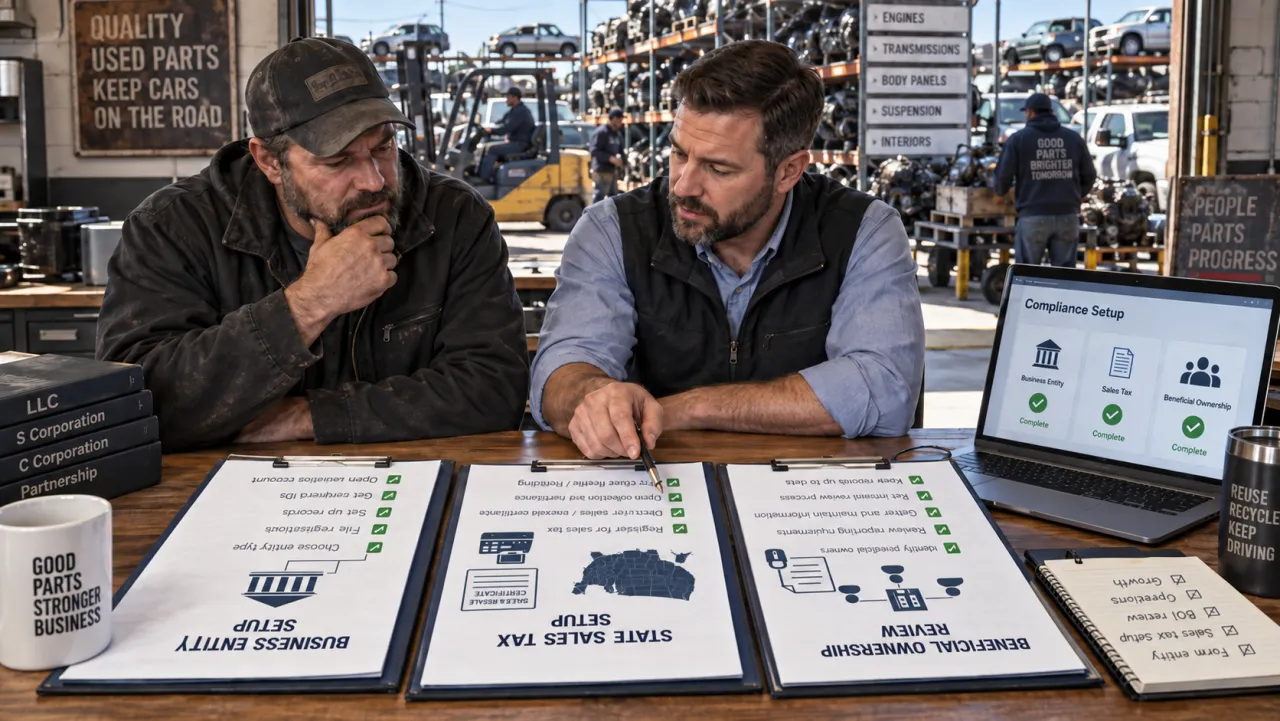
The business stack behind used auto parts business taxes
Little of the usual stack is a federal precondition to selling. You can operate as a sole proprietor where your licenses allow, and an EIN is strictly required only in specific cases - you have employees, you owe certain excise taxes, or you are a partnership or corporation - though banks and states often ask for one regardless. The EIN is free directly from the IRS; ignore sites that charge for it.
That said, the usual setup is still worth doing:
- Form an entity for liability separation. An LLC is a disregarded entity by default if it has one member, a partnership if it has more, and it can elect to be taxed as an S or C corporation - separate decisions to make with a CPA, not defaults to assume. An entity is not a substitute for proper business insurance, and it does not shield you from personal, environmental, or tax liabilities you guarantee or cause.
- Get the EIN directly from the IRS.
- Register for state and local tax accounts, including a sales-tax permit and a resale certificate.
- Open a dedicated business bank account. Keeping business and personal money separate supports your liability protection - the SBA is blunt that commingling funds can undermine it - though a separate account alone does not guarantee the corporate veil.
- Set your accounting method, chart of accounts, and inventory policy with a CPA, and when you hire, handle Form I-9 (employment eligibility, which you keep on file rather than submit), Form W-4 withholding, and state workers’ compensation and unemployment insurance.
Sales tax is the trickiest of the used auto parts business taxes
Of all used auto parts business taxes, sales tax causes the most trouble, because it is not one system: 45 states plus DC levy a general sales tax, and those regimes fan out across thousands of local and home-rule jurisdictions (Alaska has no state tax but permits local ones). A few rules do most of the work.
Nexus decides where you collect. You collect sales tax in a state where you have nexus - physical presence (an office, a yard, inventory, employees) or, since the Supreme Court’s 2018 South Dakota v. Wayfair decision, economic nexus. Economic nexus is a sales threshold - the widely copied starting point is $100,000 in sales or 200 transactions, but it varies by state and many states have dropped the transaction count, so treat that pair as a template, not a national rule.
A marketplace collecting for you is not the whole story. Almost every sales-tax state now has a marketplace-facilitator law that makes eBay or Facebook collect and remit on the sales you make through them. But per state revenue departments like Washington’s, that does not automatically clear your own duties: your own-website and in-person sales are still on you, you may still have to register and file, and marketplace sales can still count toward your nexus math.
The rest of the sales-tax checklist:
- Resale and exemption certificates. You buy inventory for resale tax-free with a resale certificate, and you must collect valid resale or exemption certificates from B2B customers who claim exemption.
- Use tax. You owe use tax on equipment and supplies you buy without paying sales tax (out of state, say) and use in your state.
- Taxability varies by item. Whether used parts, separately stated shipping, core charges, installation labor, and warranties are taxable differs by state - do not assume the answer travels across the state line.
- Zero returns. Many states require you to file a sales-tax return every period even when you had no taxable sales; skipping a “zero return” can still draw a penalty.
BOI reporting: know the current status before you file
Beneficial-ownership information (BOI) reporting under the Corporate Transparency Act was the compliance scare of 2024 and 2025, and the answer has since flipped. As of 2026, a FinCEN final rule effective August 14, 2026 permanently exempts companies created in the United States, and their beneficial owners, from BOI reporting. Certain foreign entities registered to do business in the US remain reporting companies and report their foreign beneficial owners.
For a US-formed used-auto-parts LLC or corporation, that currently means no BOI filing. But this is the single most-reversed rule in this whole guide - it went from required, to litigated, to interim-exempt, to permanently exempt in under two years - so before you rely on it, open the official FinCEN BOI page and confirm the position still holds on the day you decide.
Inventory accounting for a parts business
Parts you hold for sale are inventory, and how you account for them drives your cost of goods sold and your taxable income. Two points matter for a yard.
First, specific identification fits one-of-a-kind used parts well, but there is a catch most people miss: tying a part to its donor VIN records the part’s source, not its cost. A $2,000 donor yields dozens of parts, cores, and scrap, so you cannot assign $2,000 to each, and assigning zero until sale distorts your margins. Before specific identification means anything, you have to allocate the donor’s total cost - the purchase price plus auction fees, transport, and dismantling - across everything that came off it, under a consistent, supportable method applied the same way each year. The IRS lists specific identification as an accepted method in Publication 538 when actual cost can be matched to the item; the allocation policy is what makes that possible, and it is a CPA decision, not an automatic output of the VIN link.
Second, many small businesses can simplify. Under the IRS gross-receipts test - an inflation-adjusted threshold of $31 million for 2025 and $32 million for 2026 - a small business taxpayer can use the cash method and a simplified treatment of inventory. Whether that helps you is a CPA decision, and the threshold changes yearly, so confirm the current figure rather than assuming.
Where reParta fits
reParta does not file your used auto parts business taxes or give tax advice - that is your CPA’s job, and no software replaces it. What reParta does is keep the records those taxes run on. Every part is tied to its donor VIN, the donor’s acquisition cost is captured, and marketplace fees, shipping, refunds, and proceeds are recorded per part and rolled up per donor - so the inputs your accountant needs to allocate donor cost and compute cost of goods sold are already in one place, and your sales-tax reporting starts from real channel-by-channel numbers instead of a reconstruction at quarter-end. reParta stores the data; your CPA sets the allocation method. The cleaner your donor and part records, the shorter and cheaper every tax conversation gets.
This guide is general information, not legal or tax advice, and tax rules - especially BOI and state sales tax - change often and vary by state. Confirm your entity choice, sales-tax obligations, BOI status, and inventory method with a licensed CPA or attorney, and with the IRS, FinCEN, and your state Department of Revenue, before you file or rely on any of this.
Want tax time to be a lookup, not an archaeology dig? reParta ties every part to its donor VIN with cost, fees, shipping, and per-donor profit captured as you work, and syncs stock across eBay and Facebook for double-sale protection. Start a free 14-day trial - no card required - or see pricing.
Frequently asked questions
Do you need an LLC to sell used auto parts?
No. You can sell as a sole proprietor where your licenses allow, and forming an LLC or corporation is not a federal precondition to selling. Most operators still form an entity for the liability separation and cleaner books, but it is a choice, not a requirement. An EIN is likewise required only in specific cases - you have employees, you owe certain excise taxes, or you are a partnership or corporation - though banks and states often ask for one anyway. Get an EIN directly from the IRS; it is free.
Do I charge sales tax on used auto parts?
Usually yes, but it depends on the state and the sale. Most states tax retail sales of tangible goods, which includes used parts, but whether shipping, core charges, installation labor, and warranties are taxable differs by state. You collect based on where you have nexus - physical presence, or economic nexus (a sales-volume threshold that varies by state after the 2018 Wayfair decision). Register with each state's Department of Revenue where you have a duty, and confirm the specific rules there.
Does eBay or Facebook collect sales tax for me?
On sales made through the marketplace, generally yes - marketplace-facilitator laws in almost every sales-tax state require the marketplace to collect and remit on third-party sales. But that does not clear all of your obligations: sales through your own website or in person are still on you, you may still have to register and file returns (sometimes even zero returns), and marketplace sales can still count toward your nexus thresholds. Marketplace collection covers the marketplace channel, not your whole business.
Do I have to file a BOI report for my used auto parts business?
As of 2026, almost certainly not, if your company was created in the United States. A FinCEN final rule effective August 14, 2026 permanently exempts US-created companies and their beneficial owners from Corporate Transparency Act BOI reporting; certain foreign entities registered to do business in the US still report their foreign beneficial owners. This area has changed repeatedly and can be litigated, so confirm the current position on the official FinCEN BOI page before you decide not to file.
How do I account for used-parts inventory for taxes?
Parts you hold for sale are inventory, and you generally match each part's cost against its sale to figure cost of goods sold. Tying a part to its donor VIN records the part's source, not its cost: a $2,000 donor yields dozens of parts, cores, and scrap, so you cannot assign $2,000 to each. Specific identification is an accepted method, but it requires first allocating the donor's total cost (purchase price plus auction fees, transport, and dismantling) across everything that came off it, under a consistent, supportable method. Many small businesses under the IRS gross-receipts test (an inflation-adjusted threshold of $31 million for 2025 and $32 million for 2026) can also use the cash method and simplified inventory treatment. Set your method with a CPA.
Do I have to pay quarterly estimated taxes on a used auto parts business?
Usually yes. A sole proprietor or pass-through owner reports business profit on Schedule C and owes self-employment tax plus income tax, and because no employer withholds it, the IRS expects quarterly estimated payments (Form 1040-ES) when you will owe enough for the year. Set aside a share of every sale for it and let your CPA size the payments - underpaying can draw a penalty even if you settle the balance in April. This is separate from sales tax, which you collect from customers and remit to the state.
Is an EIN free, and where do I get it?
Yes, an EIN is free and comes directly from the IRS - online, by fax, or by mail. Ignore third-party sites that charge for it; they are selling you something the IRS gives away. You will generally want one to open a business bank account and to keep business and personal money separate, which supports (but does not by itself guarantee) your liability protection.