Salvage yard zoning and Phase I ESA: choosing a site, the costliest irreversible step
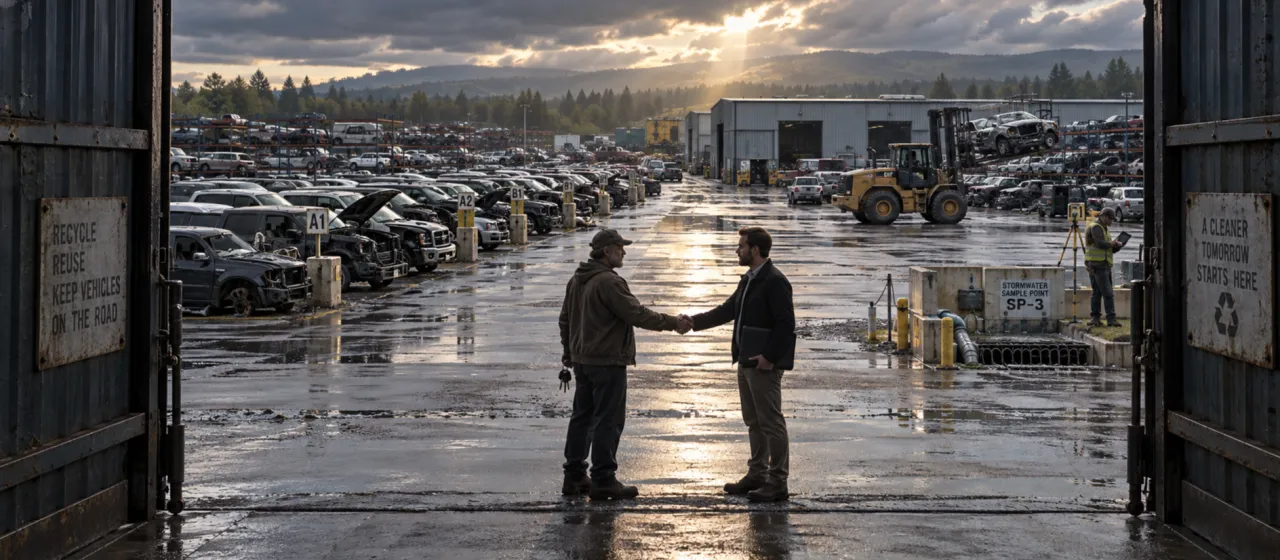
Everything else in starting a used auto parts business can be fixed later. You can change your entity, add a license, switch sales channels. The site is the one decision that is genuinely hard to reverse: once you have signed a lease or bought a property, discovered the zoning does not allow dismantling, or inherited a prior operator’s contamination, you are stuck with a problem that costs months and sometimes six figures to unwind. That is why site selection, and specifically salvage yard zoning and a Phase I environmental assessment, deserve more care than almost anything else in the launch.
This is a starting map, not legal or environmental advice - zoning is local and the stakes are high, so confirm the specifics with your city or county planning department, your state environmental agency, and a licensed environmental professional for your exact address. This sits inside how to start a used auto parts business; the federal layer is in federal regulations for auto recyclers, the environmental programs in salvage yard EPA compliance, and the state license in the state-by-state licensing guide.
Salvage yard zoning: heavy-industrial, and usually a conditional use
Your state dismantler license lets you operate somewhere. Local zoning decides where. These are separate approvals, and the local one is where most first-time operators get surprised.
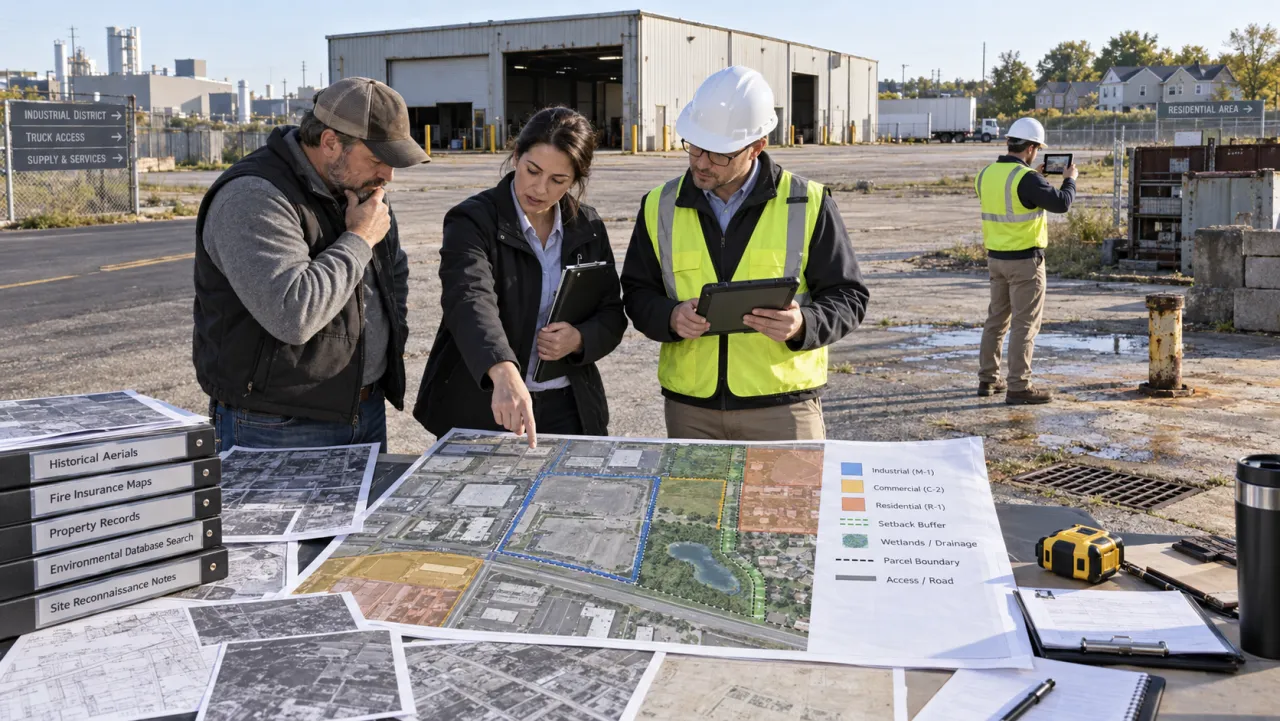
Many jurisdictions confine auto wrecking, dismantling, and scrap to industrial districts - often the heavy-industrial ones cities label M-2, M-3, or I-2 - and treat it as a conditional use rather than a by-right one, which means you need a conditional-use permit (also called a special-use permit) on top of being in the correct district. A conditional-use permit is a discretionary approval a local planning commission or zoning board grants, usually after a public hearing, and it can carry conditions or be denied outright. But it is not one national rule: some places allow it in light or general industrial or recycling-overlay districts, some permit it by-right, some ban it entirely, and some have spacing rules that leave no eligible parcel. And a conditional-use permit may run with the land or be personal to the operator, may or may not survive a change of ownership, and can lapse if the use stops - so read the permit’s own conditions, not just whether one exists.
Zoning is set locally, so the district names and the exact rules vary from one city or county to the next. Do not assume; pull your municipality’s actual zoning code for the parcel and read what it says about “automobile dismantling,” “auto wrecking,” or “salvage” - and get it in a formal zoning verification letter, not a casual word from the planning desk. If you are buying an existing yard, do not rely on “it’s been here 30 years”: confirm whether the use is a legal nonconforming use, whether it was ever abandoned or lapsed, and whether that status transfers to you and survives any expansion or rebuild.
Why a residential garage almost never works
The most common early mistake is assuming you can start dismantling in a home garage or on a residential lot. Home-occupation zoning rules are built to prevent exactly this: they typically ban outdoor storage of materials and equipment, restrict hazardous and flammable materials, cap or forbid non-resident employees, limit customer traffic, and prohibit or tightly limit signage. Regular dismantling collides with every one of those limits.
Even where a single vehicle would physically fit, routine dismantling can change the property’s lawful use, its fire load, and its wastewater exposure - and your HOA, lease, and insurer add their own private restrictions on top of the zoning. Buying and reselling already-removed parts with proper documentation is a lighter activity; dismantling whole donor vehicles is an industrial use that belongs on industrial land.
Never sign without contingencies
Because so much can disqualify a site after you fall in love with it, the LOI, lease, or purchase agreement should - as far as your attorney can negotiate - be contingent on the things that can kill the deal. Standard, real conditions to write in:
- written zoning and permitted-use confirmation for automobile dismantling at that address;
- conditional-use or special-use approval feasibility;
- dismantler or recycler license feasibility at the site;
- environmental permits (industrial stormwater and the rest);
- fire-marshal and building approvals;
- a satisfactory Phase I Environmental Site Assessment, with the right to walk, renegotiate, or order Phase II sampling if it turns up a recognized environmental condition;
- financing;
- landlord consent for outdoor storage, fluids, fencing, signage, customer traffic, and equipment;
- transferability of any existing permits.
That last point matters more than people expect. Environmental and operating permits do not automatically follow a change of operator. An existing stormwater permit generally has to be transferred or re-applied for: under 40 CFR 122.61, an NPDES permit transfer needs agency action or at least 30 days’ advance written notice, and a new operator under a general permit typically must file its own notice of intent. Buying a yard’s assets is not the same as inheriting its permits.
Salvage yard zoning meets the site diligence checklist
Once a site clears the salvage yard zoning question, walk it against the physical and regulatory checklist before you commit. The items that actually decide whether a yard can operate cleanly:
- zoning code and permitted use specifically for automobile dismantling and recycling;
- setbacks, required screening or fencing, stacking height, and vehicle-count caps;
- hours, noise, lighting, dust, and traffic limits;
- yard surface and a drainage map - where does the water go;
- storm drains, ditches, and nearby surface water;
- sanitary sewer access and any discharge prohibition;
- floodplain and wetlands status;
- fire access, hydrants, and hazardous-material inventory limits;
- tanks, sumps, pits, wells, and any history of spills;
- historical aerials, regulatory databases, and prior auto or scrap use;
- utilities, power, internet, and security;
- truck turning radius, auction transport access, and loading;
- neighbors and any complaint history;
- a valid certificate of occupancy.
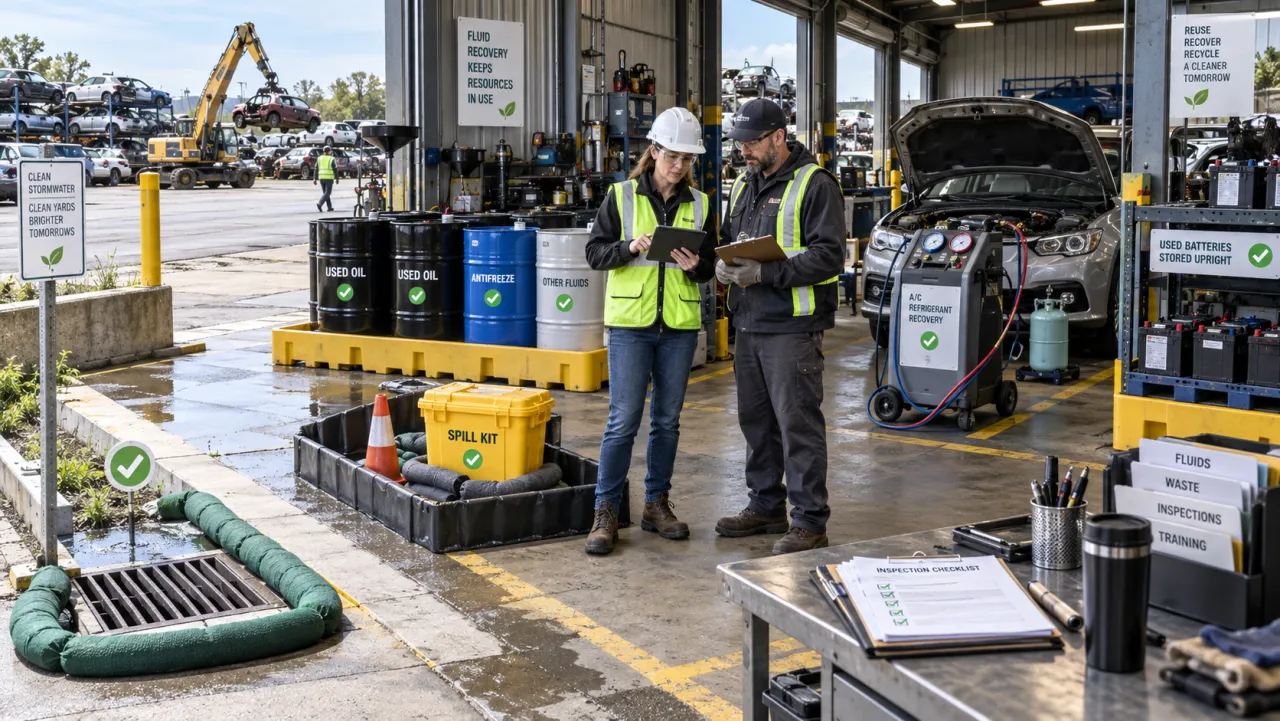
Drainage and water proximity are not box-ticking. To the EPA, an auto salvage yard is an industrial stormwater site - Sector M: Automobile Salvage Yards - so a site next to a storm drain or in a floodplain raises your discharge-control burden from day one. A certificate of occupancy confirms a building may legally be used for its stated purpose - but it covers the building, not the open-yard dismantling, and an existing CO for a warehouse, office, or repair garage does not authorize a salvage operation. You need the land-use approval, the building permits, and the applicable CO to line up, so do not assume one document covers the others.
Fire code is its own gate. Model codes such as the International Fire Code regulate high-piled combustible storage and outdoor tire storage, and a yard holding fluids, tires, and batteries will draw fire-marshal review. The specific edition and thresholds are adopted and amended locally, so treat it as “expect fire review,” not a single national number.
Phase I ESA: do it before you buy
The highest-stakes item on that checklist is the environmental one, because contamination liability can dwarf the purchase price. A Phase I Environmental Site Assessment is a non-intrusive investigation - records review, government-database and lien searches, interviews, and a visual site reconnaissance, with no sampling. It produces a professional opinion on whether there are conditions indicative of a release. If it flags something, a Phase II ESA does the actual soil and groundwater sampling.
Here is why the timing is not negotiable. A Phase I properly performed to ASTM E1527-21 can satisfy the pre-acquisition “All Appropriate Inquiries” component, codified at 40 CFR Part 312, of the CERCLA landowner liability protections - the innocent landowner defense, the contiguous property owner protection, and the bona fide prospective purchaser protection. A report with “Phase I ESA” on the cover does not by itself create the protection: it has to be done by a qualified environmental professional who signs the required declaration, and the buyer has to do their part too - disclose specialized knowledge, order a lien search, and answer the user questionnaire honestly (a hidden known spill or a skipped questionnaire can sink the whole thing). It also only works before you own the property: 40 CFR 312.20 requires the inquiry within one year prior to acquisition, with key components - interviews, the lien search, the government-records review, the visual inspection, and the environmental professional’s declaration - conducted or updated within 180 days of the acquisition date (not the report date, so a slow closing can force an update, and you cannot just lean on the seller’s old report). Do it after you close and you have already forfeited the protection.
One current-fact correction to carry into any conversation with a consultant: the older ASTM E1527-13 standard was retired. EPA’s December 15, 2022 final rule recognized E1527-21 and ended recognition of E1527-13 as of February 13, 2024, so a Phase I today should be performed to E1527-21.
The Phase I is the start, not the finish
Two things buyers get wrong about what a Phase I buys them. First, the protection is not “set and forget.” Even a perfect Phase I only preserves the CERCLA landowner defenses if you keep meeting the continuing obligations afterward: take reasonable steps to stop ongoing releases, give legally required notices, don’t disturb a cap or monitoring wells, comply with land-use restrictions, cooperate with the agency, and avoid a disqualifying tie to whoever caused the contamination. A new operator who keeps using a leaking sump, moves contaminated soil, or ignores a known release can lose the defense they paid for.
Second, a Phase I is not an environmental compliance audit. It tells you whether the ground is likely contaminated; it does not tell you whether the existing operation is meeting its stormwater permit, hazardous-waste accumulation rules, SPCC, refrigerant, UST, or fire-code obligations. If you are buying a running yard, commission a separate compliance audit and pull the permits, inspection and enforcement history, waste manifests, tank records, and any open cleanup cases. And ask your professional about scope items a standard Phase I leaves out - asbestos, lead paint, vapor intrusion, wetlands, and, increasingly, PFAS, since EPA has moved to regulate certain PFAS as hazardous substances.
A lease clause is not a shield
It is tempting to think a clause making the landlord or seller responsible for contamination solves the problem. It does not - at least not with the regulator. Under CERCLA, cleanup liability is strict and retroactive, and joint and several where the harm is indivisible (a party that proves a reasonable basis for apportioning its share can limit that), and it can reach the current owner and operator of a facility regardless of fault. A tenant is not automatically an “operator” just for signing a lease - but a salvage-yard tenant who actually runs the dismantling, fluids, tanks, and drainage very likely is, so this is your exposure, not just the landlord’s.
Two practical takeaways. First, the tenant can pursue its own protection: under the 2018 BUILD Act, a tenant can qualify for bona fide prospective purchaser protection - derivatively through a landlord who is a BFPP, or on its own by doing All Appropriate Inquiries before signing the lease and meeting the continuing obligations after. Second, the indemnity is worth having but is not magic: CERCLA Section 107(e)(1) lets the parties allocate cleanup costs between themselves, but a properly drafted, otherwise enforceable indemnity still cannot transfer your liability to EPA or a state agency, and it is worthless if the other party is insolvent when the bill lands. Write the indemnity in, back it with assets, insurance, or a guarantee where the stakes justify it, and do your own AAI anyway. It is in addition to diligence, never a substitute for it.
Where reParta fits
reParta does not choose your site, pull your zoning, or run your Phase I - site selection is the one part of this that is entirely on you and your professionals, and no software changes that. What reParta does is wait for the day the yard is open and then take the inventory and sales side off your plate: every part tied to its donor VIN and title, stock synced across eBay and Facebook for double-sale protection, and per-donor profit so you can see which cars actually paid off. The cleaner your donor records from the first intake, the less back-office drag you carry while the yard finds its feet.
This guide is general information, not legal, real-estate, or environmental advice. Zoning, permitting, fire code, and environmental requirements depend on your exact site and change over time, and local rules sit on top of the federal floor described here. Confirm the current requirements with your city or county planning and building departments, your state environmental agency, the fire marshal, and a licensed environmental professional and attorney before you sign or rely on any of this.
Ready for the part after the paperwork? Once the yard is open, reParta keeps every part tied to its donor VIN and title, syncs stock across eBay and Facebook for double-sale protection, and shows per-donor profit so you buy on real numbers. Start a free 14-day trial - no card required - or see pricing.
Frequently asked questions
What zoning do you need for a salvage yard?
Salvage yard zoning is usually industrial. Auto wrecking, dismantling, and scrap uses are commonly confined to industrial districts (often the heavy-industrial ones labeled M-2, M-3, I-2, or similar) and are frequently a conditional use even there, meaning you need a conditional-use permit on top of being in the right district. But it is local, not a national rule - some places allow it by-right, in lighter industrial or overlay districts, or ban it outright - so confirm the permitted use for automobile dismantling for your exact parcel with your own municipal zoning code and planning department before you sign anything.
What is a conditional-use permit for a junkyard?
A conditional-use permit (also called a special-use permit) is a discretionary approval a local planning commission or zoning board grants, usually after a public hearing, for a use that is not allowed by-right in a district. For a salvage yard it typically comes with conditions: sightproof fencing or masonry screening, setbacks, minimum lot size, stacking-height and vehicle-count limits, and controls on hours, noise, dust, and lighting. It can be denied, so treat it as a contingency, not a formality.
Do I need a Phase I ESA to buy a salvage-yard property?
You are not legally forced to, but you almost always should, and before you close. A Phase I done to ASTM E1527-21 can satisfy the pre-acquisition All Appropriate Inquiries component (40 CFR Part 312) of the CERCLA landowner protections - but it does not create the protection by itself: it must be done by a qualified professional with the buyer's own inputs, completed within one year before acquisition (key components - site visit, interviews, records and lien searches, and the professional's declaration - within 180 days), and paired with the continuing obligations after you own it. Skip it and you can inherit six-figure contamination liability from a prior operator.
Is ASTM E1527-13 still valid for a Phase I ESA?
No. EPA's December 15, 2022 final rule recognized ASTM E1527-21 as compliant with All Appropriate Inquiries and retired recognition of the older E1527-13 standard as of February 13, 2024. Any Phase I you commission now should be performed to E1527-21, and you should confirm the environmental professional is using the current standard.
How much does a Phase I ESA cost and how long does a conditional-use permit take?
Both vary widely by market and site, so treat these as rough planning figures, not quotes. A Phase I Environmental Site Assessment for a commercial property commonly runs in the low four figures and takes a few weeks. A conditional-use permit runs through a public hearing cycle that often takes a few months from application to decision, and longer if the jurisdiction requires studies or you draw neighbor opposition. Get real numbers and a timeline from a local environmental professional and your planning department before you build a schedule or budget around them.
Can a residential garage be used for auto dismantling?
Almost never. Home-occupation zoning rules typically prohibit outdoor storage, hazardous or flammable materials, meaningful customer traffic, non-resident employees, and signage - and regular dismantling triggers all of them. Even if one car physically fits, routine dismantling can change the property's lawful use, fire load, and wastewater exposure. Reselling already-removed parts with documentation is a different, lighter activity than dismantling whole vehicles.
Does a lease clause blaming the landlord for contamination protect me?
Only between you and the landlord. Under CERCLA, environmental liability is strict and retroactive, and joint and several where the harm is indivisible, and it can reach the current operator and owner regardless of fault - and a salvage-yard tenant who runs the dismantling and fluids is very likely an 'operator.' A private indemnity clause (allowed under CERCLA Section 107(e)(1)) can let you recover costs from the other party later, but it does not stop EPA or a state agency from pursuing you directly, and it is worthless if that party is insolvent. It is worth having in addition to your own diligence - and a tenant can also pursue its own bona fide prospective purchaser protection by doing All Appropriate Inquiries before signing the lease - not instead of it.