NMVTIS reporting explained for dismantlers: the 5-vehicle threshold
Of all the federal rules that apply to a salvage yard, NMVTIS reporting is the one small operators discover last - usually after they have already crossed the threshold that makes it mandatory. It is not a license, and depending on the reporting service it can be free or fee-based; either way it is a monthly reporting duty, and it applies to far more businesses than the name suggests. Here is what it is, who it covers, and how to make it a non-event.
For the full federal picture this sits inside, see federal regulations for auto recyclers; for the state license underneath it, our state-by-state licensing guide; and for the whole startup path, how to start a used auto parts business.
What NMVTIS is
NMVTIS - the National Motor Vehicle Title Information System - is a federal system supported by the U.S. Department of Justice. It exists to keep stolen and unsafe vehicles from being retitled and resold, and to give consumers and law enforcement a way to check a vehicle’s title, brand, and salvage history. The junk- and salvage-yard reporting requirement comes from the Anti-Car Theft Act, implemented in the regulations at 28 CFR 25.56, and it has been in force since March 2009. It is a reporting duty, not a license, and it is federal - it applies regardless of which state you operate in and on top of whatever license your state requires.
Who has to report
The federal definition is broad, and that is where most people get caught. A NMVTIS reporting entity is any individual or business in the business of acquiring or owning junk or salvage vehicles for resale in whole or as parts, or for rebuilding, restoration, or crushing. In plain terms that pulls in:
- junk yards and salvage yards;
- auto recyclers and dismantlers;
- scrap vehicle shredders and scrap metal processors;
- pull- or pick-apart (self-service) yards;
- salvage pools and salvage auctions;
- used-vehicle dealers whose actual activity meets the junk- or salvage-yard definition.
Coverage follows what you actually do, not the license you hold: a used-car dealer is not a reporting entity merely for having a dealer license or bidding at a salvage auction - it is covered only when its activity meets the federal junk/salvage-yard definition. Brokers who buy or hold salvage vehicles on behalf of others - including for overseas buyers - can meet the definition too, and industries not specifically listed can still fall under it based on what they actually do. If you are acquiring wrecked cars to sell their parts, assume you are covered until you confirm otherwise.
Insurance carriers report too, but on a separate basis: the 5-vehicle threshold is a junk/salvage-yard rule, not an insurer rule, and an insurer’s mandatory federal reporting covers the current model year and the four prior model years for vehicles it takes possession of or determines to be a total loss - even an owner-retained total loss - not simply because it sent a car to a yard. If you are a yard, the takeaway is just that a total-loss car arriving from an insurer is almost certainly reportable on your side.
NMVTIS reporting and the 5-vehicle threshold
The trigger is volume. You are subject to NMVTIS reporting once you handle five or more junk or salvage vehicles in a year. Below five in a year, you are generally not required to report; at five or more, the monthly duty applies - and once it applies, you report all qualifying vehicles for the period, not only the fifth and beyond. For a working yard that is a low bar - five donor cars is a slow month, not a year - so most real operations are in scope from the start. A few narrow carve-outs exist: a vehicle that a good-faith physical and value appraisal shows is not junk or salvage, cases where your state already collects the data and forwards it to NMVTIS, and a vehicle cleared by a federal theft verification.
What counts as “junk” or “salvage” follows the federal definitions in 28 CFR 25.52, not your own judgment - and they are narrower than they sound. A junk automobile meets two conditions: it is incapable of operating on public roads and it has no value except as a source of parts or scrap (the test is the vehicle’s value, not why you bought it). A salvage automobile is one damaged by collision, fire, flood, accident, or a similar event so that its fair salvage value plus the cost to repair it for legal road use is more than its fair market value just before the damage - and it also includes any vehicle declared a total loss by an insurer or under state law, even if the insurer never takes title. Note too that “automobile” here has a specific federal meaning (49 U.S.C. 32901): broadly a four-wheeled, on-road vehicle rated under 10,000 lb GVWR, with carve-outs like some work trucks - so it is not literally every VIN you handle. When in doubt, treat a wrecked or total-loss acquisition as reportable.
What you report, and how often
For each junk or salvage vehicle, a report includes at minimum:
- the reporting entity (your name, address, and contact);
- the VIN;
- the date you obtained the vehicle;
- the source - the name of the person or entity you obtained it from;
- the disposition - whether the vehicle was crushed or disposed of, or offered for sale or other purposes;
- who it was transferred to - the person or entity the vehicle was provided or sold to (a required part of the disposition statement, not just “sold”);
- whether the vehicle is intended for export.
Reporting runs on a monthly cycle - each month you report the qualifying vehicles you obtained the prior month, on the schedule your consolidator sets, rather than a separate 30-day clock ticking from each purchase. If a vehicle’s final disposition is not known yet, you still report the acquisition on time and file a supplemental report once the disposition is decided (and correct it if the actual fate differs from what you first reported). The takeaway that saves yards the most grief: capture the VIN, source, and disposition the moment each car arrives, so the monthly submission is a click, not a reconstruction.
How to submit
You do not upload to NMVTIS directly. Junk and salvage yards report through an AAMVA-approved data consolidator - AAMVA’s own free Single VIN Reporting Service for entering one car at a time, or a paid batch service like Auto Data Direct, Solera/Audatex, or ISO for volume. The one exception is when your state already collects the required data and forwards it to NMVTIS on your behalf - but you stay responsible for confirming it actually does. Entered by hand, a month of reporting runs roughly 30 to 60 minutes; if a non-standard VIN is rejected you can confirm it against the title and resubmit, and a wrong VIN is corrected through the consolidator. That time collapses to almost nothing when the required fields already live on each vehicle’s record in your inventory system.
Penalties and why it matters
Failing to report can carry a civil penalty of up to $1,000 per unreported vehicle (49 U.S.C. 30505) - and DOJ treats each vehicle you fail to report as its own violation, so its enforcement policy gives the example that 100 unreported vehicles can mean up to $100,000. But the fine is only part of it. NMVTIS gaps can stall title clearance, complicate an audit, and raise questions if a vehicle in your history turns up stolen. Clean, timely reporting is one of the cheapest forms of insurance a yard can buy - it just requires a system that makes the data a by-product of intake.
It stacks with your state, not instead of it
NMVTIS is a federal floor. Your state dismantler or recycler license and its title-surrender process are separate duties, and some states add their own reporting on a shorter clock - North Carolina, for instance, uses a much tighter reporting window than the federal monthly cadence. When you confirm your state licensing, ask specifically how state reporting and NMVTIS interact so you are not double-tracked or, worse, under-reporting on one of them.
Where reParta fits
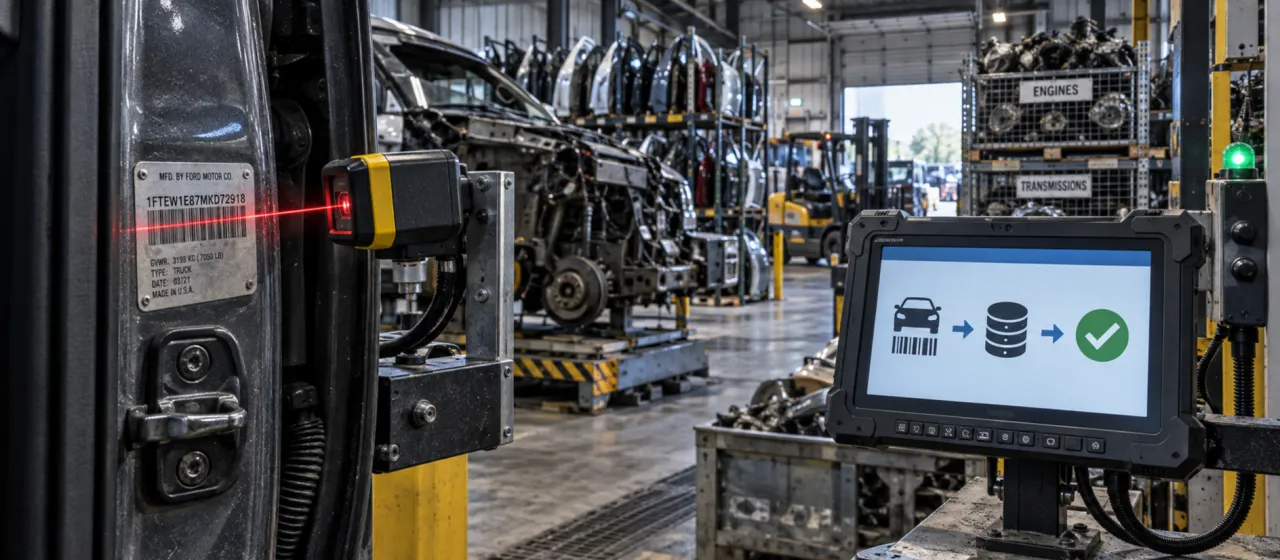
NMVTIS is fundamentally a records problem, and records are what a good system makes automatic. reParta ties every part to its donor vehicle, so the VIN, the source, and the date obtained are captured at intake - the vehicle-level fields an NMVTIS report draws on are there when you need them instead of reconstructed at month-end. One thing to be clear about: NMVTIS reports the fate of the donor vehicle (sold whole, crushed, scrapped, exported, transferred to whom), not the sale of each individual part - so selling a bumper is not a vehicle disposition. What reParta does is keep the donor record and its identifiers clean so that when you do set the donor’s disposition, the data is accurate and in one place. The same donor-linked records power your state title paperwork and a clean chain of custody, and because stock lives in one place and syncs across eBay and Facebook, a part that sells on one channel comes down from the others - double-sale protection, not angry buyers.
This guide is general information, not legal advice. NMVTIS obligations depend on your activity and can change, and states add their own reporting rules on top. Confirm the current requirements with the NMVTIS program and your state agency - and a licensed attorney where the stakes call for it - before you rely on any of this.
Want NMVTIS data to write itself? reParta captures the VIN, source, and date on every donor vehicle as it comes in, keeps the donor record clean through to its disposition, powers your title paperwork, and syncs stock across eBay and Facebook for double-sale protection. Start a free 14-day trial - no card required - or see pricing.
Frequently asked questions
Who has to report to NMVTIS?
Any individual or business whose actual activity meets the federal definition of a junk yard or salvage yard and that acquires five or more junk or salvage vehicles in a year. That includes junk yards, salvage yards, auto recyclers, scrap vehicle shredders and scrap metal processors, pull- or pick-apart yards, salvage pools, salvage auctions, and brokers - plus used-vehicle dealers, but only when their activity fits that definition, not merely for holding a dealer license or bidding at a salvage auction. Insurance carriers report too, but on a separate basis - the 5-vehicle threshold is a junk/salvage-yard rule, and an insurer's mandatory reporting covers the current and four prior model years for vehicles it takes as total losses.
What is the NMVTIS 5-vehicle threshold?
A business is subject to NMVTIS reporting if it handles five or more junk or salvage vehicles per year and is in the business of acquiring or owning them for resale in whole or as parts, or for rebuilding, restoration, or crushing. Below five a year you are generally not required to report, but at five or more the monthly reporting duty kicks in - so a small yard crosses the line quickly.
What information does NMVTIS require?
For each junk or salvage vehicle: the reporting entity's name, address, and contact; the VIN; the date you obtained the vehicle; the name of the person or entity you obtained it from; a statement of the vehicle's disposition (crushed or disposed of, or offered for sale or other purposes) including who it was transferred to; and whether the vehicle is intended for export. Reporting runs on a monthly cycle covering the vehicles you obtained the prior month, and you file a supplemental report once a vehicle's final disposition is known.
How do I report to NMVTIS?
Not directly - junk and salvage yards report through an AAMVA-approved data consolidator: AAMVA's own free Single VIN Reporting Service for one car at a time, or a paid batch service like Auto Data Direct, Solera/Audatex, or ISO for volume. The one exception is when your state already collects the data and forwards it to NMVTIS for you, though you stay responsible for confirming it does. For a small yard entering data manually it takes roughly 30 to 60 minutes a month - far less if the VIN, source, and disposition are already captured in your inventory as each car comes in.
What is the penalty for not reporting to NMVTIS?
Failing to report can carry a civil penalty of up to $1,000 per unreported vehicle (49 U.S.C. 30505) - DOJ treats each vehicle you fail to report as its own violation, so its enforcement policy notes that 100 unreported vehicles can mean up to $100,000. Beyond the fine, gaps in NMVTIS history can complicate title clearance and raise stolen-property questions, so consistent reporting protects you on more than one front.
Does NMVTIS reporting replace my state license or title paperwork?
No. NMVTIS is a federal reporting duty that sits on top of your state dismantler or recycler license and your state's title-surrender process. Some states also require their own reporting on a shorter timeline (North Carolina, for example, uses a much tighter window). Treat NMVTIS as one required layer among several, not a substitute for any of them.