One car, many sales: the math behind parting out vs whole
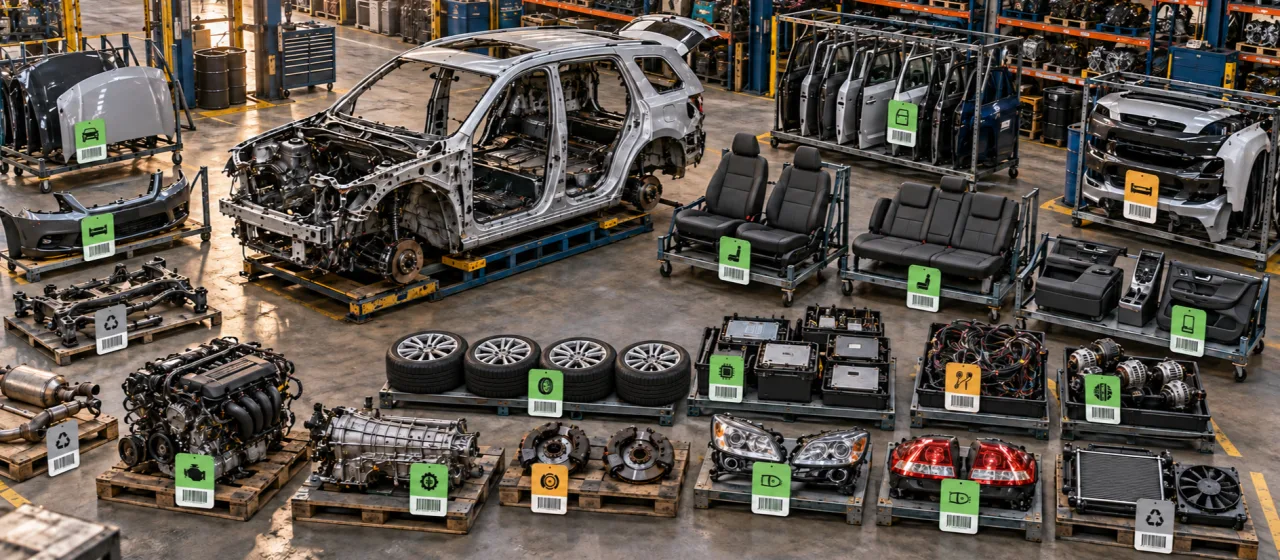
The core idea of dismantling is simple: one car becomes many sales, and the many often beat the one. But “often” is not “always,” and the difference lives in the numbers - the real ones, after costs. Done honestly, this is not a slogan, it is a calculation you can run before you ever buy the car.
The mistake that oversells part-out: gross vs net
Here is the trap almost every “parting out is more profitable” pitch falls into, including the old version of this very guide. It sums up the asking prices of the top parts and compares that total to the spread on a whole flip. That is gross on one side and gross on the other, with the costs quietly left off both.
The only fair comparison is net to net, on both sides:
- Whole-flip net = the sale price minus what you paid for the car, minus its own costs - transport, title, cleaning, and any selling cost.
- Part-out net = the parts you actually sell, plus the residual value of the shell, cores, and scrap, minus the donor cost, marketplace fees, shipping, the labor to pull, list and ship, storage while parts wait, and the parts that never sell.
Stack the sum of part prices against the whole-flip spread and part-out always looks like a landslide. Subtract the same kinds of costs from both sides and the picture gets honest fast.
Parting out vs selling whole: a worked example
These numbers are illustrative - your donor, market, and costs will differ - but the method is the point. Say you can buy a damaged donor for $1,800. Sold whole, it might bring about $2,200 - a $400 gross spread, fast, cash back in days. That spread is not pure profit either: a whole sale can still carry transport, title, cleaning, and selling cost, so treat $400 as the ceiling, not the take-home.
Parted out, an optimistic top five might ask:
- Engine: $900
- Transmission: $600
- Two clean doors: $500
- Headlight pair: $220
- Infotainment unit: $300
That is $2,520 gross - the number the old pitch would stop at. Subtract honestly, even in the best case where all five sell at full ask through separate orders:
- eBay Parts fees (about 13.6 percent for a non-Store seller, plus roughly $0.40 an order): about -$345
- The donor itself: -$1,800
That lands near $375 - and this is a partial contribution, not net. It is before the shipping you eat, the labor to pull and list five parts, and the storage while they sell, and it leaves off the part-out side’s own upside: the long tail of smaller parts and the residual value of the shell, cores, and scrap. Realized prices also tend to run below asking once buyers make offers.
So on the top five alone, part-out lands in the same neighborhood as a fast whole flip once costs come out - it does not “clear the whole price several times over.” Part-out’s real edge is the long tail plus residual recovery over the following months on a donor with real demand. That is a genuine but slower, less certain upside - exactly what you want to estimate before you bid, not discover afterward.
The costs that decide the answer
Part-out is not free money. Subtract all of it, not just the headline fee:
- Acquisition - what you paid for the donor, spent on day one and frozen until parts sell.
- Marketplace fees - about 13.6 percent on eBay Parts for a non-Store seller (a Store subscription lowers it in many categories), charged on the shipping and tax the buyer pays too, plus the per-order fee.
- Shipping - small parts ship cheap; engines, transmissions, doors, and hoods are oversized freight that can cost a lot, and often you eat it under free shipping. See free shipping vs calculated shipping.
- Labor - every listed part carries a minimum cataloging and transaction cost, but removal, testing, cleaning, and shipping labor vary widely by component. Measure contribution per direct labor hour, not per part, so a stack of cheap, high-hassle parts does not quietly sink your throughput.
- Storage and carry - a whole flip recycles your cash in days; a part-out ties it up for months while the tail sells, and a stripped shell occupies space until it is hauled. Calculate your own carry from rent, capital, and handling rather than a generic percentage.
- The unsold tail - parts you paid to pull and list that never sell cost you that labor and shelf space, net of any later sale, core, or scrap recovery.
- Hull and residual - after the good parts are gone, the shell is drained of fluids, stripped of hazards, and scrapped or hauled. Scrap, cores, and recyclable metal are a real recovery: sometimes small, and sometimes - on a cheap donor with a catalytic converter or heavy metal content - a meaningful part of the math, net of depollution and hauling.
The real decision rule
Replace “if the top five parts beat the whole price, part it out” with an honest, net-based test:
Part out only when the expected part-out net clears the whole-flip net by enough to pay you for the months of labor and tied-up cash - and to cover the extra risk.
A simple way to weigh it without a spreadsheet is to sort the parts into three tiers and value each at a realistic realized price, not full ask:
- High-confidence (strong, steady demand) - value at a realistic realized price.
- Medium-confidence (sells eventually, seasonal, model-dependent) - value at a discount.
- Speculative (rarely worth the labor) - value near zero, or as scrap and core recovery.
Add the tiers, subtract the costs above, add the residual, and compare to the whole-flip net. Because part-out carries more transactions, returns, and uncertainty than one clean sale, build in a buffer: a small edge over the whole flip is usually not worth the months of work and risk. And weigh cash velocity - a smaller whole-flip profit earned in two weeks can beat a larger part-out profit spread over eight months if you can reliably redeploy that cash into another good donor. This is the same discipline as setting a max bid you will not cross and valuing the donor part by part before you commit.
A third path: selective harvest
The choice is not only all-or-nothing. Often the best return is to pull the few high-confidence parts fast, then sell the rest of the car whole or as scrap - you capture the drivetrain, panels, or modules that move quickly and skip the months of long-tail labor and storage. Weigh three exits, not two:
| Exit | Cash speed | Labor | Upside |
|---|---|---|---|
| Sell whole | Fast | Low | Lower |
| Selective harvest, then sell the rest | Medium | Medium | Medium to high |
| Full part-out | Slow | High | Highest, least certain |
On a lot of donors - especially middling ones - selective harvest is the quiet winner: most of the profit lives in a handful of parts, and the long tail is where the labor and storage quietly eat it back.
When selling whole (or harvesting) wins
Full part-out is the instinct for a parts-focused yard, but the right move is to weigh every donor against its best exit. Lean toward whole or selective harvest when:
- The donor is low-value, where parts are cheap and heavily supplied and each sale barely clears handling cost.
- It is picked over - the engine, transmission, panels, or modules are already gone.
- It has too little verified demand for its parts relative to acquisition, labor, storage, and shipping. That can happen with a rare model (small buyer pool) or an over-supplied economy car - rarity and commonness are both just inputs to demand-versus-supply, not verdicts on their own.
- It has flood or fire damage, which hurts both exits: water and heat ruin electronics, wiring, and interior, and a branded or non-repairable title plus disclosure rules can limit the whole-vehicle sale too - so model the legally available channel (retail, wholesale, or scrap) rather than assuming a clean flip.
- You have no storage or labor capacity, or you need fast cash.
Damage location changes the surviving mix rather than settling the decision: compare the undamaged high-demand parts on the specific car, not the impact direction alone. A hard front hit may take out lighting and front panels while leaving the drivetrain usable; a side or rear hit destroys a different valuable group and can deploy costly restraint components.
One more check before you lean on “sell whole” as your exit: reselling whole vehicles regularly can require a dealer or dismantler license plus title and disclosure steps your parts operation may not already cover - confirm what your state requires before you count on it.
Which donors are worth parting out
Liquidity, not sticker value, decides it. A $200 part on a common truck can beat a $600 part on a rare car because one sells this month and the other sells next year. The donors that part out well tend to share a few traits:
- High-population models and popular trucks or SUVs - deep buyer pools and higher part values. Popular also means more competing supply, so it is demand relative to supply that matters, not population alone.
- Clean, undamaged high-value parts present - drivetrain intact, straight panels, good glass, working modules and lights.
For choosing the right car in the first place, see the best cars to part out and is a salvage car worth parting out before you bid.
Put real numbers on the choice, before you bid
The whole point is to run this math before the money is committed, not after. Pre-bid ROI turns a VIN and your max bid into a projected parts list, a value and net estimate, and a risk score using real used-market prices, so you can weigh the expected part-out return against a fast whole flip at the auction - for Copart, IAA, and private lots. You enter the VIN and your assumptions; it does not scrape the auctions, and it is an estimate to guide the call, not a guarantee of price, sell-through, timing, or profit.
After the sale, per-donor profit and loss tracks what each part actually nets after fees and shipping, so you can compare the projection to what really happened, donor after donor. Both run inside reParta’s auto parts inventory management software, so the decision, the cataloging, and the P&L live in one place. You can start a free 14-day trial (no card) and run the numbers on your next donor, or see the pricing first.
The math is not hard. Skipping it - or doing it on gross instead of net - is what costs dismantlers money.
Related reading
- Is parting out a car worth it? Run the numbers - the go or no-go before you buy.
- The complete guide to a profitable part-out - the full workflow once you have decided.
- Cheaper than Hollander: what you actually need to pay for - keeping the tooling cost off your margin.
Frequently asked questions
Is parting out always more profitable than selling a car whole?
No. Parting out usually produces more gross revenue per car, but not always more net profit, and it always ties up your cash and labor for longer. Whether it wins depends on the donor's part demand, your labor and storage capacity, and how fast you need the money back. On low-value, picked-over, or flood and fire damaged donors, a fast whole flip or a selective harvest often beats a slow full part-out.
How do I compare parting out vs selling whole correctly?
Compare net to net on both sides. The common mistake is stacking the sum of part asking prices (gross) against the whole-flip spread (also gross). Part-out is the parts you actually sell plus the residual value of the shell, cores, and scrap, minus the donor cost, marketplace fees (about 13.6 percent on eBay Parts for a non-Store seller), shipping, the labor to pull, list and ship, storage, and the parts that never sell. A whole flip is the sale price minus the donor cost and its own transport, title, and selling costs. Then factor how many months each ties up your cash.
When should I sell a car whole instead of parting it out?
Sell whole (or pull a few parts and then sell the rest) when the numbers or situation favor speed and certainty: a low-value donor where parts are cheap and heavily supplied, a picked-over car with the good parts gone, a model with too little verified demand for its acquisition and handling cost, flood or fire damage that ruins electronics and interior, no storage or labor capacity, or when you need the cash back quickly to buy the next car.
How much does eBay take when I sell used parts?
For a non-Store seller, eBay's Parts and Accessories final value fee is about 13.6 percent of the total sale up to $7,500, plus a per-order fee of about $0.40, and the fee is charged on the shipping and tax the buyer pays too. A Store subscription lowers the percentage in many categories. Either way it is real money to subtract from every part sale before you compare part-out to a whole-car flip. Verify the current fee schedule for your account and category.
Does reParta tell me whether to part out or sell a car whole?
reParta gives you the numbers to decide. Pre-bid ROI turns a VIN and your max bid into a projected parts list, a value and net estimate, and a risk score before you buy, using real used-market prices, so you can weigh the expected part-out return against a whole flip. You enter the VIN and your assumptions; it does not scrape the auctions, and it is an estimate, not a guarantee of price, sell-through, timing, or profit. After the sale, per-donor profit and loss tracks the actual net after fees and shipping, so you can compare the projection to what really happened.