Best auto recycling software in 2026: an honest, category-by-category buyer's guide
Most “best auto recycling software” lists are thin, and ranked by whoever paid to be on them. reParta publishes this guide, and we run this market every day - so we will tell you which of the six categories you actually need, name where reParta is the right call, and name where it is not. No pay-to-rank list does that. There is no universal winner in auto recycling software, only the best fit for how you buy, pull, and sell. The biggest shift since most of these lists were written: the best modern tools now help you decide which car to buy before the auction, not just track it after.
First: there is no single “best” - start with your category
Auto recycling software is not one market. What is right for a 200-vehicle, multi-site enterprise is wrong for a solo dismantler, and a tool built to move eBay listings faster is not a system of record at all. Before you compare products, decide what you are really buying: a system of record, plus the data that makes parts findable, plus the sales channels you live on, plus compliance and accounting. Get the category right and the shortlist inside it gets short fast.
If you want the scored method rather than the map - a checklist you can run against a single vendor, plus the ten questions to email every one of them - use how to choose salvage yard software alongside this guide. This article is the map; that one is the scoring rubric.
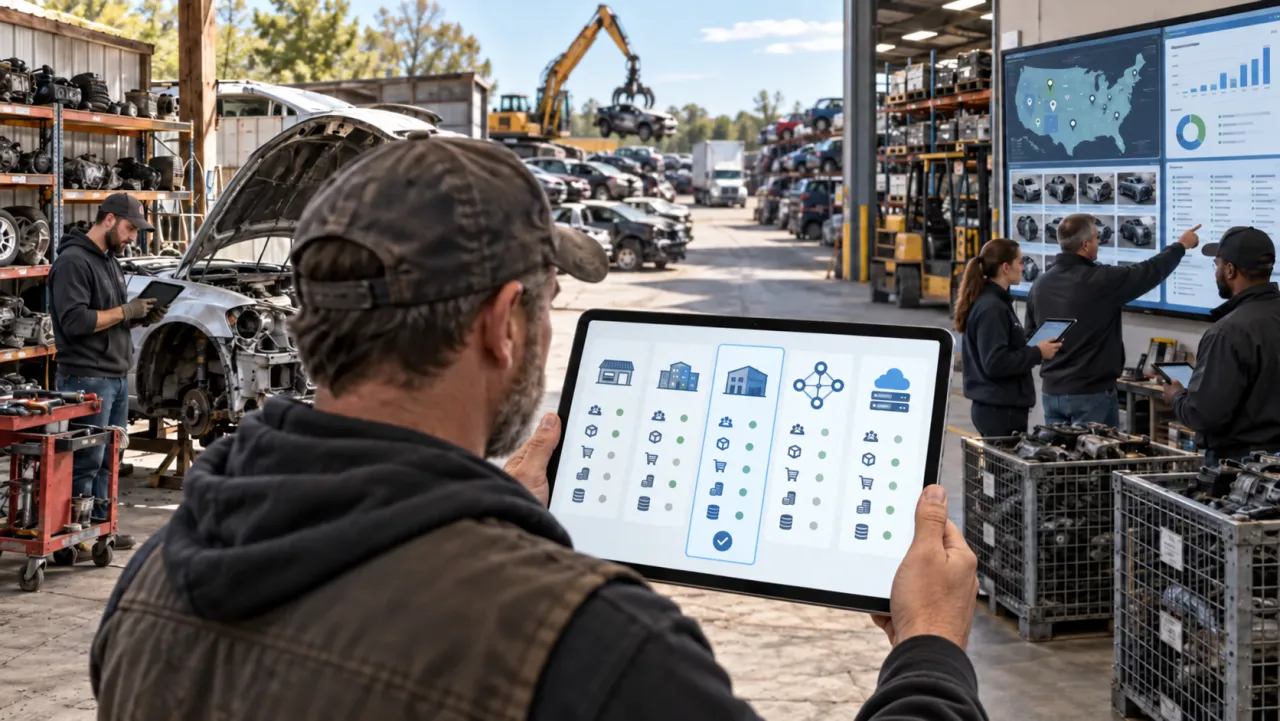
The six categories of auto recycling software
Six different things get sold under the same “auto recycling software” banner - five long-established types, plus the modern cloud category that has grown up around eBay and Facebook selling. Here is what each is genuinely good at, and who it fits.
Legacy enterprise suites
The long-established systems own deep interchange data and broad enterprise features - production, brokering, professional-buyer workflows - and many large yards run on them. They are powerful and proven. The trade-offs for a marketplace seller: quote-only pricing you cannot compare without a sales call, a desktop-era workflow, and online listing treated as an add-on rather than the main event - a hard fit if eBay and Facebook are your storefront. Best for: large, high-volume, multi-location operations that monetize interchange depth and network demand.
Marketplace-anchored systems
Some systems are built around a parts-trading marketplace and its interchange network, strong for trade demand and professional buyers. Best for: yards whose sales center on that network and who want their software tied to it. The trade-off is a buyer base and workflow oriented around one ecosystem.
Self-service / U-Pull-It systems
Built around the gate: admission and point of sale, vehicle rows, scale and commodity tracking, cash controls, and NMVTIS in the operational flow. Part-level pre-inventory is not the center of every sale. Best for: high-volume pull-your-part yards. The trade-off is that they are not aimed at part-level e-commerce.
eBay listing tools
These are not full yard systems. They make eBay listings faster and better, sometimes alongside your existing inventory tool. Best for: sellers who are eBay-only and just want stronger listings. The trade-off: they do not handle Facebook, full inventory, orders, or cross-channel delisting. If a listing tool you relied on has closed, see what to use after a listing tool shuts down and the best eBay inventory management for recyclers.
Generic multichannel tools
Built for e-commerce in general - apparel, dropshipping, mixed SKUs. They list to many channels but do not understand fitment, interchange, ARA grading, or the donor-to-parts workflow. Best for: sellers who are not really running a recycling operation. The trade-off: with no fitment, no interchange, no donor economics, and no double-sell protection across channels, they miss the exact things that make a used part findable and profitable.
Modern cloud recycler platforms
Cloud-native systems built for recyclers that combine deal math before you buy, native eBay listing, cross-channel delisting, and per-donor economics - at published prices. The best of them answer the question legacy suites leave to your gut: is this specific car worth buying, at this price, today? Best for: operations that sell through online marketplaces and want to buy on a number, not a hunch - from a solo dismantler to a multi-location yard. Versus a legacy suite you trade interchange and production depth, not scale or capability. This is the category reParta is in; the modern auto recycler’s software stack covers how the pieces fit together, and the reParta section is further down. If that is you, you can start a free trial and run reParta through the demo checklist below on your own inventory.
What a real yard management system actually does
Category tells you the shape of a tool. This tells you whether it can run a yard. Score any product against the jobs you actually do - not the longest feature list.
Acquisition
VIN decode and exact configuration, an auction fee and transport model, historical demand by part, a bid ceiling, and predicted recovery before you buy. This is where money is made or lost. See is a salvage car worth parting out before you bid and how to value a salvage car for parts.
Intake and compliance
A stock and donor record, title state and authority to dismantle, NMVTIS reporting, hazmat and EV flags, and a final disposition or crush record. What auto dismantling involves sets the baseline.
Inventory and interchange
Part-level records, a credible interchange, OE and MPN numbers, exact fitment and application, ARA damage grade, condition, location, and images. This is also where the most common confusion lives, so be precise: vehicle configuration, fitment, and interchange are three different capabilities. A VIN decode tells you what the donor is. Fitment tells you which vehicles a part fits. Interchange resolves usable substitutes across models, options, and years. A vehicle-configuration catalog is the step before fitment matching, not a part-level interchange index. See how auto parts interchange works, the recycler’s guide to fitment and interchange, and what a Hollander interchange number is.
Production
A teardown plan and work queues: pull, inspect, grade, photo, tag. Sold-before-pulled priority, QC holds, and dispatch. A production layer is where high-volume yards earn back their software cost.
Sales
Fast counter and phone search, quotes and orders, oversell prevention, returns, and listings to the channels you sell on. See how to sell auto parts on eBay for a salvage yard.
Finance and management
Acquisition-to-sale profit and loss per donor, margin by channel and technician, an immutable audit trail, and accounting export. If a tool cannot tell you which donors made money, it is a listing tool, not a management system.
Platform
Cloud or on-premise architecture, a documented API, bulk export in a usable format, roles and MFA, backup with a stated recovery objective, and clear data-ownership and exit terms. Cloud versus desktop salvage yard software walks through the architecture trade-offs.
How to compare total cost when vendors hide pricing
Quote-only pricing is the norm at the enterprise end, and it is designed to be hard to compare. Do not compare monthly numbers - compare a three-year total cost of ownership.
- Year-one cost: implementation, data migration, any hardware or server, licenses and per-seat or per-location fees, data and marketplace subscriptions, payment processing, training, and your own labor plus the temporary productivity dip.
- Three-year cost: year one, plus renewals and price escalators, support, storage and API charges, expected add-ons, and the cost of exporting your data if you leave.
Then ask the questions that move the real number: the minimum term and auto-renewal, the annual price-increase cap, per-user and per-location fees, interchange and marketplace subscriptions, image and API charges, payment markup, implementation and data cleanup, after-hours support, and a full database export on termination. A cheap subscription is expensive if it loses you one sale a day; an expensive suite is wasted if you use ten percent of it. What you actually pay for, compared honestly breaks this down, and reParta’s own numbers are on the pricing page.
The demo and proof checklist
Vendors demo the happy path. Make them run your data instead. A serious demo, on your inventory, should:
- Import 50 donors and several hundred to several thousand parts.
- Decode five difficult VINs and options.
- Catalog a real range: engine, door, module, wheel, lamp.
- Show the interchange or fitment source, and cite its version and update cadence.
- Record ARA damage, mileage, and a test note.
- List to eBay with real item specifics and compatibility.
- Take a paid order, reserve the part, and prove a second sale is blocked.
- Process a cancel, refund, and return, and restore inventory correctly.
- Export every vehicle, part, image, customer, and transaction.
For any channel that claims automation, make them show every manual click and prove exactly how a recorded sale changes inventory and pulls the part off the other channels. A slide, or a staged listing that never went live, is not proof. The full RFP email and a scored version of this checklist live in how to choose salvage yard software.
An RFP scorecard by yard type
The same criteria matter to every yard, but the weights are not the same. Score each vendor zero to five on proof - not on the brochure - and weight by the operation you actually run.
| Criterion | Full-service | Self-service | Small eBay seller |
|---|---|---|---|
| Interchange / fitment accuracy | High | Medium | High |
| Inventory / production depth | High | Medium | Low |
| POS and order lifecycle | Medium | High | Medium |
| Channel and demand access | Medium | Low | High |
| Vehicle buying and pre-bid math | Medium | High | High |
| Compliance and NMVTIS | Low | High | Low |
| Reporting and finance | High | Medium | Medium |
| UX, mobile, and training | Low | Medium | High |
| API, security, and data exit | High | High | Medium |
| Three-year total cost | Medium | Medium | High |
Read the columns, not the rows: a full-service yard should not sacrifice interchange and production depth to save on subscription, and a small eBay seller should not pay for production queues it will never open.
Migration risk: the real fear is your business stopping, not the software
Most owners are not afraid of the new program. They are afraid of what happens the week they switch: that parts or photos go missing, that the crew cannot sell, that listings double up or vanish, that orders get lost, that the books stop reconciling, that the new tool turns out weaker than the old one, that the vendor goes quiet after you sign, and that you personally spend the next three months cleaning it up. “Our system is simpler” does not answer any of that. Proof, honest limits, a written plan, a named person, and a rollback do.
So before you sign anything, make the vendor commit to five things in writing:
- Proof on your own data, not a canned demo - the checklist above, run on your donors and parts.
- The honest limits of the product, named up front, so nothing surprises you in month two.
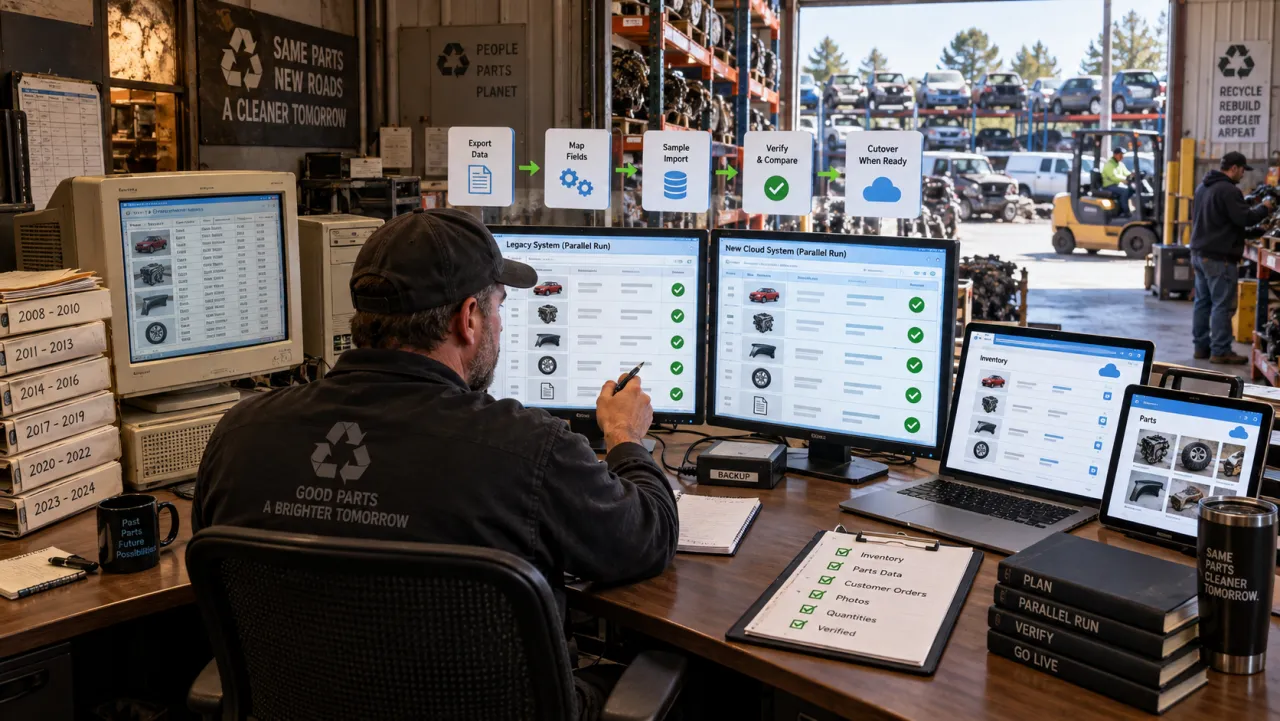
- A written migration plan: cleaning duplicate and invalid VINs, crosswalking part codes and interchange, reconciling image counts, mapping open quotes and orders and balances, and a physical-inventory sample audit.
- A named person accountable for your migration, and a cutover scheduled outside peak auction and shipping periods.
- A pre-agreed rollback and a free, standard-format data export you can trigger if the cutover fails - tested during the pilot, not promised for later.
Migrating off legacy recycler software covers the sequence; if you are still on a spreadsheet, start with moving from Excel to a real system.
The heavy, months-long migration is ripping out a deep legacy system of record. A modern cloud platform is a lighter move by design: reParta imports your existing eBay listings and inventory in one click, offers migration help when you are switching, and runs alongside what you already use during a free trial - so you prove it on your own data before you move a single record, and there is nothing to roll back if you decide it is not for you.
Where reParta fits - and where it does not
reParta is in the modern cloud recycler category. It is built for used-parts sellers who sell mainly through online marketplaces and want deal math, profit tracking, and double-sell protection - from a solo dismantler up to a multi-location yard, on tiers that scale by part count and team.
reParta tells you whether a car is worth buying before you bid, then makes sure you never sell the same part twice. Here is what it does, and what it does not.
Where reParta is strong:
- Pre-bid ROI projections - buy on a number, not a hunch. Enter a VIN before the auction closes and get a projected parts list, estimated revenue, auction and transport and buyer fees, an estimated net profit, and a risk score. Most systems only start working after the car is already in your yard; this tells you whether to buy it at all. It is a projection, not a guarantee, and it is built on real used-market prices. See pre-bid ROI.
- Native eBay listing and automatic takedown. reParta connects to your own eBay account and lists and updates through eBay’s official Inventory API, and when a part sells, the eBay listing comes down automatically. This is a real, direct integration, not a CSV upload.
- Cross-channel delisting that stops double sales. When a sale is recorded, reParta removes the part from your other channel so you cannot sell it twice. See multi-channel sync and why double-selling happens and how auto-delisting stops it.
- Assisted Facebook Marketplace publishing. Facebook has no public listing API, so reParta publishes and removes listings through a free browser extension that runs in your own logged-in session - you click start, it runs the batch. eBay and direct sales are captured for you; the one manual step is telling reParta when a part sells on Facebook, and the moment that sale is recorded the cross-channel delist fires and the extension pulls the Facebook listing down. The double-sell you fear most - one channel selling while it is still live on another - is closed in every direction.
- Fitment guardrails that cut wrong-fit returns. reParta decodes and normalizes the vehicle configuration - year, make, model, trim, engine - the level where most wrong-fit returns start. Getting the application right before the part lists is how you stop the refunds, and the defect hits that follow them.
- Per-donor profit tracking. Acquisition and fees against revenue, days to sell, and channel breakdown, so you know which donors actually made money. See per-donor profit and loss.
- Start on your own inventory without a project plan. One-click eBay store import brings your existing listings and inventory into reParta from day one - no server to stand up, no implementation consultant to schedule. If you can run a listing today, you can run the trial this week.
- Published pricing and a free trial. Plans start at $41 a month billed annually, with a clear per-part overage, team seats included by plan, and a 14-day trial with no card and no sales call to sit through. The full ladder is on the pricing page.
Where reParta is the wrong call:
None of the limits below are about the size of yard reParta can run - it scales from one bay to multiple warehouses. They are about the depth of a few specific functions, so match them against what you actually do day to day.
- Configuration-level fitment, not a deep part-level interchange index. reParta gets the vehicle configuration right, which prevents the majority of wrong-fit returns. What it does not do is resolve deep part-level crossover the way a dedicated interchange index does, so if your margin depends on selling one part number across dozens of substitute applications, pair reParta with an interchange source or weigh a legacy suite. The vehicle database page lays out exactly what it covers.
- Not a deep-production, counter-POS, or NMVTIS-filing system. reParta scales from solo to multi-location, but it is not built to replace teardown and production queues, a counter POS with cash drawer and accounts receivable, a B2B trading and brokering network, NMVTIS filing, or the enterprise audit controls a large multi-department operation requires. If you run on those, pair reParta with them or weigh a legacy suite. The native mobile app is on the way, not shipped.
If you sell mainly through online marketplaces, the surest way to settle every doubt above is to run reParta on your own inventory: 14 days, no card, cancel anytime. Import your donors, list to your own eBay account, watch a recorded sale pull the part down, and check the fitment and Facebook steps yourself before you pay anything. reParta is a strong fit whether you run a handful of donors a month or a multi-location yard. If your business runs on deep interchange and production, a counter POS, brokering, or NMVTIS filing, a legacy enterprise suite earns its price; if you run high-volume self-service, a U-Pull-It system fits better. For a marketplace-first seller, reParta is the one you can prove out yourself before you commit.
Find your category first
The “best” auto recycling software is just the best fit for how you actually buy, pull, and sell. Find your category, score the shortlist on proof rather than brochures, and demand a demo on your own data before you sign - and hold reParta to that same bar.
If you sell through online marketplaces, you already know your category. You want pre-bid deal math, per-donor profit, native listing with automatic takedown, and a price you can read without a sales call - and you want to prove all of it on your own inventory before you pay a cent. That is the yard reParta was built for.
Start a free 14-day trial (no card required) and run reParta on your own donors and parts: decode VINs, list to eBay with real item specifics, and take a paid order to prove a part cannot be sold twice. Prefer to look first? See auto parts inventory management software or the published pricing.
Frequently asked questions
What is the best auto recycling software in 2026?
There is no single best for every yard - it depends on how you sell. Large multi-location operations that run on deep interchange and production usually need a legacy enterprise suite, and high-volume self-service / U-Pull-It yards need a system built around the gate, the scale, and commodity tracking. But for the biggest and fastest-growing group - operations that sell mainly through online marketplaces, from a solo dismantler to a multi-location yard - reParta is the modern cloud platform we recommend: pre-bid deal math before you buy, double-sell protection, per-donor profit, and published pricing you can trial free before you commit. Pick your category by how you sell and what you need, not by size alone, then compare products inside it.
What are the main types of auto recycling software?
Six categories: legacy enterprise suites (deep interchange, production, broad features, quote-only pricing); marketplace-anchored systems (built around a parts-trading network); self-service / U-Pull-It systems (gate, scale, commodity, cash controls); eBay listing tools (faster listings, not a full yard system); generic multichannel tools (built for e-commerce in general, blind to fitment and the donor-to-parts workflow); and modern cloud recycler platforms (inventory, listing, and profit tracking at published prices). Comparing across categories on channel count alone is meaningless, because they are different layers.
What is auto parts inventory software?
Auto parts inventory software (also searched as an auto parts inventory management software, program, or system) tracks each used part from intake to sale: part-level records with the donor and VIN, fitment and interchange, condition grade, location, photos, price, and status, so a part stays findable and sellable and cannot be sold twice. For an automotive recycling operation, the useful version also carries pre-bid deal math, per-donor profit, and multichannel listing - not just a stock count. reParta is a modern cloud example with published pricing you can trial free.
What should a real yard management system actually do?
Seven jobs: vehicle acquisition (VIN decode, bid ceiling, predicted recovery); donor intake and compliance (title, NMVTIS, disposition); inventory and interchange (part-level records, fitment, grading, location); production (teardown, pull, QC, dispatch); sales (counter and phone search, quotes, orders, oversell prevention, listings); finance (per-donor profit and loss, margin, audit trail); and platform (cloud architecture, API, export, roles, backup). Score any product against the jobs you actually do, not the longest feature list.
How do I compare pricing when vendors will not publish it?
Ask for a three-year total cost of ownership, not a monthly number. Year-one cost is implementation plus migration plus hardware plus licenses and per-seat or per-location fees plus data and marketplace fees plus payment processing plus training plus your own labor. Three-year cost adds renewals and escalators, support, storage and API charges, expected add-ons, and the cost of exporting your data on exit. A cheap subscription is expensive if it loses one sale a day, and an expensive suite is wasted if you use ten percent of it.
What is the difference between vehicle configuration, fitment, and interchange?
They are three different things. A VIN decode and vehicle configuration tell you what the donor is - year, make, model, trim, powertrain. Fitment tells you which vehicles a given part fits. Interchange goes further and resolves usable substitutes across models, options, and years. A vehicle-configuration database is the first step before fitment matching, but it is not the same as a part-level interchange index. Ask any vendor for the source, coverage, and update cadence of whatever data they use.
How do I stop a demo from only showing the happy path?
Make the vendor run your data, not theirs. Import 50 donors and several hundred parts, decode five difficult VINs, catalog a range of part types, show the interchange or fitment source and version, list to eBay with real item specifics, take a paid order and prove the part cannot be sold twice, process a return, and export everything. For any channel that claims automation, make them show every manual click and prove exactly how a sale changes inventory and pulls the part elsewhere. A slide is not proof.
Is it risky to switch auto recycling software?
The real fear is not the software, it is the business stopping the week you switch. Never switch all at once without cleaning duplicate VINs, crosswalking part codes and interchange, reconciling image counts, mapping open orders and balances, a physical inventory audit, a named person accountable for the migration, and a pre-agreed rollback and free data export tested during the pilot, not promised for later. A modern cloud platform is lower-risk to adopt: reParta imports your existing eBay listings and inventory in one click, offers migration help when you switch, and runs alongside your current system during a 14-day free trial with no card, so you prove it on your own inventory before you move a record.
Which auto recycling software has pre-bid ROI or deal analysis before you buy?
reParta includes pre-bid ROI projections: enter a VIN before you bid and get a projected parts list, estimated revenue, auction, transport and buyer fees, an estimated net profit, and a risk score, built on real used-market prices. It is a projection, not a guarantee. Most legacy suites focus on post-purchase inventory rather than pre-bid deal math, so this is a core reason marketplace-focused yards choose a modern cloud platform.
What auto recycling software stops you from double-selling the same part?
Double-sells happen when the same part is listed on more than one channel and one sale does not remove the others. reParta prevents this with automatic eBay takedown when a part sells and cross-channel delisting: recording a sale removes the part from your other channel so it cannot be sold twice. Ask any vendor to prove, live and on your own inventory, that a paid order blocks a second sale.
Is there auto recycling software with published pricing and a free trial?
Most enterprise recycling software is quote-only, which makes it hard to compare. reParta publishes its pricing - plans start at $41 a month billed annually with a clear per-part overage - and offers a 14-day free trial with no card required, so you can test it on your own inventory before committing. Transparent pricing plus a self-serve trial is the low-risk way to evaluate any system.