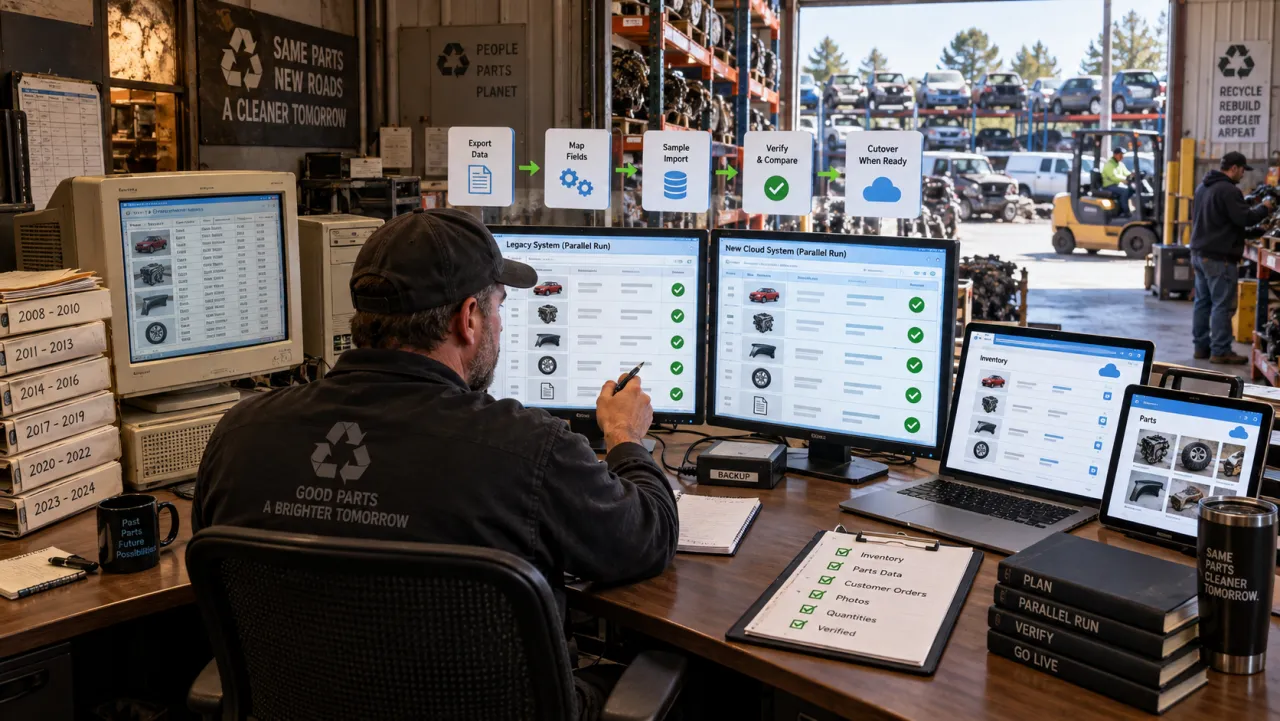
The modern auto recycler's software stack
Ask ten yards what software they run and you will get ten different answers, most of them a patchwork: one tool for inventory, a spreadsheet for fitment, a listing app for eBay, manual posts on Facebook, and email for orders. This is the “stack” most dismantlers actually have, and the gaps between the pieces are where money leaks. Here is what a modern stack covers, and why a single source of truth - not a single vendor - is the whole game.
The patchwork most yards actually run
The real-world stack is a stack of seams. A part gets typed into inventory, then typed again into each listing. Fitment lives in one person’s head instead of in the data. A sale on Facebook does not touch the eBay listing. Nobody can see profit per donor because the numbers are scattered across tools that do not talk. It is often the natural result of growing past a spreadsheet one tool at a time - the move off Excel is where many yards start - and each seam is quiet, manual work that scales with you.
The functions a parts operation needs
At the sell-side and inventory core, a used-parts business has to do all of this:
- Acquisition - value donors before you buy, and track what you paid.
- Inventory and cataloging - parts, conditions, locations, photos.
- Fitment and interchange - so parts reach the right buyers. What a real compatibility engine does is its own subject, inside the wider fitment and interchange guide.
- Multichannel listing - eBay, Facebook, networks, your site, to the criteria that actually matter.
- Delisting on sale - pull a part from the other channels when it sells, which is its own mechanism.
- Orders and customers - quotes, invoices, history.
- Reporting - profit per donor, aging inventory, what sells.
Every one of these is necessary for an eBay-first dismantler. Priorities shift for other models - a self-service or U-pull yard may not track part-level inventory the same way, and a B2B operation may lean on trade networks over Facebook - but the functions above are the spine of selling used parts online.
The fuller stack: compliance, production, POS, finance
Calling any setup “complete” means naming the parts this core does not cover. A full operation also runs compliance (title and VIN intake, NMVTIS reporting, EPA fluid and refrigerant rules, converter and disposal records), production and dismantling (work orders, grading, QC, EV high-voltage procedures), physical inventory (barcode, bins, multi-yard moves), counter POS with sales tax, fulfillment and freight, and finance (payments, marketplace fees, COGS, accounting export). You do not need one vendor to do all of it, but you do need to know which system owns each. The regulatory layer is not optional - the federal regulations for auto recyclers maps it - and the physical intake side has its own workflow.
Why one source of truth wins
When the core functions share one authoritative record, a part is entered once and everything else flows from it: cataloged with fitment, listed across channels, pulled from the others on sale, attached to orders, and rolled into reporting. Integration reduces the duplicate entry, the sync gaps, and the double sales - provided every channel is actually connected, failures are reconciled, and offline sales are recorded promptly. It does not make them vanish: even one system faces API latency, expired tokens, failed callbacks, and the counter sale nobody logged. The honest version is what real-time sync should actually mean - fast, verified, recoverable - not a promise of zero. Done well, it also raises the value of the business beyond any one person: the data is in one place, so you can hire, delegate, and eventually sell.
One system, or a connected stack?
“One system or seven” is the wrong question. Plenty of good setups are not a single monolith - a core yard-management system with integrated modules, a cloud all-in-one, or a system of record with connected layers can all work. The goal is the single source of truth, however you assemble it: where does the authoritative record for each vehicle, part, price, location, order, and sale live, and how reliably does everything else sync to it? The failure mode is not too many logos; it is the same part living in two tools with two conflicting copies. Whether that record should sit in the cloud or on a local server is a decision of its own.
What to look for
When you evaluate the core, judge it on evidence, not slogans:
- Fitment by evidence. Not “native versus bolted on” - ask about coverage, qualifiers, supersession, update cadence, and how a wrong mapping gets corrected. Guessed fitment is the cheap path to wrong-fitment returns.
- Honest sync. eBay is directly connected via API; Facebook Marketplace is assisted through a browser extension because it has no public listing API. Ask which steps stay manual and what happens when a delist fails.
- The eBay-specific slice, if that is your main channel, has its own buyer checklist.
- Deployment and total cost. Weigh a subscription against a server plus its upkeep honestly, and price your own case.
The step past “what is in the stack” is “how do I choose and test one” - that is how to choose auto dismantler software.
How reParta fits
reParta is the integrated sell-side and inventory core of a modern recycler’s stack: one browser-based workflow that carries a donor from planning to profit instead of scattering it across disconnected tools, for yards of any size. The pillars, honestly: Pre-bid ROI projects a donor’s return against real used-market prices before you bid (a projection to guide the buy, not a guaranteed outcome); inventory and cataloging live in the same system you plan and sell in; reParta’s own built-in OEM cross-reference and part-level fitment identify the donor and surface the vehicles a part fits, which you confirm before listing; listing runs to eBay directly through the API and to Facebook Marketplace assisted through the extension, with near-real-time delisting and retry when a part sells; and orders and per-donor P&L show projected and realized profit per teardown. Watch out for tools that let AI guess fitment from a photo or a prompt - a confident wrong compatibility becomes a return; reParta anchors fitment to its own data the seller confirms. Because it is the sell-side and inventory core, operations that need deep B2B trading networks, full POS and accounting, heavy production management, or regulatory reporting can pair reParta alongside those systems - one source of truth for planning, listing, and profit. It is all one used auto parts inventory software.
The most expensive software stack is the patchwork you cannot see. Replacing it with one source of truth is usually the single biggest operational upgrade a growing yard can make. Start a free 14-day trial - no card required - or see plans and pricing.
Frequently asked questions
What software does an auto recycler actually need?
At the sell-side and inventory core: donor acquisition and pre-bid valuation, inventory and cataloging, fitment and interchange, multichannel listing, delisting when a part sells, orders and customers, and per-donor reporting. A full operation also runs compliance (title/VIN, NMVTIS, EPA), production and dismantling, physical inventory, counter POS, fulfillment, and finance. Not every yard weights these the same - a self-service or B2B operation prioritizes differently than an eBay-first dismantler - but the question is always whether these functions share one source of truth or drift apart across separate tools.
Is one all-in-one system really better than separate tools?
The goal is not one vendor for everything; it is a single source of truth. Whether you run one platform or well-integrated pieces, what matters is that each entity - a part, a price, a location, an order, a sale - has one authoritative record and the rest sync reliably to it. A disconnected patchwork, where the same part lives in two tools with two conflicting copies, is what creates duplicate entry, sync gaps, and double sales. Integration reduces those problems; it does not make them vanish, so ask any vendor how it reconciles failures and records offline sales.
Does an integrated system eliminate double sales?
It reduces them, it does not eliminate them. Independent marketplaces share no single transaction, so there is always a small race window, and even one system faces API delays, expired tokens, failed callbacks, and manual or counter sales. The honest standard is near-real-time delisting with retry and a reconciliation sweep, plus prompt recording of offline and Facebook sales - which makes a double sale rare and recoverable, not impossible.
Is eBay and Facebook listing the same in a recycler stack?
No. eBay offers official Sell APIs, so listing and delisting can run automatically on your own account. Facebook Marketplace has no public listing API, so tools work there through an assisted browser-extension flow, and an in-person Facebook sale has to be recorded to trigger the delist rather than being detected automatically. A stack should treat eBay as a directly connected channel and Facebook as an assisted one, and say plainly which steps stay manual.
What should I look for in fitment inside a recycler stack?
Judge it by evidence, not by where the lookup sits. Ask about coverage across the vehicles and years you sell, whether it carries qualifiers and supersession, how often it updates, and how a wrong mapping gets corrected. Remember a VIN identifies the donor but does not by itself prove a part fits, and fitment (the vehicles a part fits) is a different layer from interchange (the other parts that can replace it).