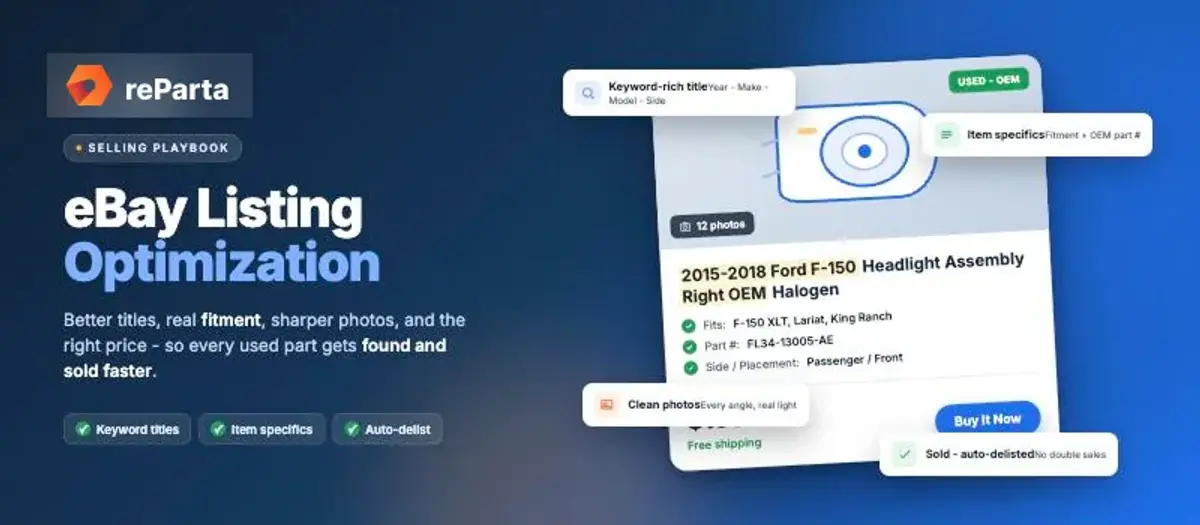
eBay Listing Optimization for Used Auto Parts: Get Found, Get Clicked, Get Sold
You have got a clean part, a fair price, and a few decent photos - and the listing just sits there while similar parts pull in views and sales. The usual reaction is to rewrite the title with more keywords. That almost never works, because eBay listing optimization is not a keyword-stuffing exercise. It is a structured system: you give eBay the data it needs to classify and filter the part, and you give the buyer the evidence they need to trust it.
Two different jobs sit inside that. Completeness makes a listing eligible to appear. Performance - getting clicked and bought - makes it rank. Most sellers skip straight to performance tricks on a listing that is not even eligible for the searches it should be in. On eBay Motors that is usually a fitment and item-specifics problem, not a title problem.
Most optimization advice online is written for a retailer selling new goods out of a clean catalog. This is written for used-parts sellers on eBay Motors and Facebook Marketplace - whether you run a full salvage yard, a growing recycling operation, or part out a few cars on weekends - where the make-or-break data is fitment, condition, and the exact part number, and where a one-of-a-kind used part you optimize today can be gone tomorrow.
Diagnose before you change anything
Good eBay listing optimization starts with a diagnosis, not a rewrite of the title. Do not touch the title until you know what is actually failing. Pull the listing’s numbers in Seller Hub and separate three very different problems - each one has a different fix, and changing the wrong thing wastes the effort.
| Symptom | What it means | Where to fix it |
|---|---|---|
| Low impressions | The listing is barely eligible - weak fitment, thin item specifics, or wrong category | Compatibility table, item specifics, leaf category |
| Impressions, few clicks | It shows but does not win the click | Lead photo, first ~40 characters of the title, price in results |
| Clicks, few sales | Buyers look but do not trust or commit | Condition clarity and grade, photos of flaws, shipping cost, returns terms |
For a used part the pattern is usually obvious once you look: no impressions means eBay does not know which cars your part fits; clicks without sales means the buyer is not sure it is the right part or honestly described. Optimize the stage that is broken, in that order - completeness first, because a listing that is filtered out of search cannot be rescued by a better photo.
How reParta does it - the slow part, done once. reParta catalogs a part in seconds and builds the listing from the catalog - named, fitment-matched, and priced - so the fields that decide eligibility are complete before the listing ever goes live.
- Catalog-driven fitment and item specifics, not hand entry
- The data buyers and search read, filled from the part record
- Fewer dead listings that never enter the right searches
Fitment and item specifics: the biggest lever for parts
On eBay Motors most buyers never type keywords. They pick their vehicle and eBay shows parts that fit. That match comes from your structured compatibility table and item specifics - year, make, model, trim, engine, and the part number in its own field - not from your description. A part with no fitment data is filtered out of those searches before ranking happens, and the free-text description does not save it.
So the single highest-leverage optimization for a parts listing is completing fitment and item specifics accurately. Put the OEM or interchange number in the MPN field, list every fitting vehicle at the trim and engine level in the compatibility table, and complete every item specific that applies - each one is also a left-rail filter a buyer can narrow by. The full mechanics are in our guide to eBay Motors fitment and item specifics.
Two 2026 changes matter here. myFitment shut down on September 30, 2026, so on eBay the fitment automation now is eBay’s own Fitment Plus Auto, which uses your Brand and MPN to add compatible vehicles to eligible listings - US sellers were auto-enrolled starting October 20, 2025. It is useful, but on used parts a wrong Brand or MPN makes it add the wrong vehicles, and every false match becomes a wrong-fit return, so review what it adds. And accurate fitment is what earns the green Guaranteed Fit checkmark: if a buyer returns a fit-confirmed part as not fitting and you accept the return, eBay provides the return label at no charge to you (international, oversized or freight, and multi-package returns are exceptions, and tires and wheels are excluded from the program). Keep your own copy of each listing’s fitment so you can restore or correct it.
One cross-channel note: Facebook Marketplace has no structured compatibility table, so the fitment you build for eBay has to go into the title and description on Facebook instead. That is one more reason to keep a single clean part record and let it fill each channel’s format for you, rather than re-typing fitment per platform - the same record that feeds eBay’s structured fields writes the Facebook title and description too.
How reParta does it - fitment from the catalog. reParta pulls accurate year, make, model, trim and engine fitment straight from the vehicle catalog, so buyers find the part and wrong-fit returns go down - no hand-typing the compatibility table.
- Catalog-driven fitment, not manual entry
- The exact interchange and OEM number in its own field
- Better placement in vehicle-filtered search on eBay and Facebook
The title: 80 characters that match how buyers search
You get 80 characters. Use them all, and front-load the first ones, because that is what shows in results and on a phone. Lead with what a buyer actually types: the brand, the part and the OEM or interchange number. eBay says there is no need to repeat vehicle compatibility in the title when you use the compatibility list, so the year-make-model goes there. Drop the filler - words like “L@@K”, “WOW”, and “NEW” are not how anyone searches, and eBay treats padded adjectives as noise that can push you down, not up.
A title like Ford OEM Headlight Assembly Right Halogen FL34-13005-AE works
because every word is a term a buyer searches or filters by. The full 80-character formula sits
in the fitment and item specifics guide, and the
whole listing skeleton - title through terms - is in how to write an auto part listing.
Photos that prove condition, not just show it
Photos do not carry keywords, but they drive the click and the sale, and clean photos on a white background can also surface your part in Google Shopping. eBay allows up to 24 free photos in most categories and recommends images around 1600 pixels on the longest side (minimum 500), with no added borders, watermarks, or text.
Count matters less than coverage. For a used part, shoot every side, the stamped part number, the mounting points and connectors, and a close-up of every flaw. Those flaw shots do double duty: they lift conversion because the buyer trusts what they see, and they are your evidence if a buyer later claims the part was not as described. Mark the physical part - a grease pen around a crack - but never add digital arrows or text on the image, which eBay’s photo standards prohibit. The full phone photo SOP is in how to photograph used parts for eBay.
Condition and honest grading: the conversion and returns lever
Pick the condition correctly first. On eBay, Used means the part works as intended with normal wear; For parts or not working means it is defective. The wrong choice is itself a misdescription and a guaranteed return. Then over-disclose in the Condition Description field and item specifics: name the broken tab, the scuff, the mileage, whether it was tested. It feels like talking yourself out of the sale, but it filters out the buyers who would have opened a case and it lifts conversion with the ones who buy.
This is also account-health optimization, not just per-listing. A trickle of “Item Not As Described” claims raises your return and defect metrics, which eBay reads as a weak seller and quietly pushes your listings down - and a Very High item-not-as-described rate adds a fee on top (see eBay service metrics for parts sellers). Note too that since July 2025 eBay requires 30-day free returns on new and new-other Parts and Accessories listings over $10; used parts are exempt from the mandate, but a clear return policy still builds the buyer trust that converts. For what an INAD costs and how to cut it, see how to cut eBay Motors return losses and how to reduce wrong-fitment returns.
How reParta does it - honest listings, fewer returns. reParta names the part from the catalog and keeps fitment accurate, so the listing says what the part actually is - the single biggest driver of fewer “not as described” claims.
- Guided part naming and condition from the part record
- Accurate fitment that cuts wrong-fit returns
- Cleaner seller metrics, which Best Match rewards
Category and price: the fields buyers filter and compare on
Two quieter levers decide whether an eligible listing converts. Category: pick the deepest correct leaf (Charging & Starting Systems > Alternators, not a generic “Other Parts” node), or you fall out of the category filter buyers use and no fitment data brings you back. Price: anchor to what the exact part actually sold for, not the asking prices you see, and tier it by demand and shippability - small high-demand parts hold margin, bulky low-demand parts get priced to clear the shelf. Remember the fees come off the top: eBay’s Parts and Accessories final value fee (lower with a Store subscription) applies to the shipping you collect too. The full pricing method is in how to price used auto parts, and the fee math is in how to sell auto parts on eBay profitably.
How reParta does it - price in seconds. reParta suggests a price from live market data and its catalog, so you list at the right number instead of guessing or copying a stale asking price.
- Smart price suggestion from real used-market data
- Priced in seconds, not spreadsheet research
- The right number is the one that actually sells
Shipping and handling are part of the listing
Best Match weighs total cost and delivery, so shipping is an optimization lever, not an afterthought. Set accurate dimensional weight so a light part is not billed like a brick, offer calculated shipping (or freight on anything near 150 pounds) instead of eating a flat fee, and keep handling time tight - same-day or one business day gives the strongest estimated-delivery and Best Match lift, as long as you consistently meet it. The full shipping playbook, including what counts as freight, is in how to ship used auto parts.
Promotion: when Promoted Listings actually helps
Promoted Listings amplifies a strong listing; it does not fix a weak one. If a part has a complete, accurate listing and good photos but still needs a push into a crowded search, a small ad bid can buy visibility that earns clicks and sales, which in turn lift organic rank. But promotion changed on January 13, 2026 - the General attribution window and which ads can win the top slot both shifted - so understand the new mechanics before you spend. How ranking and promotion actually interact for parts is in why your auto parts are not selling on eBay.
AI listing tools and AI search in 2026
eBay’s Magical Listing tool drafts a listing from a photo - title, category, item specifics, price. It is a time-saver for simple goods and a trap for parts: a photo cannot tell it your exact trim, engine, or interchange number, so it leaves the fitment fields thin, blank, or wrong
- the exact data that gets a part found. Treat its output as a first draft, fix every fitment field, or list from the desktop form where compatibility is easier to get right. The full rundown of what AI drafting gets right and wrong on used parts is in eBay AI listing tools for auto parts.
The same principle covers the newer “GEO” advice - optimizing so AI shopping assistants quote your listing. There is no separate trick for it: AI search reads the same structured, complete, honest data that Best Match rewards. Accurate fitment, full item specifics, clear condition, and strong seller metrics are what make a listing quotable by an AI assistant and rankable by Cassini alike. Optimize the fundamentals and you have optimized for both.
Myths that waste your optimization time
The web is full of eBay advice that was true years ago or never was. Skip these:
- “Stuff keywords into the description to rank.” eBay counts the quality of your listing (description, photos, and so on) among its Best Match factors, but that means an accurate, clear description, not keywords crammed in. Vehicle filters run on the title, item specifics, and compatibility table. Write the description short and defects-first for the human.
- “More photos is the whole game - and 12 is the max.” The limit is 24, and coverage of fitment proof and flaws beats raw count. Twelve great shots beat twenty-four repetitive ones.
- “Free shipping automatically boosts ranking.” It is a total-cost signal, not a hard boost. On heavy parts, forced free shipping just raises your price - calculated or freight wins.
- “List in the evening or on weekends to rank higher.” Listing time of day is not a Best Match factor; the clock is folklore.
- “Ending and relisting (or Sell Similar) resets the algorithm for a fresh boost.” eBay’s developer documentation says relisting through its API gives the item a new item ID but usually carries over its performance score and best match score instead of resetting them (API relists only). Do not assume a relist resets anything; the lever you control is the listing itself - title, item specifics, price, photos.
- “The lowest price wins Best Match.” It does not. Conversion, complete data, and seller performance outweigh being cheapest - a well-built listing beats a rock-bottom bad one.
- “Set universal fitment so it shows for everything.” That drops you out of the year-make- model filters most buyers use and drives wrong-fit returns. Name only the vehicles the part truly fits.
The catch: optimization is wasted if the part double-sells
Here is the trap that is unique to used parts and that no generic optimization guide addresses. You can perfectly optimize a listing - but your inventory is mostly one-of-a-kind parts. If you list the same alternator on eBay and Facebook by hand and it sells on one, the other listing sits live until you remember to pull it, and eventually you sell it twice. A canceled order dents the exact seller metrics you just worked to protect, and the optimization effort on that listing is gone.
The fix is to list from one inventory that auto-delists the moment a part sells, so a sold part cannot stay live anywhere. That is also what makes the optimization worth doing at volume: catalog the part once, and the fitment, title, and price you got right are pushed to every channel and pulled back automatically on sale - you are not re-optimizing the same part in two places.
How reParta does it - catalog once, publish, auto-delist. Catalog a part in seconds, review the title and price, publish to your own eBay account and assist Facebook Marketplace, and it auto-delists everywhere the moment it sells. It all lives in reParta’s auto parts inventory software.
- eBay publishing plus a Facebook Marketplace extension
- Auto-delist on sale - no double-selling, no dented metrics
- One inventory whether you part out whole donors or buy by the lot
Your eBay listing optimization checklist
Run every underperforming listing against this, in order - completeness first, then the click-and-convert elements:
- Diagnosed the real failure: impressions, clicks, or conversion
- Deepest correct leaf category chosen
- OEM or interchange number in its own field
- Compatibility table complete - year, make, model, trim, engine
- Every applicable item specific filled
- Title uses all 80 characters, buyer terms front-loaded, no filler adjectives
- Photos: every side, the part number, connectors, and each flaw (up to 24, ~1600px, no added text)
- Correct condition grade and every flaw named in the Condition Description
- Price set to recent sold comps, tiered by demand, fees accounted for
- Accurate shipping (calculated or freight) and tight handling time
- Promotion only on listings that are already complete and converting
- One inventory, so the part delists everywhere the second it sells
Keep optimizing your eBay listings in that order - the data eBay needs to classify the part, then the evidence buyers need to trust it - and make sure the part you just optimized can only be sold once.
If the slowdown is store-wide rather than one listing, start with the slow auto parts sales playbook to tell a visibility problem from a conversion or demand problem.
reParta is an independent product and is not affiliated with, endorsed by, or sponsored by eBay or Meta. eBay, eBay Motors and Facebook Marketplace are trademarks of their respective owners.
Frequently asked questions
What is eBay listing optimization?
eBay listing optimization is improving an existing listing so it ranks in Best Match and converts browsers into buyers. It is not keyword stuffing. It is a structured system: complete the fields eBay needs to classify and filter the item (fitment, item specifics, category), then supply the evidence a buyer needs to trust it (photos, honest condition, clear price and shipping). Completeness makes a listing eligible to appear; performance - clicks and sales - is what makes it rank.
Why is my eBay listing getting no views?
No views is an eligibility problem, not a ranking one. For auto parts it is almost always missing or thin fitment and incomplete item specifics - a part with no compatibility data is filtered out of vehicle-filtered search before ranking even happens - or the wrong category. Fix the structured fields first: the OEM or interchange number in its own field, a full year/make/model/trim/engine compatibility table, and the deepest correct leaf category. A description full of keywords does not fix this: vehicle filters run on the structured fields, not on the description.
How do I get my eBay listings to the top of search?
There is no single switch. eBay's Best Match rewards listings that match the buyer's search closely (complete title and item specifics), then perform - get clicked and bought - from a seller with good account health. So optimize in that order: completeness to become eligible, then the click-and-convert elements (lead photo, title, price, condition clarity, shipping) to earn the performance signals that lift you. For parts specifically, accurate fitment is the single biggest lever.
Does the item description affect eBay search ranking?
Yes, as part of listing quality, but it does not replace the structured fields. eBay's Best Match help lists the quality of your listing (description, photos, and so on) among its factors, while vehicle filters use the title, item specifics, and the compatibility table. So write the description short, plain, and defects-first: it builds trust and lifts conversion. Put the words buyers filter on in the title and item specifics, because keyword stuffing is no substitute for accurate structured fields.
Does free shipping boost eBay ranking?
Free shipping is a competitiveness signal, not an automatic ranking boost. Best Match weighs total cost to the buyer - item plus shipping - so building shipping into the price can help a small, light part look cheaper in results. But on a heavy or oversized part, forcing free shipping just raises your price and can cost you the sale; accurate calculated or freight shipping is the better call. Optimize for the lowest honest total cost, not for the words free shipping.
How many photos should an eBay auto part listing have?
Use as many as it takes to prove condition, up to eBay's limit of 24 free photos in most categories. For a used part that means every side, the stamped part number, the mounting points and connectors, and a close-up of each flaw. eBay recommends images around 1600 pixels on the longest side (minimum 500) with no added borders, watermarks, or text. Count matters less than coverage: the shots that prove the part is the right one and honestly described are what lift clicks and cut returns.
What is the eBay Magical listing tool and should I use it for parts?
Magical Listing is eBay's AI tool that drafts a listing - title, category, item specifics, price - from a photo of the item. Use it as a first draft, not the final listing. A photo cannot tell it your part's exact year, make, model, trim, engine, or interchange number, so it nails the easy fields and leaves fitment thin, blank, or wrong - which is the exact data that gets a part found and cuts wrong-fit returns. If you use it, fix every fitment field before publishing, or list from the desktop form where those compatibility fields are easier to get right.
How often should I re-optimize or refresh eBay listings?
On a schedule, not in a panic. Review slow movers on a regular cadence: check the listing's impressions, clicks, and sales to see which stage is failing, then fix that one lever in place - the title, item specifics, price, or photos. Do not just end and relist (or Sell Similar) to 'refresh' it. eBay's developer documentation says that relisting through its API gives the item a new item ID but usually carries over its performance score and best match score, and that a watched auction-style item stays watched. That covers API relists only and says nothing about Sell Similar. Rather than relying on a relist, fix the title, item specifics, price, or photos in place.
Did myFitment shut down, and what do auto parts sellers use now?
Yes. myFitment closed as a standalone service on September 30, 2026, and support for Amazon and other outside platforms ended with it. On eBay, fitment automation is now eBay's own Fitment Plus Auto, which uses your Brand and Manufacturer Part Number to add compatible vehicles to eligible listings; US sellers were auto-enrolled starting October 20, 2025, and you can opt out in Motors Selling Preferences. Keep your own copy of each listing's fitment off eBay so you can restore or correct it, because eBay's catalog can still add wrong vehicles from a bad Brand or MPN.