eBay AI Listing Tools for Used Auto Parts: What They Get Right, What They Get Wrong
An eBay AI listing tool can turn a photo of a part into a finished-looking listing in seconds - title, category, item specifics, a price, even a cleaned-up image. For a lot of sellers that feels like the end of the worst chore in the business. The question for a used-parts seller is narrower and more important: can you trust it to list a used part, where the whole sale rides on fitment and condition the camera cannot see?
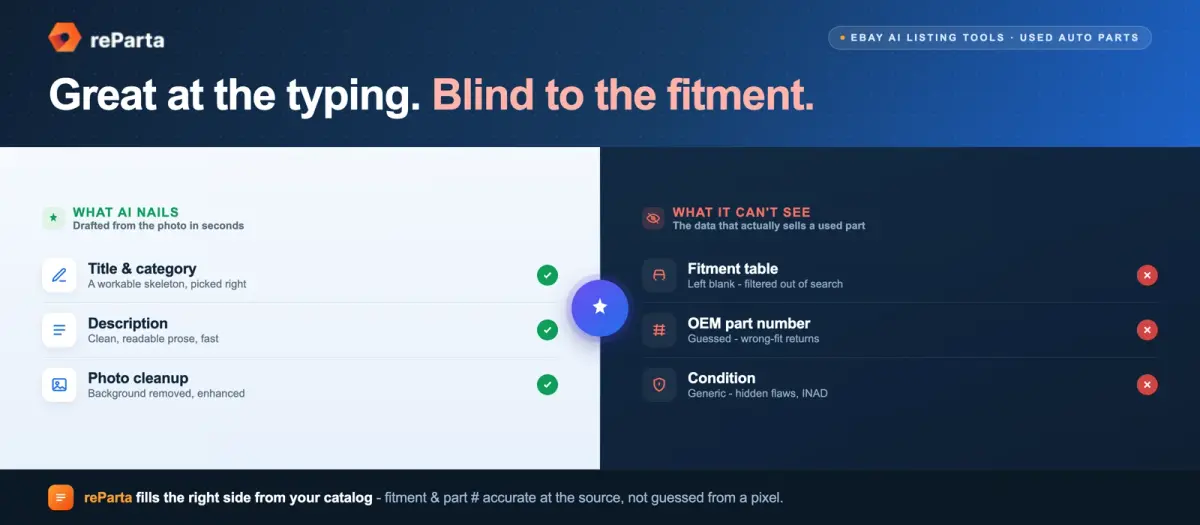
The honest answer is “for the easy half, yes - for the half that matters, no.” AI is genuinely good at the typing. It is bad at the judgment a used part needs, because the data that gets a part found and keeps it from coming back is not in the photo. This guide covers what eBay AI listing tools actually do in 2026, where they help, where they quietly cost you sales and returns on parts, and how to use them without getting burned.
What eBay AI listing tools actually do in 2026
There are two kinds of AI listing tool a parts seller runs into.
- eBay’s own tool, Magical Listing. This is eBay’s artificial intelligence listing tool, free in the eBay app and Seller Hub. You point your phone at the item and eBay drafts the listing - title, category, item specifics, price, and shipping - from the photo. It runs as a single-listing flow in the eBay app and a bulk flow in Seller Hub (point it at a batch of photos and it drafts multiple listings), and eBay pairs it with AI photo cleanup. Everything it produces is an editable draft; nothing publishes until you approve it.
- Third-party AI listers and AI description generators. A crop of outside tools do similar drafting - an eBay AI description generator writes the body, an AI lister fills fields. They vary in quality and most are built for general resale, not vehicle parts.
The thing to hold onto: every one of these is a drafting aid. It speeds up the typing. It does not know your part.
Where eBay AI listing tools genuinely help
Give AI the work it is good at:
- Speed and a first draft. Turning a blank form into 80% of a listing in seconds is real, especially when you are listing at volume.
- Category and a basic title. For a recognizable part it usually picks a sane category and a workable title skeleton you can sharpen.
- Description prose. It writes clean, readable sentences faster than you will - useful as a starting point, with the caveat below.
- Photo cleanup. Background removal and basic enhancement make a phone photo look consistent.
On simple, identical, new-in-box goods, that can be most of the job. On a used part off a specific donor, it is the beginning of the job, not the end.
Where eBay AI breaks on used auto parts
Here is the part no general “AI for eBay” guide tells you, because they are not thinking about vehicle parts. An AI listing tool drafts from what it can see. The three things that decide whether a used part sells are things it cannot see:
- Fitment. An alternator off a 2014 Chevrolet Cruze 1.4L looks almost identical to several other years and engines. The AI cannot tell the donor’s exact year, make, model, trim, and engine from a photo, so it leaves the compatibility table blank or guesses it. On eBay Motors, a part with no fitment data is filtered out of vehicle-filtered search before ranking even happens - so a blank the AI left is a part no buyer sees. The mechanics are in our guide to eBay Motors fitment and item specifics.
- The exact part number. A stamped OEM or interchange number can be read by OCR from a clean, well-lit shot - but most part photos are not that shot (the number is out of frame, or the part is dirty and shot in a dim garage), so the AI usually leaves it blank or guesses. And without that number the AI is identifying the part from its shape alone, where many parts look alike across years and engines. Leave the number blank or wrong and you lose the buyers who search by it - and a wrong Manufacturer Part Number makes eBay’s own Fitment Plus Auto confidently add the wrong compatible vehicles, turning every false match into a wrong-fit return.
- Condition. The camera sees a part; it does not know it was tested, what the mileage was, or that one mounting tab is cracked on the side not facing the lens. AI tends to pick a generic condition and skip the flaws - and an undisclosed flaw is an “Item Not As Described” return waiting to happen. See how to cut wrong-fitment returns.
So the failure mode is not an obviously broken listing. It is a plausible-looking listing with thin, blank, or wrong fitment - which is the most expensive kind, because it looks done and quietly does not sell, or sells to the wrong car and comes back.
How reParta does it - accurate at the source, not guessed from a pixel. reParta builds the listing from structured part data, so fitment and the part number are right at creation instead of corrected after an AI guess.
- Fitment pulled from the vehicle catalog, not inferred from a photo
- The OEM or interchange number in its own field, where buyers and search read it
- Fewer wrong-fit returns because the compatibility table is accurate, not approximate
The right way to use an eBay AI listing tool on parts
AI is a fine first draft if you treat it like one. The rule: let it remove the typing, never the thinking.
- Let it draft the category, a title skeleton, and the description.
- Then manually verify and complete the fields that decide the sale: the exact OEM or interchange number, the full year/make/model/trim/engine compatibility table, the correct condition grade, and photos of every flaw.
- For anything with real compatibility data, listing from the desktop form is often faster than fixing what the AI guessed - the fitment fields are easier to control there.
The full field-by-field listing skeleton is in how to write an auto part listing, and the broader optimization system is in eBay listing optimization.
AI descriptions: useful, but not a shortcut for eBay Best Match
An eBay AI description generator is the most oversold piece of this - for eBay ranking. eBay’s own Best Match lists the quality of your listing (description, photos, and so on) among its factors, but vehicle filters run on the structured fields - title, item specifics, the compatibility table - so a polished AI description does not replace them or guarantee a better rank. It still earns its keep in two other places: Google indexes the description text and sends external traffic to the listing, and AI shopping assistants read natural-language text, so a plain line like “fixes a cold-start bearing whine” can surface you for a conversational query that your item specifics do not phrase. So write a description - just write it for humans, Google, and AI, not as a Best Match shortcut. And keep it honest: buyers skim it on a phone, where the body is collapsed behind a “See more” tap, and many skip a listing the moment it reads like generated filler. Keep it short, plain, and defects-first in your own words, and still put the heavy effort into the fitment and item-specific fields the AI left thin.
AI search is coming too, and it rewards the same work
There is a lot of 2026 noise about optimizing for AI shopping assistants. Treat it calmly: AI search reads the same structured, accurate data eBay’s own ranking does. Complete item specifics, accurate fitment, clear condition, and strong seller metrics are what make a listing quotable by an AI assistant and rankable in Best Match alike. There is no separate AI-search trick to buy - the fundamentals do double duty. How ranking works underneath is in why your auto parts are not selling on eBay.
Myths about AI listing, parts edition
- “AI writes the whole listing now.” It writes the easy fields. On a used part the fitment, part number, and condition still need a human, because they are not in the photo.
- “More AI means less work.” It moves the work, it does not remove it. The typing shrinks; the verifying of fitment stays - and if you skip it, the returns do the work instead.
- “The AI knows what the part fits.” It infers what it can see and guesses the rest. A confident, wrong compatibility table is worse than a blank one, because it generates returns.
- “An AI description will rank me on eBay.” eBay counts description quality among its Best Match factors, but the specifics and the compatibility table decide the vehicle filters, so a polished description is no shortcut. It also helps with Google and AI assistants, so write it well.
The accurate-at-the-source alternative
The reason eBay AI listing tools struggle with parts is that they start from a photo and work backward to the data. The fix is to start from the data. If the part’s fitment, number, and condition already live in a catalog or donor record, the listing is right the moment it is created - no guessing, no after-the-fact correction.
How reParta does it - catalog once, list everywhere, delist on sale. Catalog a part in seconds and reParta fills fitment, title, and a suggested price from the catalog record, then publishes to your eBay account and assists Facebook Marketplace - and auto-delists everywhere the moment it sells. It all lives in reParta’s auto parts inventory software.
- Catalog-driven fitment, title, and price suggestion - accurate, not inferred from a pixel
- One inventory for eBay and Facebook, with auto-delist so you never double-sell
- Photo-based part identification is on the roadmap and coming soon; today the accuracy comes from the catalog and the part number
That is the real choice for a used-parts seller: use an eBay AI listing tool as a fast first draft and do the fitment work yourself, or start from accurate part data so the work is done once and done right. AI is a shortcut through the typing. It is not a shortcut through knowing your part.
Checklist: using AI on a used-parts listing without getting burned
- Treat the AI output as a draft, never a finished listing
- Verify and fix the category and the title skeleton
- Add the exact OEM or interchange number in its own field
- Complete the full compatibility table - year, make, model, trim, engine
- Set the correct condition grade and name every flaw
- Add your own flaw photos (AI cleanup is fine; AI cannot invent the shot of the crack)
- Rewrite any AI description short, plain, and defects-first in your own voice
- Never publish a bulk AI batch of parts without checking fitment on each one
reParta is an independent product and is not affiliated with, endorsed by, or sponsored by eBay or Meta. eBay, eBay Motors and Facebook Marketplace are trademarks of their respective owners.
Frequently asked questions
What is the eBay AI listing tool?
eBay's built-in AI listing tool is called Magical Listing. You point your phone at an item and it drafts the listing for you - title, category, item specifics, price, and shipping - which you can edit before publishing. It runs as a single-listing flow in the eBay app and a bulk flow in Seller Hub, and eBay also offers AI photo cleanup. Separately, third-party AI listers and AI description generators do similar drafting. All of them are drafting aids: they speed up typing, they do not replace the judgment a used part needs.
Can eBay AI write my whole auto part listing?
It can draft most of it, but not the parts that decide whether a used part sells. A photo usually cannot give the AI the donor vehicle's exact year, make, model, trim, and engine, a reliable read of the OEM or interchange part number, or the true condition and any flaws - so it fills those fitment and condition fields thin, blank, or wrong. Those are the exact fields eBay uses to show your part in vehicle-filtered search and to prevent wrong-fit returns, so you still have to complete them yourself. Treat the AI output as a first draft, not a finished listing.
Is eBay's Magical Listing good for used car parts?
It is good for the easy half and risky for the half that matters. It will usually get the category, a basic title, and a clean photo right, which saves typing. But for a used part it tends to leave fitment (year/make/model/trim/engine), the interchange or OEM number, and the real condition blank or guessed, because a photo cannot know the donor. Since that is the data that gets a part found and keeps returns down, go through every fitment and condition field and fix it before you publish, or list from the desktop form where those fields are easier to control.
Should I use an AI description generator for eBay auto parts?
Use it, but know what it does and does not do. eBay's Best Match lists the quality of your listing (description, photos, and so on) among its factors, while vehicle filters run on the structured fields (title, item specifics, compatibility table). So an AI-written description helps when it is accurate and specific, and it is no substitute for those fields. It also helps in two other channels: Google indexes the description and can send external traffic, and AI shopping assistants read natural language, so a plain line about the symptom a part fixes can surface you for a conversational query. Just keep it short, honest, and defects-first in your own words (buyers skim it and skip generated filler), and still spend the heavy effort on the fitment and item-specific fields, which are what eBay's vehicle filters read.
Why does AI get auto parts fitment wrong?
Because the part's identity is not reliably visible in a photo. An alternator off a 2014 Chevrolet Cruze 1.4L looks almost identical to several other years and engines, so AI cannot pin the exact fitment from appearance alone. The stamped OEM or interchange number would settle it, and OCR can read it from a clean, well-lit shot - but most part photos are too dirty, dim, or badly framed for a reliable read, so the AI leaves it blank or guesses. Either way you get a plausible-looking listing with blank or wrong year/make/model/trim/engine - and a wrong Manufacturer Part Number also makes eBay's own Fitment Plus Auto add the wrong compatible vehicles, garbage in, garbage out.
What is the safest way to use AI for eBay parts listings?
Use AI to remove typing, not thinking. Let it draft the title, category, and description, then manually verify and complete the fields that decide the sale: the exact OEM or interchange number, the full year/make/model/trim/engine compatibility table, the correct condition grade, and photos of every flaw. Better still, start from accurate part data - a catalog or donor record that already knows the fitment - so the listing is right at creation instead of corrected after the AI guesses.
Does reParta use AI to list auto parts?
reParta builds accurate listings from structured part data rather than guessing from a photo: catalog a part once and it fills fitment, title, and a suggested price from the catalog record, then publishes to your eBay account and assists Facebook Marketplace from one inventory that auto-delists the moment the part sells. Photo-based part identification (reading a part from an image) is on reParta's roadmap and not live yet; today the accuracy comes from the catalog and the OEM or interchange number, which is exactly the data a photo-only AI tool cannot supply.
Will AI shopping assistants find my eBay listings?
Increasingly, yes - and they read the same structured data eBay's own search does. AI shopping assistants and AI search pull from complete, accurate item specifics, clear condition, and strong seller signals, not from keyword-stuffed descriptions. So the work that makes a listing rank in eBay Best Match - full fitment, complete specifics, honest condition - is the same work that makes it quotable by an AI assistant. There is no separate AI-search trick; get the fundamentals right once.