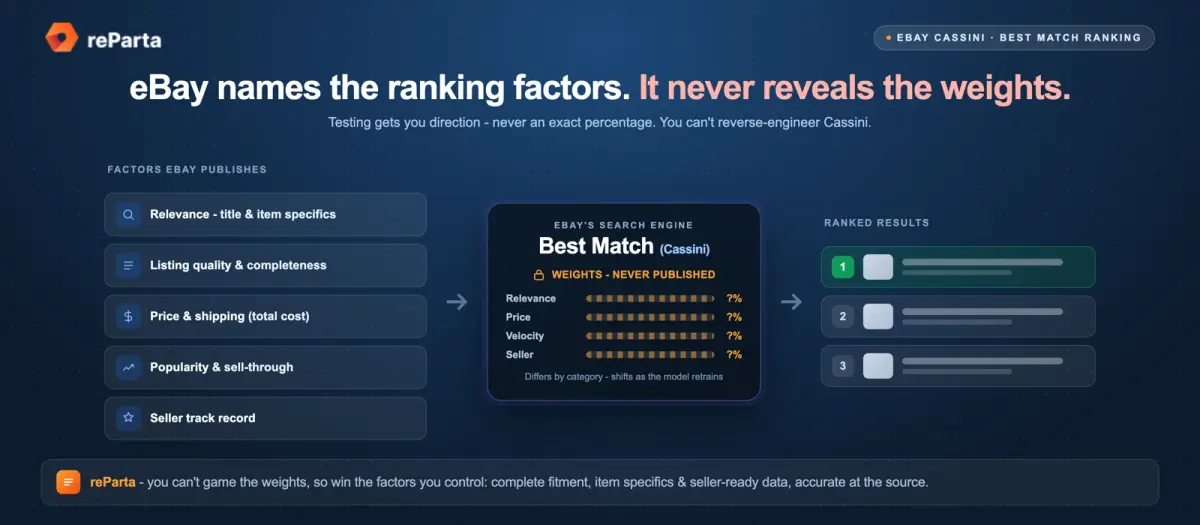
The eBay Cassini Algorithm: Can You Reverse-Engineer the Weights by Testing?
Every used-parts seller eventually asks the same question about the eBay Cassini algorithm: if I knew exactly how much each factor is worth, I could game my way to the top of Best Match. So people go searching “cassini ebay”, “ebay cassini seo”, and “ebay cassini secrets” for the weights - and the internet is happy to sell them a reverse-engineering plan, complete with formulas and clever experiments.
Here is the honest version, before you spend a weekend on it. You can learn a lot by testing, but you cannot extract eBay’s exact weighting - and a good chunk of the “Cassini secrets” floating around are not tests at all, they are search manipulation that can get your listings suppressed or your account dinged. This guide separates what you can actually measure from what will quietly cost you, and why the whole exercise is especially hard on one-of-a-kind used parts.
What the eBay Cassini algorithm actually is
Cassini is the community nickname for eBay’s search engine; eBay’s own term for the buyer-facing ranking is Best Match. It decides which listings to show, and in what order, by predicting what is most likely to sell from a reliable seller. eBay publishes the categories of factors it weighs - relevance from your title and item specifics, listing quality and completeness, price and shipping competitiveness, popularity and engagement, and your seller track record - but it has never published the weights. How those factors actually rank your parts is covered in why your auto parts are not selling on eBay; this article is about the next question: can you figure out the weights yourself?
Can you reverse-engineer Cassini’s weights by testing?
Partly, and it is worth being precise about what “partly” means.
What you can get: directional signals. Run a disciplined test - change one variable, hold the rest constant, watch what happens - and you can learn that, say, completing every item specific clearly lifts your impressions in your category. That is real, useful knowledge.
What you cannot get: eBay’s exact internal weighting. eBay never publishes it, it differs by category, and it shifts over time as the model is retrained. So the honest output of all your testing is “complete item specifics clearly help my impressions,” never “item specifics are 17.3% of the score.” Anyone quoting a precise percentage is guessing. Keep that expectation and testing is useful; lose it and you are chasing a number that does not exist.
The legitimate way to test
The method is simple and it is the same one real analysts use: isolate one variable.
- Change one thing at a time. If you edit the title, the price, and the photos at once, you cannot know which one moved the needle. One variable per test.
- Measure in Seller Hub. Watch the listing’s impressions, clicks, and sales before and after, over a week or two, not a day.
- Check rank in incognito, but trust it loosely. Private browsing drops your own account history, but it does not remove eBay’s geo and personalization (buyer location, the car in “My Garage,” device fingerprint), and eBay runs bucket tests that show different buyers different results. So incognito is a rough read, not the exact position a buyer two states away sees - treat it as directional.
Three safe experiments worth running:
- Item-specifics completeness. Two comparable parts: one with a great title but thin specifics, one with a simpler title but every specific filled. Watch impressions. This usually shows how much Cassini leans on the structured fields - the lever we cover in fitment and item specifics.
- Total cost, not “free shipping” magic. Test item price plus shipping against the same total structured differently. Free shipping is a total-cost signal, not an automatic boost, so you are really testing which total cost wins - see eBay listing optimization.
- Handling-time consistency. Tighten handling on a stable listing and watch reach, but only a speed you can actually sustain - the signal rewards consistently met handling, not a promise you break.
One lever worth naming because it genuinely interacts with ranking: Promoted Listings. Paid promotion is not a test, but it is a legitimate way to influence Cassini - a paid push drives early clicks and sales, and that sales velocity is itself one of the strongest organic Best Match signals, so it can lift a listing’s organic position too. If you test or scale, factor it in rather than pretending organic and paid are separate worlds; how it works for parts is in why your auto parts are not selling on eBay.
Why single-part tests fail, and how to test in cohorts instead
This is the catch no generic “test Cassini” guide mentions. A clean A/B test needs two identical items, so the only difference is the variable you are testing. Used auto parts are one-of-a-kind - each comes off a specific donor with its own mileage, condition, and fitment - so you cannot run a clean split test on a single part, and testing one part sequentially breaks the moment it sells and is gone.
The fix the bigger sellers use is to test cohorts, not single parts. Take a group of 50 similar parts (say, alternators across a few models), fill every item specific on all of them, and leave a comparable group of 50 with thin specifics. Then compare the aggregate impressions, clicks, and sell-through of the two groups over a few weeks. No single pair is identical, but across 50 and 50 the differences average out and you get a real, directional read on how much that one variable moves the needle - the same logic analysts call a cohort or interrupted-time-series test. It is more work than a two-listing A/B, and it is the honest way a used-parts seller actually learns what Cassini rewards. If you do not have dozens of comparable parts, you are left with loose observation over time, so weight those conclusions accordingly.
The “Cassini secrets” that will get you penalized
Most of the aggressive reverse-engineering advice online is not testing. It is manipulation, and eBay is built to catch it. Do not do these, no matter who calls them a hack:
- Fake CTR warming - asking friends, or using multiple devices and IPs, to search and click your listing. This is artificial engagement. It does not convert to real sales (which is what actually feeds ranking), eBay’s systems detect it, and manipulating search puts your account at risk.
- Buying junk traffic. Pouring bought, untargeted clicks onto a listing inflates views and lowers your conversion rate, which is the opposite of what you want - “empty traffic” is a signal, not a boost. (This is different from genuine targeted referrals: a link to a rare motor from a model-specific forum or Google Shopping sends real buyers who convert, and that is fine - it is the paid or fake junk click that hurts.)
- Duplicate listings to probe the algorithm. eBay’s Duplicate Listings Policy restricts listing the same item repeatedly; duplicates get suppressed or removed and can hurt your standing. Clones are a violation, not an experiment.
- Deliberately tanking your own metrics. Intentionally missing a tracking upload or shipping deadline to “measure the penalty” sabotages real buyers and damages metrics that are slow to rebuild.
- Intentional out-of-stock. Zeroing stock on a listing that is actually selling to watch the velocity drop means throwing away live sales to chase a number.
A trickle of policy trouble also shows up as the 5% service-metrics fee and ranking drag and as more wrong-fit returns - the exact things that pull you down. Gaming the algorithm and protecting your account pull in opposite directions.
The formulas: real shape, invented weights
You will see confident math - “EPV = CTR x Conversion x Price,” references to “Gini impurity,” a precise weighting table. Be precise about what is real here and what is not. The shape is real: modern ranking systems, Cassini included, predict a probability of purchase (roughly click-through times conversion) to maximize the marketplace’s gross sales, and the gradient-boosted tree models behind that kind of system genuinely use measures like Gini impurity. What is not real is any exact, published weight or formula for eBay - eBay publishes none, and the model is dynamic, so it shifts. Use the general logic as intuition (Best Match ranks by predicted sale value from a reliable seller); treat any precise equation or percentage someone hands you as guesswork, not a number to optimize against.
So: test it yourself, or stop chasing it
There are really three honest paths, not two, and most used-parts sellers should lean to the last.
Play with it yourself. Run the safe single-variable tests above, test in cohorts where you have the volume, read the results as directional, and accept that one-of-a-kind inventory makes them loose. A fine way to build intuition; a poor way to spend hours you could be dismantling.
Understand it and use that understanding. Know the real levers - structured data, sales velocity, Promoted Listings, seller metrics - and apply them deliberately, by hand or with whatever tools you already run. You do not need our software to do this; you need to stop chasing hidden weights and work the factors that actually move.
Or let the fundamentals run themselves. The factors that reliably move Best Match are not secret, even though the weights are: complete, accurate fitment and item specifics, a clear lead photo and keyword-first title, honest condition, a fair total cost, fast consistent handling, and good seller metrics. Doing those on every listing is the thing that ranks - the problem is doing it right, every time, at volume. That is the slow, repeatable work, and it is exactly what reParta takes off your plate (one of several ways to get there, and the fastest if you are listing at volume).
How reParta does it - the fundamentals, automatically. Instead of running experiments on parts that sell and vanish, reParta gets every listing right at the source: catalog a part once and it fills accurate fitment, the title, and a suggested price from the catalog record, then publishes to your eBay account and assists Facebook Marketplace from one inventory that auto-delists on sale. It all lives in reParta’s auto parts inventory software.
- Complete, accurate fitment and item specifics on every listing - the factor Best Match rewards most
- One inventory for eBay and Facebook, with auto-delist so you never double-sell
- The slow, repeatable work done for you, so you are not gaming an algorithm by hand
If you would rather use AI to speed up the drafting while you keep the fitment accurate, see eBay AI listing tools for auto parts - same principle: the tool helps, the accurate part data is what actually ranks.
Checklist: a safe Cassini test (if you insist)
- Test one variable at a time; hold everything else constant
- Use two parts as comparable as you can get (accept they are not identical)
- Measure impressions, clicks, and sales in Seller Hub over 1-2 weeks, not a day
- Check rank in incognito for a rough read (it drops your history, not eBay’s geo-personalization)
- Where you have the volume, test in cohorts (groups of similar parts), not single one-of-a-kind parts
- Read results as directional signals, never exact weights
- Never use fake clicks, bought traffic, duplicate listings, or deliberate metric damage
- When in doubt, optimize the fundamentals instead of hunting hidden weights
reParta is an independent product and is not affiliated with, endorsed by, or sponsored by eBay or Meta. eBay, eBay Motors and Facebook Marketplace are trademarks of their respective owners.
Frequently asked questions
What is the eBay Cassini algorithm?
Cassini is the community name for eBay's search engine; eBay itself calls the buyer-facing ranking Best Match. It decides which listings to show and in what order, based on what it predicts is most likely to sell from a reliable seller. eBay publishes the categories of factors it weighs - relevance (title and item specifics), listing quality and completeness, price and shipping competitiveness, popularity and engagement, and your seller track record - but it does not publish the weights. So treat any exact Cassini formula you read as guesswork.
Can you reverse-engineer the eBay Cassini algorithm?
Partly. You can run disciplined split tests to get directional signals - change one variable on a listing, hold everything else constant, and watch how impressions, clicks, and sales move in Seller Hub. That tells you which levers matter more for your category. What you cannot get is eBay's exact internal weighting, because eBay never publishes it and the algorithm adjusts over time. So you learn 'complete item specifics clearly help my impressions,' not 'item specifics are 17.3% of the score.'
What is the safe way to test eBay Cassini ranking factors?
Isolate one variable at a time. Change a single element (item specifics, price, handling time), leave the rest alone, and compare the listing's impressions, clicks, and sales before and after in Seller Hub over a week or two. Check your ranking in incognito/private browsing to drop your own account history, but read it as a rough signal - it does not remove eBay's geo and personalization, so it is not the exact result a buyer elsewhere sees. If you change the title, price, and photos all at once, you learn nothing about which one worked. Where you have the volume, test cohorts (groups of similar parts) rather than single one-of-a-kind parts.
Do fake clicks or asking friends to click improve eBay ranking?
No - and it is a bad idea. Coordinated clicks from friends, multiple devices, or different IPs to inflate click-through rate is search manipulation. eBay's systems are built to detect artificial engagement, the signal does not convert to real sales (which is what actually feeds ranking), and manipulating search can put your account at risk. It is not a Cassini hack, it is a liability. Earn clicks with a strong lead photo, title, and price instead.
Will creating duplicate listings help me test or rank on eBay?
No. eBay's Duplicate Listings Policy restricts listing the same item multiple times, and duplicates can be suppressed or removed and can hurt your account standing. Spinning up duplicate or near-duplicate listings to probe the algorithm is a policy violation, not an experiment. If you want more visibility for a part, optimize the one listing and consider Promoted Listings, not clones.
Should I let a listing go out of stock to test Cassini?
No. Deliberately zeroing stock on a listing that is actually selling, or intentionally missing a shipping deadline to 'measure the penalty,' means sabotaging your own sales and your real buyers to chase a number. Sales history and seller metrics are hard to rebuild and easy to damage. Never run a test that knowingly harms your metrics or a customer's order.
Why is testing eBay Cassini so hard for used auto parts?
A clean A/B test needs two identical items so the only difference is the variable you are testing. Used auto parts are one-of-a-kind - each comes off a specific donor with its own mileage, condition, and fitment - so you rarely have two identical parts to compare. Testing sequentially on a single part breaks the moment it sells and is gone. The workaround bigger sellers use is cohort testing - compare a group of ~50 similar parts with full item specifics against a comparable group without, and read the aggregate metrics - but that needs volume, so for most used-parts sellers rigorous DIY reverse-engineering stays far less practical than it is for someone selling a hundred identical new units.
What actually moves eBay Best Match for auto parts?
The factors are not secret, even if the weights are. Complete, accurate fitment and item specifics (so you are eligible for vehicle-filtered search at all), a clear lead photo and keyword-first title (so you earn the click), honest condition and a fair total cost (so you convert), fast consistent handling, and good seller metrics. Get those right on every listing and you have done the thing that reliably ranks - no hidden-weight hunting required.