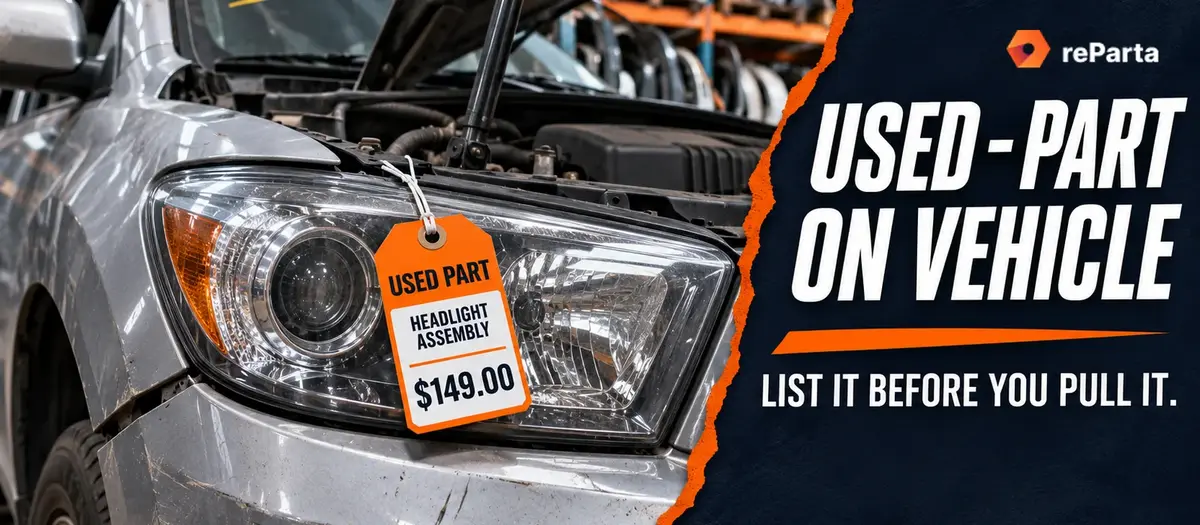
eBay Used - Part on Vehicle: List Parts Before You Pull Them Without Wrecking Your Seller Level
At a glance - eBay Used - Part on Vehicle (checked November 16, 2026)
- What it is: a Certified Recycled condition for a part still installed on a donor vehicle when you list it
- The flow: list it, and after an order remove it, inspect it, then ship if it passes or cancel if it fails (eBay’s own instruction)
- The catch: eBay publishes no exception that keeps a failed-inspection cancellation from counting as a transaction defect
- Not in the public conditions list: it appears only inside the Certified Recycled program, not on eBay’s general item-conditions help or its developer condition list
- Buyer note is required: the listing must explain that removal happens only after the sale, and how removal and shipping will work
- Not published: which part types are eligible, any special shipping window, and whether the condition exists outside the US
eBay’s “Used - Part on Vehicle” item condition lets an auto recycler list a part while it is still bolted to the donor car, then pull and inspect it only after someone buys it. It is part of eBay’s Certified Recycled program, and it is genuinely useful: you can advertise inventory you have not torn down yet. It also carries a risk eBay has not fully spelled out, because the same program that tells you to cancel a part that fails inspection has a cancellation policy that treats a seller cancellation as a defect. This guide covers what the condition is, what a listing has to show, the cancellation rule in plain terms, a routine that keeps your seller level safe, and the questions still worth putting to eBay in writing. If you are new to the wider program, start with our eBay Certified Recycled guide.
Decide before you list - our view, not eBay’s. Use Part on Vehicle for parts you can grade reliably while they are still on the car, and keep anything whose real condition you cannot confirm until it is out as a normal Used listing you pull first. Every Part-on-Vehicle order you cannot fulfill is a cancellation, and until eBay says otherwise, treat each cancellation as a possible transaction defect.
What “Used - Part on Vehicle” is (and is not)
Per eBay’s Seller Center, you “use the ‘Used - Part on Vehicle’ item condition for eligible parts that are still installed on a donor vehicle when listed.” The point, in eBay’s words, is that the condition “helps buyers understand that the part will be removed and inspected after purchase” and “gives you a more accurate way to describe eligible inventory that hasn’t yet been removed from the vehicle.” The post-order flow is stated directly: “After a buyer places an order, remove the part and inspect it carefully. If it meets your quality standards, ship it to the buyer. If it doesn’t, cancel the order.”
Three things it is not:
- It is not in eBay’s general conditions. eBay’s public item-conditions help page for Motors Parts and Accessories lists only New, New other, Remanufactured, Used, and For parts or not working, and “Used - Part on Vehicle” is not among them. eBay’s developer condition-ID master list has no Part-on-Vehicle value either, though eBay notes condition values vary by category and are set through its Metadata API. So eBay does call this an item condition, but it surfaces through the Certified Recycled program rather than the general conditions, which is why you need the program to use it; its exact condition ID and whether it is exposed through the API are not established on the public pages we read. For what the program involves, see our Certified Recycled guide.
- It is not a license to list anything. eBay does not publish which part types are eligible. It only refers to “eligible parts,” so the judgment of what is safe to list this way is yours.
- It is not a looser return or warranty. The buyer page treats returns the normal way: “Returns follow the seller’s return policy and eBay’s Money Back Guarantee, where applicable.” Listing a part before it is pulled does not change what you owe after it sells.
What an eBay Part-on-Vehicle listing shows
The buyer page is specific about the buyer-facing promise. “‘Item Condition: Used - Part on Vehicle’ means the part is shown attached to the donor vehicle,” and “the listing would include a short note explaining the part would be dismantled or removed only after the transaction.” It adds that “only after passing the seller’s quality check will it be shipped to the buyer,” and that “if a part is listed as ‘Part on vehicle,’ the seller must explain how removal and shipping will work.” For buyers, eBay even puts the note on a checklist: look for the “‘Part on vehicle’ note (when applicable)” and “review that note carefully before buying.”
On top of that note, eBay’s Seller Center says qualifying Certified Recycled listings “should include structured condition details such as item condition grade, damage code, location, and mileage where relevant.” Notice what is and is not on that list. A condition grade, a damage code, a location, and mileage are named. A donor VIN is not named as a requirement for this condition on any page we read, so do not assume eBay demands it here, even though tying every part to a source VIN is good practice in your own yard for recall and traceability reasons. Fitment still matters too: the condition says nothing about compatibility, and a wrong-fitment part still comes back. See our eBay Motors fitment and item specifics guide.
The cancellation rule nobody should ignore
Here is the tension at the center of this condition. The Seller Center tells you, in plain language, to “cancel the order” when a Part-on-Vehicle part fails inspection. But eBay’s order-cancellation policy says that canceling “because the item is out of stock will result in a transaction defect,” and its seller performance standards count a transaction defect when “the seller cancels the order unexpectedly (e.g. because it was out of stock, or because they sold it to someone else).” We found no published exception, on either page or on the program pages, that spares a failed-inspection Part-on-Vehicle cancellation from being a defect.
Two more lines from the cancellation policy matter. “Sellers must select the accurate cancellation reason when canceling an order,” and “using an incorrect reason to avoid a defect or to bypass eBay policies is not allowed.” So the tempting workaround, picking a reason that does not count, is itself against policy. Do not do it.
What this means in practice: until eBay confirms the treatment in writing, assume a Part-on-Vehicle order you cannot fulfill after inspection may cost you a defect, and run the numbers on your own account. eBay’s seller standards allow “up to 2% of transactions with defects within an evaluation period,” and only drop you Below Standard when the defects touch “more than 4 different buyers.” Top Rated is tighter: “no more than 0.5%, associated with no more than 3 different buyers.” To see how defects, late shipments, and cases hit your overall level, read our eBay service metrics for auto parts sellers.
eBay does run a defect-removal process, but its published criteria do not appear to cover this case. Its appeal page says it automatically removes some defects, for example those caused by eBay site issues or an on-time tracking scan, usually within 72 hours, and that you can request a review within 90 days through Seller Help. For a seller cancellation, though, its removal criteria list only two reasons: a buyer retracted a bid that disrupted an auction, or a buyer requested something not in the original listing. A part that failed your own inspection is on neither list. So the appeal route exists, but nothing eBay publishes says a failed Part-on-Vehicle cancellation qualifies for removal. Check your Seller standards dashboard, appeal if a defect appears, and do not plan around getting it removed.
A back-of-the-envelope check (illustrative, numbers invented)
Say you run 500 eBay orders in an evaluation period. The 2% maximum gives you room for up to 10 transactions with defects before the Below-Standard trigger, and only then if more than four buyers are involved. Top Rated, at 0.5%, is about 2 at that volume, since a third defect would already be 0.6%. Now imagine you list 40 parts as Part on Vehicle and 1 in 10 fails inspection. That is 4 cancellations, or 0.8%. It will not, by itself, usually push a 500-order seller Below Standard, but it blows past the Top Rated line, where every tenth of a percent counts. One caveat on the method: eBay evaluates the last three months once you pass 400 transactions, and the last twelve months otherwise, so use the window that matches your volume. The lesson is not “never use the condition.” It is “list only what you can deliver,” because the fail rate, not the feature, is what hurts.
Which parts to list this way (and which not to)
eBay does not define eligibility, so this is our judgment, not a rule. Good candidates are parts you can grade honestly while they are still on the car:
- Body panels, bumpers, doors, hoods, and tailgates, where dents, rust, and paint are visible.
- Lamps, mirrors, grilles, and trim, where cracks and clouding show.
- Wheels for visible curb rash and finish, though a bent rim or a slow leak may not show until the tire is off, so grade these with care.
- Many bolt-on assemblies you can see and photograph in place.
Weaker candidates are parts whose real condition hides until they are out:
- Internal mechanical parts whose wear you cannot confirm on the car.
- Electronics and modules you cannot bench-test in place.
- Anything you would normally pull and inspect before you would feel comfortable promising it.
The honest test is simple: if you are not confident you can ship it after you pull it, do not list it before you pull it. That one habit does more for your seller level than any template.
An order-to-ship routine with the clocks running
eBay sets no special shipping window for Part on Vehicle on the pages we read, so your normal handling time and the late-shipment rule apply. A tracked order is late when “the delivery scan is after the latest estimated delivery date and there is no carrier scan within your handling time.” Translation: your handling-time clock starts when the buyer’s payment clears, not when you get around to the teardown. Our recommended routine, since eBay publishes none:
- Set a realistic handling time for these listings, longer than a shelf part, so you have room to pull and inspect. Do not use your default. Our guide on how long an eBay seller has to ship covers how the clock works.
- Pull and inspect fast when an order lands. The sooner you know pass or fail, the sooner you ship or make the call.
- If it passes, photograph the removed part, confirm it matches the listing, and ship within your handling time with tracking.
- If it fails, cancel promptly with the accurate reason, and message the buyer. A clean, honest cancellation beats a late or wrong shipment. For what a late or disputed delivery can trigger, see eBay cancelled order already delivered.
- Log the outcome against the donor so you can watch your own Part-on-Vehicle fail rate over time. If it climbs, tighten what you list.
A seller note you can adapt
eBay requires you to explain removal and shipping. Keep it short, specific, and honest. A pattern you can edit:
This part is currently installed on the donor vehicle shown. After your order, we remove it and inspect it against our grading standard. If it passes, we ship within our stated handling time with tracking. If it does not meet standard on removal, we will cancel and refund in full and let you know right away. Questions before buying? Message us.
That note sets the expectation the buyer page asks for, and it makes a cancellation, if it happens, feel like the policy you promised rather than a surprise.
The metrics to watch
Because this condition turns some orders into go/no-go decisions after the sale, watch the numbers it touches:
- Transaction defect rate, against the 2% maximum and the 0.5% Top Rated line.
- Cases closed without seller resolution, where eBay allows “2 cases closed without seller resolution within an evaluation period, or 0.3% of your transactions, whichever is higher.”
- Late shipment rate, since a long teardown can push a delivery past the estimate.
- Your own Part-on-Vehicle fail rate, the leading indicator the others follow.
If any of these drift, the fix is almost always upstream: list fewer marginal parts this way.
The double-sale trap
A Part-on-Vehicle listing advertises a part before it is in your hands, and in a yard most parts are quantity-of-one. If the same part is live on another channel and sells there first, you can be left canceling an eBay order you can no longer fill, which is the out-of-stock defect all over again. This is the strongest reason to keep a single, authoritative record of what is available and to have it come off every other channel the moment a part sells. For how that cross-channel removal works, and why it is near-real-time rather than instant, see list once and sell everywhere. For what a double sale actually costs, the free double-sales calculator does the math.
What eBay has not published
As of November 16, 2026, these were not stated on the official pages we read:
- Whether a failed-inspection Part-on-Vehicle cancellation is exempt from the transaction-defect rule
- Which part types or categories are eligible for the condition
- Any shipping window specific to Part on Vehicle, beyond the normal handling-time rule
- Whether the condition is available on eBay sites outside the US
- Whether there is a cap on how much of your inventory may be listed this way
Questions worth sending eBay seller support in writing:
- When a Part-on-Vehicle item fails inspection and I cancel, does it count as a transaction defect, and is there a cancellation reason that avoids the defect without violating policy?
- Which categories support the Used - Part on Vehicle condition?
- Is there a handling-time expectation specific to Part on Vehicle, or does my standard handling time govern?
- Is the condition available on any eBay site outside the US?
Where reParta fits
How reParta helps - and where it does not.
- One record of availability. reParta keeps a single source of truth for what you have, and when a part sells on one channel it is removed from the others automatically, which is exactly the control a Part-on-Vehicle listing needs. Facebook Marketplace is assisted rather than fully automatic because Facebook has no public listing API. See multi-channel sync.
- Your own eBay account. reParta publishes to the eBay seller account you already own.
- Per-donor measurement. Per-donor P&L ties each part to its donor, channel, and days to sell, so you can watch which Part-on-Vehicle listings actually convert and which generate cancellations. The VIN decoder is free.
- What we do not claim. reParta does not grade parts for you, does not promise support for the Part-on-Vehicle condition, and is not a CARE audit or compliance tool. The decision to list a part before you pull it, and the inspection after, are your own process. See plans and pricing.
Sources and data check
Checked November 16, 2026. We read these directly and quote them where a fact is load-bearing. The “which parts to list,” the order-to-ship routine, and the illustrative defect math are our own judgment, not eBay rules, and the numbers are invented for illustration.
- eBay Seller Center - Certified Recycled program
- eBay - Certified Recycled buyer page
- eBay item conditions help (Motors Parts and Accessories)
- eBay order cancellation policy
- eBay seller performance standards
- eBay - appeal a defect or late shipment (defect removal criteria)
- eBay developer - condition ID values
Everything marked “not published” was absent from the official pages above on the date checked. We will update this guide when eBay publishes more.
reParta is an independent product and is not affiliated with, endorsed by, or sponsored by eBay, Meta, ARA, URG or CARE. eBay, eBay Motors and Facebook Marketplace are trademarks of their respective owners. This guide is general information, not legal or business advice.
Frequently asked questions
What is eBay Used - Part on Vehicle?
It is an item condition in eBay's Certified Recycled program for a part that is still installed on a donor vehicle when you list it. Per eBay's Seller Center, after a buyer orders, you remove the part, inspect it, then ship it if it meets your quality standards or cancel the order if it does not. The buyer page says the listing must carry a short note explaining that removal happens only after the transaction.
Does a failed Part-on-Vehicle inspection cancellation count as a defect?
eBay has not published an exception that says it does not. eBay's order-cancellation policy states that canceling because an item is out of stock results in a transaction defect, and its seller standards count an unexpected seller cancellation as a defect. The Seller Center tells recyclers to cancel a Part-on-Vehicle order that fails inspection but is silent on any waiver. Until eBay confirms the treatment in writing, plan for a possible defect and list conservatively.
Where does Used - Part on Vehicle appear in eBay's conditions?
Through the Certified Recycled program, not eBay's general conditions. eBay's public item-conditions help page for Motors Parts and Accessories lists New, New other, Remanufactured, Used, and For parts or not working, and does not include Used - Part on Vehicle, and the developer condition-ID master list has no Part-on-Vehicle value. eBay still calls it an item condition, and notes condition values vary by category via its Metadata API, so whether it maps to a specific condition ID in the API is not something the public pages we read establish.
Which parts can I list as Part on Vehicle?
eBay does not publish a list of eligible part types or exclusions on the pages we read. It only refers to eligible parts and eligible inventory. Our own guidance is to use it for parts you can judge reliably on the car, such as body panels, lamps, mirrors, wheels, and many bolt-on assemblies, and to avoid it for parts whose condition you cannot confirm until they are out, which is exactly where a failed inspection and a cancellation come from.
How long do I have to ship a Part-on-Vehicle order?
eBay states no special shipping window for this condition on the pages we read, so the normal handling-time and late-shipment rules apply. A tracked order counts as late when the delivery scan is after the latest estimated delivery date and there is no carrier scan within your handling time. Set a handling time that leaves room to pull and inspect the part, not your listing default.
What must a Part-on-Vehicle listing tell the buyer?
The buyer page says the part is shown attached to the donor vehicle and the listing must include a short note explaining that it will be dismantled or removed only after the transaction, and the seller must explain how removal and shipping will work. eBay also says qualifying Certified Recycled listings should include a condition grade, damage code, location, and mileage where relevant.
Is Used - Part on Vehicle available outside the US?
The pages we read make no statement either way. The condition lives inside the Certified Recycled program, which is built on US recycler membership (ARA or URG) and the US CARE designation, so it reads as US-focused, but eBay does not literally say US only or name other sites. Do not assume it works on an eBay site outside the US.
How does Part on Vehicle affect the double-sale risk?
It raises it. You are advertising a part before it is off the car and in your hands, often the only one you have, so if it also sells on another channel at the same moment you can end up canceling a sale you cannot fulfill. One authoritative record of availability, with automatic removal from your other channels the moment a part sells, is the control that keeps a quantity-of-one part from selling twice.